
Best Midsize Business Jets: Comparing Speed, Range, and Cabin Comfort
What Defines the Best Midsize Business Jet in 2026?

In 2026, the best midsize business jets include the Gulfstream G280 for transcontinental range, the Bombardier Challenger 350 for cabin comfort and quietness, and the Embraer Praetor 500 or Cessna Citation Latitude for advanced avionics and short-runway agility. These aircraft deliver true stand-up headroom, transcontinental range, and generous baggage capacity, while retaining access to shorter runways that large-cabin airliners cannot touch. Buyers and charter clients evaluating luxury private planes expect these cabins to function as fully connected, airborne executive boardrooms rather than cramped passenger tubes.
Modern midsize cabins typically feature a flat-floor architecture, an interior height of around six feet, fully enclosed aft lavatories, and external baggage compartments capable of handling full-size luggage and golf bags. With cruise speeds commonly ranging between Mach 0.78 and Mach 0.84, these aircraft turn four-hour commercial journeys into effortless point-to-point hops.
| Aircraft Model | Max Range (nm) | Max Cruise Speed | Typical Passenger Seating | Cabin Height / Width |
|---|---|---|---|---|
| Gulfstream G280 | 3,590 nm | Mach 0.85 (482 ktas) | 8–10 passengers | 6 ft 3 in / 7 ft 2 in |
| Bombardier Challenger 350 | 3,200 nm | Mach 0.83 (470 ktas) | 8–10 passengers | 6 ft 0 in / 7 ft 2 in |
| Cessna Citation Latitude | 2,700 nm | Mach 0.80 (446 ktas) | 8–9 passengers | 6 ft 0 in / 6 ft 5 in |
| Embraer Praetor 500 | 3,340 nm | Mach 0.83 (466 ktas) | 7–9 passengers | 6 ft 0 in / 6 ft 10 in |
| Dassault Falcon 2000LXS | 3,350 nm | Mach 0.86 (490 ktas) | 8–10 passengers | 6 ft 2 in / 7 ft 8 in |
| Cessna Citation Ascend | 1,940 nm | Mach 0.80 (441 ktas) | 7–12 passengers | 5 ft 8 in / 5 ft 6 in |
Midsize vs. Light and Super-Midsize Aircraft
Understanding this category requires looking at what sits immediately above and below it. Light jets excel at short regional hops under 1,500 nautical miles, but they often require passengers to crouch and sacrifice dedicated flight-attendant service or enclosed private lavatories. Super-midsize aircraft offer coast-to-coast capabilities with 8 to 12 passengers, but their larger frames demand higher fuel burn, more runway length, and steeper acquisition capital.
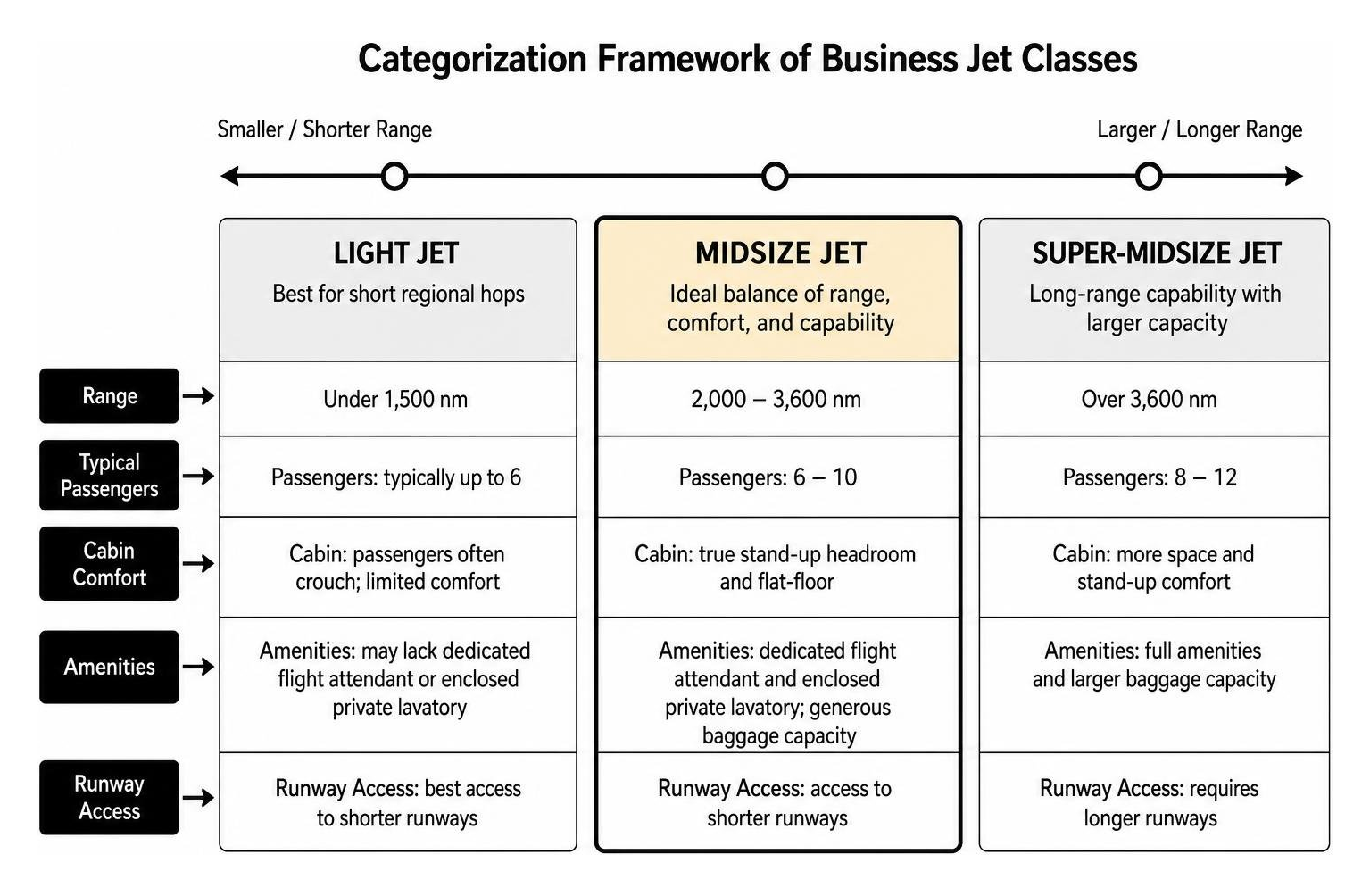
Midsize jets carve out the ideal profile: carrying 6 to 10 passengers over distances between 2,000 and 3,600 nautical miles. This allows you to fly non-stop from New York to Salt Lake City, San Francisco to Miami, or Dallas to Palm Beach without stopping for fuel, all while enjoying true stand-up comfort and dedicated baggage bays.
Acquisition Costs and Direct Operating Expenses
Purchasing in this space requires evaluating both upfront capital outlays and recurring hourly economics. In the current market, acquisition prices range from $7 million for well-maintained pre-owned airframes up to $25 million for pristine, factory-new deliveries. When reviewing options in our comprehensive private jet buying guide 2026, smart allocators weigh initial capital against long-term direct operating costs (DOC).
Direct operating expenses for midsize aircraft typically run between $2,500 and $4,000 per flight hour. This figure covers:
- Fuel Consumption: Engines like the Honeywell HTF7250G or Pratt & Whitney PW300/PW500 series burn between 200 and 280 gallons per hour depending on altitude and cruise profile.
- Engine Reserves and Maintenance Programs: Guaranteed hourly engine programs (such as ESP or MSP) to offset major overhauls.
- Crew Compensation & Direct Trip Expenses: Pilot salaries, recurrent simulator training, ground handling fees, and landing charges.
Top Contenders: Speed, Range, and Cabin Comfort Compared
When selecting the ideal aircraft, buyers usually find themselves balancing three core pillars: non-stop range, runway agility, and interior refinement.
Selecting the Best Midsize Business Jet for Transcontinental Range
For principals who routinely fly transcontinental routes against heavy winter headwinds, the Gulfstream G280 remains a standout performer. With an impressive maximum range of 3,590 nautical miles, it easily connects coast-to-coast city pairs with comfortable fuel reserves. Furthermore, Gulfstream's advanced aerodynamic developments—exemplified on the G300 - Gulfstream Aerospace —demonstrate how clean wing designs and high-thrust engines enable smooth high-speed cruises at Mach 0.85.
If your corporate mission involves crossing continents or heading south into Latin America without intermediate technical stops, prioritizing high-efficiency wings is essential. For global executives who also evaluate long-range platforms, exploring the longest range corporate jet provides valuable perspective on how long-distance cabin dynamics function at scale.
Discovering the Best Midsize Business Jet for Cockpit Avionics and Runway Versatility
Technological innovation has transformed the flight deck, significantly reducing pilot workload and enhancing safety margins. The Embraer Praetor 500 stands out in this regard as one of the few jets in its class featuring full fly-by-wire flight control technology, paired with active turbulence reduction systems.
For regional versatility and wide market support, the Citation Latitude incorporates the intuitive Garmin G5000 avionics suite, offering touch-screen flight management, synthetic vision, and class-leading runway performance (requiring just 3,580 feet of takeoff field length). Meanwhile, the Dassault Falcon 2000 series leverages French aerodynamic lineage to provide high-speed cruising near Mach 0.86 alongside exceptional short-field capabilities. While it does not claim the absolute top speed title of the fastest private jet in the world, its real-world speed and short-strip agility make it exceptionally versatile.
Cabin Ergonomics, Quietness, and Passenger Productivity
Flight hours should be productive, restful working hours. The Bombardier Challenger 350 and its evolutionary successor, the Challenger 3500, set the standard for sound suppression, delivering whisper-quiet cabin acoustics that make natural conversation and focused deal-making effortless.
Modern cabins prioritize passenger wellness through lower cabin pressurization altitudes (often below 5,000 feet at cruising flight levels) and continuous fresh-air circulation. The Citation Ascend integrates high-efficiency Pratt & Whitney PW545D engines with an ultra-quiet cabin, flat-floor layout, and wireless charging at every seat. While midsize fuselages do not feature the dedicated master suites found in larger luxury jets with bedrooms, their berthing club seats convert rapidly into flat sleeping surfaces for overnight legs.
Real-World Operational Factors: Short Runways and High-Altitude Access

On paper, many jets display identical cruise speeds. In practice, operational access defines true utility. High-elevation airfields surrounded by mountainous terrain—such as Aspen or Telluride—combine thin air, hot summer temperatures, and short runways, imposing strict payload penalties on less capable aircraft.
Dassault’s Falcon 2000 series and Textron’s light-to-midsize crossover models excel in these environments due to their high-lift wing designs and robust thrust-to-weight ratios. The latest aircraft developments, like the Citation CJ4 Gen3 , offer integrated Garmin Emergency Autoland systems and rapid climb gradients that give flight crews massive safety buffers when navigating restricted departures.
At the upper end of cabin volume, platforms like the ACJ TwoTwenty the first ACJ bizjet | Airbus push cabin size to unmatched proportions (786 sq ft of floor area), but require distinct operational considerations compared to midsize jets that slip easily into regional airports. For many family offices, acquiring a versatile midsize airframe represents the optimal balance of capability and capital conservation when shopping for a private jet under 30 million.
Ownership Models vs. Charter and Jet Cards
Deciding how to access a midsize jet requires matching your annual flight hours to the right capital structure.
- On-Demand Charter (Under 25 Hours/Year): Perfect for sporadic travel. You pay only for occupied flight time, with zero capital commitment or recurring maintenance liabilities.
- Jet Cards & Membership Programs (25 to 50 Hours/Year): Offers guaranteed availability, fixed hourly rates, and predictable billing without long-term asset risk.
- Fractional Ownership (50 to 200 Hours/Year): Purchasing a 1/16th to 1/2 share provides tax depreciation benefits, guaranteed response windows, and consistency in cabin quality.
- Direct Whole Ownership (200+ Hours/Year): Full operational control over your schedule, custom interior tailoring, vetted flight crews, and potential revenue through charter management offsets.
Understanding these operational layers mirrors how executives evaluate private corporate transport versus commercial options when assessing business jet airlines. Direct control over the aircraft asset guarantees consistent maintenance standards and eliminates the aircraft substitutions common in open charter markets.
Frequently Asked Questions About Midsize Business Jets
What is the average non-stop range of a midsize private jet?
Midsize business jets deliver typical non-stop ranges between 2,000 and 3,600 nautical miles under standard payload conditions. This performance allows seamless non-stop travel across the continental United States (such as New York to San Francisco or Miami to Las Vegas) without requiring intermediate refueling stops.
Which midsize jet offers the lowest hourly operating cost?
Aircraft in the Cessna Citation midsize lineage, such as the Citation Ascend and Citation Latitude, consistently demonstrate some of the lowest direct hourly operating costs in the class. Their Pratt & Whitney engines deliver exceptional fuel burn characteristics, and Textron’s global service network helps keep scheduled maintenance costs predictable.
How does cabin altitude affect passenger fatigue on long flights?
Traditional airliners are pressurized to an equivalent altitude of 7,000 to 8,000 feet, which reduces blood oxygen saturation and causes physical fatigue and dehydration. Modern midsize jets maintain cabin altitudes between 4,800 and 6,000 feet at typical cruising levels (FL410–FL450), ensuring passengers arrive alert, energized, and ready for immediate executive meetings.
Conclusion
Finding the optimal midsize business jet comes down to aligning your most frequent flight routes, passenger counts, and destination runway requirements against long-term operating costs. Whether your priority is the transcontinental range of the Gulfstream G280, the quiet productivity of the Challenger 350, or the short-field agility of the Citation Latitude, this aircraft class delivers unmatched executive freedom.
At Jets & Capital, we operate at the intersection of business aviation, investment capital, and high-level deal flow. We organize private, invite-only networking summits hosted directly inside luxury hangars across major hubs including San Francisco, New York, Miami, Palm Beach, Dallas, Las Vegas, and Salt Lake City. With our strict vetting process maintaining an 85% allocator ratio, our events bring together leading family offices, institutional investors, and founders alongside the finest luxury corporate jets in the sky.
