
Breaking the Sound Barrier: What is the Fastest Private Jet in the World?
The Fastest Private Jet in the World in 2026: A Quick Answer
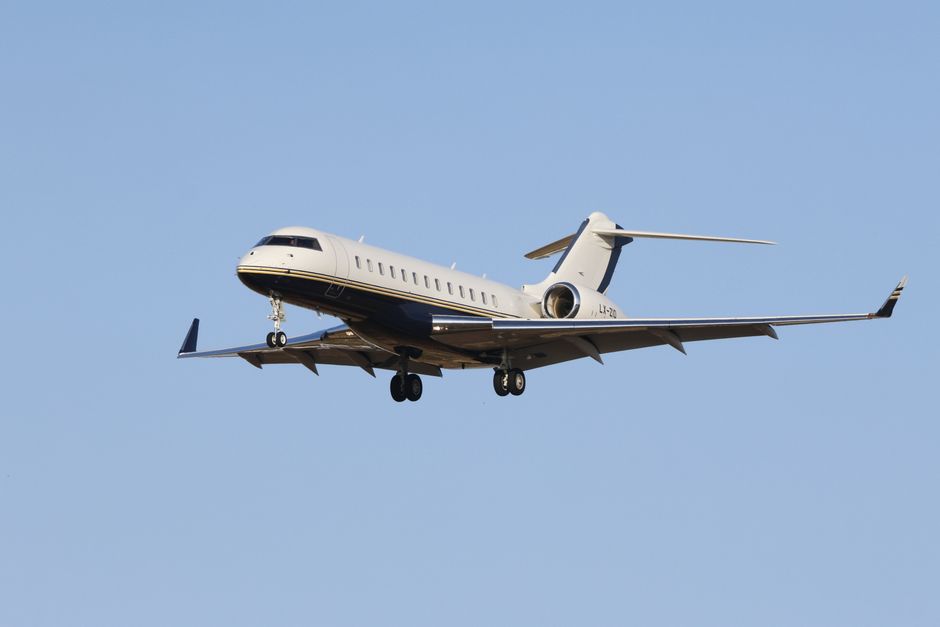
The fastest private jet in the world right now is the Bombardier Global 8000, which hit the market in late 2025. Here's the short answer if that's all you need:
| Rank | Aircraft | Top Speed | Range |
|---|---|---|---|
| 1 | Bombardier Global 8000 | Mach 0.95 (729 mph) | 8,000 nm |
| 2 | Gulfstream G700 | Mach 0.935 (717 mph) | 7,750 nm |
| 3 | Cessna Citation X+ | Mach 0.935 (717 mph) | 3,400 nm |
| 4 | Gulfstream G650ER | Mach 0.925 (710 mph) | 7,500 nm |
| 5 | Bombardier Global 7500 | Mach 0.925 (710 mph) | 7,700 nm |
The Global 8000 received its Transport Canada Type Certification in November 2025 and delivered its first aircraft to a private owner in December 2025. It is the fastest civil aircraft since the Concorde retired in 2003 — and it does it with a four-zone cabin and 8,000 nautical miles of range.
Private jets have always been about time. But the aircraft at the top of today's rankings push that idea further than ever. The gap between a Mach 0.85 cruise and a Mach 0.95 top speed might sound small on paper — until you realize it translates to arriving hours earlier on a New York-to-Sydney routing without a single fuel stop.
For high-net-worth travelers and family office principals who measure time in deal flow and missed opportunities, that difference matters.
I'm Jordan Hutchinson, founder of Jets & Capital, and through years of organizing elite networking events inside private jet hangars and connecting ultra-high-net-worth investors across the globe, I've seen how the fastest private jet in the world shapes how serious players move and do business. Below, I'll walk you through the top contenders, what the numbers actually mean, and why the Global 8000 sits in a category of its own.
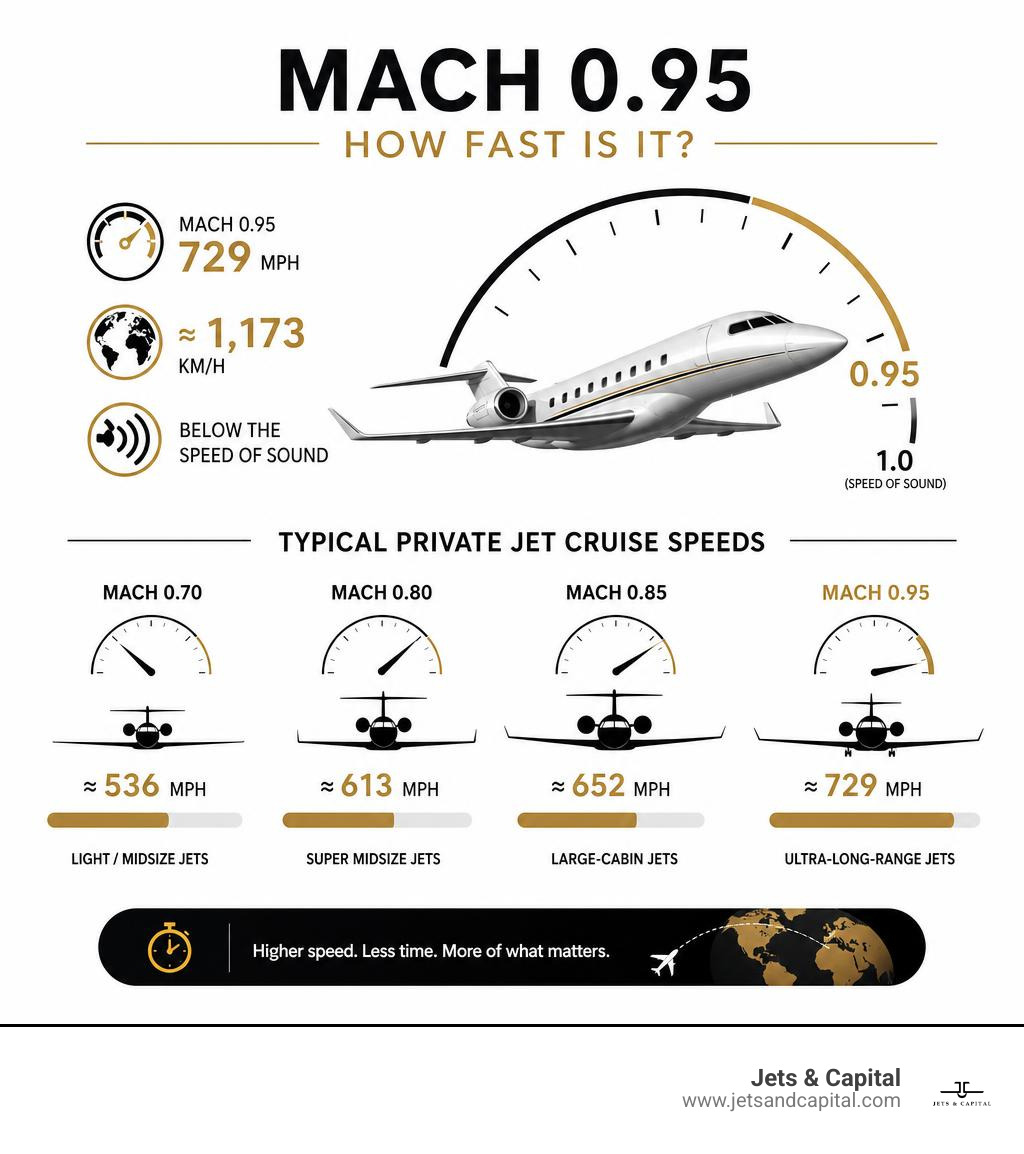
Fastest private jet in the world: the current top-speed champion
The Bombardier Global 8000 is not just marginally faster than its predecessors; it represents a major engineering milestone. Achieving a maximum operating speed of Mach 0.95 (approximately 729 mph or 1,173 km/h), it officially claims the title of the fastest private jet in the world.
This ultra-long-range business jet entered service in December 2025, fulfilling the promise of a true "time machine" for global business leaders. During its rigorous development phase, a test vehicle even broke the sound barrier, reaching an astonishing Mach 1.015 in flight. This historic milestone was achieved using Sustainable Aviation Fuel (SAF), demonstrating that high performance and future-focused engineering can go hand in hand.
Why the Bombardier Global 8000 is the fastest private jet in the world
The secret behind the Global 8000’s record-breaking speed lies in its advanced aerodynamics and propulsion. Bombardier equipped the aircraft with a highly engineered transonic wing, known as the Smooth Flĕx Wing. This wing features leading-edge slats and double-slotted Fowler flaps, which optimize aerodynamic efficiency across different speed profiles.
Powering this flagship are dual General Electric Passport engines, each producing 18,920 lbf of thrust. These engines are flat-rated to ISA +15°C, providing robust, consistent performance even in challenging high-altitude and hot-temperature conditions. Together, the advanced wing design and powerful propulsion system allow the Global 8000 to maintain an ultra-high-speed cruise of Mach 0.92, making transcontinental journeys faster than ever before. More details on this speed breakthrough can be found in the Bombardier Global 8000 speed update.
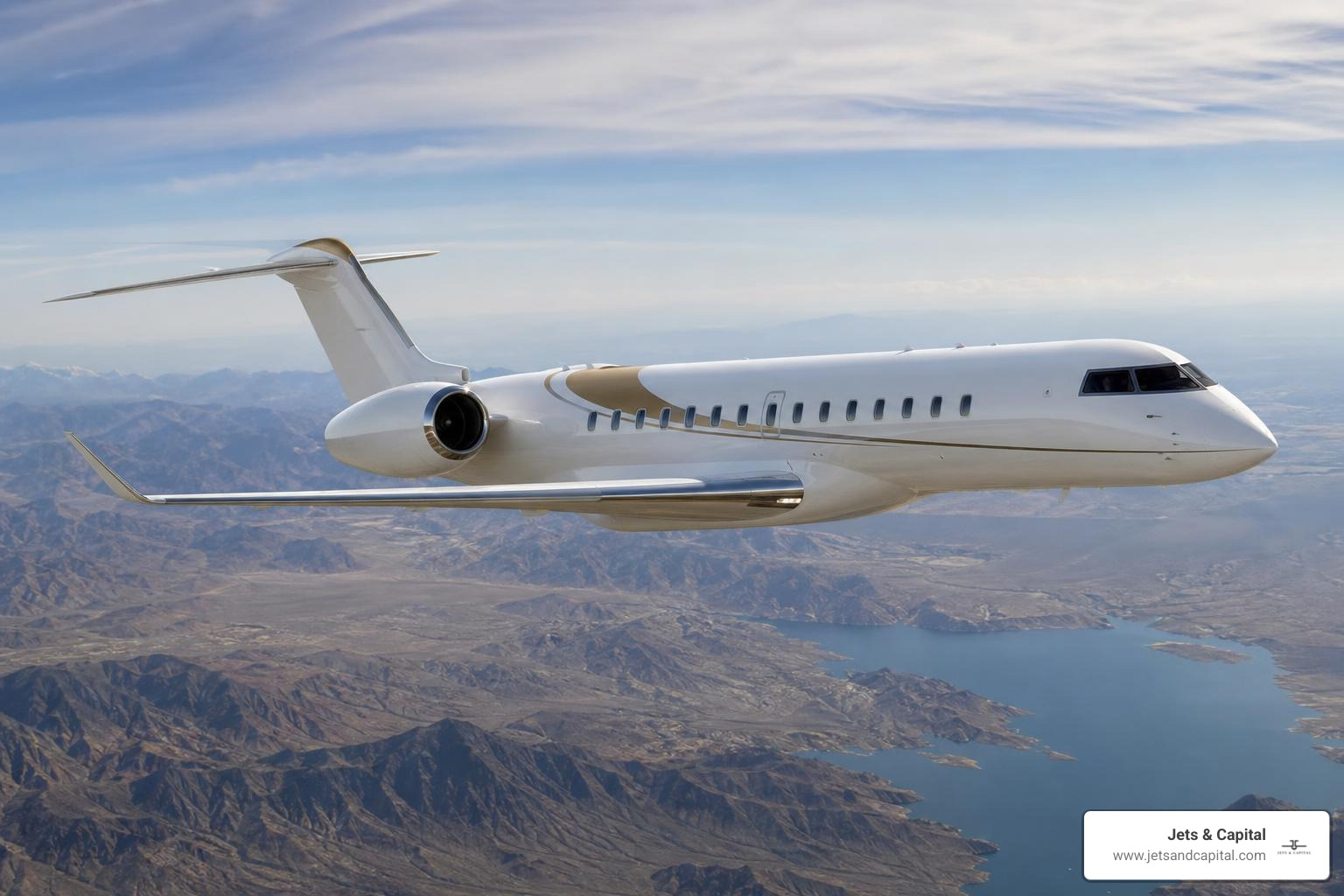
Key Global 8000 specifications at a glance
To understand why this aircraft dominates the ultra-long-range segment, we have to look at its core technical specifications:
- Maximum Speed: Mach 0.95 (729 mph / 1,173 km/h)
- Maximum Range: 8,000 nautical miles (14,816 km) at Mach 0.85
- Maximum Operating Altitude: 51,000 feet
- Initial Cruise Altitude: 43,000 feet (at maximum takeoff weight)
- Cabin Altitude: 2,691 feet (while cruising at 41,000 feet)
- Passenger Capacity: Up to 19 passengers
- Cabin Dimensions: 54 ft 5 in (length) x 8 ft (width) x 6 ft 2 in (height)
- Engines: GE Passport (18,920 lbf thrust each)
- Takeoff Distance: 5,760 feet (1,756 m)
- Landing Distance: 2,220 feet (677 m)
How close is Mach 0.95 to breaking the sound barrier?
Mach 1 represents the speed of sound, which is roughly 761 mph (1,225 km/h) at sea level under standard atmospheric conditions. However, because air temperature and pressure drop at high altitudes, the physical speed required to "break" the sound barrier decreases as an aircraft climbs. At a typical cruise altitude of 41,000 feet, Mach 1 is approximately 660 mph.
Operating at Mach 0.95 means the Global 8000 flies in the high transonic flight regime. At this speed, air flowing over certain parts of the aircraft's curved surfaces actually exceeds the speed of sound, creating localized shockwaves.
While the historic Concorde flew at a supersonic speed of Mach 2.04, it was retired in 2003 due to high operating costs and strict noise regulations over land. The Global 8000 operates just below the supersonic threshold, allowing it to bypass the strict regulatory bans on supersonic flight over populated landmasses while still delivering near-supersonic travel times.
The 10 fastest private jets ranked by maximum speed
When evaluating the fastest private jets, it is helpful to look at how the entire market ranks. The table below outlines the top 10 fastest business aircraft currently in production or recently active in the global fleet.
| Rank | Aircraft Model | Maximum Speed (Mach) | Approx. Top Speed (mph) | Maximum Range (nm) | Passenger Capacity | Standout Feature |
|---|---|---|---|---|---|---|
| 1 | Bombardier Global 8000 | Mach 0.95 | 729 mph | 8,000 nm | Up to 19 | Fastest civil jet since Concorde |
| 2 | Gulfstream G700 | Mach 0.935 | 717 mph | 7,750 nm | Up to 19 | Over 50 speed records set |
| 3 | Cessna Citation X+ | Mach 0.935 | 717 mph | 3,400 nm | Up to 12 | Super-midsize speed legend |
| 4 | Gulfstream G650ER | Mach 0.925 | 710 mph | 7,500 nm | Up to 19 | Farthest-fastest flight record holder |
| 5 | Gulfstream G800 | Mach 0.925 | 710 mph | 8,000 nm | Up to 19 | Longest-range Gulfstream |
| 6 | Dassault Falcon 10X | Mach 0.925 | 710 mph | 7,500 nm | Up to 19 | Widest cabin in business aviation |
| 7 | Bombardier Global 7500 | Mach 0.925 | 710 mph | 7,700 nm | Up to 19 | 100 speed records in under 7 years |
| 8 | Gulfstream G600 | Mach 0.925 | 710 mph | 6,600 nm | Up to 19 | Advanced fly-by-wire flight deck |
| 9 | Bombardier Global 6500 | Mach 0.90 | 690 mph | 6,600 nm | Up to 17 | Exceptional short-field capability |
| 10 | Dassault Falcon 8X | Mach 0.90 | 690 mph | 6,450 nm | Up to 16 | Highly efficient tri-jet design |
Fastest private jet in the world vs Gulfstream G700, G650ER, and G800
The rivalry between Bombardier and Gulfstream has driven incredible innovation in the business aviation sector. The Gulfstream G700, which has set over 50 speed records, tops out at Mach 0.935. While incredibly fast, it sits just behind the Global 8000’s Mach 0.95 limit.
In terms of range, the Global 8000 matches the Gulfstream G800 at 8,000 nautical miles, but the Global 8000 does so while offering a larger, four-zone cabin compared to the G800's slightly shorter fuselage. The legendary G650ER, which has set over 125 world speed records, maxes out at Mach 0.925 and a 7,500 nm range, making the newer Global 8000 a clear step forward in both speed and distance.
Global 8000 vs Dassault Falcon 10X and Global 7500
Dassault’s upcoming flagship, the Falcon 10X, is slated to offer a top speed of Mach 0.925 and a range of 7,500 nautical miles. It stands out for having the widest cabin in the industry, but it falls short of the Global 8000's speed and range.
Meanwhile, the Global 8000 serves as the direct successor to the highly successful Bombardier Global 7500 Wikipedia. While the Global 7500 established the baseline for a four-zone cabin and reached Mach 0.925, the Global 8000 optimizes this platform with upgraded software, enhanced engine tuning, and aerodynamic refinements to squeeze out that extra speed and an additional 300 nautical miles of range.
What the rankings reveal about private jet speed
While maximum operating speed (MMo) makes for great headlines, real-world flight operations are highly dynamic. Pilots typically maintain a long-range cruise speed (usually around Mach 0.85) to optimize fuel burn, passenger comfort, and overall range.
However, having the capability to step up to Mach 0.90 or Mach 0.92 during a mission allows operators to bypass headwind delays, adapt to changing weather patterns, and shave significant time off ultra-long-haul routes. On a 12-hour flight, cruising at Mach 0.90 instead of Mach 0.80 can save over an hour of flight time, translating directly to reduced crew fatigue and quicker arrivals for busy passengers.
What makes the Global 8000 unique beyond speed?
Speed is only half the story. When flying for 14 hours straight, the interior environment becomes just as critical as the engines. The Global 8000 was designed from the inside out to serve as both a high-productivity workspace and a wellness-focused sanctuary.

Cabin design built for ultra-long-range travel
The Global 8000 features the longest seated cabin length in its class, measuring 54 feet and 5 inches. This generous footprint allows for a layout with four true living spaces, plus a dedicated, private crew rest area to ensure pilots remain alert on long flights. The cabin configuration includes:
- The Club Suite: Featuring four ergonomic Nuage seats and large side tables.
- The Conference Suite: An elegant dining or meeting space for up to six passengers.
- The Entertainment Suite: Designed for media viewing, complete with a large high-definition screen and premium audio.
- The Principal Suite: A quiet, private master bedroom with an adjoining en-suite lavatory that can be configured with a stand-up shower.
Additionally, the aircraft features the industry's largest galley, giving flight attendants the space and equipment needed to prepare gourmet meals mid-flight. More details on these cabin amenities can be explored in the Global 8000 aircraft overview.
Comfort and wellness technology
To combat the physical toll of ultra-long-haul travel, Bombardier integrated advanced health and comfort technologies into the cabin. Most notably, the Global 8000 features the industry's lowest cabin altitude. While cruising at 41,000 feet, the cabin is pressurized to a comfortable 2,691 feet. This drastically reduces the physiological symptoms of jet lag, leaving passengers feeling refreshed upon arrival.
The cabin air is continuously refreshed using Bombardier’s Pũr Air system, which features an advanced HEPA filter capable of capturing up to 99.99% of microscopic particles, including bacteria and viruses.
To help regulate sleep cycles, the aircraft utilizes the Soleil lighting system—aviation's first fully integrated circadian rhythm-based lighting. By aligning the cabin's light spectrum with passengers' natural sleep-wake cycles, the system helps minimize the impact of crossing multiple time zones. Furthermore, the Nuage seats feature a unique deep-recline "zero-gravity" position, which neutralizes pressure points and promotes optimal blood circulation.
Connectivity, entertainment, and onboard productivity
For executives and family office principals, a private jet is a mobile headquarters. The Global 8000 is equipped with ultra-fast, low-latency Ka-band internet, ensuring seamless video conferencing, large file transfers, and real-time communication anywhere in the world.
Whether you are coordinating an investment round or preparing for a high-stakes board meeting, the quiet cabin environment and seamless connectivity allow for uninterrupted productivity. To learn more about how ultra-high-net-worth individuals leverage private aviation to drive business and expand their networks, see our Private Aviation Networking Guide.
Range, runway performance, and real-world city pairs
The true utility of the fastest private jet in the world is realized when its high-speed capability is paired with massive range. The Global 8000's 8,000-nautical-mile range unlocks direct city pairs that were previously impossible without a refueling stop.
Why 8,000 nautical miles matters
An 8,000 nm range allows travelers to fly nonstop between almost any two major financial centers on Earth. For example, the Global 8000 can easily connect:
- New York to Sydney
- London to Perth
- Singapore to Los Angeles
- Dubai to Houston
By eliminating the need for technical stops to refuel, passengers save hours of ground time, avoid customs delays in transit countries, and reduce the overall wear and tear on the aircraft.
Shorter runway performance and airport access
Historically, ultra-long-range jets required massive commercial runways to take off at maximum weight. The Global 8000 challenges this limitation. Thanks to its Smooth Flĕx Wing and leading-edge slats, the aircraft has exceptional low-speed lift.
With a takeoff distance of 5,760 feet and a landing distance of just 2,220 feet, the Global 8000 can access up to 30% more airports (approximately 2,000 additional locations worldwide) than its closest competitors. This allows travelers to land closer to their final destinations, utilizing smaller, more convenient executive airports rather than congested commercial hubs.
How competitors compare on range and runway flexibility
While the Gulfstream G800 matches the Global 8000's 8,000 nm range, it does so with a smaller cabin. The Gulfstream G700 offers 7,750 nm of range, and the Dassault Falcon 10X offers 7,500 nm.
In terms of runway flexibility, the Global 8000's advanced wing design gives it a distinct advantage in "hot and high" conditions—such as departing from high-altitude airports like Aspen or Toluca on warm summer days—where thinner air typically limits an aircraft's takeoff weight and range.
Certification, first deliveries, customers, and market positioning
The journey from concept to delivery for an ultra-long-range jet involves rigorous safety testing and regulatory hurdles. The Global 8000 successfully cleared these milestones to establish itself at the pinnacle of the business aviation market.
When did the Global 8000 enter service?
The Global 8000 was officially awarded its Type Certification by Transport Canada in November 2025, confirming that all performance targets, including its record-breaking speed and ultra-low cabin altitude, had been met or exceeded.
Shortly thereafter, on December 8, 2025, the very first production aircraft was delivered to its launch customer in Mississauga, Ontario. This historic delivery marked the official entry into service of the fastest civil aircraft since the Concorde. You can read more about this milestone in the Global 8000 enters service report.
Who operates or ordered the Global 8000?
The launch customer for the first delivered Global 8000 was Canadian entrepreneur Patrick Dovigi, with the aircraft's operational custody managed by Chartright Air Group.
On a broader fleet scale, major fractional ownership operators have placed significant orders for the flagship. Most notably, NetJets signed a landmark agreement to add the Global 8000 to its global fleet, solidifying the aircraft's position as the premier choice for fractional shareholders who demand the absolute best in speed and range. Details on this fleet expansion can be found in the coverage of the NetJets Global 8000 fleet addition.
Why it sits at the top of the ultra-long-range market
With an equipped price tag in the $81 million range, the Global 8000 is positioned at the absolute high end of the business jet market. It appeals to a select group of billionaires, multinational corporations, and elite charter operators.
By combining the fastest speed, the longest range, and an uncompromised four-zone cabin, Bombardier has created a highly differentiated product that commands a premium. To see how this aircraft compares to other ultra-luxury assets owned by the world's wealthiest individuals, explore our feature on Billionaire Luxury Private Jets.
The future of fast private aviation: supersonic concepts and what comes next
While the Global 8000 represents the current peak of subsonic and transonic flight, the aviation industry continues to look toward the horizon of supersonic travel.
Is any future jet faster than the fastest private jet in the world?
Several aerospace firms are actively working on supersonic business jet concepts designed to fly well beyond Mach 1. One of the most discussed projects is the Spike S-512 Supersonic Diplomat, a concept targeting a cruise speed of Mach 1.6 (approximately 1,100 mph).
Spike Aerospace claims that the S-512 will utilize proprietary Quiet Supersonic Flight technology to minimize the sonic boom, potentially allowing it to fly supersonic over land without violating noise regulations. If successfully developed and certified, it could cut travel times from New York to London to just 3.3 hours. However, supersonic projects face steep regulatory, environmental, and financial challenges before they can reach commercial production. You can review their design goals directly on the Spike S-512 Supersonic Diplomat page.
Why Concorde is still in another category
Despite modern advancements, the Concorde remains a unique icon in aviation history. Flying at Mach 2.04, it was twice as fast as today's fastest business jets. However, Concorde was a commercial airliner carrying up to 100 passengers, requiring massive fuel burn and generating a loud sonic boom that restricted its routes almost entirely to oceanic crossings.
Today's private jet market prioritizes a balance of high speed, fuel efficiency, long-range flexibility, and extreme cabin comfort—qualities that the Concorde, for all its speed, could not offer.
What innovations will define the next generation
The next generation of high-speed business jets will likely be defined by:
- Sustainable Propulsion: Advanced engines optimized to run 100% on Sustainable Aviation Fuel (SAF) to reduce emissions.
- Boom-Reduction Aerodynamics: Airframe designs that reshape shockwaves to eliminate the disruptive sonic boom.
- Intelligent Flight Decks: Increased automation and artificial intelligence to assist pilots and enhance safety.
- Active Cabin Noise Cancellation: Advanced acoustic technologies to keep ultra-fast cabins whisper-quiet.
Frequently Asked Questions about the fastest private jet in the world
What is the fastest private jet in the world in 2026?
The fastest private jet in the world is the Bombardier Global 8000, which entered service in late 2025. It has a maximum operating speed of Mach 0.95 (approximately 729 mph / 1,173 km/h), making it the fastest civil aircraft since the Concorde.
How far can the Bombardier Global 8000 fly nonstop?
The Global 8000 has a maximum range of 8,000 nautical miles (14,816 km) when flying at its long-range cruise speed of Mach 0.85 with NBAA IFR fuel reserves. This allows for nonstop flights between major city pairs like New York to Sydney or London to Perth.
Is the Global 8000 faster than Concorde?
No. The Concorde could reach a maximum speed of Mach 2.04 (over 1,350 mph). While the Global 8000 is the fastest active civil aircraft, it operates in the high subsonic/transonic range (Mach 0.95) to comply with international noise regulations and maximize fuel efficiency.
Conclusion
The Bombardier Global 8000 has firmly established itself as the fastest private jet in the world. By combining a top speed of Mach 0.95 with an 8,000 nm range, a highly customizable four-zone cabin, and an industry-leading 2,691-foot cabin altitude, it represents the ultimate tool for global business and luxury travel.
At Jets & Capital, we understand that for ultra-high-net-worth individuals, family offices, and top-tier investors, time is the ultimate currency. That is why we organize highly curated, invite-only networking events inside private jet hangars across premier locations like Las Vegas, Palm Beach, Miami, New York, and San Francisco.
Our strict vetting process ensures that 85% of attendees are qualified allocators, creating a high-caliber environment for deal-making, relationship building, and discussions on the future of global business and aviation.
If you are looking to connect with an elite circle of peers in an atmosphere defined by luxury and opportunity, we invite you to join us. Explore our upcoming gatherings on our Private Aviation Events page, or secure your place at our next exclusive event by visiting the Jets & Capital Las Vegas Events portal.
