
The Longest Range Corporate Jet Showdown Between Bombardier and Gulfstream
Gulfstream vs. Bombardier: The Longest Range Corporate Jet Contenders Compared
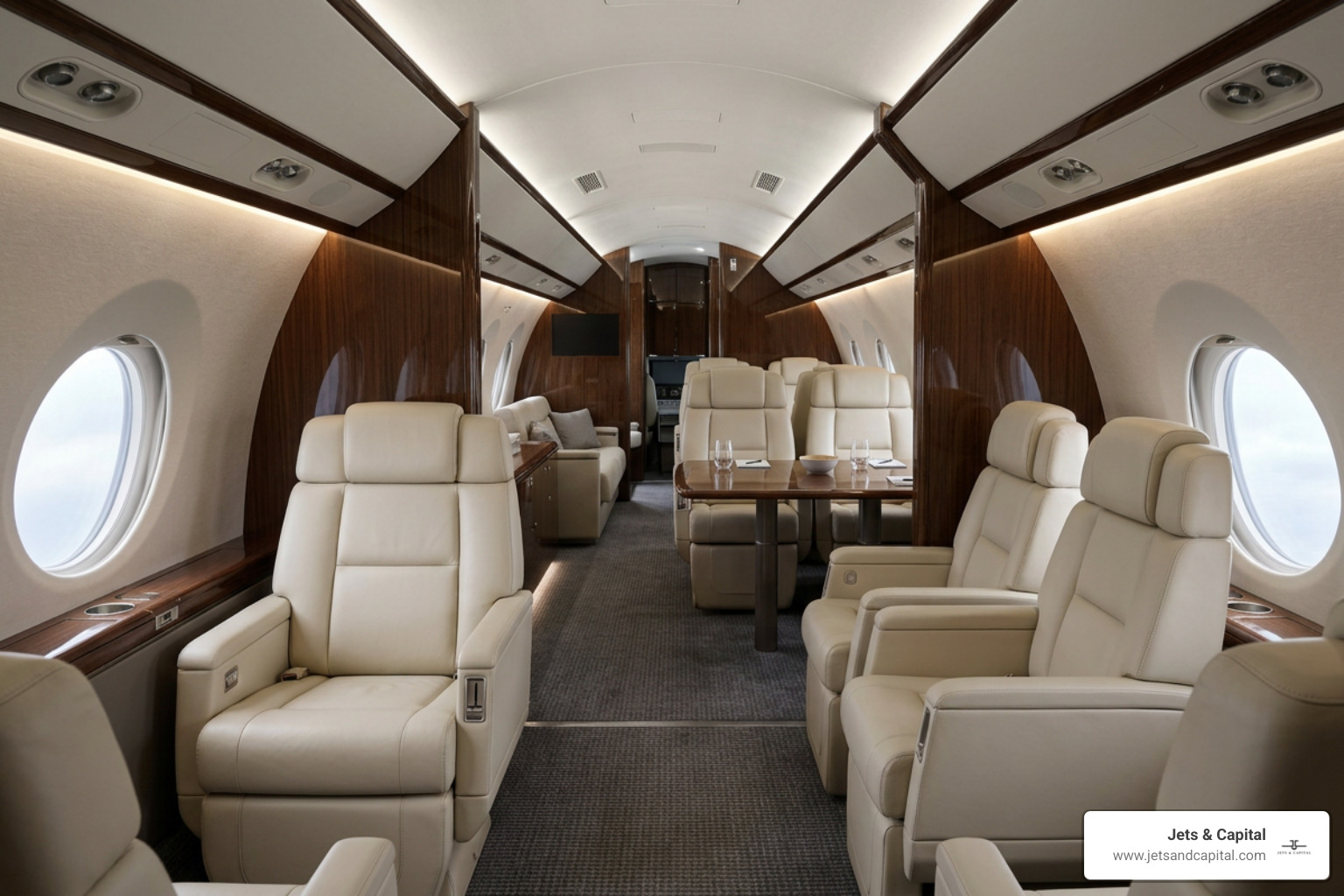
The Gulfstream G800 currently holds the title of the longest range corporate jet with an NBAA IFR range of 8,200 nautical miles (15,186 km), followed closely by the Bombardier Global 8000 at 8,000 nautical miles (15,000 km). Evaluating the apex tier of corporate aviation requires looking past marketing claims to analyze how platforms perform under demanding mission profiles. For global business leaders, family offices, and enterprise flight departments, selecting between these platforms shapes intercontinental efficiency for decades. The race between Savannah and Montreal has produced extraordinary machinery that turns 15-hour journeys into productive, fatigue-free working days.
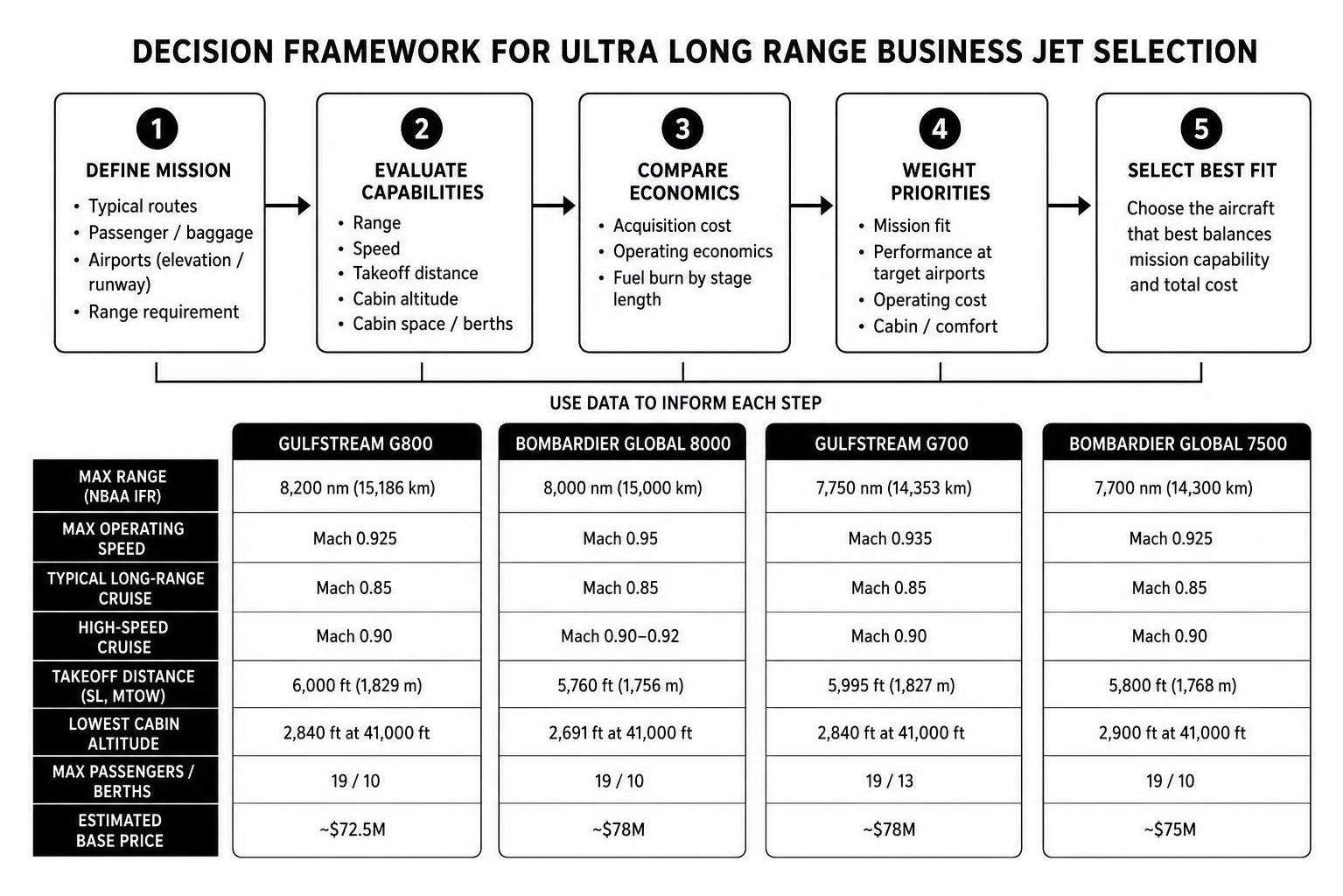
| Specification / Feature | Gulfstream G800 | Bombardier Global 8000 | Gulfstream G700 | Bombardier Global 7500 |
|---|---|---|---|---|
| Max NBAA IFR Range | 8,200 nm (15,186 km) | 8,000 nm (15,000 km) | 7,750 nm (14,353 km) | 7,700 nm (14,300 km) |
| Max Operating Speed | Mach 0.925 | Mach 0.95 | Mach 0.935 | Mach 0.925 |
| Typical Long-Range Cruise | Mach 0.85 | Mach 0.85 | Mach 0.85 | Mach 0.85 |
| High-Speed Cruise | Mach 0.90 | Mach 0.90–0.92 | Mach 0.90 | Mach 0.90 |
| Engine Model | 2× Rolls-Royce Pearl 700 | 2× GE Passport 20 | 2× Rolls-Royce Pearl 700 | 2× GE Passport 20 |
| Engine Thrust (per engine) | 18,250 lbf | 18,920 lbf | 18,250 lbf | 18,920 lbf |
| Lowest Cabin Altitude | 2,840 ft at 41,000 ft | 2,691 ft at 41,000 ft | 2,840 ft at 41,000 ft | 2,900 ft at 41,000 ft |
| Living Areas | Up to 4 | Up to 4 | Up to 5 | Up to 4 |
| Max Passengers / Berths | 19 / 10 | 19 / 10 | 19 / 13 | 19 / 10 |
| Takeoff Distance (SL, MTOW) | 6,000 ft (1,829 m) | 5,760 ft (1,756 m) | 5,995 ft (1,827 m) | 5,800 ft (1,768 m) |
| Estimated Base Price | ~$72.5M | ~$78M | ~$78M | ~$75M |
When we review the best business jets in the ultra-long-range category, acquisition costs are only one part of the fleet planning calculation. Operating economics, fuel burn over specific stage lengths, and runway performance at high-altitude airports all factor heavily into the decision.
Gulfstream G800: The Longest Range Corporate Jet Titleholder
The Gulfstream G800 represents the current pinnacle of nonstop reach in purpose-built executive aviation. Achieving an NBAA IFR range of 8,200 nautical miles at Mach 0.85 with eight passengers and four crew members aboard, it connects distant city pairs that previously required commercial airliner conversions. Even when pushed to its high-speed cruise of Mach 0.90, the G800 delivers a 7,000 nautical mile range, keeping major continental connections well within nonstop reach.
Powering this performance are two Rolls-Royce Pearl 700 turbofans, each producing approximately 18,250 pounds of thrust. Combined with Gulfstream’s aerodynamically refined, clean-sheet wing and advanced winglets, the aircraft achieves substantial fuel-efficiency gains over legacy airframes while supporting a maximum takeoff weight of 47,899 kg (105,600 lbs).
Inside the cabin, the G800 accommodates up to 19 passengers and provides sleeping accommodations for up to 10 across four distinct living areas. Passengers benefit from 16 panoramic oval windows, an ultra-low cabin altitude of 2,840 feet while cruising at 41,000 feet, and a plasma-ionization clean-air system that refreshes interior air every two to three minutes. Up front, pilots operate the award-winning Symmetry Flight Deck, featuring active-control sidesticks, integrated touchscreen avionics, and a Combined Vision System for enhanced situational awareness during adverse weather operations.
Following formal FAA and EASA type certifications in April 2025, customer deliveries commenced later that year, securing the G800's position as a premier asset for global flight operations.
Bombardier Global 8000: High-Speed Competitor for the Longest Range Corporate Jet Crown
Bombardier’s flagship counterpoint is the Global 8000 - The flagship for a new era. While its published range of 8,000 nautical miles sits 200 nautical miles behind the G800, it compensates with class-leading speed. With a maximum operating speed of Mach 0.95, it stands as the fastest private jet in the world among civil aircraft in service since the retirement of Concorde.
During flight testing, Bombardier demonstrated the airframe's aerodynamic capabilities by flying a test vehicle supersonically to Mach 1.015 in a shallow dive. In routine service, that high-speed capability translates to notable time savings on long routes, such as transcontinental runs between Los Angeles and Western Europe.
The Global 8000's long-range performance relies on twin General Electric Passport 20 engines, delivering 18,920 pounds of thrust each, alongside the proprietary Smooth Flx Wing. This high-lift, transonic wing structure flexes in turbulent air like a natural shock absorber, providing smooth ride quality while cutting drag.
Passenger wellness is further supported by an industry-low cabin altitude of 2,691 feet while cruising at 41,000 feet. The four-zone interior features Bombardier’s zero-gravity Nuage seating, dedicated master suites with optional standing showers, and the Pūr Air hospital-grade HEPA filtration system.
Secondary Flagships: Gulfstream G700 and Bombardier Global 7500
Buyers seeking slightly different balances of interior volume, delivery timelines, and range often look to the G700 - Gulfstream Aerospace and the Bombardier Global 7500.
The G700 shares the Rolls-Royce Pearl 700 powerplant and wing architecture with the G800, but offers a stretched cabin volume of 2,603 cubic feet that supports up to five living areas and berthing for up to 13 passengers. With an NBAA IFR range of 7,750 nautical miles at Mach 0.85 and a top speed of Mach 0.935, it trades 450 nautical miles of maximum distance for class-leading internal space.
The Bombardier Global 7500, which entered service in December 2018, established the four-zone baseline upon which the Global 8000 was developed. Featuring a 7,700 nautical mile range and over 100 speed records, the Global 7500 completed the longest nonstop mission flown by a purpose-built business aircraft: an 8,225 nautical mile crossing from Sydney to Detroit over 16 hours in October 2019. Operators of the Global 7500 can also access an upgrade path to unlock the speed and range enhancements of the Global 8000 platform.
Engineering Ultra-Long-Range Flight: Aerodynamics, Engines, and Cabin Altitude
Executing nonstop flights spanning one-third of the globe requires an integrated engineering balance between aerodynamics, engine thermal efficiency, lightweight materials, and life-support systems.
Modern ultra-long-range business aircraft rely heavily on high-aspect-ratio swept wings designed through computational fluid dynamics to maintain laminar airflow at transonic speeds (Mach 0.85 to Mach 0.92). Dassault approaches this challenge on the Falcon 10X - Dassault Falcon using carbon-fiber composite wings, whereas Gulfstream and Bombardier utilize optimized aluminum-lithium structures that reduce dead airframe weight while maximizing internal wing fuel volume.
On the G800, the maximum fuel capacity reaches 22,407 kg (49,400 lbs), accounting for almost half of its 47,899 kg maximum takeoff weight. Lifting this fuel load efficiently demands modern powerplants. High-bypass engines like the Rolls-Royce Pearl 700 and GE Passport feature blisk fan architecture, advanced thermal coatings, and improved pressure ratios, yielding fuel-efficiency gains up to 33% better than legacy powerplants.
Equally critical is passenger comfort across 14- to 16-hour flights. Flying at high altitudes (FL450 to FL510) places the aircraft in thinner air, reducing aerodynamic drag and keeping the aircraft above commercial airline traffic and weather systems.
However, maintaining a low cabin altitude requires heavy structural reinforcement along the fuselage pressure vessel. Keeping cabin pressure between 2,690 and 2,900 feet—instead of the 6,000 to 8,000 feet common in standard airliners—significantly reduces passenger dehydration, fatigue, and jet lag. When stepping aboard luxury private planes built for intercontinental missions, low cabin altitude is one of the most noticeable elements supporting onboard productivity.
Real-World Mission Profiles: Published Range vs. Operational Reality
While brochure figures cite theoretical NBAA IFR maximum ranges under ISA (International Standard Atmosphere) conditions, real-world flight operations require practical mission planning. Published numbers assume an optimal cruising speed, a light passenger payload (typically four to eight passengers), and standard fuel reserves for divert routing.
In real-world flight planning, several variables directly influence practical operational range:
- Jetstream Headwinds: Flying westbound over the North Pacific or North Atlantic during winter months can present sustained headwinds of 80 to 140 knots. A 100-knot continuous headwind over a 14-hour flight effectively increases the air distance required by 1,400 nautical miles, turning an 8,000 nm theoretical flight into an operational challenge.
- Payload and Luggage Weights: Full-cabin operations with 14 to 19 passengers and heavy luggage loads reduce available fuel capacity to stay within maximum takeoff and zero-fuel weight limits. Carrying an additional 10 passengers can reduce total range by 300 to 500 nautical miles compared to an executive four-passenger configuration.
- Mandatory Reserves and Alternates: Flight regulations require aircraft to land with adequate fuel reserves to execute a missed approach, climb, divert to an alternate airport, and hold for 30 to 45 minutes.
- High-Speed Penalties: Cruising at Mach 0.90 instead of Mach 0.85 saves significant block time, but increases fuel burn, reducing the G800's range from 8,200 nm to roughly 7,000 nm.

When planning routes with our corporate jet buying guide 2026, applying a 15% to 20% planning buffer to published ranges provides a reliable baseline for year-round nonstop dispatch reliability:
- Los Angeles to Sydney (6,500 nm): Reliably flown nonstop year-round on both the G800 and Global 8000, eliminating the traditional refueling stop in Honolulu.
- New York to Dubai (5,950 nm): Achievable nonstop at high-speed cruise (Mach 0.90), shaving over an hour off standard block times.
- London to Buenos Aires (5,980 nm): Operable with full passenger complements and standard reserves in all seasons.
- San Francisco to Singapore (7,340 nm): Achievable westbound against moderate headwinds with controlled payload weights, showcasing the practical utility of an 8,200 nm airframe.
Frequently Asked Questions About Ultra-Long-Range Private Jets
Which business aircraft currently holds the record for the longest flight range?
The Gulfstream G800 holds the record for the longest published range among purpose-built business jets, capable of flying 8,200 nautical miles (15,186 km) nonstop at Mach 0.85 under NBAA IFR conditions with eight passengers and standard crew.
How does the Bombardier Global 8000 compare in speed and range to the G800?
The Bombardier Global 8000 features a maximum range of 8,000 nautical miles—just 200 nautical miles short of the G800—while delivering a higher maximum operating speed of Mach 0.95 (compared to the G800's Mach 0.925). This makes the Global 8000 the fastest civil aircraft in operation since Concorde.
How much do real-world conditions reduce an ultra-long-range jet's advertised range?
Real-world operational conditions typically reduce an aircraft's practical nonstop range by 15% to 20% below published brochure figures. Factors such as winter headwinds exceeding 100 knots, full passenger cabin loads, high-altitude airport departures, and regulatory fuel reserve requirements for distant alternate airports all impact operational distance.
Conclusion
The ultra-long-range sector continues to redefine global mobility. Gulfstream’s G800 leads on absolute range at 8,200 nautical miles, while Bombardier’s Global 8000 delivers a competitive 8,000 nautical mile range paired with a Mach 0.95 top speed. Choosing between them often comes down to an operator's preference for outright distance versus block-speed time savings and cabin design philosophies.
At Jets & Capital, we host private networking events inside executive hangars across premier aviation hubs—including Miami, Palm Beach, New York, Dallas, Las Vegas, Salt Lake City, and San Francisco, California. By gathering family offices, institutional investors, and sovereign wealth allocators alongside modern business aircraft, we create an environment where strategic deal-making and aviation insight come together.
To explore current fleet capabilities and market data, review our analysis of luxury corporate jets.
