
Fast-Track Your Private Wealth Career Across Dallas Family Offices Today
Find the Right Family Office Jobs in Dallas

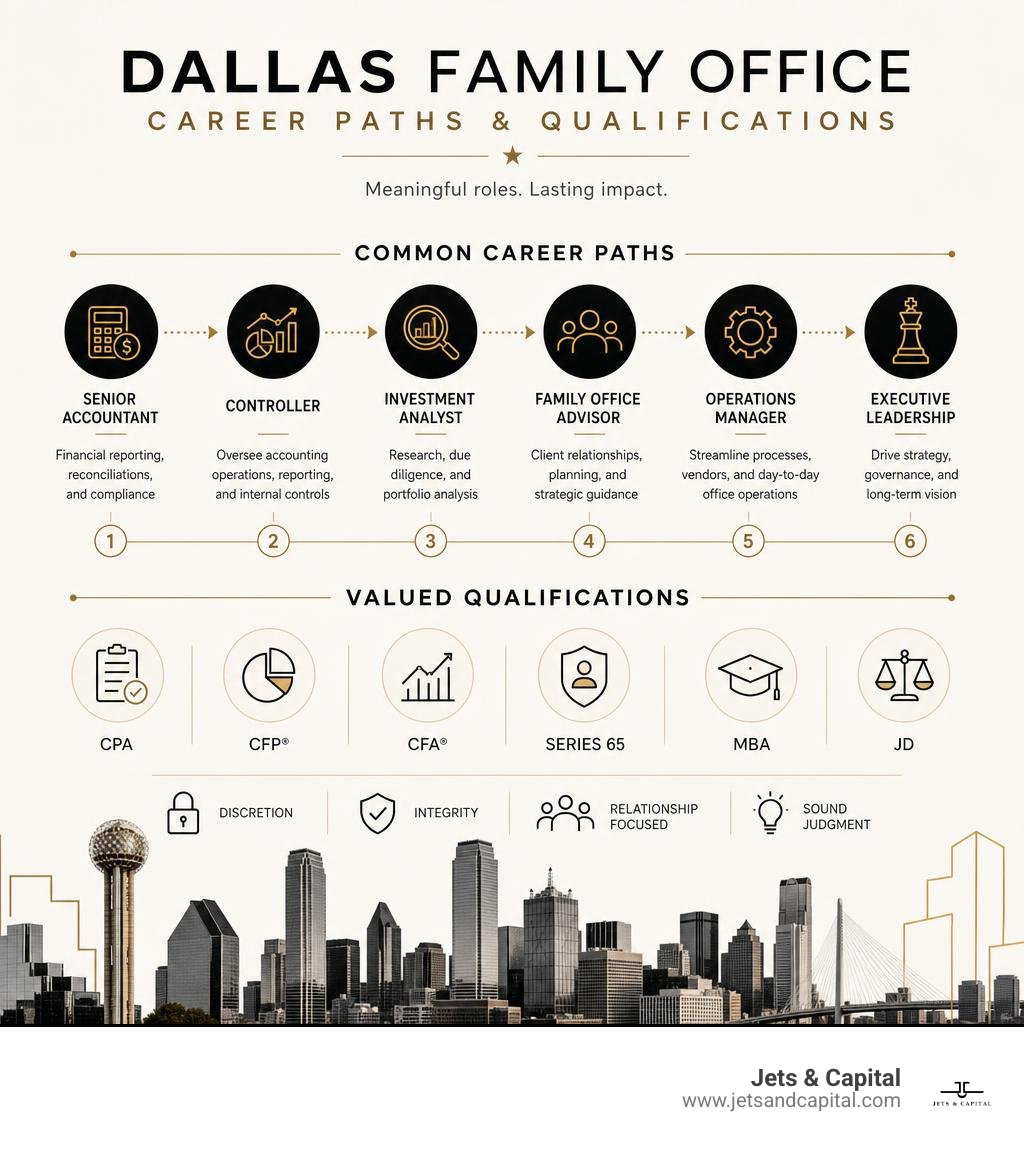
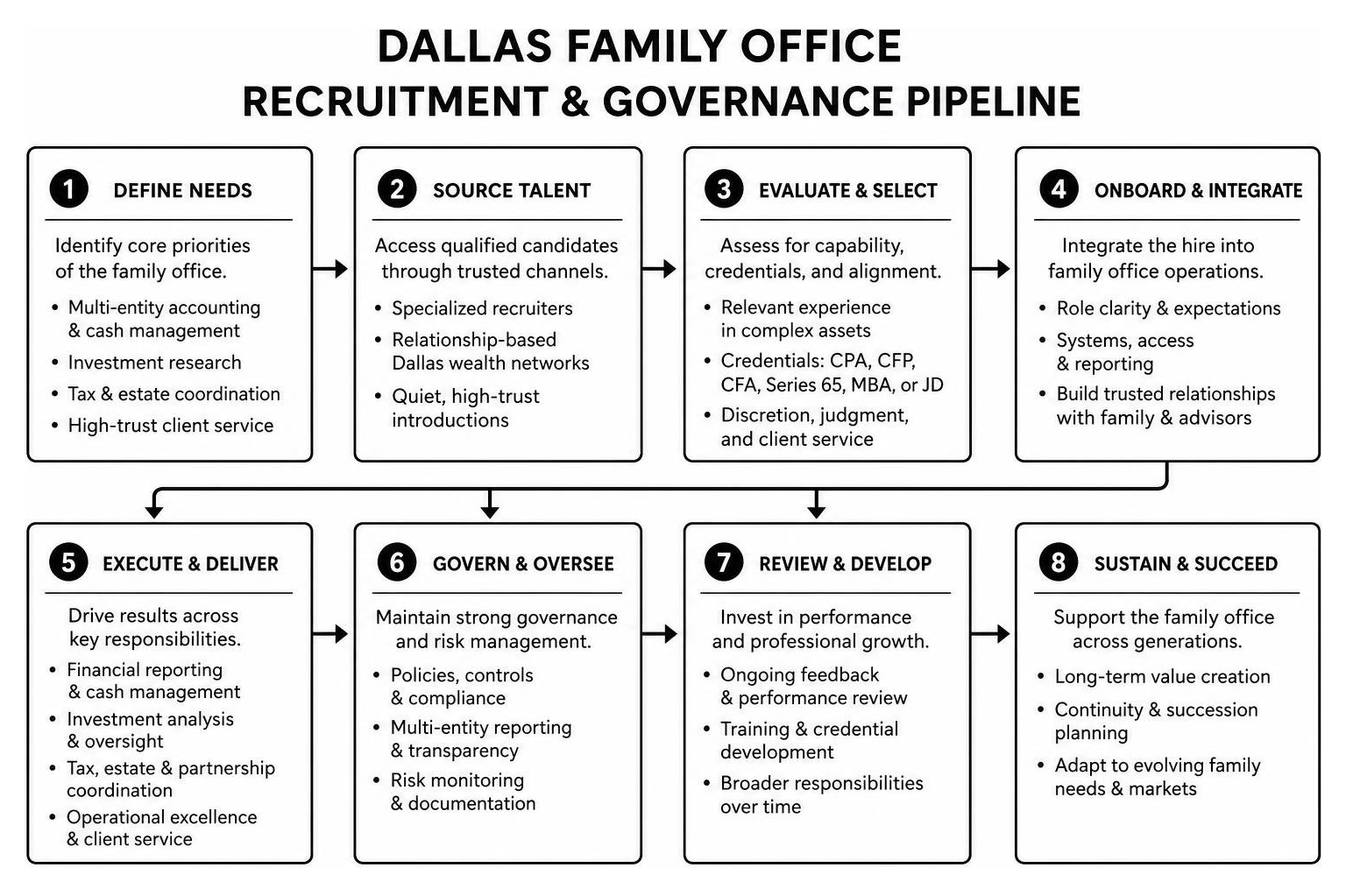
Family office jobs Dallas seekers should target include senior accountant, controller, investment analyst, family office advisor, operations manager, and executive leadership roles. Start by matching your experience to the office's core needs: multi-entity accounting and cash management, investment research, tax and estate coordination, or high-trust client service. Then use specialized recruiters and relationship-based Dallas wealth networks, since many roles are filled quietly rather than broadly advertised.
Dallas demand is supported by wealth tied to energy, commercial real estate, logistics, healthcare, and technology. Both single-family and multi-family offices need professionals who can handle complex assets while communicating clearly with families, attorneys, tax advisors, and private bankers.
The strongest candidates bring discretion, sound judgment, and a relevant credential such as a CPA, CFP, CFA, Series 65, MBA, or JD. For example, current Dallas accounting openings commonly ask for 3-5 years of general-ledger experience, while senior single-family-office roles may require multi-entity reporting, partnership accounting, and specialized assets such as private aviation.
I am Jordan Hutchinson, an entrepreneur, investor, and family-office network builder who has helped create high-trust connections among private investors and operators. Through Jets & Capital events and my work in private markets, I see how relationships and practical expertise shape access to family office jobs Dallas professionals want most.
Landscape of Family Office Jobs Dallas

The wealth ecosystem in North Texas is undergoing rapid expansion. Over the last several years, the Dallas-Fort Worth metroplex has become a magnet for ultra-high-net-worth (UHNW) families, corporate headquarters, and institutional allocators. Significant liquidity events across the region—spurred by oil and gas operations, commercial development, and technology exits—have fueled the establishment of new single-family offices (SFOs) and multi-family offices (MFOs).
To understand the broader market, reviewing our Dallas Family Offices Guide 2026 provides valuable context on how local families organize their capital. The Texas business environment, marked by favorable tax structures and zero state personal income tax, attracts substantial capital inflows from coastal hubs like New York and California. As private wealth relocates to North Texas, offices require versatile talent capable of managing sophisticated asset bases, complex partnership holding structures, and intergenerational governance frameworks.
Key Sectors Driving Family Office Jobs Dallas
Unlike markets dominated solely by public equities or pure technology, Dallas private wealth is deeply rooted in several foundational, cash-flow-heavy industries:
- Energy and Natural Resources: Traditional oil and gas royalties, midstream assets, and renewable energy transition ventures continue to produce substantial liquidity that demands specialized tax and accounting oversight.
- Commercial Real Estate and Development: Dallas families frequently hold direct real estate portfolios spanning industrial hubs, multifamily units, and master-planned communities.
- Logistics and Supply Chain: As a central freight crossroads, DFW-based logistics and transport enterprises generate ongoing operating earnings that flow directly into family investment vehicles.
- Healthcare and Life Sciences: Physician-network rollups, medical billing operations, and regional healthcare services create exits that transition operating wealth into private investment portfolios.
- Enterprise Technology and Venture: Emerging tech founders in North Texas are increasingly allocating capital into Family Office Venture Capital initiatives, seed-stage deals, and direct equity plays.
Compensation Trends for Family Office Jobs Dallas
Dallas offers highly competitive compensation packages that often rival or exceed purchasing power in major coastal financial centers. While nominal base salaries in New York or San Francisco may sit slightly higher on paper, the absence of state and local income tax in Texas dramatically boosts take-home compensation for finance professionals.
| Role Level | Dallas Base Salary Range | Coastal Markets (NY / SF) | Variable / Bonus Potential | Key Dallas Perks & Incentives |
|---|---|---|---|---|
| Senior Accountant | $90,000 – $120,000 | $100,000 – $130,000 | 10% – 25% | 100% employer-paid healthcare, 401(k) match, hybrid schedules |
| Accounting Manager / Controller | $130,000 – $185,000 | $145,000 – $210,000 | 20% – 35% | Discretionary performance bonuses, cell phone reimbursement |
| Family Office Advisor / VP | $160,000 – $240,000 | $180,000 – $275,000 | 25% – 50% | Profit-sharing pools, multidisciplinary team resources |
| Managing Director / CIO | $250,000 – $500,000+ | $300,000 – $600,000+ | 50% – 100%+ | Carried interest, co-investment rights, shadow equity |
Recent listings, such as a Senior Accountant, Family Office (Hybrid) in Dallas, Texas | LHH posting offering $90,000 to $95,000 base pay with complete health coverage and scaling PTO, illustrate the strong baseline packages available for early-to-mid-career professionals. At senior levels, long-term incentive plans (LTIPs) and direct co-investment carve-outs create substantial long-term wealth creation opportunities.
Top Roles and Career Paths in Dallas Family Offices

Operating within an UHNW Family Office requires agility. Unlike massive banking institutions where analysts are siloed into narrow functions, family offices reward professionals who can wear multiple hats. Roles span investment execution, high-touch advisory, and multi-entity financial administration.
Chief Investment Officer and Investment Directors
The Chief Investment Officer (CIO) and senior investment team lead portfolio strategy, risk management, and capital deployment across public and private markets. In Dallas, investment directors frequently evaluate direct allocations to Private Equity Family Offices and structure syndicated investments.
These teams actively pursue Co-Investment Opportunities Complete Guide deals alongside other prominent family groups while maintaining broad diversification through Fund of Funds vehicles. Professionals in these seats generally bring CFA credentials, extensive investment banking or private equity track records, and the ability to underwrite direct operating businesses.
Family Office Advisors and Managing Directors
Advisors and Managing Directors focus on holistic wealth preservation, generational education, philanthropic vehicles, and governance. Positions like the Family office advisor - District Partners (Dallas, Texas) role demonstrate demand for specialists who can integrate estate structures, trust administration, and liquidity event planning for multi-generational families and business founders. These professionals act as high-touch relationship orchestrators who coordinate closely with outside legal counsel and private banks.
Senior Accountants, Controllers, and CFOs
Financial operations form the operational backbone of every wealth enterprise. Professionals targeting roles like the Family Office Senior Accountant – Single-Family Office, Dallas, Texas - Agreus vacancy manage month-end closes, general ledger maintenance, partnership tax allocations, and cash-flow forecasting.
Because wealthy Texas families often hold specialized physical assets, accounting teams frequently handle unique tasks, including private aviation accounting, yacht management, and ranch property operations alongside traditional GAAP reporting. Proficiency in enterprise platforms such as QuickBooks Online and Sage Intacct, paired with an active CPA license, gives candidates an immediate competitive edge.
Essential Qualifications and Positioning for Family Office Roles
Landing a family office seat requires technical competence combined with exceptional discretion. Principals demand absolute confidentiality regarding personal holdings, family dynamics, and investment decisions.
Key qualifications that command attention in the Dallas market include:
- Professional Designations: Active CPA, CFA, CFP, or Series 65 registrations show baseline regulatory and analytical proficiency.
- Advanced Degrees: An MBA with a concentration in finance, a Master of Science in Accounting, or a JD specializing in tax and estate planning provides credibility.
- Private Wealth Background: Direct prior experience within UHNW Private Banking, boutique RIAs, or Big Four private client groups.
- Emotional Intelligence (EQ): Working in a single-family office means operating inside the principal’s personal orbit. Polished relationship management and low ego are just as critical as financial modeling skills.
Networking Strategies to Access the Hidden Dallas Job Market
A significant portion of family office hiring never appears on public job boards. Openings are frequently filled through word-of-mouth recommendations, boutique executive recruiters, and intimate allocator circles.
To tap into this off-market landscape, candidates should actively participate in regional gatherings and specialized roundtables. Attending focused Dallas Family Office Events and practicing proactive Family Office Networking allows you to connect directly with decision-makers.
Applying proven C-Suite Networking Tips 2026—such as delivering value upfront, engaging local estate planning councils, and building genuine peer relationships—positions you in front of private principals before a vacancy is ever publicly posted.
Frequently Asked Questions About Dallas Family Office Careers
What are the most in-demand certifications for family office jobs in Dallas?
The Certified Public Accountant (CPA) license is the most widely requested credential across accounting and controller roles due to the prevalence of multi-tiered pass-through entities and partnership tax structures. For investment management positions, the Chartered Financial Analyst (CFA) designation remains the benchmark, while Certified Financial Planner (CFP) marks and JD credentials are preferred for client-facing advisory and estate structuring seats.
How do Dallas family office salaries compare to coastal markets like New York?
While nominal base compensation in Dallas may appear 5% to 15% lower on standard job sheets compared to New York or San Francisco, overall purchasing power is significantly higher. With no Texas state personal income tax, lower comparative housing costs, and robust annual bonus structures, professionals in Dallas frequently retain a larger share of their net earnings.
How can professionals transition from public accounting or corporate finance into a Dallas family office?
Professionals transitioning from Big Four audit/tax or corporate finance should emphasize experience with partnership accounting, trust and estate filings, multi-entity cash management, and high-touch client service. Highlighting exposure to real estate holdings, energy assets, or private equity accounting will immediately resonate with Dallas-based hiring managers.
Conclusion
The family office sector across North Texas offers dynamic career opportunities for finance, investment, and operational leaders seeking meaningful responsibility beyond corporate structures. Whether you are managing complex partnership tax returns or leading direct equity allocations, Dallas provides an exceptional environment for long-term career growth.
At Jets & Capital, we host exclusive, invite-only networking summits in private jet hangars across top wealth centers, bringing together family offices, direct investors, and UHNW principals. Our strict vetting process ensures an 85% allocator audience, creating a high-trust environment where lasting professional relationships and career partnerships are built. Explore our work in Dallas to connect with the private wealth leaders shaping the future of alternative capital.
