
High-Yield Investment Strategies for the Modern Portfolio
Why Co-Investment Opportunities Are Reshaping Modern Portfolios

Co-investment opportunities give investors direct access to private deals alongside experienced fund managers — without the high fees or blind-pool commitments of traditional funds.
Here's a quick breakdown of what that means in practice:
| What You Get | What You Skip |
|---|---|
| Direct stake in a specific company or asset | Committing capital to a blind-pool fund |
| Reduced or zero management fees | Typical 2% management + 20% carry structures |
| Deal-by-deal investment choice | Locked-in allocations across a full fund |
| Access to institutional-quality deal flow | Years-long capital deployment timelines |
| Diversification across sectors and geographies | Concentration in a single manager's strategy |
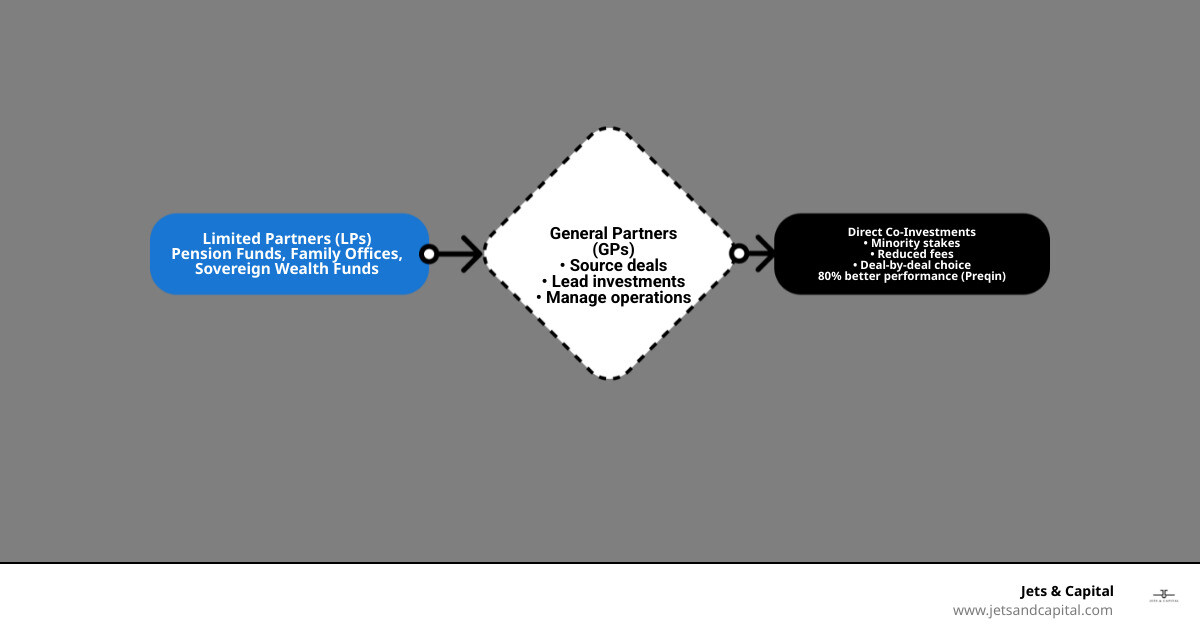
The numbers back this up. A Preqin study found that 80% of limited partners reported better performance from co-investments than from traditional fund structures. Meanwhile, sovereign wealth funds alone invested over $331 billion across 469 deals between 2018 and 2023. Family offices, pension funds, and corporate investors have followed suit — and the momentum isn't slowing down.
The appeal is straightforward: more control, lower costs, and better alignment with the deals that actually matter to you.
But co-investing isn't without its complexities. Understanding the structure, the risks, and the right partners is what separates high-yield outcomes from costly mistakes. This guide walks you through everything you need to know.
I'm Jordan Hutchinson — entrepreneur, investor, and founder of Jets & Capital, with deep roots in private equity through my family's role in founding Bridge Investment Group (NYSE: BRDG). My hands-on experience across capital raising, family office deal flow, and high-net-worth networks gives me a front-row seat to the most compelling co-investment opportunities available today. Let's dig into how you can use them to build a stronger, more diversified portfolio.
Understanding Equity Co-Investment Opportunities

In private equity, the traditional model involves a "blind pool." You give your money to a General Partner (GP), and they decide which companies to buy over the next five years. You’re along for the ride, but you don’t have a say in the specific deals.
Co-investment opportunities change that dynamic. They allow Limited Partners (LPs)—like family offices or pension funds—to invest directly into a specific company alongside the GP’s main fund. It’s a "side-car" arrangement where you get to see exactly what you are buying before the capital is deployed.
As GPs tap co-investments as debt dries up and fundraising lags, these opportunities have moved from a "nice-to-have" perk for large institutions to a core strategy for savvy allocators. At Jets & Capital, we see this in our hubs like Miami and San Francisco, where investors are increasingly looking for more surgical ways to deploy capital.
Defining the Co-Investment Model
At its core, a co-investment is a minority stake in a company. The GP (the fund manager) finds a deal that is perhaps too large for their main fund to handle alone due to concentration limits. Instead of passing on the deal, they invite their most trusted LPs to fill the equity gap.
This model offers incredible capital efficiency. Because you are investing on a deal-by-deal basis, you aren't paying fees on committed capital that hasn't been called yet. You only put your money to work when the right opportunity arrives.
How Co-Investments Differ from Traditional Private Equity
The primary difference lies in the level of discretion and the fee load. In a traditional fund, the GP has full discretion. In a co-investment, you have the discretion to say yes or no to that specific asset.
| Feature | Traditional PE Fund | Co-Investment |
|---|---|---|
| Control | GP decides all investments | LP chooses specific deals |
| Fees | 1.5% – 2% Management Fee | Often 0% or significantly reduced |
| Carry | Standard 20% | Often 0% – 10% |
| Transparency | Blind-pool (unknown assets) | Full transparency of the target asset |
| Speed | Slow capital call process | Rapid deployment for specific deals |
The Strategic Shift: Why Co-Investments are Surging Post-2022
The investment landscape shifted dramatically in 2022. We saw the number of private equity funds plummet from 1,129 to just 597. Fundraising for first-time funds hit a nine-year low. Why? Interest rates spiked, debt became expensive, and LPs became much more cautious.
In this "unsettled market," as described in this roundtable on how co-investors are adjusting, co-investments became a vital lifeline. When the credit markets tightened, GPs needed more equity to close deals. This created a massive opening for co-investors to step in and provide that "friendly" capital.
Market Drivers for Co-Investment Opportunities
There are three main drivers fueling this surge:
- Equity Gaps: With banks lending less, GPs need more equity to acquire the same size of company.
- Fundraising Lags: It’s taking longer for GPs to raise their next big fund. Co-investments allow them to keep doing deals and building a track record in the meantime.
- Relationship Building: Co-investments are the ultimate "sticky" product. They deepen the bond between the GP and the LP.
We track these shifts closely through our insights on family office deal flow, noting that the most successful families are those who can move quickly when these gaps appear.
Performance Trends and Investor Appetite
The data is hard to ignore. When you strip away the heavy management fees and the "drag" of underperforming companies in a large fund, the returns on co-investments often shine. The Preqin study mentioning an 80% performance boost isn't an anomaly—it’s the result of being able to double down on a GP's "high-conviction" deals.
Key Participants and Market Trends in Co-Investment Opportunities
Who is actually writing the checks? It’s a diverse group, ranging from government-backed giants to the family next door (if that family happens to have a few hundred million in the bank).
The Rise of Family Offices and UHNWIs
Family offices are currently at the forefront of this trend. Globally, 42.5% of family offices are already engaged in co-investing. They often prefer "club deals," where a few families pool their resources to take a significant stake in a business or real estate project.
This shift is documented in recent research on the rise of family offices co-investing. These investors value the "personal" nature of these deals. They aren't just numbers on a screen; they are partnerships with people they trust. This is exactly why we host our events in private jet hangars—it’s about creating the environment where these high-stakes relationships can actually form.
Sector Focus: From Deep Tech to Real Estate
Where is the money going?
- Deep Tech: Programs like the EIC Fund have mobilized over €1.6 billion, focusing on high-potential startups with a tiny 2% success rate for selection.
- Real Estate: In markets like Dallas, Salt Lake City, and Palm Beach, we see a massive appetite for multifamily housing and "Opportunity Zone" developments.
- The Autonomous Era: There is a growing network of investors thinking in decades, not quarters, backing infrastructure for the future of automation.
Whether you are an early stage investor or a real estate veteran, the variety of co-investment opportunities is wider than ever.
Structuring and Managing Co-Investment Opportunities
You can't just Venmo a GP $5 million and call it a day. These deals require sophisticated legal and operational structures.
The Role of SPVs in Modern Deal-Making
The Special Purpose Vehicle (SPV) is the workhorse of the co-investment world. An SPV is a separate legal entity created for a single investment.
- Cap Table Simplification: Instead of 50 individual investors appearing on a company's books, only the SPV appears.
- Growth: The annual count of new SPVs has grown 116% over the last five years.
- Size: For larger deals, the median SPV size reached nearly $22.6 million in 2023.
Interestingly, about 56% of these SPVs charge no management fees at all, making them an incredibly cost-effective way to gain exposure.
Navigating Regulatory and Operational Complexities
With great opportunity comes great paperwork. The SEC has recently adopted a rule updating the thresholds for private funds, which impacts how these deals are reported.
Investors must also keep an eye on:
- Tag-along/Drag-along Rights: Ensuring you can exit when the majority exits.
- Audit Readiness: Keeping clean books for every single SPV.
- Transparency: Unlike a blind fund, you expect (and should receive) regular, detailed reporting on the specific asset.
Our portfolio management insights emphasize that operational excellence is just as important as the investment thesis itself.
Risk Mitigation and Due Diligence for High-Yield Portfolios
If co-investing was all upside, everyone would do it. But there are unique pitfalls you must navigate.
- Adverse Selection: Are you getting the GP's best deal, or the one they couldn't fund elsewhere? This is sometimes called "cherry-picking" in reverse.
- Concentration Risk: If you put too much into one co-investment and it fails, it hurts more than a single failure in a diversified fund.
- Lack of Control: As a minority investor, you are usually a passenger. You rely entirely on the GP to manage the exit.
Essential Due Diligence Checklists
Before signing a subscription agreement, we recommend a "trust but verify" approach:
- Management Vetting: Who is running the day-to-day?
- Track Record: Has the GP successfully exited similar co-investments?
- Exit Strategy: Is there a clear timeline for liquidity?
- Fee Transparency: Are there hidden "monitoring fees" or "transaction fees" buried in the fine print?
Managing Conflicts and Allocation Policies
Conflicts of interest can arise if a GP offers a better deal to one investor to entice them into a future fund. To mitigate this, look for GPs with clear, written allocation policies. You want to see "pro-rata" rights, ensuring that if there’s a follow-on round, you have the right to maintain your ownership percentage.
Frequently Asked Questions about Co-Investing
What is the minimum investment for most co-investment deals?
While institutional deals can require $10 million or more, many SPVs and club deals for high-net-worth individuals start at $50,000 to $250,000. This lower barrier to entry is part of why these opportunities are becoming so popular among family offices.
How do co-investments improve overall portfolio performance?
They improve performance primarily through "fee alpha." By eliminating the 2% management fee and reducing the 20% carry, more of the underlying company's growth stays in your pocket. Additionally, they allow you to overweight sectors where you have high conviction.
What are the main risks of investing alongside a General Partner?
The biggest risk is "passive reliance." If the GP makes a bad call or the market turns, you have very little recourse to change the management or the strategy of the company. You are also subject to the GP’s timeline for selling the asset, which might not align with your own liquidity needs.
Conclusion
The landscape of wealth management is moving toward transparency and directness. Co-investment opportunities represent the pinnacle of this shift, offering a way to bypass the "black box" of traditional private equity.
Success in this arena isn't just about having the capital; it’s about having the access. At Jets & Capital, we pride ourselves on being the bridge. Whether it's in New York, Las Vegas, or at our upcoming Super Bowl Edition in San Francisco, we bring together the 85% allocator crowd to ensure that when you see a deal, it’s been vetted by the best in the business.
Building a high-yield portfolio requires more than just a spreadsheet—it requires a network of people who think in decades. If you’re ready to move beyond the traditional fund model and explore exclusive deal flow, we invite you to attend an exclusive investment summit and see the difference that a vetted, high-quality network can make.
