
A No-Nonsense Guide to Private Equity Capital Introduction
What Are Capital Introduction Events (And Why They Matter for Raising Capital)

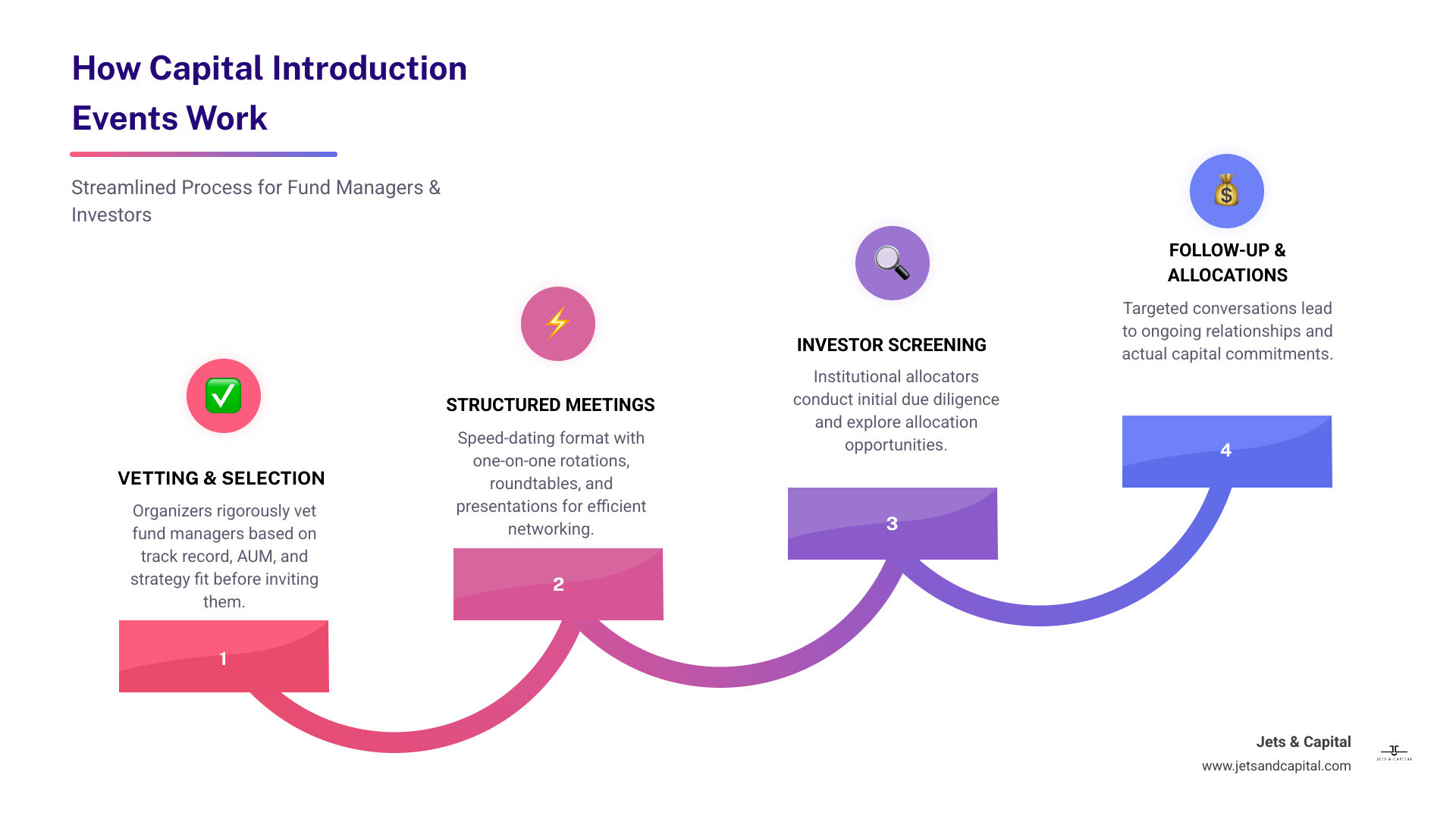
Capital introduction events are structured gatherings where fund managers and institutional investors meet face-to-face — often in a speed-dating format — to explore potential capital allocations.
Here's a quick breakdown of how they work:
| Element | Details |
|---|---|
| Who attends | Hedge fund managers, PE/VC managers, family offices, endowments, pensions, sovereign wealth funds |
| Format | One-on-one meetings, roundtables, best-idea presentations, cocktail receptions |
| Goal | Initial introductions and due diligence between managers and allocators |
| Organizers | Prime brokers (e.g., large banks) or independent event organizers |
| Cost | Free for investors; flat fees or bundled prime brokerage costs for managers |
| Outcome | Targeted capital allocation conversations, ongoing investor relationships |
These events have grown significantly in popularity over the past decade. They give both sides something valuable: managers get in front of qualified capital, and investors get an efficient way to screen many opportunities in a short time.
But not all cap intro events are created equal — and understanding the differences can save you a lot of wasted time and money.
I'm Jordan Hutchinson, founder of Jets & Capital, and my background spans family office investing, private equity, and organizing exclusive capital introduction events for high-net-worth individuals and institutional allocators. In the sections below, I'll walk you through everything you need to know to use these events effectively.
The Evolution and Mechanics of Capital Introduction Events
The alternative investment world didn't always have these high-speed networking hubs. To understand where we are today, we have to look back at the late 1990s. This was the era when investment banks realized that "prime brokerage"—providing clearing, custody, and financing to hedge funds—was becoming a bit of a commodity. To stand out, they needed to offer something more than just tech and leverage; they needed to offer access to money.
Thus, the "cap intro" desk was born. These teams within major banks began hosting conferences to introduce their hedge fund clients to the bank's institutional investor relationships. It was a win-win: the fund got capital, and the bank got a loyal client who would generate massive fees through securities lending and trade execution. Over the last decade, the popularity of these events has exploded, evolving from simple boardroom meetups to massive global summits.
If you want to dive deeper into the history of these services, you can listen to more about capital introduction and prime services to see how the landscape has shifted from purely bank-driven models to the diverse ecosystem we see today. In cities like New York, Miami, and San Francisco, these events have become the heartbeat of the fundraising cycle. You can find more info about investor networking events that cater to this high-stakes environment.
Prime Brokerage vs. Independent Capital Introduction Events
When you start looking for capital introduction events, you’ll notice two distinct flavors: those run by prime brokers (the big banks) and those run by independent organizers.
Prime brokerage events are often "free" for the manager to attend, but as the saying goes, there’s no such thing as a free lunch. The bank expects the manager to do significant trading business with them to justify the spot. This creates a structural conflict of interest: the bank might prioritize a manager who generates high commissions over a manager who has the best performance. Furthermore, prime brokers often gravitate toward "crowded" strategies like Long/Short Equity because those funds utilize more leverage and generate more profit for the bank.
Independent events, on the other hand, usually operate on a flat-fee model. Managers pay to play, which often results in a higher-quality pool of participants—if a manager is willing to write a check for $5,000 or $10,000 just to be in the room, they usually have a high degree of confidence in their strategy and materials. These events also tend to offer much better strategy diversity, including private equity, venture capital, and real estate, rather than just hedge funds.
| Feature | Prime Broker Events | Independent Events |
|---|---|---|
| Primary Driver | Trading commissions/profitability | Flat registration fees |
| Strategy Focus | Heavy on Long/Short & Macro | Broad (PE, VC, Real Estate, Credit) |
| Conflicts | Potential bias toward high-fee clients | Generally neutral; fee-based entry |
| Vetting | Based on bank relationship | Based on track record and strategy |
Selection Criteria for Capital Introduction Events
How do you get into the room? It’s not as simple as clicking "register." High-quality capital introduction events use a rigorous vetting process to protect the time of the allocators.
For managers, organizers look at:
- Track Record: Consistent performance over multiple years is the gold standard.
- AUM (Assets Under Management): Some events target "emerging managers" (under $100M-$250M), while others only want the giants.
- Strategy Fit: Organizers often use a matching survey process to ensure the manager's strategy aligns with what investors are currently hunting for.
- De-risked Assets: Especially in niche sectors like biotech or hardware, investors want to see assets that are close to "proof of concept" or clinical stages.
At Jets & Capital, we take this a step further. We maintain an 85% allocator-to-manager ratio, ensuring that every conversation a manager has is with someone who actually has the "dry powder" to make an investment.

Strategic Benefits for Managers and Institutional Investors
For a fund manager, the primary benefit is efficiency. Instead of flying across the country for three separate meetings, you can sit in one room in Miami or Salt Lake City and have 15 high-quality "first dates" in a single afternoon. It’s the ultimate way to complete initial due diligence and gauge market interest in your strategy.
For institutional investors—like family offices, endowments, and pensions—these events act as a filter. They can see a dozen managers in a day, comparing strategies side-by-side. It’s a massive time-saver for a family office CIO who might be looking for a very specific type of "alpha" to fill a gap in their portfolio. If you are curious about how these offices operate, we've put together some insights on family office deal flow to explain their unique requirements.
Maximizing ROI at Capital Introduction Events
To get the most out of these events, you can't just show up with a pitch deck and a smile. You need a strategy.
- Refine Your Messaging: You often only have 15 to 20 minutes. If you can't explain your edge in the first 5 minutes, you've lost them.
- Use the Feedback Loop: One of the most underrated parts of capital introduction events is the feedback. If ten investors in a row ask the same difficult question about your risk management, you know exactly what you need to fix in your pitch.
- Targeted Mandates: Don't pitch a pension fund on a high-risk, seed-stage VC play if they only have a mandate for core real estate. Research the attendees beforehand.
Networking with Ultra-High-Net-Worth Individuals (UHNWIs) requires a different touch than pitching a corporate pension. For those looking to master this, check out our guide to UHNW networking.
Navigating Costs, Compliance, and Conflicts
Let's talk about the "boring" but vital stuff: regulation and money. In the United States, capital introduction is a regulated activity. Most providers must be registered broker-dealers with the SEC and comply with strict anti-fraud and Anti-Money Laundering (AML) rules.
Costs for Managers:
- Prime Brokerage: Often "free" but requires high trading volumes.
- Independent Events: Tiered pricing is common. For example, some global virtual events might start at $4,975 for early-bird registration and scale up to $7,975 as the event nears.
- Success Fees: In some cases, third-party marketers might charge a percentage of the capital raised (often 1-2%), though this is less common for the events themselves.
Compliance Considerations: Managers must ensure their marketing materials are compliant with SEC marketing rules. You should always consult with your CCO before distributing materials at any event. If you're attending a family office investment summit, ensure you understand the specific solicitation rules for that jurisdiction.
The Future of Networking: Virtual, Hybrid, and Blurring Asset Classes
COVID-19 changed everything. For a while, we all thought virtual events were just a temporary fix. But data suggests they are here to stay. Virtual capital introduction events offer incredible efficiency—no travel costs and the ability to meet a manager in London at 9:00 AM and one in San Francisco at 10:00 AM.
However, "meeting burnout" is real. We’ve seen a shift toward two-week windows for virtual events, allowing participants to spread out their meetings rather than cramming 40 Zoom calls into two days.
The most exciting trend is the blurring of asset classes. Historically, hedge fund events and private equity events were separate worlds. Today, they are merging. Allocators are looking for "total return," and they don't care as much about the wrapper as they do about the quality of the underlying assets.
At Jets & Capital, we believe the future is hybrid. We use virtual tools for initial screening, but we believe the biggest deals are still closed in person—often in unique, high-trust environments. Whether it’s at a hangar in Dallas or a summit in Palm Beach, the "vibe" matters. For more on how to navigate these high-end environments, see our guide to private jet networking.
Frequently Asked Questions about Cap Intro
How effective are these events at securing actual capital allocations?
It varies, but industry insights suggest they are highly effective for starting the process. Rarely does an allocator sign a check at the event. However, these events facilitate thousands of targeted introductions annually. For instance, some prime brokers facilitate over 3,000 high-touch introductions a year, leading to billions in moved capital over the long term. Success depends on the follow-up.
What are the typical costs for fund managers to participate?
For independent events, expect to pay between $5,000 and $10,000 for a premium spot. Prime brokerage events are generally "free" for existing clients, but you'll likely need to be generating six or seven figures in annual trading commissions to be invited.
Are virtual formats here to stay in the alternative investment industry?
Absolutely. While they can't replace the trust-building of an in-person dinner, their efficiency is unmatched. Many organizers now offer hybrid models: virtual one-on-one meetings followed by regional in-person cocktail parties in hubs like New York or Miami.
Conclusion
At the end of the day, the alternative investment industry is a relationship business. Capital introduction events are the engines that power those relationships. Whether you are a manager looking for your first $50 million or a family office looking for a niche credit strategy, these events provide the structure and vetting necessary to make high-stakes deal-making possible.
We pride ourselves on moving away from the "volume-based" approach of big banks. We focus on exclusivity, vetting, and high-quality environments. If you’re ready to step into a room where 85% of the people are actual allocators, we invite you to view our upcoming event calendar and join us at one of our upcoming summits in San Francisco, Miami, or New York.
Raising capital isn't just about the numbers; it's about being in the right room with the right people. We'll see you there.
