
Unlocking Opportunities: The Power of Deal Sourcing Events for Family Offices
Why Family Office Deal Flow Matters More Than Ever in 2026

Family office deal flow is the lifeblood of successful private capital deployment, yet it remains one of the most challenging aspects for single family offices (SFOs) to master. Here's what you need to know:
Key Components of Family Office Deal Flow:
- Sourcing Methods - Network-driven referrals from trusted advisors, bankers, and other family offices (not cold pitches like VCs)
- Investment Structures - 69% prefer club deals for risk-sharing; direct investments growing rapidly
- Return Expectations - Target 2-5x returns (sometimes 10x), unlike VCs seeking 100x outcomes
- Asset Allocation - 31% in venture capital, 39% in real estate, 19% in private equity (H1 2026)
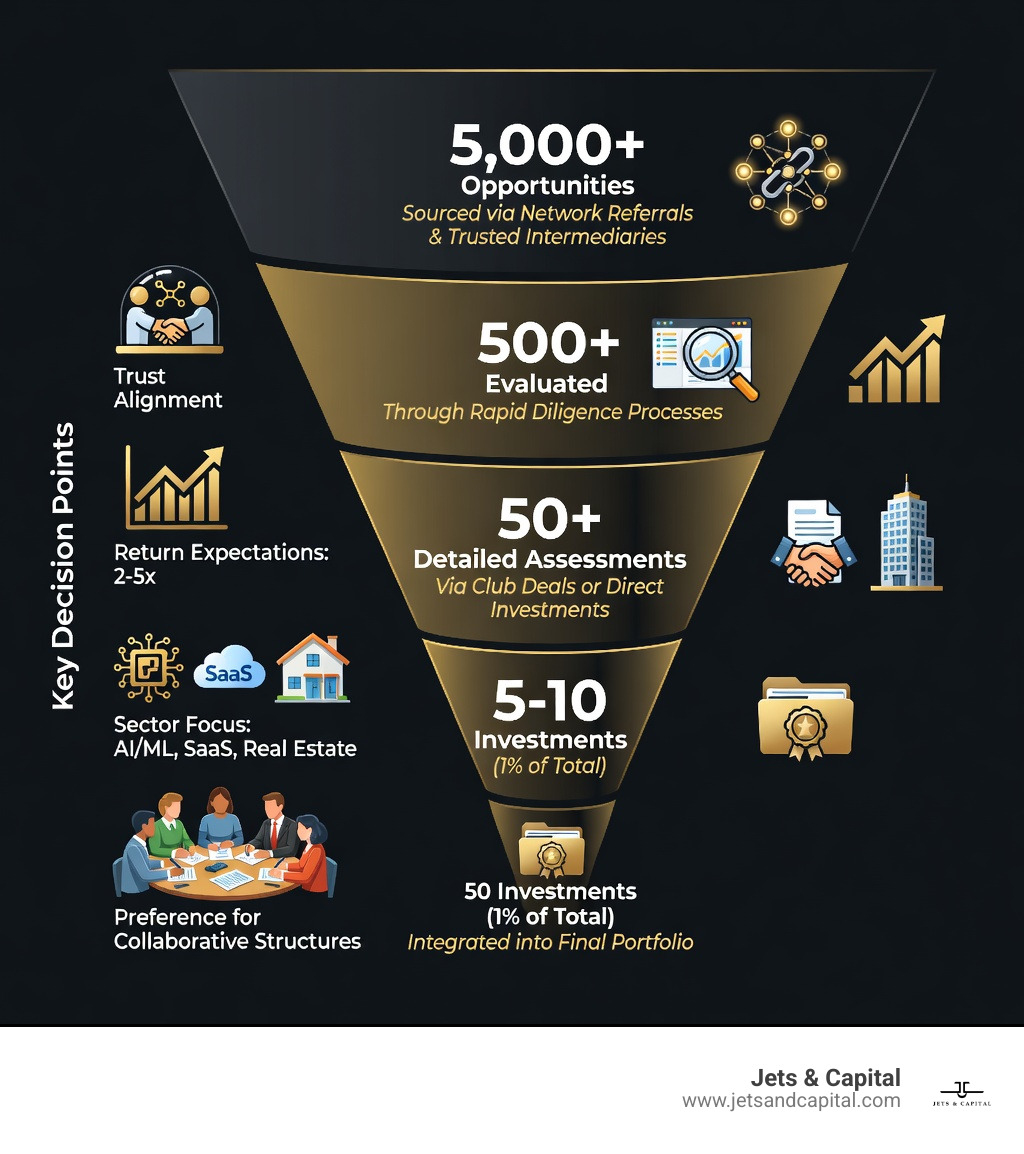
- Deal Volume Reality - Only 1% of opportunities become investments; need thousands of deals to build a diverse portfolio
The landscape has shifted dramatically. Global family office investments peaked at 17,460 deals worth $1,054.5 billion in H2 2021 but fell to below 7,200 deals and $439.6 billion in H1 2026—the lowest in a decade. Yet this isn't a retreat. It's a strategic recalibration toward quality over quantity.
The challenge is clear: competition for deal flow is extremely high, with a large amount of capital in the market chasing too few deals. Around 80% of family offices now make venture investments regularly, up from just 40% a decade ago. But sourcing has evolved beyond opportunistic referrals. Leading family offices are building sophisticated "deal sourcing machines" that combine relationship intelligence with data-driven targeting.
What makes family office deal flow fundamentally different from traditional VC pipelines? Trust-based networks. Family offices source primarily through friends, relatives, trusted bankers, service providers, and brokers—not through cold email campaigns or pitch competitions. They pursue deals VCs often avoid, like bio-medical companies pre-FDA approval or businesses in non-venture-backable industries. And they can be patient capital, willing to accept different risk-return profiles than institutional investors demanding power-law outcomes.
The shift toward direct investments, co-investments, and club deals reflects a deeper motivation: greater transparency, increased control, and the loss of interest in being a blind pool investor. Family offices want to know exactly where their capital goes and have a say in how it's deployed. This means building infrastructure for rapid diligence and evaluation—a significant operational challenge for offices that traditionally relied on external fund managers.
Geographic and sector trends are also reshaping the opportunity set. AI and machine learning deal values more than doubled between 2024-2026, while real estate rebounded to 39% of allocations after hitting a low of 26%. Emerging hubs like the UAE and Singapore are attracting significant capital, with Singapore hosting more family offices than New York City or London combined.
I'm Jordan Hutchinson, founder of Jets and Capital, where I've spent years facilitating exclusive networking opportunities for high-net-worth individuals and family offices seeking to optimize their family office deal flow through vetted, relationship-driven environments. My family's involvement in founding Bridge Investment Group and our experience across private equity and venture investments has given me insight into what separates successful deal sourcing from simply chasing volume.
Understanding the Landscape of Family Office Deal Flow
As we navigate the current market, it is essential to recognize that Family offices are no longer the "quiet observers" of the investment world. We have seen a massive professionalization of these entities, with 75% of existing global family offices established since 2001. This explosion in growth means that the competition for high-quality family office deal flow has reached a fever pitch.
Unlike a traditional Limited Partner (LP) who might passively write a check to a massive fund, modern SFOs are increasingly active. They are looking for more than just a line item on a quarterly report; they are looking for strategic alignment. This shift has changed the "where" and "how" of deal sourcing. In cities like New York, San Francisco, and Dallas, the traditional boundaries between private equity and family wealth are blurring.

Sourcing Beyond Traditional VC Pipelines
If you've ever sat in a room with a seasoned venture capitalist, you know their world is built on the "power law"—the idea that one massive winner will pay for 99 losers. Because of this, their pipelines are often filled with high-burn, high-growth tech startups. According to the Harvard Business Review on VC decision making, only about 1% of venture deal flow ends up as investee companies.
For family offices, the pipeline looks very different. We don't just look for the next moonshot; we look for resilient businesses. Our sourcing relies heavily on:
- Trusted Referral Networks: Deals shared between families who have known each other for decades.
- Service Providers: Lawyers, accountants, and boutique advisors who understand the specific "flavor" of a family's investment thesis.
- Banker Introductions: But not just any banker—usually those with deep, multi-generational relationships.
The Shift Toward Direct and Co-Investments
Why are we seeing such a massive move toward direct private equity and co-investments? It boils down to three things: transparency, control, and fees. Many SFOs have grown weary of the "blind pool" nature of traditional funds. We want to see under the hood.
By moving toward direct investments, we gain the ability to apply our own operational expertise. Many family offices were born from active businesses—86% of them, in fact—meaning the principals often know more about running a company than the analysts at a mega-fund. This "operator-first" mentality is a significant driver in how we curate our family office deal flow.
Strategic Sourcing: From Passive Referrals to Proactive Origination
The days of sitting back and waiting for the phone to ring are over. To secure the best deals in 2026, we have to be "hunters, not gatherers." This means moving from a passive discovery model to a proactive origination strategy.
One of the most effective ways we've seen this play out is through the rise of collaborative structures. As the market becomes more crowded, pooling resources isn't just a luxury; it's a necessity for survival.
Why Club Deals Dominate Family Office Deal Flow
Club deals have become the dominant force in our world, making up 69% of family office investments in the first half of 2026. But why do they work so well?
- Risk Sharing: No one wants to be the only one holding the bag if a deal goes south.
- Resource Pooling: One family might have deep expertise in real estate in Salt Lake City, while another has a tech background in San Francisco. Together, they are a formidable force.
- Lead SFO Advantage: Often, one lead family office handles the heavy lifting of due diligence, allowing others to participate with lower overhead.
These deals provide access to higher-quality returns while maintaining a level of comfort that sole deals often lack.
Aligning Return Expectations and Risk Appetites
We need to talk about the "math gap." VCs are often swinging for a 100x return, which forces them to take extreme risks. Family offices, however, are often looking for 2-5x or perhaps 10x returns. We are "patient capital."
| Investment Type | Target Returns | Investment Horizon | Risk Profile |
|---|---|---|---|
| Family Office (SFO) | 2-5x (up to 10x) | 7-10+ Years | Capital Preservation |
| Venture Capital (VC) | 100x (Power Law) | 10+ Years | High Risk / High Reward |
Because our valuations aren't always tied to the next funding round, we can afford to stay in a deal longer. We aren't pressured by an artificial fund lifecycle. This allows us to invest in "unsexy" but highly profitable sectors like agriculture, energy, or middle-market manufacturing.
Optimizing Your Family Office Deal Flow Through Exclusive Events
If the best deals happen through networks, then the quality of your network is the ceiling of your success. This is why we focus so heavily on the environment in which deals are discussed. You can't find a proprietary, off-market gem at a 2,000-person convention. You find it in a private hangar in Palm Beach or a luxury suite in San Francisco.
The Role of Trust-Based Networking in Deal Flow
At Jets & Capital, we believe that trust is the ultimate currency. When you are in an invite-only environment, the "noise" of the market disappears. You aren't being pitched by 50 different software companies. Instead, you are talking to Allocators who have already vetted the opportunities they are bringing to the table.
Strategic alignment happens naturally when you are surrounded by peers. Whether you are looking for Tickets to an exclusive summit or a private dinner, the goal is always the same: building the relationship before the deal.
Leveraging High-Quality Allocator Environments
Our USP is a strict vetting process that ensures 85% of our attendees are allocators. Why does this matter for your family office deal flow? It means the person sitting across from you is a decision-maker, not just a salesperson.
When you join us for an event—like our upcoming Super Bowl Edition in San Francisco—you are entering a room designed for high-stakes deal-making. You can learn more About our mission to connect the world's most influential capital with the most promising opportunities by visiting our site.
Sector Trends and Geographic Shifts in 2026
The 2026 landscape is showing some fascinating shifts. According to the PwC Global Family Office Deals Study 2026, we are seeing a "quality over quantity" mindset take hold.
Emerging Hotspots for Global Capital Deployment
While Singapore and the UAE are making headlines, North America remains the dominant force, accounting for 63% of global family office deals. Within the U.S., we see specific hubs growing:
- San Francisco & Silicon Valley: Still the king of AI and SaaS.
- Miami & Palm Beach: A massive influx of wealth and financial services.
- Dallas & Las Vegas: Growing as secondary hubs for private equity and real estate.
The McKinsey Global Private Markets Report 2026 notes that while fundraising fell, capital deployment grew by double digits, particularly in these key U.S. markets.
Sector Focus: AI, Biotech, and the Real Estate Rebound
Family offices are currently balancing growth and stability. We've seen:
- Real Estate: A rebound to 39% of portfolios. Despite the White & Case on Real Estate Headwinds report highlighting challenges, family offices are finding value in apartments and development sites.
- Venture Capital: Now at 31%, with a heavy focus on AI/ML and SaaS.
- Biotech: Family offices are increasingly playing in the pre-FDA space where traditional VCs might hesitate due to longer timelines.
Building Infrastructure for Rapid Diligence and Evaluation
One of the biggest hurdles for SFOs is the "speed to lead." If a great deal hits your desk on Friday, can you have a preliminary diligence report by Monday? If not, you might lose the deal to a faster-moving fund.
Building this infrastructure doesn't necessarily mean hiring 50 analysts. It means being a smart Sponsor and leveraging the right external partners.
Effective Acquisition Strategies for SFOs
To optimize your family office deal flow, consider these "hybrid" models:
- Buy-Side Advisors: Retaining a boutique buy side firm can provide you with a constant stream of vetted deal flow without the overhead of a full-time staff.
- Boutique SFO Advisory: These services offer a suite of options for the CIO, including introductions to exclusive deal pipelines.
Utilizing Independent Sponsors and Hybrid Models
An independent sponsor can be an incredible asset. These are private equity professionals who find a deal first and then look for the capital to fund it. For a family office, this is a "best of both worlds" scenario:
- You get the operational expertise of a PE pro.
- You maintain the final "yes/no" power over the investment.
- You avoid the high management fees of a committed fund.
Overcoming Challenges in Modern Family Office Deal Flow
The market is currently "capital abundant" but "deal scarce." This means valuations can get pushed to uncomfortable levels. To protect your Portfolio, you must have a disciplined approach.
Mitigating Risks in a Capital-Abundant Market
As noted in the RBC Wealth Management on Family Office Reset, many families are resetting their expectations after the volatility of early 2026.
- Avoid Over-exposure: Be careful not to co-invest in the same companies that your existing VC funds are already backing.
- Governance First: Ensure your investment guidelines are updated to handle the speed of direct deals.
Adapting to Larger Ticket Sizes and Professionalization
We are seeing a clear shift toward larger deals. Small investments (under $25M) have dropped from 70% to 59% of family office deal flow. Meanwhile, medium ($25M-$100M) and large deals are on the rise. This trend, highlighted by Institutional Investor on Private Markets Shift, indicates that family offices are looking to put more capital to work in fewer, higher-conviction opportunities.
Frequently Asked Questions about Family Office Deal Flow
How do family office return expectations differ from traditional VCs?
Family offices generally target 2-5x returns and prioritize capital preservation and long-term growth. Traditional VCs require "power-law" returns (100x) because they expect the majority of their portfolio to fail. Family offices are often "patient capital," willing to wait 7-10+ years for a steady exit.
Why are club deals becoming the preferred structure for SFOs?
Club deals allow family offices to share the risk and the due diligence burden. They also provide access to larger, higher-quality deals that a single SFO might not want to fund entirely on its own. It's about "strength in numbers" while maintaining more control than a blind-pool fund.
What are the most effective ways to source off-market deal flow?
The most effective way is through high-quality, vetted networking environments. Proprietary deals rarely come from cold emails; they come from peer-to-peer referrals, boutique advisors, and exclusive events where trust is established before the transaction is discussed.
Conclusion
Mastering family office deal flow in 2026 requires a blend of old-school relationship building and modern data-driven origination. Whether you are navigating the real estate market in Salt Lake City or looking for the next AI breakthrough in San Francisco, the key is to be proactive.
At Jets & Capital, we provide the ultimate "deal sourcing machine" through our exclusive hangar events. Our upcoming Super Bowl Edition is the perfect example of how we bring together 85% allocators in a high-trust, luxury environment to facilitate real deal-making.
Don't let your venture ambitions be sidelined by a lack of quality pipeline. Take the first step toward optimizing your investment strategy and Book a consultation on our calendar today. We look forward to helping you unlock your next great opportunity.
