
What Is an Institutional Investor Forum (and Why It Matters)
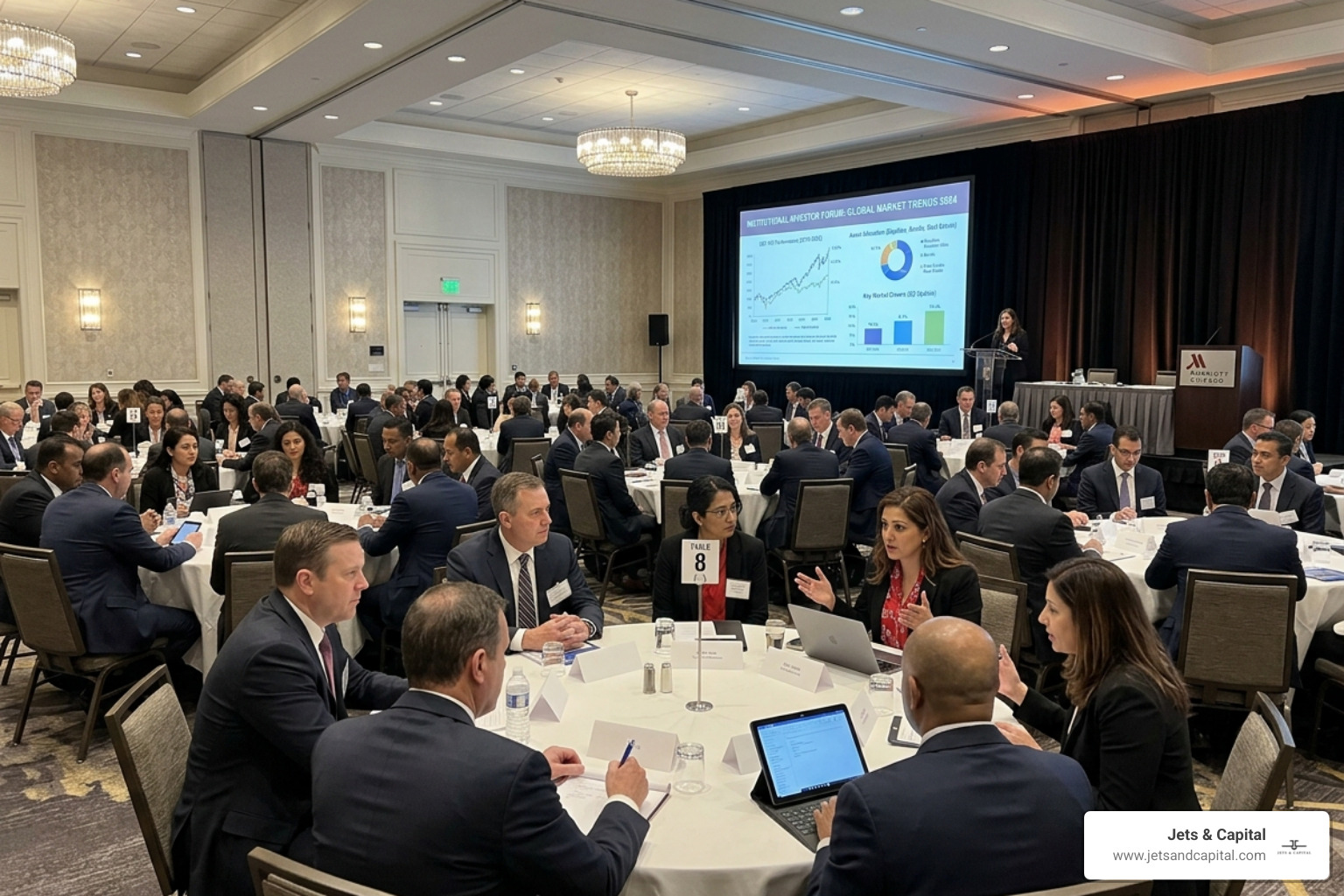
An institutional investor forum is a structured gathering where senior asset owners — think pension funds, endowments, sovereign wealth funds, and foundations — meet to share insights, debate strategy, and build relationships that shape how trillions of dollars get deployed.
Here's a quick breakdown of what these forums are and who they're for:
| Feature | Details |
|---|---|
| What it is | A curated event for senior investment leaders to discuss long-term investing strategy |
| Who attends | Pension funds, endowments, foundations, sovereign wealth funds, insurance portfolios, family offices |
| Key topics | Private markets, fixed income, AI, real assets, macroeconomic outlook, energy transition |
| Format | Closed-door, invitation-only, often under Chatham House Rules |
| Major organizers | Global research firms, academic institutions, and industry associations |
| Scale | Forums like Harvard Law School's represent members managing over $15 trillion in assets |
These aren't typical conferences with vendor booths and sales pitches. The best ones are deliberately small, exclusive, and off the record — designed to produce real conversations, not rehearsed presentations.
The problem? Walking into one of these rooms without context can leave you spinning. The players, the format, the unspoken rules — it's a lot to navigate if you're new to the space.
I'm Jordan Hutchinson, founder of Jets & Capital and a longtime participant in the institutional investor world through my family office's work co-founding Bridge Investment Group (NYSE: BRDG) — experience that gave me a front-row seat to how the best institutional investor forums actually function. In the sections below, I'll walk you through everything you need to know to show up prepared and make the most of these rooms.
Understanding the Value of an Institutional Investor Forum
When we talk about an institutional investor forum, we are talking about the engine room of global finance. These events aren't just about drinking expensive coffee and swapping business cards; they are high-stakes environments where the future of asset allocation is decided. For asset owners and investment leaders, these forums serve as a critical compass in an increasingly volatile market.
The value lies in the concentration of expertise. At a typical forum, you’ll find leaders navigating the 2025-2026 macroeconomic outlook, debating the merits of defensive portfolio shifts, and trying to figure out if the Federal Reserve's balance sheet adjustments will finally cool down the markets. These gatherings address the most pressing allocator challenges, such as how to maintain yield when traditional fixed income feels shaky or how to integrate real assets to cushion against inflation.
We’ve seen that these forums provide a unique "safety in numbers" for CIOs. When you're managing billions, the weight of a single decision is immense. Being in a room where others are facing the same risk management hurdles—whether it’s concentration risk in factor strategies or the reputational risks of certain real asset investments—is incredibly grounding.

Why Peer-to-Peer Networking Matters
The real magic happens in the "candid dialogue" that only occurs when the doors are closed. Many elite forums strictly exclude brokers and vendors to ensure that the interactions remain "buyside only." This exclusivity creates a sanctuary for off-the-record interactions.
When we attend these events, we aren't looking for a sales pitch. We are looking for:
- Interactive Workshops: Where we can roll up our sleeves and look at the "plumbing" of a total portfolio approach.
- Roundtable Discussions: Small, intimate groups where a pension fund leader from California can talk shop with an endowment manager from New York.
- Collaborative Research: Participating in surveys and studies that help us understand where our peers are moving their capital.
This peer-driven model is why the most respected forums count dozens of leading firms among their membership. It’s about building a community of "the best and brightest investment minds" who can sharpen each other’s understanding of critical factors.
The Role of Global Research and Governance
An institutional investor forum isn't just about the "now"; it’s about the "what’s next." This is where organizations like the Harvard Law School Institutional Investor Forum (HIIF) come into play. By collaborating with the Harvard Law School Forum on Corporate Governance, these forums bridge the gap between academic theory and institutional practice.
The scale here is staggering. The aggregate assets managed by members of the Harvard forum exceed $15 trillion. When you have that much capital represented in one room, the discussions on policy-making and corporate discourse carry immense weight. These forums aren't just reacting to the market; they are often the ones setting the standards for governance and financial regulation. With over 3,500 contributors, including regulators and practitioners, the insights generated here influence everything from ESG mandates to the way boards are structured at the world's largest companies.
Key Features of Elite Institutional Investor Forums
If you're wondering what sets a top-tier institutional investor forum apart from a standard industry conference, look at the rules of engagement. These events are designed to protect the privacy of the participants while maximizing the quality of the information exchanged.
One of the most common features is the use of Chatham House Rules. This means that while participants are free to use the information received, they cannot reveal the identity or affiliation of the speaker. This encourages a level of honesty you simply won't find in a public setting. Furthermore, many boutique organizations have a strict "no-press" policy. This ensures that a CIO can admit they are worried about a specific private equity energy model without seeing it as a headline in the financial news the next morning.
Navigating the 2025-2026 Global Event Calendar
As we look ahead to 2025 and 2026, the calendar is packed with regional and global summits. While global forums like those hosted by MSCI (which has run for over 20 years) offer a broad look at North America, APAC, and EMEA, regional forums offer a more localized "deep dive."
For our partners in California and New York, attending regional institutional summits is essential. These regional events often feature a speaker faculty primarily comprised of leaders from that specific area, making the networking even more relevant.
| Forum Type | Focus | Attendance Policy | Best For |
|---|---|---|---|
| Global (e.g., MSCI) | Global research, total portfolio approach, macro trends | Broad institutional access | High-level strategy and global benchmarking |
| Regional Forums | Local leadership, regional economic drivers | Invitation-only, allocator-focused | Deep networking with local peers and regional deal flow |
| Academic (e.g., Harvard) | Governance, policy, and financial regulation | Highly selective | Understanding the regulatory and legal landscape |
| Boutique Forums | Community, friendship, and candid education | Limited access, no press | Intimate peer learning and confidential sharing |
Emerging Trends in an Institutional Investor Forum
What are people actually talking about behind those closed doors? The agenda for 2025-2026 is dominated by a few key themes:
- AI Integration: Beyond the hype, how are institutional allocators actually using AI for decision-making, risk management, and operational efficiency?
- Private Credit: This asset class has seen a meteoric rise, fueled by post-Great Recession bank regulations. Forums are now focusing on how to find alpha in private credit as the market becomes more crowded.
- Energy Transition and Decarbonization: Allocators are navigating a "dual mandate"—generating risk-adjusted returns while supporting the move toward net-zero. This includes looking at transformational technologies and the "energy transition framework."
- The Total Portfolio Approach: Moving away from traditional, "siloed" asset allocation toward a more dynamic, outcome-driven strategy. This trend is particularly strong among APAC investors but is quickly gaining traction in the U.S.
- Real Assets: With inflation concerns still lingering, real assets like infrastructure, agriculture "version 2.0," and royalties are being viewed as essential defensive plays.
Maximizing Your Attendance and Networking Strategy
To get the most out of an institutional investor forum, you need a plan. You can't just show up and hope for the best. We always suggest starting with the family office events that align with your specific investment goals.
Networking at this level is about family office deal flow. It is about finding that one partner who has the specific expertise you lack. Sponsorship opportunities also play a role; many firms support these events not just for branding, but to gain qualified access to sophisticated allocators.
If you are a manager, your goal is to be seen as a thought leader, not a salesperson. Engaging with the advisory board of these forums can help you understand what is truly top of mind for the people you want to reach.
How to Prepare for Your Next Institutional Investor Forum
Before you head to your next event, whether it's in New York or San Francisco, follow these steps:
- Request Agendas Early: Most organizers allow you to request a preliminary agenda. This helps you identify which sessions are can't miss.
- Understand the Vetting Process: Elite forums are invitation-only for a reason. Make sure your profile is up to date and reflects your role as a decision-maker.
- Set Peer Learning Goals: Don't just look for deals; look for knowledge. What can you learn from a peer who has already successfully integrated AI into their workflow?
- Follow Up: The forum is just the beginning. The real relationship building happens in the weeks following the event.
For those looking at international expansion, checking out the APAC Family Office Investment Summit can provide a completely different perspective on global capital flows.
Frequently Asked Questions about Institutional Investor Forums
Who is eligible to attend these exclusive forums?
Typically, attendance is reserved for senior investment decision-makers. This includes Chief Investment Officers (CIOs), trustees, and senior staff from pension funds, endowments, foundations, and sovereign wealth funds. Many boutique forums mandate that at least half of the attendance must be from the "allocator" community to maintain a healthy balance and prevent the event from becoming a "sell-side" circus.
What are the primary discussion topics for 2025-2026?
Expect heavy focus on the "Great Convergence" of public and private markets, the implementation of AI in portfolio construction, and the ongoing challenges of the energy transition. Macroeconomically, the impact of the 2024 U.S. elections and the Federal Reserve's borrowing needs will be central to every discussion on fixed income and equities.
How do regional forums differ from global investment summits?
Global summits provide a "birds-eye view" of the world economy and are great for benchmarking your strategy against global peers. Regional forums (like those in California or New York) are much more intimate. They allow for deeper relationship building with local leaders and focus on the specific economic and regulatory drivers of that region. For example, a California-based forum might lean more into tech and venture capital, while a New York forum might focus more on global macro and credit markets.
Conclusion
Navigating an institutional investor forum doesn't have to be overwhelming. When you understand that these rooms are built for peer-to-peer connection and candid dialogue, you can move from being a passive observer to an active participant in the global investment conversation.
At Jets & Capital, we take this concept of exclusivity and high-quality networking to the next level. We organize exclusive, invite-only networking events for family offices and UHNWIs in unique venues like private jet hangars. Our strict vetting process ensures an 85% allocator ratio, creating an environment that is purpose-built for high-quality deal-making and relationship building. Whether it's our upcoming Super Bowl Edition in San Francisco or an intimate gathering in Palm Beach, we focus on getting you in front of the right people.
If you’re ready to move beyond the traditional forum and experience a more curated approach to investment networking, we invite you to explore our Family Office Investment Summit or get tickets for the next exclusive event. The world of institutional investing is vast—don't get lost in it; lead it.
