
Keeping Up with the Centimillionaires: A UHNW Family Guide
What Is a UHNW Family — and Why It Matters

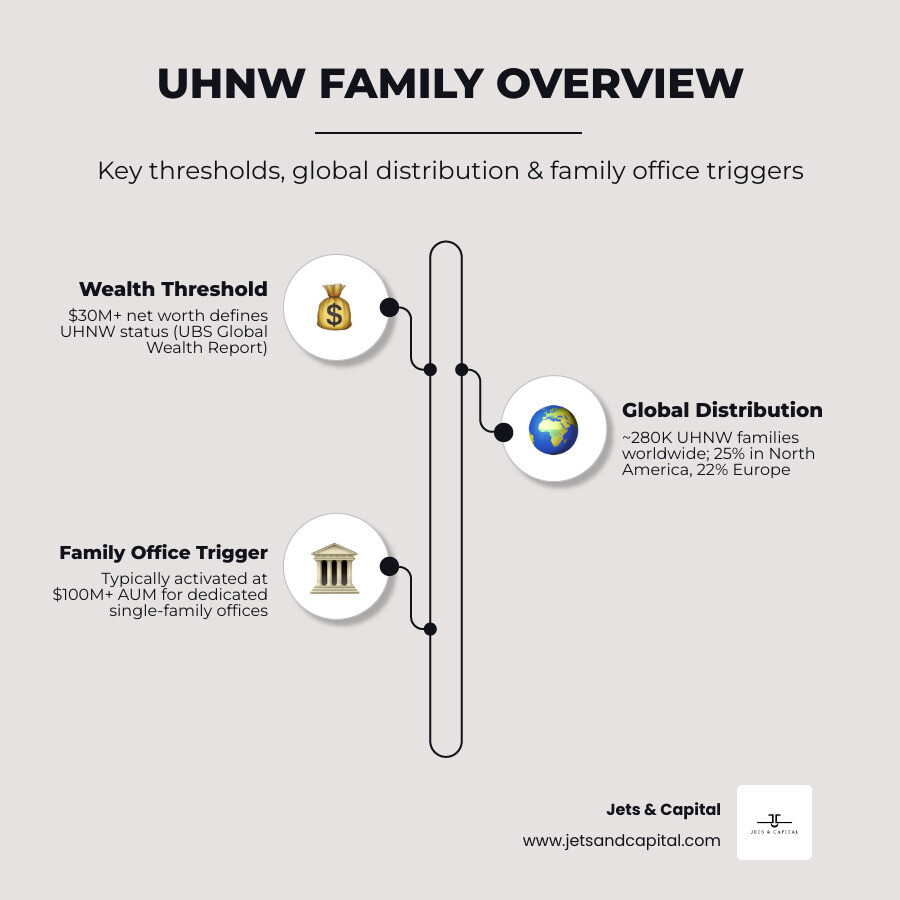
A uhnw family — short for Ultra-High Net Worth family — is generally defined as a household with $30 million or more in investable assets. Here's a quick breakdown of the key thresholds:
| Wealth Tier | Investable Assets |
|---|---|
| High Net Worth (HNW) | $1M - $5M |
| Very High Net Worth (VHNW) | $5M - $30M |
| Ultra-High Net Worth (UHNW) | $30M - $100M |
| Centimillionaire | $100M |
| Billionaire | $1B |
Dedicated family office structures typically become relevant once assets exceed $100–250 million.
As of 2024, roughly 626,619 people globally qualify as UHNW individuals — that's just 0.0077% of the world's population, or fewer than 8 in every 100,000 people. In the US alone, approximately 129,665 households held more than $30 million in net worth as of 2022, representing a combined $15 trillion in wealth.
These families don't just have more money. They face an entirely different set of challenges — from complex multi-jurisdictional assets and governance structures, to the very human difficulty of talking openly about wealth across generations. Research shows that fewer than half of UHNW baby boomers have shared relevant financial information with their beneficiaries, and 23% of UHNW parents aren't discussing later-in-life planning with their children at all.
Managing wealth at this scale requires more than a good financial advisor. It requires a system.
I'm Jordan Hutchinson, an entrepreneur and investor with deep roots in the family office world — including a key role in a family office that co-founded Bridge Investment Group, a publicly traded private equity firm — and I've spent years inside the networks where uhnw family capital is deployed, protected, and passed on. This guide draws on that experience to give you a clear, practical picture of how ultra-wealthy families are structured, how they operate, and what keeps them thriving across generations.
Defining the UHNW Family: Thresholds and Demographics
When we talk about a uhnw family, we aren't just talking about "rich" people. We are talking about a demographic that controls a staggering percentage of global capital. While the baseline for entry is often cited as $30 million in net worth, the industry differentiates between total net worth and "investable assets"—the liquid capital available for deployment into markets, private equity, or real estate.

The landscape is shifting rapidly. According to 2024 Knight Frank data, the number of UHNWIs grew significantly this year, yet they remain a tiny fraction of the global population. In the United States—specifically in hubs like New York, Miami, and Palm Beach—the concentration of these families is at an all-time high. As of year-end 2022, nearly 130,000 U.S. households held over $30 million, but the real "movers and shakers" are the centimillionaires—those with $100 million or more. At this level, the needs of the family shift from simple investment growth to complex legacy preservation.
Understanding UHNW demographics and needs is essential because these families often operate like small corporations. They require UHNW Private Banking services that go far beyond what a local branch can offer, involving cross-border tax strategies and bespoke credit facilities.
The Architecture of Wealth: Family Office Models
To manage this level of complexity, a uhnw family usually graduates from traditional wealth management to a family office model. Think of a family office as a private company that manages the investments and trusts of a single wealthy family.
There are three primary models we see in the industry:
- Single-Family Office (SFO): This is the "gold standard" for families with $100M–$250M or more. It is a dedicated entity that works only for one family. It offers total control, absolute privacy, and a staff that knows every detail of the principal’s life.
- Multi-Family Office (MFO): For families in the $30M–$100M range, an MFO provides the same sophisticated services as an SFO but shares the overhead costs across several unrelated families. This allows for institutional-grade management without the $2M+ annual price tag of running a private office.
- Hybrid/Virtual Models: A newer trend where a family keeps a small core team (like a CFO and an assistant) and outsources everything else—from Family Office Deal Flow to legal compliance—to external experts.
These structures are vital for accessing Family Office Events and exclusive investment circles where the best deals are found.
Choosing the Right Model for a UHNW Family
The decision usually comes down to a cost-benefit analysis. Is the family’s life complex enough to justify a dedicated team? If you own properties in Las Vegas, a ranch in Dallas, and a penthouse in New York, the logistical "noise" alone might require an SFO.
We often look to UHNW Institute frameworks to help families assess their needs. These frameworks, like the "Ten Domains of Family Wealth," remind us that it’s not just about the money; it’s about social capital, family history, and leadership. For families looking to expand globally, attending events like the APAC Family Office Investment Summit can provide clarity on how different regions handle these structures.
How the UHNW Family Office Differs from Private Banking
A private bank is a service provider; a family office is an advocate. While a private bank might offer excellent products, they are often limited to their own "menu." A family office has a fiduciary alignment—their only goal is the family’s best interest.
They provide "non-investment" services that banks rarely touch, such as family governance, philanthropy strategy, and even conflict resolution. As we see in Investor insights for the next generation, the "Next Gen" wants a more holistic, values-aligned approach to wealth than their parents did. They want to know why they own what they own.
Navigating Complexity: Governance and Generational Transitions
The greatest threat to a uhnw family isn't a market crash—it's a family feud. "Shirtsleeves to shirtsleeves in three generations" is a cliché for a reason. Succession planning is the most avoided topic in the living rooms of the ultra-wealthy.
Many parents experience "thoughtful hesitancy." They worry that revealing the full extent of the wealth will disincentivize their children or make them targets. However, research shows that 23% of UHNW parents aren't talking to their kids about any later-in-life topics. This silence creates a vacuum of preparation.
To fix this, we recommend Strategies for generational wealth conversations. It’s about moving from a "Yes, but..." mindset (Yes, I want to tell them, but I’m afraid) to a "Yes, and..." mindset (Yes, I will tell them, and I will provide the education they need to handle it). UHNW Networking with other families who have successfully navigated these transitions is often the best way to learn.
Beyond the Balance Sheet: Services and Lifestyle Management
Managing a uhnw family means managing a lifestyle that never stops moving. It’s not just about stocks and bonds; it’s about the 44% of family offices that intend to increase their real estate allocations in 2025, or the complex insurance needed for a private jet fleet.
At this scale, the family office provides:
- Investment Management: Access to Family Office Investment Summit opportunities and direct private equity deals.
- Tax Optimization: Navigating the complex tax codes of states like California versus Florida.
- Risk Management: Protecting assets from litigation and ensuring physical security for family members.
Lifestyle and Household Oversight for the UHNW Family
For a family with multiple residences in places like Montecito or Palm Beach, the household staff can rival a mid-sized hotel. We see families employing security directors, estate managers, and even specialized roles. According to Superyacht recruitment insights, a single yacht owner might have a "boat team" of over 400 people when including shore-side support.
Managing these teams requires a Chief of Staff who can handle everything from art collection curation to the logistics of private aviation. It is about removing the friction from the principal's life so they can focus on their legacy.
Philanthropy and Legacy in the UHNW Family
Legacy is the "soul" of the uhnw family. Strategic giving has moved beyond just writing checks; it’s now about "impact investing"—investing in companies that do good while providing a return.
Families often use the UHNW Institute resource library to find frameworks for mission statements. By involving the younger generation in the family foundation early, parents can teach financial literacy and family values through the lens of giving back.
Professional Excellence: Working Within an Ultra-Wealthy Household
Working for a billionaire or a uhnw family is a career path unlike any other. It requires a "T-shaped" professional—someone with deep expertise in one area (like finance or estate management) but a broad ability to handle anything that comes their way.
The roles are demanding. A Chief of Staff or a Private PA might be on call 24/7. As noted in Working for a billionaire, the most valued trait is discretion. You are privy to the most intimate details of a family’s life, and trust is the only currency that matters.
For those looking to enter this world, our Private household career guide suggests using the STAR method (Situation, Task, Action, Result) in interviews to demonstrate resourcefulness. Be prepared for rigorous background checks and a long interview process that often includes meeting the spouse or even the children to ensure a "cultural fit."
Frequently Asked Questions about UHNW Families
What is the typical net worth of a UHNW family?
A uhnw family typically has a net worth starting at $30 million. However, in major financial hubs like San Francisco or New York, the "working" definition often shifts toward $50 million or $100 million to account for the higher cost of lifestyle and asset management.
When should a family consider establishing a dedicated family office?
The "tipping point" is usually when the complexity of managing the wealth becomes a full-time job for the family members or when investable assets exceed $100 million. At this level, the cost of an SFO (usually 1-2% of AUM) becomes more efficient than paying various external advisors separately.
Why do UHNW parents hesitate to discuss wealth with their children?
It’s often a mix of fear and "thoughtful hesitancy." Parents worry about "affluenza"—the idea that too much money will kill their children’s drive. Advisors can facilitate these talks by breaking them into smaller, manageable pieces rather than one big "reveal" of the balance sheet.
Conclusion
Managing a uhnw family is a marathon, not a sprint. It requires a delicate balance of institutional-grade financial rigor and deeply personal family governance. Whether you are a family member looking to protect your legacy or a professional looking to serve this elite group, success comes down to one thing: relationships.
At Jets & Capital, we understand that the best deals and the strongest bonds aren't made in boardrooms—they are made in environments where trust is high and the "noise" is low. Our exclusive, invite-only networking events in private jet hangars are designed for exactly this. We maintain a strict vetting process to ensure that 85% of our attendees are Allocators, creating a high-quality space for relationship building and deal-making.
Wealth is a tool. With the right structure, the right team, and the right network, it can be a tool that builds a legacy for centuries to come.
