
Cracking the Code on High Net Worth Investor Relations
Understanding the Profiles of High Net Worth Investors

High net worth investors are individuals who hold at least $1 million in liquid financial assets, and they represent one of the most influential forces in global finance today.
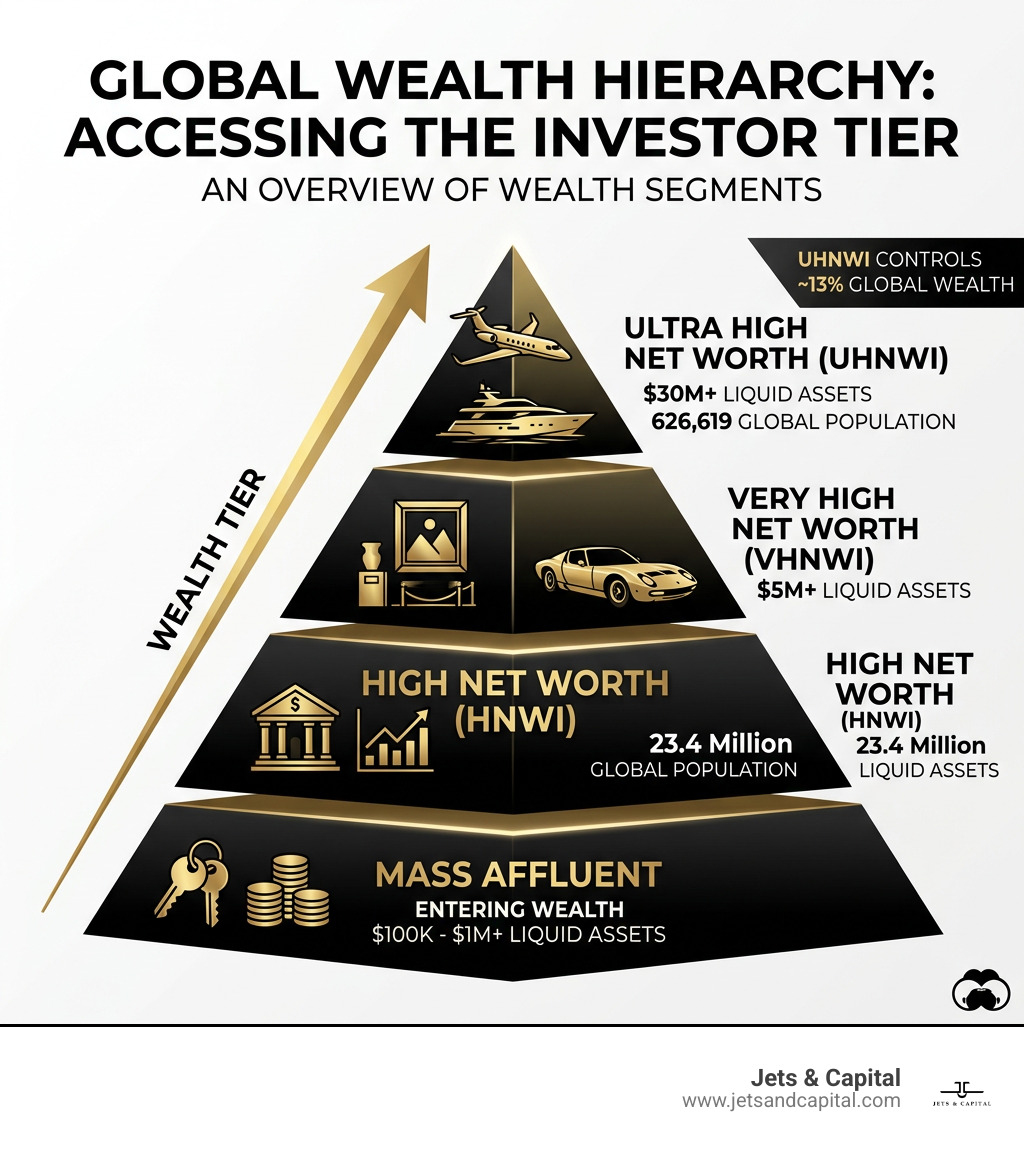
Here's a quick breakdown of the key wealth tiers:
| Tier | Common Label | Minimum Liquid Assets |
|---|---|---|
| High Net Worth | HNWI | $1 million+ |
| Very High Net Worth | VHNWI | $5 million+ |
| Ultra High Net Worth | UHNWI | $30 million+ |
As of 2024, there are approximately 23.4 million HNWIs worldwide, holding a combined $90.475 trillion in wealth. At the top of the pyramid, just 626,619 individuals qualify as ultra-high-net-worth — yet this tiny group represents only 0.003% of the world's population while controlling roughly 13% of all global wealth.
Understanding who these investors are, how they built their wealth, and what drives their decisions isn't just academic. It's the difference between building real relationships in this space and spinning your wheels.
This guide breaks down everything you need to know — from wealth profiles and investment preferences to the strategies that actually work when engaging this audience.
I'm Jordan Hutchinson, founder of Jets & Capital and a longtime member of the family office world, with hands-on experience raising capital and facilitating deals among high net worth investors at the highest levels. In the sections ahead, I'll share what I've learned about how this world really works.

When we talk about high net worth investors, we aren't just talking about people with a "nice" bank account. We are talking about a specific demographic that financial institutions and regulatory bodies define with precision.
According to the World Wealth Report 2025, the standard industry benchmark for an HNWI is someone with $1 million or more in liquid assets. This distinction is vital. You might own a $2 million home in San Francisco, but if your bank account and brokerage portfolios are empty, you aren't an HNWI in the eyes of a private bank. Liquid assets include cash, stocks, bonds, and ETFs—things we can move quickly.
However, the SEC (Securities and Exchange Commission) often plays by slightly different rules. Under SEC Form ADV, an advisor might consider a client "high net worth" if they have $750,000 in assets under management or a total net worth of $1.5 million.
The "Accredited" Advantage
Most high net worth investors also fall into the category of Accredited Investors. To qualify in the US, you generally need a net worth of over $1 million (excluding your primary home) or an annual income exceeding $200,000 ($300,000 for couples) for the last two years.
Why does this matter? It’s the "velvet rope" of the investing world. Accredited status grants access to private equity, venture capital, and hedge funds—opportunities that are legally off-limits to the general public.
Global Wealth Distribution and the UHNW Landscape
Wealth isn't spread evenly across the map. It clusters in specific "power hubs" where business, culture, and capital intersect. According to The Wealth Report 2025, the global UHNWI population reached 626,619 by 2025.
The United States remains the undisputed heavyweight champion of wealth concentration, home to 225,077 UHNWIs—roughly 35.9% of the world’s total. If we look at the cities where these individuals live and work, our company's key locations dominate the list:
- New York City: The global leader with 16,630 UHNWIs.
- Los Angeles: A massive hub for entertainment and tech wealth with 8,955 UHNWIs.
- San Francisco: The heart of the venture capital world.
- Miami and Palm Beach: Rapidly growing as the "Wall Street South," especially following high-profile relocations from firms like Citadel.
We’ve seen a fascinating "migration of millions" recently. While New York remains the capital, cities like Miami, Dallas, and Las Vegas have seen an explosion in high net worth investors looking for tax-friendly environments and a higher quality of life.
The Evolving Role of Women as High Net Worth Investors
One of the most significant shifts we are witnessing is the "feminization" of wealth. As of 2022, women made up only 11% of global UHNW investors. However, we are standing on the precipice of a historic change.
An estimated $54 trillion is projected to pass to widowed spouses over the coming years, and 95% of those recipients are women. Nearly $40 trillion of that will go to women in the Baby Boomer and older generations. This is a cohort that, in some cases, lived through eras where they couldn't even open their own bank accounts. Now, they are becoming the primary decision-makers for the world's largest family fortunes.
For us in the investor relations space, this means the "old boys' club" mentality isn't just outdated—it’s a business liability.
Primary Sources of Wealth for High Net Worth Investors
How did they get there? The data shows that the "self-made" narrative is more than just a myth.
- Self-Made: 67.7% of the UHNW population built their own fortunes.
- Inherited: Only 8.5% rely solely on inherited wealth.
- The Hybrid: 23.7% combined an inheritance with their own entrepreneurial success.
The source of wealth often dictates the median level of that wealth. Entrepreneurs sit at the top with a median wealth of $77.7 million. They are followed by inheritors ($52.4 million) and corporate executives ($40.9 million).
Knowing whether an investor is a "founder" or a "steward" of wealth changes how we approach them. Founders often have a higher risk tolerance and a desire for "hands-on" deals, while inheritors may focus more on preservation and philanthropy.
Investment Preferences: The Shift Toward Alternative Assets
If there is one thing that separates high net worth investors from the "mass affluent," it is their appetite for alternative investments.
While the average person might have a 401(k) full of mutual funds, UHNWIs allocate about 20% of their assets to alternatives. For HNWIs with $1 million+, that number rises to 28%. But the real experts in this space—Family Offices—allocate a staggering 42% to alternatives.
According to the Future of Alternatives 2025 report, total alternative assets under management are projected to hit $29.2 trillion by 2029.
What are they buying?
- Private Equity: This is the crown jewel. It has consistently outperformed the S&P 500 over 3-year and 5-year horizons.
- Real Estate: A classic staple. Despite rising interest rates, luxury real estate in markets like Miami and Palm Beach remained resilient in 2023.
- Luxury Goods (Passion Investments): 57% of UHNWIs now track the financial returns on their "passions." Rare whisky, for example, saw a 192% growth over ten years. Art, classic cars, and even dinosaur fossils (like the $44.6 million Stegosaurus recently purchased) are seen as both trophies and hedges against inflation.
- Digital Assets: While crypto interest dipped to about 2% of portfolios after the 2022 volatility, it remains a "wait and see" category for younger HNWIs.
Portfolio Diversification for High Net Worth Investors
We often see that the wealthier the individual, the less they care about short-term market "noise." Their goal is yield generation and risk management across generations.
The 2023 EY Global Wealth Management Research Report highlights that high net worth investors are increasingly looking for "illiquidity premiums." They are willing to lock their money up for 7–10 years in a private deal if it means a significantly higher return than the public markets.
This is why we see such a high allocation to private credit and venture capital. They don't need the money for next month's mortgage; they are building a legacy.
Best Practices for High Net Worth Investor Relations
Raising capital or building a network among high net worth investors requires a total departure from traditional marketing. You cannot "spam" your way into a family office.
At Jets & Capital, we’ve built our entire model on three pillars: Vetting, Environment, and Trust.
1. The Power of the Vetting Process
The biggest complaint we hear from UHNWIs is that they are constantly "hounded" by people who haven't done their homework. Our events maintain a strict 85% allocator ratio. This means when you are standing in a hangar in San Francisco or Palm Beach, you aren't surrounded by "service providers" trying to sell you something. You are surrounded by peers.
2. Personalized "Concierge" Service
HNWIs value time above all else. If a financial advisor or a deal sponsor can't explain a complex structure in three minutes, they’ve already lost the room. As the late Peter Lynch famously suggested, you should know exactly what you own and why you own it. We apply that same simplicity to networking.
3. Creating the Right Environment
Why do we host events in private jet hangars? Because it matches the lifestyle and mindset of our clients. Whether it's our upcoming Super Bowl Edition in San Francisco or an intimate gathering in Miami, the environment must signal that this is an exclusive, high-stakes space.
4. Transparency and "Skin in the Game"
Investors like Ken Griffin or Warren Buffett didn't get where they are by taking uncalculated risks. They value transparency. When we facilitate deal flow, we emphasize the importance of sponsors having their own capital committed. High net worth individuals want to see that you are sitting on the same side of the table as them.
Frequently Asked Questions about High Net Worth Investors
What is the difference between HNWI and UHNWI?
The primary difference is the scale of liquid assets. An HNWI has $1 million or more. An Ultra-High-Net-Worth Individual (UHNWI) has $30 million or more. While HNWIs might focus on retirement and growth, UHNWIs are often focused on complex estate planning, private foundations, and intergenerational wealth transfer.
Where do most ultra-high-net-worth individuals live?
In the US, the highest concentrations are in New York City, Los Angeles, and San Francisco. However, we are seeing a massive surge in "secondary" hubs like Miami, Dallas, and Palm Beach due to favorable tax laws and the relocation of major hedge funds.
Why are alternative investments popular among wealthy investors?
Alternatives like private equity and real estate offer three things traditional stocks don't: lower volatility, higher potential returns (the illiquidity premium), and a hedge against inflation. For someone with $50 million, a 2% "alpha" (outperformance) on their portfolio is worth an extra $1 million a year—that's a lot of motivation to seek out private deals.
Conclusion
The world of high net worth investors is growing faster and becoming more complex than ever before. With total alternative assets projected to reach $29.2 trillion by 2029, the opportunity for those who can "crack the code" on these relations is immense.
We are seeing a shift toward self-made wealth, a historic transfer of capital to women, and a relentless move toward private, off-market deals.
At Jets & Capital, we don't just watch these trends—we live them. Our mission is to provide the high-quality environment where these 23.4 million individuals can connect, share deal flow, and build lasting partnerships.
If you’re ready to step into this world, join us at our next exclusive event, including the highly anticipated Super Bowl Edition in San Francisco, CA. It’s time to move beyond the spreadsheets and into the hangar.
