
Private Investment Groups: A Guide to the Big Players
What Are Private Investment Groups? A Quick Answer for Serious Investors

Private investment groups are firms that pool capital from institutional and high-net-worth investors to deploy into assets outside public markets — think private equity, real estate, infrastructure, and private credit.
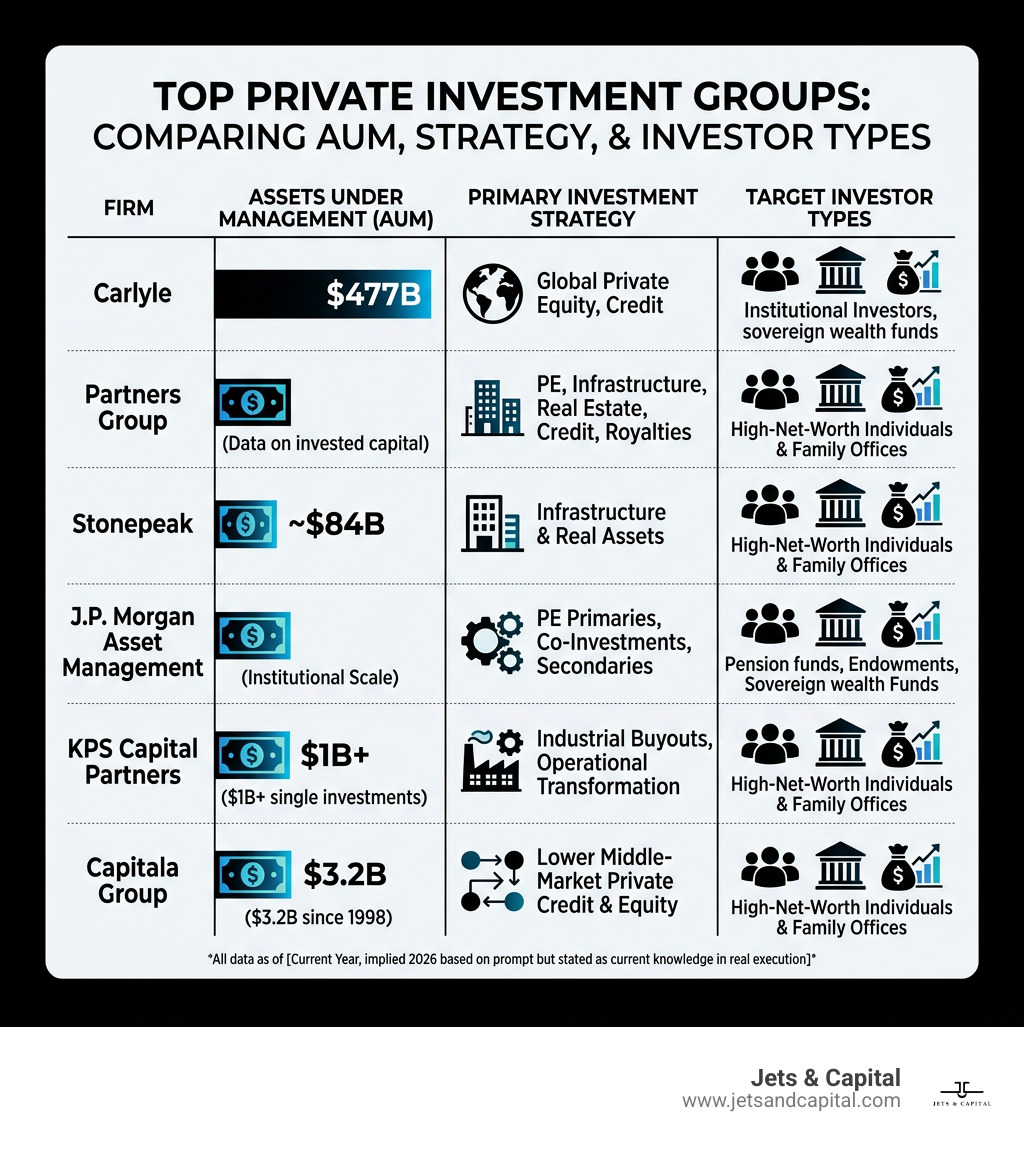
Here's a quick overview of the biggest players covered in this guide:
| Firm | AUM | Primary Focus |
|---|---|---|
| Carlyle | $477B | Global private equity, credit |
| Partners Group | $261B invested since 1996 | PE, infrastructure, real estate, credit, royalties |
| Stonepeak | ~$84B | Infrastructure and real assets |
| J.P. Morgan Asset Management | Institutional scale | PE primaries, co-investments, secondaries |
| KPS Capital Partners | $1B+ single investments | Industrial buyouts and operational transformation |
| Capitala Group | $3.2B since 1998 | Lower middle-market private credit and equity |
These groups differ from traditional investment firms in one key way: they take an active role in building and transforming the businesses they invest in, rather than simply buying and holding securities.
Private investment groups range from global giants managing hundreds of billions to specialized middle-market firms focused on specific sectors or deal sizes. The right group depends on your goals, risk tolerance, and the type of exposure you're looking for.
I'm Jordan Hutchinson, founder of Jets & Capital and a longtime participant in private investment groups through my involvement with a family office that co-founded Bridge Investment Group (NYSE: BRDG). That hands-on experience gives me a grounded perspective on how these firms actually operate and create value — which is exactly what this guide is built around.
Understanding Private Investment Groups vs. Traditional Firms
When we talk about private investment groups, we are looking at a world that operates quite differently from the "Wall Street" model most people are used to. While traditional investment firms often focus on liquid, public securities like stocks and bonds, private groups dive deep into the "Main Street" economy. They aren't just betting on ticker symbols; they are acting as business builders.
One of the most significant differentiators is the industrial mindset. Firms like Partners Group emphasize this approach, moving away from simple financial engineering and toward actual operational improvement. In this model, success isn't just about timing the market; it’s about rolling up sleeves to help a company grow its revenue, improve its supply chain, or expand into new territories.

These groups primarily serve two types of clients: institutional investors (like pension funds and endowments) and private wealth (including family offices and ultra-high-net-worth individuals). Because these investments are often "locked up" for several years, they require a different level of trust and relationship building than a standard brokerage account.
Core Strategies of Leading Private Investment Groups
To understand how these groups operate, we have to look at their "playbooks." Most leading firms utilize a mix of five core strategies:
- Private Equity: Buying a majority or significant minority stake in a company to improve its value over time.
- Real Estate: Investing in physical assets, often using a "thematic" approach to target high-growth sectors like logistics or residential living.
- Private Credit: Acting as the lender to companies that might not want to use traditional bank financing, often providing more flexible terms.
- Infrastructure: Investing in the "backbone" of society, such as power grids, water systems, and transportation.
- Royalties: A more specialized strategy where the group earns a percentage of revenue from intellectual property, such as music catalogs or pharmaceutical patents.
| Strategy | Primary Goal | Typical Asset |
|---|---|---|
| Private Equity | Capital Appreciation | Mid-market manufacturers, tech firms |
| Infrastructure | Stable, Long-term Yield | Solar farms, toll roads, data centers |
| Real Estate | Income & Appreciation | Warehouses, multi-family housing |
For those looking for a comprehensive look at how these markets function globally, A leading global private markets firm - Partners Group provides an excellent example of an integrated platform that covers all these bases.
Private investment groups in Infrastructure and Real Estate
In recent years, infrastructure has become a darling of the private investment world. It offers something rare: essential services with high barriers to entry and often inflation-protected returns.
Stonepeak is a standout here, managing approximately $84 billion in assets. They focus on the infrastructure that underpins our daily lives. Think about the data center that hosts your favorite app or the solar farm providing clean energy to a university. Stonepeak’s portfolio includes massive players like Lineage, the world’s largest temperature-controlled logistics company, and Cologix, a leader in North American data center connectivity.
In the real estate sector, thematic investing is the name of the game. Rather than just buying "any" office building, groups are managing platforms with upwards of $38 billion in AUM focused on specific trends, such as the energy transition or the rise of e-commerce. You can explore more about these mission-critical assets at We invest in the infrastructure that underpins our daily lives.
Specialized Private investment groups and Middle-Market Leaders
While the "mega-firms" get the headlines, specialized groups often drive incredible value in the lower middle-market. These are companies that are too big for a local bank but perhaps too small for a global giant.
- KPS Capital Partners: Known for its manufacturing focus, KPS is one of the few firms with the operational expertise to execute billion-dollar turnarounds in the industrial sector. They don't rely on heavy debt; they rely on making the factory run better.
- Capitala Group: Since 1998, they have managed over $3.2 billion, providing creative financing solutions to North American businesses. Their flexibility allows them to offer both equity and credit, depending on what the business needs to reach the next level.
For those interested in how these mid-market deals come together, Middle-Market Private Equity | Charlesbank Capital Partners is another key name to watch in the space.
Key Players and Assets Under Management (AUM)
When evaluating private investment groups, scale matters—not just for bragging rights, but for the "deal flow" and resources a firm can bring to the table.
Carlyle sits at the top of the mountain with $477 billion in AUM. With 27 offices worldwide and nearly four decades of experience, they use a "world of connections" to find opportunities that others might miss. They recently highlighted their investment in Medline, a healthcare giant, as a prime example of how they use sector expertise to scale a business.
Partners Group has a similarly impressive track record, having invested over $261 billion since its founding in 1996. They recently made waves with the sale of atNorth, a data center platform, for an enterprise value of $4 billion, showcasing their ability to build and exit high-value technology infrastructure.
For investors in our key hubs like San Francisco, Miami, or Dallas, seeing the actual results of these strategies is vital. You can view examples of how capital is deployed effectively by checking out our Portfolio page, which highlights the types of high-quality deals we track.
Value Creation, Sustainability, and Market Outlook 2026
The "secret sauce" of private investment groups is how they create value after the check is signed. It isn't magic; it’s a combination of operational levers and strategic growth.
The Buy-and-Build Strategy
Many groups use a "buy-and-build" approach. They start with a "platform" company and then acquire smaller competitors to create a market leader. This consolidation creates efficiencies and allows the company to serve larger customers.
Sustainability and Impact
Sustainability is no longer a "nice-to-have" feature; it is a core value driver. Whether it's Stonepeak investing in solar energy via Madison Energy Investments or Partners Group focusing on the energy transition, these firms are proving that doing good can also mean doing well. They look for "macro tailwinds"—long-term trends like decarbonization that ensure their investments remain relevant for decades.
Market Outlook: 2026 and Beyond
Looking toward 2026, several trends are emerging:
- AI Integration: Firms like Carlyle are looking at "bubbles" in AI not as a threat, but as a feature of technological revolutions that create long-term winners.
- The Security Premium: Due to global conflicts, there is an increasing premium on energy and commodity security, driving investment into domestic infrastructure.
- Secondary Markets: As investors look for liquidity, the secondary market (buying existing stakes in private funds) is seeing double-digit growth.
To stay ahead of these trends and see how they impact your own capital allocation, keeping an eye on Family Office Deal Flow is essential for any serious investor.
Frequently Asked Questions about Private Investment Groups
How do private investment groups differ from traditional investment firms?
Traditional firms (like mutual funds) usually buy small pieces of many public companies. Private investment groups buy large pieces of private companies and take an active role in management. They focus on long-term "Main Street" value rather than daily "Wall Street" stock fluctuations.
What are the most common investment strategies used by these groups?
The "Big Five" are private equity (buying companies), infrastructure (roads, power, data), private credit (lending), real estate (buildings and land), and royalties (income from IP).
How do these firms create value for their portfolio companies?
They use "operational levers." This might mean upgrading the company’s technology, helping them expand into Europe or Asia, or merging them with another company to save on costs. It’s about building a better business, not just a more expensive one.
Conclusion
The world of private investment groups is complex, but the core mission is simple: find great businesses and infrastructure, and make them better. Whether it’s Carlyle’s global network, Stonepeak’s focus on the "backbone" of our daily lives, or the operational grit of KPS, these firms are the engines of the private markets.
At Jets & Capital, we believe that the best deals aren't found on a computer screen; they are found through relationships. We host exclusive, invite-only networking events in private jet hangars—from Palm Beach to San Francisco—to bring together the world's top allocators and investors.
With a strict vetting process that ensures 85% of our attendees are allocators, we provide the high-quality environment needed for real relationship building and deal-making. If you are looking to connect with the people behind these massive investment moves, we invite you to join us at our next event.
Secure your spot at our upcoming Super Bowl Edition in San Francisco or explore our other locations at https://www.jetsandcapital.com/tickets.
