
Understanding Fund of Funds: Your Gateway to Diversified Investment Access
A Fund of Funds (FOF) is an investment vehicle that pools capital to invest in a portfolio of other funds—rather than buying individual stocks, bonds, or securities directly. Think of it as a "fund that buys funds."
Quick Answer: What is a Fund of Funds?
- Structure: A pooled investment that holds shares in multiple underlying funds (hedge funds, private equity, mutual funds, etc.)
- Purpose: Provides instant diversification across managers, strategies, and asset classes
- Key Benefit: Access to top-tier funds with lower minimums than direct investment
- Main Drawback: Layered fees—you pay both the FOF manager and the underlying fund managers
- Typical Scale: The average FOF invests in approximately 20 funds, giving exposure to roughly 400 companies
For high-net-worth individuals and family offices, FOFs offer a practical path to sophisticated portfolio construction. Instead of vetting dozens of individual fund managers and meeting steep minimum requirements (often $5-25 million per fund), you gain professional diversification through a single investment vehicle. The FOF manager handles due diligence, portfolio allocation, and rebalancing—though this convenience comes at a cost through additional management fees.
The concept isn't new. Bernie Cornfeld created the first Fund of Funds in 1962, and the strategy has evolved significantly since then. In 2006, private equity FOFs represented 14% of all committed capital in the private equity market, demonstrating their staying power despite criticism around fee structures.
Why does this matter for serious allocators? Because constructing a truly diversified private markets portfolio independently requires significant capital—replicating a top-tier FOF's diversification across 20-30 funds would demand over $1 billion in commitments. FOFs also aggregate capital calls, reducing hundreds of potential underlying fund requests into fewer than 10 manageable calls over a typical three-year investment period.
However, the FOF landscape changed dramatically after the Bernie Madoff scandal exposed serious due diligence failures. Today's regulatory environment is stricter, with SEC Rule 12d1-4 (updated in 2020) governing fund-of-funds arrangements and requiring transparency through Acquired Fund Fees and Expenses (AFFE) disclosures.
I'm Jordan Hutchinson, and through my work with a family office that helped found Bridge Investment Group and my role organizing Jets & Capital events for high-net-worth allocators, I've seen how sophisticated investors use Fund of Funds strategies to build diversified private market exposure while maintaining operational simplicity. Understanding the FOF structure—both its advantages and its costs—is essential for anyone deploying significant capital across alternative investments.
What is a Fund of Funds (FOF) and How Does it Work?
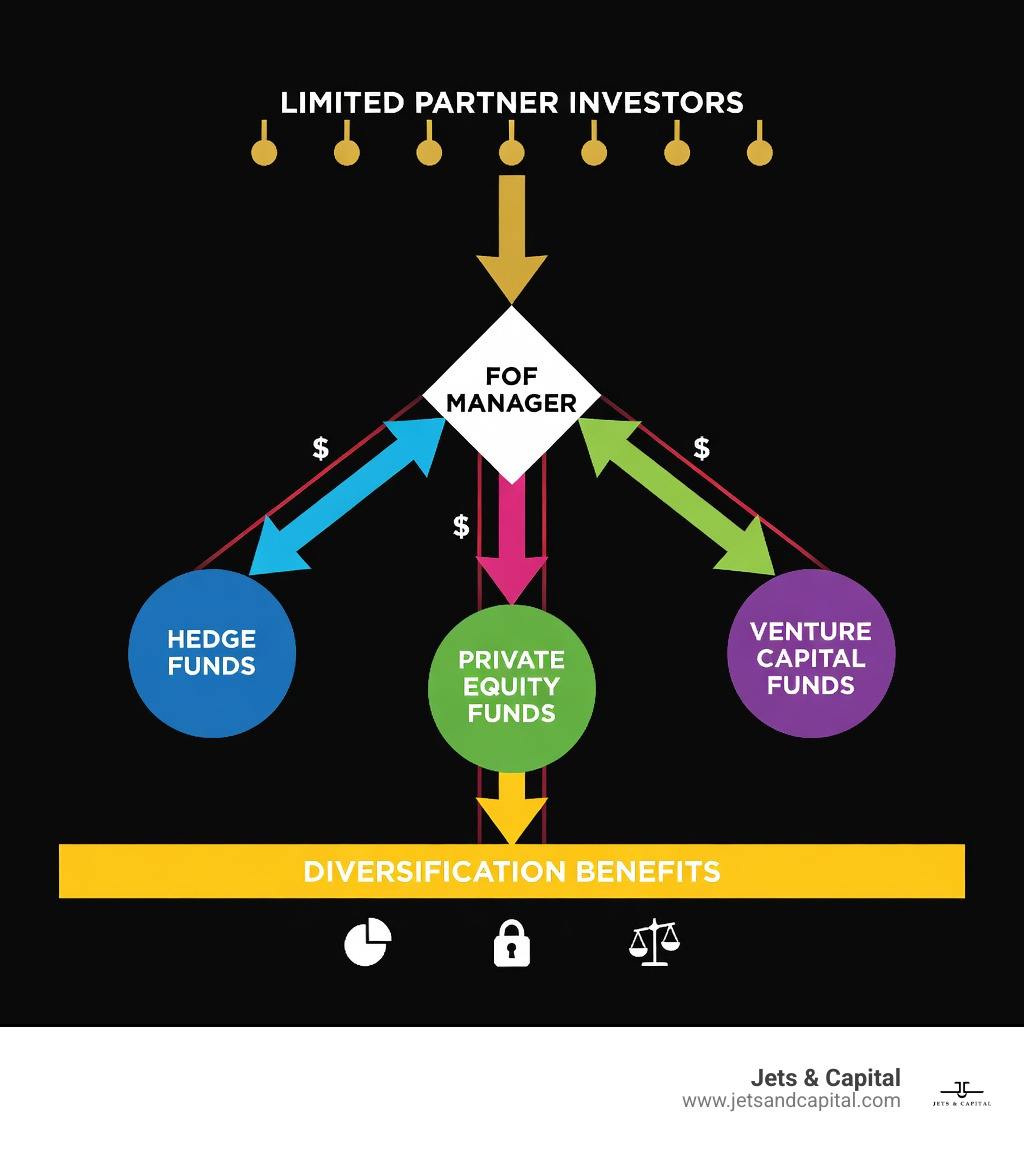
At its core, a Fund of funds operates as a "multi-manager" investment strategy. While a traditional mutual fund might buy 50 different stocks, a FOF buys 20 different funds, each of which might own 20 to 80 underlying companies. We often describe this as "strategic asset allocation" because the FOF manager isn't just picking winners; they are building a macro-level portfolio designed to weather various market conditions.
The Fund of Funds (FOF) Definition highlights that this is a pooled investment vehicle. The "Master Fund" (the FOF) collects capital from Limited Partners (LPs). The FOF manager, acting as a General Partner (GP), then conducts exhaustive due diligence to select the best "Sub-Funds."
This process of manager selection is where the FOF earns its keep. For an individual allocator in San Francisco or New York, the barrier to entry for a top-tier venture capital fund might be a $10 million minimum and a pre-existing relationship. A FOF manager, however, leverages their institutional scale and long-standing industry ties to gain access to these capacity-constrained managers.
Historically, the industry traces its roots back to Bernie Cornfeld and his "Investors Overseas Service" in the early 1960s. While Cornfeld's empire eventually collapsed, the structural genius of the FOF model survived and flourished, particularly in the private equity and hedge fund sectors where manager dispersion—the difference between the best and worst performers—is massive.
Fettered vs. Unfettered Fund of Funds
When we look at how these funds are structured, we generally categorize them into two buckets:
- Fettered Fund of Funds: These funds invest only in other funds managed by the same investment house. For example, a large asset manager in Dallas might create a "Conservative Growth FOF" that only holds other mutual funds from their own brand. This often results in lower administrative costs but limits the manager's ability to pick the "best of breed" across the entire market.
- Unfettered Fund of Funds: These have the flexibility to invest in any fund from any manager globally. This "manager of managers" approach is what most private equity and hedge fund allocators prefer. It removes the conflict of interest inherent in fettered funds and allows the FOF manager to pivot to wherever the highest quality deal-making is happening.
The Operational Mechanics of a Fund of Funds
Operationally, a Fund of funds simplifies the life of an investor. Consider the logistical nightmare of a family office in Palm Beach trying to manage 30 different private equity investments. Each fund has its own capital call schedule, tax reporting (K-1s), and performance metrics.
The FOF manager provides capital call aggregation. Instead of dealing with 500+ individual capital calls over a three-year period, the FOF investor might only see 8 to 10. The FOF manager also handles:
- Portfolio Weighting: Ensuring the portfolio isn't over-exposed to a single sector (like tech) or geography (like Silicon Valley).
- Rebalancing: Moving capital from over-performing asset classes back into undervalued ones to maintain the target risk profile.
- Regulatory Compliance: Adhering to the SEC Final Rule: Fund of Funds Investments, which sets the framework for how these funds can own shares in one another without creating "pyramids" of excessive fees and complexity.
Primary Types of Fund of Funds Strategies
Not all FOFs are created equal. Depending on your goals—whether it’s retirement planning or aggressive growth—there is likely a FOF structure designed for that specific purpose.
- Mutual Fund FOFs: Common in retail investing, these pool various mutual funds to create a balanced portfolio.
- ETF-of-ETFs: A modern, lower-cost version of the FOF that uses exchange-traded funds to gain broad market exposure.
- Target-Date Funds: These are the ultimate "set it and forget it" FOFs. They automatically shift their allocation from aggressive (stocks) to conservative (bonds) as you approach a specific year, such as your planned retirement date.
- Infrastructure and Commodity Funds: These provide exposure to niche markets like toll roads, energy pipelines, or gold, which are often too complex for individual investors to manage directly.
Comparison Table: Alternative Asset FOFs
| Feature | Hedge Fund FOF | Private Equity FOF | Venture Capital FOF |
|---|---|---|---|
| Typical Goal | Volatility Reduction | Long-term Growth | High-Alpha / Innovation |
| Liquidity | Monthly/Quarterly | 10+ Year Lock-up | 10-15 Year Lock-up |
| Underlying Assets | Long/Short Equity, Macro | Buyouts, Growth Equity | Seed to Late-stage Startups |
| Diversification | High (Multi-strategy) | Very High (~400 companies) | High (30-80 companies/fund) |
The Role of a Private Equity Fund of Funds
In private equity, a Fund of funds strategy is a powerhouse for diversification. A typical buyout fund might invest in 8-20 companies. By investing in a FOF that holds 20 underlying PE funds, you gain exposure to roughly 400 companies. This massive diversification significantly lowers the risk of a "total loss" on your capital.
We also see FOFs using three distinct investment "sleeves":
- Primaries: Investing in a new fund being raised by a GP.
- Secondaries: Buying existing interests in funds from other investors, often at a discount.
- Co-investments: Investing directly into a specific company alongside a GP, often with lower or no fees.
Large managers like Partners Group (which managed $100 billion in 2020) have mastered this "diversified category" approach. Research shows that FOFs utilizing secondaries and co-investments returned more than 2.0x their capital 56% of the time, compared to only 45% for traditional direct funds.
Hedge Fund of Funds and Risk Mitigation
For institutional allocators in New York or Miami, Hedge Fund of Funds are often used for "absolute return" strategies. The goal here isn't necessarily to beat the S&P 500 every year, but to provide positive returns with very low volatility. By blending different strategies—such as Global Macro, Merger Arbitrage, and Distressed Debt—the FOF manager can smooth out the "performance dispersion" that often plagues individual hedge funds.
Advantages and Risks of the FOF Model
Every investment has its trade-offs. The Fund of funds model is built on a "convenience for cost" exchange.
The Advantages
- Professional Management: You are hiring an expert whose full-time job is to grill fund managers, analyze track records, and spot "style drift" (when a manager starts investing outside their expertise).
- Lower Minimums: Instead of needing $50 million to build a diversified PE portfolio, a FOF might let you in for $250,000 or $1 million.
- Access: FOFs can get you into "closed" funds that are oversubscribed and not taking new individual investors.
- Simplified Reporting: You receive one consolidated statement and one K-1 instead of dozens.
The Risks
- Selection Risk: If the FOF manager picks bad underlying funds, the diversification won't save you.
- Market Responsiveness: Because there are two layers of decision-making, FOFs can be slower to react to sudden market shifts.
- Opacity: It can be difficult to see exactly what is in the portfolio on a day-to-day basis. You might not realize that three of your underlying funds are all betting heavily on the same volatile tech stock.
Understanding the Fund of Funds Fee Structure
This is the most criticized aspect of the Fund of funds world. We call it "layered fees" or "double-dipping."
- The Underlying Fund Layer: Usually "2 and 20" (2% management fee, 20% carried interest/performance fee).
- The FOF Layer: On average, FOFs charge an additional 0.8% management fee and 5% carried interest.
If you use FINRA’s Fund Analyzer for comparing layered expenses, you can see how these costs compound. For example, a $10,000 investment in a FOF with a 1% fee on top of underlying 2% fees could result in nearly $300 in annual expenses. This is why FOFs report their performance on a "net-net" basis—meaning the returns you see are after both layers of fees have been deducted.
Performance During Economic Downturns
Where the Fund of funds truly shines is during a crisis. Because of their broad diversification, they offer significant "downside protection."
Consider the "dot-com bubble" of 2000 or the 2006 vintage funds just before the Great Financial Crisis. Historical analysis shows that the bottom 5th percentile of FOFs in the 2000 vintage had a net IRR of -1%. Compare that to -20% for venture capital and -3% for buyout funds. In 2006, the bottom 5th percentile for FOFs was actually positive at 2%, while venture capital was -18% and buyout was -10%.
In short: FOFs might not always give you the "home run" 10x return, but they are much less likely to leave you with a total loss.
Strategic Considerations for Modern Allocators
For the modern allocator—whether you're a family office in Salt Lake City or a high-net-worth individual in Dallas—the Fund of funds remains a vital tool for long-term strategy.
We believe that for most investors, the "DIY FOF" approach is incredibly risky. Unless you have a dedicated team of analysts to perform the same level of due diligence as an institutional FOF manager, you are likely to fall victim to "adverse selection"—investing in the funds that are easiest to get into, rather than the best ones.
At Jets & Capital, we see the value of these structures every day. Our Allocators are often looking for high-quality deal-making opportunities that have already been vetted by professionals. Whether you are attending our events in San Francisco or New York, the conversation often revolves around how to balance the need for high-alpha returns with the operational simplicity provided by a FOF.
If you’re interested in meeting the people who manage these billions of dollars, you might consider attending our Allocator Full Weekend NYC. It's a rare chance to step away from the spreadsheets and build the relationships that lead to better deal flow.
Regulation and Transparency Post-Madoff
The ghost of Bernie Madoff still haunts the FOF industry. Many FOFs were "feeder funds" for Madoff, and their failure to spot his fraud led to a massive overhaul in how we regulate these vehicles.
Today, SEC Rule 12d1-4 provides a much stricter framework. It requires:
- Enhanced Disclosures: FOFs must clearly list their fees under the "Acquired Fund Fees and Expenses" (AFFE) line item.
- Custodial Oversight: Stricter rules on where the assets are actually held to prevent managers from simply making up their performance numbers.
- Due Diligence Standards: Managers are now under much more pressure to prove they are actually "kicking the tires" of the underlying funds.
Frequently Asked Questions about FOFs
Can individual investors create their own Fund of Funds equivalent?
Technically, yes. You can buy 10 different mutual funds or ETFs yourself. However, for "Alternative Assets" like private equity or hedge funds, this is nearly impossible for individuals. You simply won't have the $100M+ capital required to meet the minimums of 20 different top-tier funds, nor will you have the access to get through the door of the most exclusive managers.
Are Funds of Funds regulated by the SEC?
Yes, they are heavily regulated. In the U.S., they must comply with the Investment Company Act of 1940 and the more recent Rule 12d1-4. These regulations are designed to prevent "fee layering" from becoming predatory and to ensure investors have a clear picture of the underlying risks.
How do FOFs compare to multi-strategy funds?
This is a common point of confusion. A Multi-strategy fund is a single fund managed by a single firm that uses many different internal strategies. A Fund of funds is a fund that invests in external funds managed by different firms. Multi-strategy funds often have lower fees because there is only one management layer, but they carry "single-manager risk"—if that one firm fails, the whole portfolio goes down.
Conclusion
The Fund of funds model isn't perfect, but for many allocators, it is the most efficient way to achieve institutional-grade diversification. By trading a layer of fees for professional due diligence, access to exclusive managers, and massive operational simplicity, you can build a portfolio that is designed for stability and long-term growth.
At Jets & Capital, our mission is to facilitate the high-quality deal-making and relationship-building that makes these investment strategies possible. We believe that the best investments aren't just found in a prospectus; they are found through a vetted network of peers. Whether you are looking for your next FOF allocation or looking to connect with other UHNWIs, we invite you to join us at our next hangar event.
Secure your spot at the next exclusive allocator event and join the 85% allocator community that is shaping the future of private market investing. From the Super Bowl Edition in San Francisco to our flagship weekends in New York and Palm Beach, we provide the venue where the world's most sophisticated investors demystify the market together.
