
The Secret Sauce of Successful Investment Deal Sourcing
Why Investment Deal Sourcing Determines Who Wins in Private Markets

Investment deal sourcing is the process of finding, qualifying, and securing investment opportunities before your competitors do. Here's a quick breakdown of what it involves:
- Deal sourcing - The overall process of identifying and pursuing investment opportunities
- Deal flow - The volume and rate of opportunities coming into your pipeline
- Deal origination - The specific act of initiating contact or uncovering a deal
- Inbound sourcing - Deals that come to you via referrals, reputation, or submissions
- Outbound sourcing - Proactively reaching out to targets that fit your investment thesis
The stakes are high. Top-tier venture capital firms review roughly 3,000 opportunities per year. Of those, only about 200 are considered fundable — and just 15 generate 95% of total returns. Meanwhile, 50% of investors say sourcing new deals is their single biggest priority, and 46% point to intensifying competition as the top threat to their deal flow.
The uncomfortable truth? Most capital is chasing the same visible deals. The investors who consistently win are the ones who have systems for finding opportunities others never see.
That gap between average and elite isn't talent — it's process.
I'm Jordan Hutchinson, a private equity insider and founder of Jets & Capital, with hands-on experience in investment deal sourcing through my work with a family office that co-founded Bridge Investment Group (NYSE: BRDG) and through running exclusive high-net-worth investor events where the most impactful deals get done. In the sections ahead, I'll walk you through the exact frameworks and channels that serious investors use to build a consistent, high-quality deal pipeline.
Mastering the Investment Deal Sourcing Process
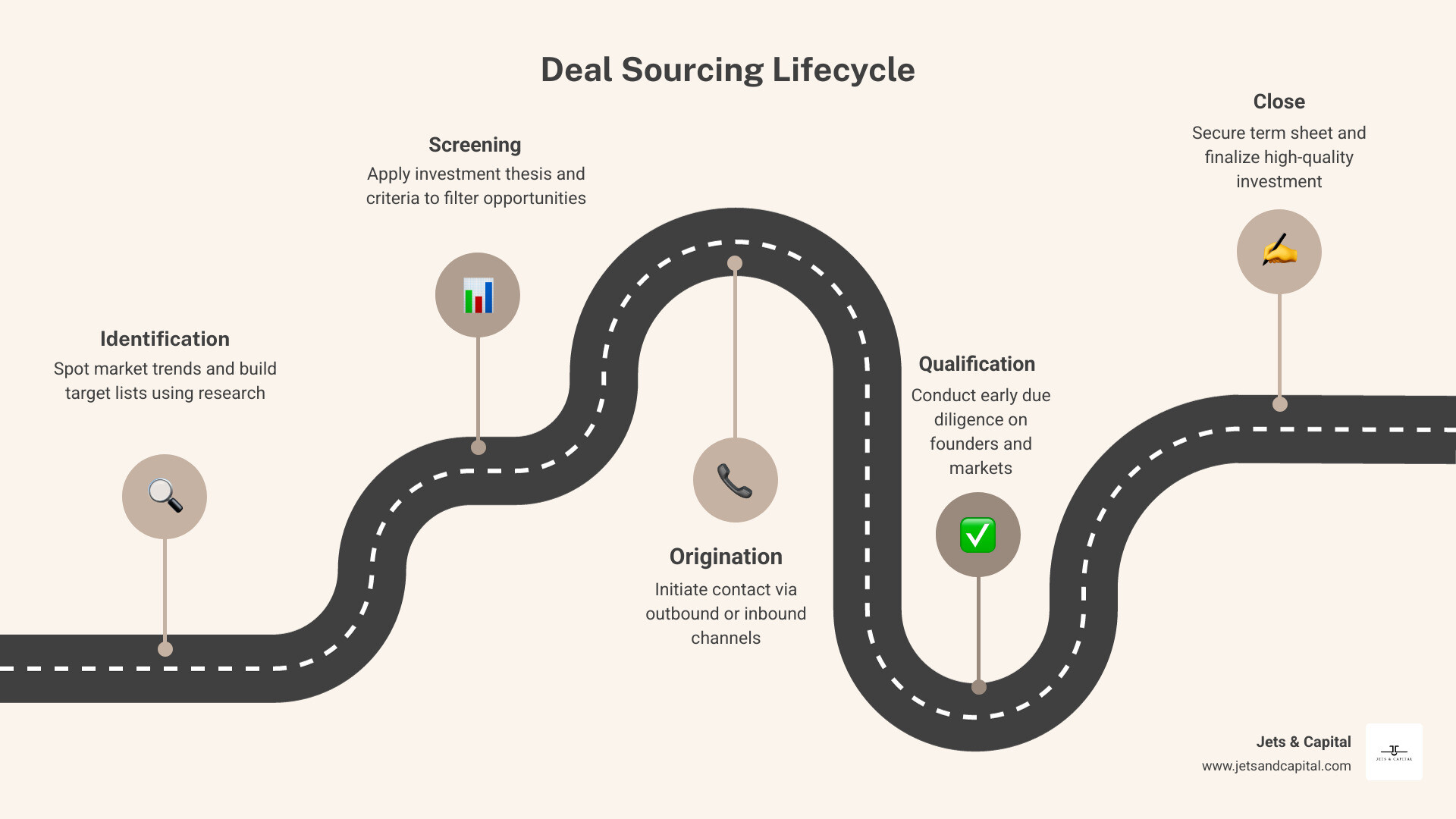
In the high-stakes world of private equity and venture capital, we often say that success is 90% sourcing and only 10% picking. If you aren't seeing the right deals, your ability to analyze them doesn't matter. To move from "lucky" to "legendary," we have to treat investment deal sourcing as a repeatable science rather than an art form.
The process begins with a strategic roadmap. We don't just wake up and hope a unicorn lands in our inbox. We build a funnel that starts with deep market research to identify trends—like the 40% surge in global M&A deal value we saw in 2025—and ends with a signed term sheet.
A critical part of this roadmap is the "Target List." In the past, these were static Excel sheets that gathered digital dust. Today, elite firms use dynamic lists that auto-update based on specific triggers, such as a company hiring a new CFO or a spike in web traffic. This allows us to Discover Investment Opportunities at the exact moment a company becomes "ripe" for capital.
Comparing Inbound vs. Outbound Sourcing Strategies
To build a robust pipeline, we must balance two distinct approaches. Think of inbound as "fishing with a net" and outbound as "spear-fishing."
| Feature | Inbound Sourcing | Outbound Sourcing |
|---|---|---|
| Source | Referrals, website submissions, brand reputation | Direct outreach, cold emails, data-driven targeting |
| Quality | Variable; often highly competitive (auctions) | High; usually proprietary and less competitive |
| Time Investment | Low (deals come to you) | High (requires research and relationship building) |
| Conversion Rate | Low (often <1% for cold submissions) | Higher (targets are pre-vetted for fit) |
| Control | Reactive | Proactive |
Defining a Precise Investment Thesis
If we try to invest in "everything good," we usually end up with nothing. A precise investment thesis is the North Star of investment deal sourcing. It shouldn't just be a sector; it should be a specific point of view. For an Early Stage Investor, this might mean focusing on B2B SaaS companies in the New York or San Francisco hubs that have hit $1M in ARR without taking institutional capital.
Your thesis should account for:
- Core Strengths: Where do we have an unfair advantage or deep industry knowledge?
- Market Trends: Are we riding a tailwind, like the current $3.8 trillion backlog of unsold private equity companies?
- Risk Parameters: What is our tolerance for pre-revenue vs. EBITDA-positive companies?
- Valuation Caps: At what point do we walk away from a "great" company because the price is wrong?
Integrating Early Due Diligence
One of the biggest mistakes we see is waiting until a deal is "hot" to start due diligence. By then, it’s often too late. We integrate early due diligence directly into our sourcing phase.
Before a founder even knows we’re looking at them, we evaluate:
- Founder Credibility: Do they have a track record of "doing what they say they’ll do"?
- Market Viability: Is the Total Addressable Market (TAM) actually large enough to support a venture-scale return?
- Competitive Positioning: Does the product solve a "hair on fire" problem, or is it just a "nice to have"?
- Financial Health: Even in early stages, we look for "intent-to-sell" signals or revenue growth patterns that suggest a sustainable business model.
By filtering the pipeline early, we ensure that our partners only spend time on deals that have a legitimate chance of closing.
Traditional vs. Modern Sourcing Methods
The "Old Boys Club" isn't dead, but it has definitely moved into the cloud. Historically, investment deal sourcing relied entirely on who you knew. You’d grab a steak in Dallas or a drink in Miami, and someone would mention a "friend with a business." While those warm introductions still account for 70% of VC deals, the modern investor uses technology to scale that network.
The shift to modern methods is driven by competition. With over half of private capital firms now using more than four different data sources just for sourcing, relying on your Rolodex alone is a recipe for falling behind. We also have to navigate new regulatory landscapes, such as the Asset managers and the impact of California adopted sourcing rule, which affects how firms in places like San Francisco and Los Angeles manage their operations.
The Shift to Data-Driven Origination
Modern origination is criteria-based. Instead of waiting for a broker to call us, we use platforms like Sourcescrub the Deal Sourcing Platform for AI Driven Investment Research & Deal Origination to map entire markets.
Data-driven sourcing allows us to:
- Map the Market: Identify every company in a specific niche (e.g., "AI-driven logistics in Salt Lake City").
- Enrich Data: Automatically pull in hiring data, revenue estimates, and tech stack information.
- Get Real-Time Updates: Be the first to know when a company hits a growth milestone or wins a major award.
This "sources-first" approach ensures we are "first in line" for deals, often months before they officially go to market.
The Power of Proprietary Deal Flow
Proprietary deal flow is the "Holy Grail" of investing. These are deals where you are the only one at the table. Why does this matter?
- Auction Avoidance: You aren't bidding against 20 other firms, which keeps valuations sane.
- Better Terms: When you have a direct relationship with a founder, you can structure deals that work for both parties.
- Relationship Longevity: Proprietary deals are built on trust, often over 12-24 months of "keeping in touch" before a transaction occurs.
Avoiding the "Winner’s Curse"—where the person who wins the auction is the one who overpaid—is only possible if you have a system for direct outreach.

High-Yield Channels for Proprietary Deal Flow
To find the deals that others miss, we have to look where others aren't looking. While everyone is scrolling through the same LinkedIn feeds, elite sourcers are digging into university R&D departments and tech transfer offices.
For example, did you know that over 80% of Fortune 100 companies now conduct hackathons? These events are goldmines for discovering raw talent and emerging technologies before they ever become "startups." We also keep a close eye on platforms like Product Hunt to spot breakout successes in their infancy.
Expanding Your Investment Deal Sourcing via Alternative Channels
Beyond the standard databases, we leverage several high-yield alternative channels:
- Universities & R&D: Partnering with academic institutions in tech hubs like San Francisco or Salt Lake City to find "lab-to-market" opportunities.
- Accelerators & Incubators: Engaging with founders while they are still in the "forming" stage.
- Niche Verticals: Looking into bootstrapped, non-sponsored companies that have never taken outside capital.
- Hackathons & Demo Days: Attending events to see products being built in real-time.
By diversifying our Family Office Deal Flow, we ensure that our pipeline stays full even when the broader market slows down. Using a specialized Private Equity Deal Sourcing Platform can help automate the "scouring" of these thousands of diverse data sources.
Building Relationships for Long-Term Investment Deal Sourcing
At the end of the day, people invest in people. Even with the best AI tools, investment deal sourcing is still a relationship business. We focus on "Value Exchange"—offering founders mentorship, introductions, or market insights long before we ever ask for a deal.
Building a strong social media presence and a reputation for being "founder-friendly" creates a flywheel effect. When you provide value to one founder, they refer you to three more. This is why events like a Family Office Investment Summit are so critical; they provide the face-to-face "trust building" that technology can't replicate.
Optimizing Performance with Data and Technology
In 2026, being a "tech-enabled" investor isn't an option; it's a requirement. We use "Relationship Intelligence" tools to track every interaction across our team. If a partner in New York met a founder three years ago, our CRM should tell us exactly what they talked about so our associate in Dallas can follow up with context.
AI is the newest weapon in our arsenal. We use it for "Intent-to-Sell" signals—identifying patterns in data that suggest a company might be looking for an exit or a capital infusion. This includes everything from executive turnover to changes in patent filing frequency.
Key Metrics for Sourcing Efficiency
We can't improve what we don't measure. To optimize our investment deal sourcing, we track several key performance indicators (KPIs):
- Deal Volume: How many opportunities are entering the top of the funnel each month?
- Conversion Rates: What percentage of sourced deals move from "Discovery" to "Due Diligence" to "Closed"?
- Channel Attribution: Which sources (referrals, cold outreach, events) are producing the highest-quality deals?
- Pipeline Velocity: How long does it take for a deal to move through our system?
- Outreach ROI: Are we getting a better return from our AI platforms or our networking events?
Top firms see a 16% year-over-year increase in warm introductions by simply tracking these metrics and focusing on their most productive "referrers."
Leveraging AI for Scalable Origination
AI allows us to do in seconds what used to take months. With "Agentic Search," we can converse with our data tools like they are junior analysts. We can ask, "Find me every bootstrapped manufacturing company in the Dallas-Fort Worth area with $10M+ in revenue and a founder over the age of 60," and get a verified list in minutes.
Platforms like OmniSource | AI-Driven Deal Sourcing Platform for Lower Middle Market M&A allow us to:
- Automate Enrichment: Instantly pull executive contacts and financial estimates.
- Contextual Understanding: AI reads company websites to understand their business model better than a simple SIC code ever could.
- Global Coverage: Monitor 28M+ companies across 160 countries to ensure we never miss a deal, regardless of geography.
Frequently Asked Questions about Deal Sourcing
What is the difference between deal sourcing and deal flow?
Think of investment deal sourcing as the "activity" (the hunting) and deal flow as the "result" (the meat). Sourcing is the proactive process of searching, networking, and using tools to find opportunities. Deal flow is the actual volume of opportunities that sit in your pipeline at any given time. You source to create flow.
How do venture capital and private equity sourcing strategies differ?
The main difference is the "target profile." Venture Capital is often about "finding the needle in the haystack"—looking for high-growth potential in companies that may not even have revenue yet. Private Equity is more about "finding the diamond in the rough"—looking for established, EBITDA-positive companies where operational improvements can drive value. VC sourcing relies heavily on founder networks and "hype" platforms like Product Hunt, while PE sourcing relies more on industry mapping and cold outreach to "boring but profitable" businesses.
Why is networking still critical in a data-driven market?
Data can tell you what a company is, but it can't tell you who the founder is. In a competitive market, founders often have multiple term sheets. They will choose the investor they trust and like. Furthermore, 70% of the best deals still come from existing networks. Technology gets you to the table, but relationships close the deal.
Conclusion
Mastering investment deal sourcing is a journey of combining "high-tech" with "high-touch." We use AI and data to scan the horizon, but we use personal relationships and exclusive networks to secure the win. In an era where $4.9 trillion in M&A value is moving through the market, you cannot afford to wait for deals to find you.
At Jets & Capital, we believe the most important conversations don't happen in a boardroom—they happen in a private jet hangar. Our exclusive, invite-only networking events in cities like Las Vegas, Palm Beach, and San Francisco are designed to bypass the noise. With a strict vetting process that ensures an 85% allocator ratio, we bring together the people who have the deals and the people who have the capital.
Whether it’s our upcoming Super Bowl Edition in San Francisco or a summit in Miami, we provide the environment where proprietary deal flow is born. Don't leave your pipeline to chance.
Attend the next exclusive investment summit and see how the "Secret Sauce" of elite deal sourcing can transform your portfolio.
