
Building Bridges in the World of Private Equity Networking
Why Venture Capital Networking Is the Foundation of Deal Success

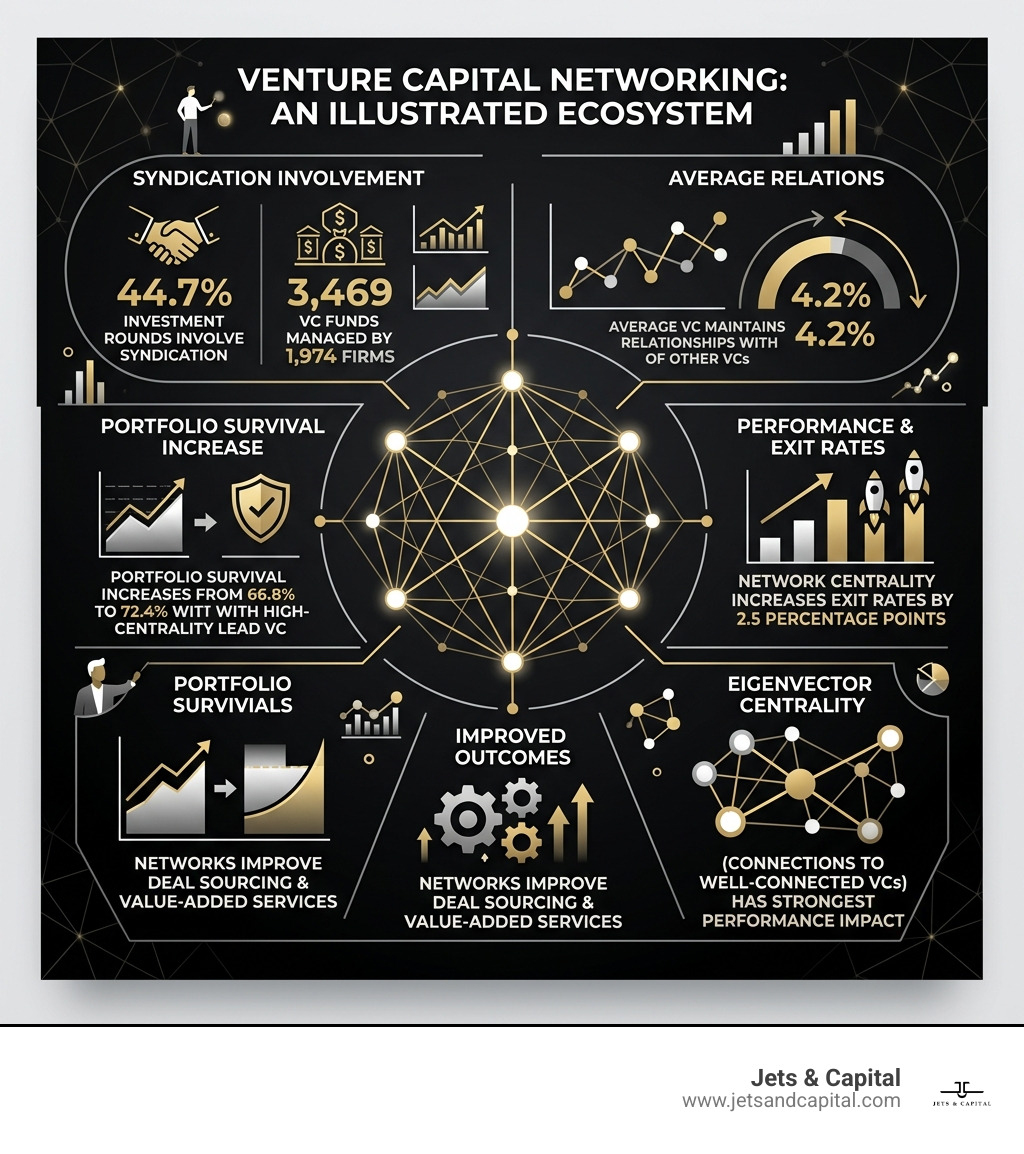
Venture capital networking is the cornerstone of success in private markets—not just for securing funding, but for unlocking better deal flow, higher exit rates, and stronger portfolio performance. Research shows that a one-standard-deviation increase in network centrality can boost exit rates by 2.5 percentage points from the industry average of 34.2%, translating directly to improved IRR equivalents. The key isn't just who you know, but how well-connected those people are within the ecosystem.
Quick Answer: What You Need to Know About Venture Capital Networking
- Network centrality drives performance: VCs with stronger syndication networks achieve 2.5% higher exit rates and better returns
- Quality over quantity: The average VC maintains active relationships with only 4% of other VCs, emphasizing depth over breadth
- Eigenvector centrality matters most: Connections to well-connected investors have the strongest impact on fund performance
- Warm introductions are gold: 44.7% of investment rounds involve syndication, making trusted referrals essential
- Value creation is bilateral: Networks improve both deal sourcing and value-added services to portfolio companies
As the founder of Jets & Capital, I've organized exclusive networking events for high-net-worth individuals and family offices in unique settings like private jet hangars and Formula 1 races, where venture capital networking happens organically among the most influential allocators and fund managers. Through years of facilitating these connections and advising on capital raising across multiple investment vehicles, I've seen how the right relationships—built in the right environments—accelerate deal flow and create compounding value for all parties involved.
Mastering Venture Capital Networking for Superior Fund Performance
When we talk about Venture capital networking, we aren't just talking about swapping business cards at a cocktail mixer. We are talking about the structural architecture of the financial markets. According to the seminal study by Hochberg, Ljungqvist, and Lu (2007), the way a VC firm positions itself within a network of peers is a primary determinant of its financial success.
The research analyzed thousands of VC funds and found a striking correlation: better-networked firms experience significantly better fund performance. Specifically, a one-standard-deviation increase in network centrality increases exit rates by approximately 2.5 percentage points. In an industry where the average exit rate is 34.2% (comprising 20.7% IPOs and 13.6% M&A), that 2.5% bump is massive. It represents a tangible increase in Internal Rate of Return (IRR) equivalents, proving that your social capital is directly convertible to financial capital.
Understanding Network Centrality in Venture Capital Networking
To master the game, we first have to understand the scoreboard. In Venture capital networking, "centrality" is the metric that matters.
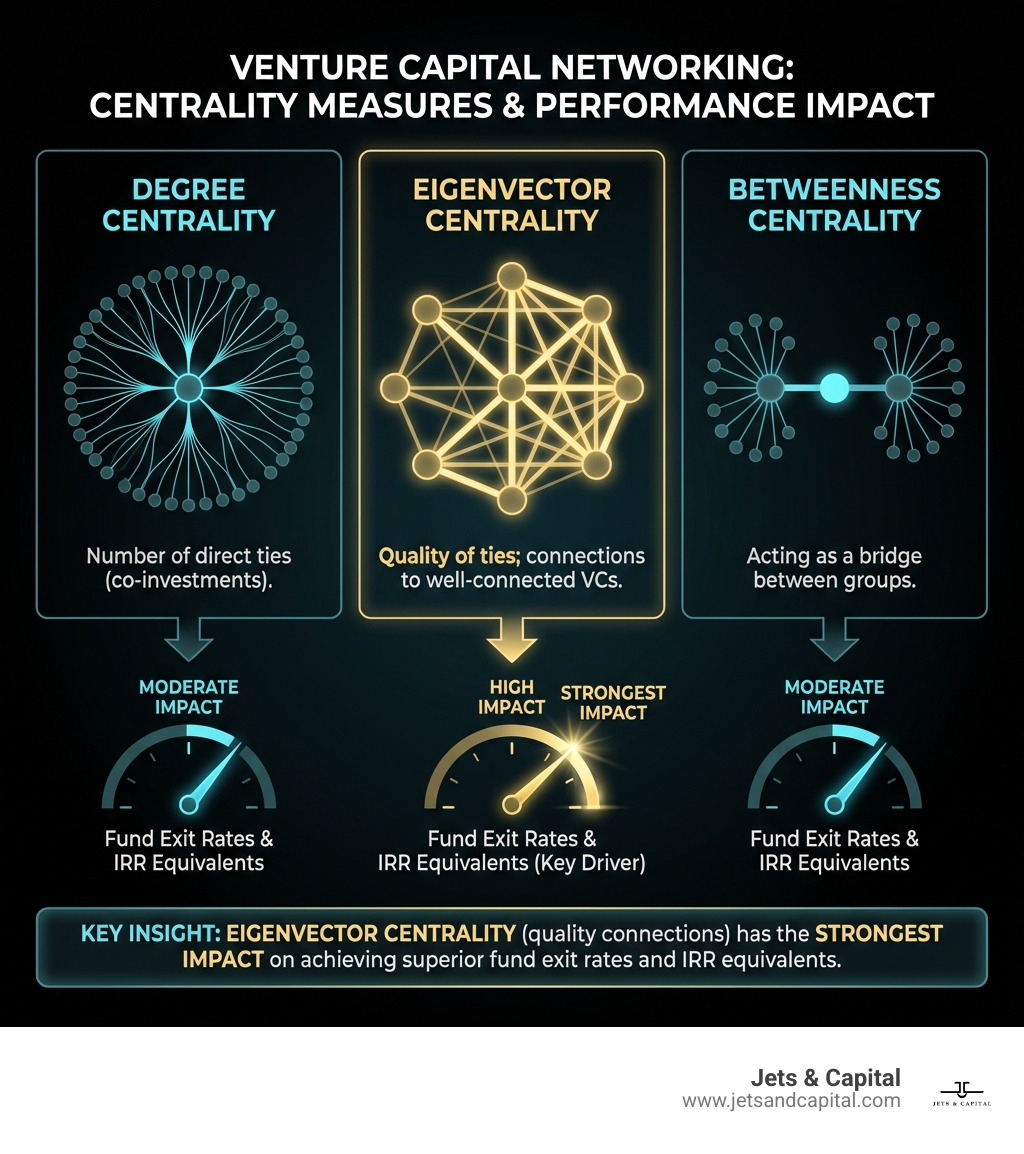
- Degree Centrality: This is the simplest measure—how many other VC firms have you co-invested with? The average VC firm has a degree centrality of about 4.2%, meaning they have ties with a small fraction of the total market.
- Eigenvector Centrality: This is the "prestige" measure. It doesn’t just count your friends; it looks at how many friends your friends have. The Hochberg study found that Eigenvector centrality has the strongest economic impact on performance. If you are syndicating deals with the "titans" of Sand Hill Road or Manhattan, your performance metrics tend to climb.
- Betweenness Centrality: This measures your role as a gatekeeper or a bridge. Firms like New Enterprise Associates, which syndicated with 369 different VCs over a five-year period, excel here.
This isn't just about vanity. Higher centrality leads to better portfolio survival. The probability of a company surviving its first funding round increases from 66.8% to 72.4% when the lead VC is highly networked. This happens because central VCs can provide better value-added services, from recruiting top talent to securing follow-on funding from their well-connected peers.
The Impact of Syndication on Portfolio Outcomes
Syndication is the engine room of Venture capital networking. Approximately 44.7% of all investment rounds and 50.3% of companies in the sample involved syndicated funding. But why do VCs share the "spoils" of a great deal?
- Risk Mitigation: No one likes to lose money alone. Co-investing allows firms to pool capital and diversify.
- Signal Pooling: If three smart firms think a startup is a winner, it’s a much stronger signal than if just one firm does.
- Reciprocity: I invite you into my deal today; you invite me into yours tomorrow. This "I scratch your back" culture is why 10.3% of firms that never syndicate often find themselves left out in the cold.
- Information Sharing: Different firms bring different expertise. One might be a wizard at Networking for founders while another specializes in technical due diligence.
Strategic Deal Sourcing and Value Creation
The lifeblood of any fund is deal flow. But not just any deal flow—high-quality, "alpha-generating" deal flow. We’ve found that the best deals rarely come through a "Contact Us" form on a website. They come through the network.
Better-networked VCs don't just see more deals; they see better deals. Because they are central to the ecosystem, they are the first call for entrepreneurs and other investors. This creates a virtuous cycle: better deals lead to better exits, which improves the firm's network position, which leads to even better deals. If you find yourself wondering what to do if you want to broaden your venture capital network beyond your immediate circle, the answer lies in increasing your value-add to others first.
How Syndication Enhances Venture Capital Networking Outcomes
Syndication acts as a filter for uncertainty. In the early stages of a startup, data is scarce. By forming a network, VCs can pool their "signals." If a lead VC in San Francisco syndicates with a firm in New York, they are combining local market intelligence with industry-specific expertise.
The research shows that these effects are even more pronounced in geographically concentrated hubs. In California, for instance, the impact of networking on performance is nearly twice as large as the national average. Proximity breeds trust. When we host events in San Francisco or Miami, we see this in action—the "handshake" still carries immense weight in an increasingly digital world.
Improving Deal Flow Through Relationship Depth
Deep relationships are the "moat" of a successful VC firm. This depth is built on:
- Warm Introductions: These are the "gold standard." A referral from a trusted partner carries 10x the weight of a cold pitch.
- Trust Building: Trust is earned over years, often through shared "battles" in the boardroom of a struggling portfolio company.
- Credibility: When Allocators look at a fund, they aren't just looking at the spreadsheet; they are looking at who the GP can call when things go sideways.
High-Impact Strategies for Connecting with Private Market Investors
If you want to move from the periphery to the center of the Venture capital networking world, you need a strategy. You cannot simply wait for the phone to ring. You must become an "attractor" of talent and capital.
Leveraging Exclusive Events and Digital Platforms
The most effective way to jumpstart your network is to put yourself in the room where it happens. But not just any room. We specialize in creating environments where the "noise" is filtered out. For example, our upcoming events in Miami and San Francisco are designed specifically for those who value time and quality over volume.
Beyond physical events, your digital presence acts as your 24/7 business card. Engaging on LinkedIn, contributing to niche communities, and even speaking at local events can help build your "Eigenvector" score. You want to be the person that well-connected people want to know. This is the core of Networking Your Way into Venture Capital.
Nurturing Long-Term Investor Relationships
Networking is a marathon, not a sprint. We’ve seen many people make a great first impression only to let the relationship wither through lack of follow-up.
- Quarterly Updates: Even if you don't have a deal to share, a quick note on market trends keeps you top-of-mind.
- Mentorship: Giving back to the next generation of founders or analysts builds a "reputation bank" that pays dividends for decades.
- Reciprocal Deal Sharing: If you see a great deal that isn't a fit for your mandate, pass it to a friend. They will remember it when they have a "unicorn" on their hands.
- Personal Touch: Following up after an event in New York with a personalized note about a specific topic discussed shows you were listening, not just waiting for your turn to speak.
Navigating Invite-Only Environments and High-Net-Worth Circles
The highest level of Venture capital networking happens behind closed doors. This isn't about being "elitist"; it's about efficiency. When you are managing millions—or billions—of dollars, you cannot afford to spend your time vetting every person you meet.
This is why we maintain a strict 85% allocator ratio at our events. Whether it's a family office from Palm Beach or an institutional investor from Dallas, our guests know that the person sitting next to them in the hangar is a peer. This strategic proximity creates a "safe space" for high-stakes deal-making.
In these environments, the "barrier to entry" is actually a feature, not a bug. It ensures that every conversation has the potential to move the needle. When you are in a private jet hangar in Las Vegas during a major summit, the atmosphere is focused. There are no "pitch decks" being shoved in faces; there are only relationships being built.
Frequently Asked Questions about Venture Capital Networking
Does network centrality really improve fund performance?
Yes, the data is conclusive. The Hochberg, Ljungqvist, and Lu study showed that a one-standard-deviation increase in network centrality correlates with a 2.5 percentage point increase in exit probability. This isn't just a correlation; the researchers used robust controls to show that networking actually drives the performance through better deal sourcing and enhanced value-added services.
How can I get a warm introduction to a top-tier VC?
The most effective route is through their portfolio founders. VCs trust the entrepreneurs they have already backed. If you can't find a founder, look to your alumni networks or shared co-investors. Attending high-quality industry events is also a proven way to turn a "cold" contact into a "warm" one through a face-to-face interaction.
What is the best way to maintain long-term investor relationships?
Adopt a "value-first" approach. Always ask yourself, "How can I help this person?" before you ask for anything. This might mean sharing a relevant research report, making an introduction to a potential hire, or providing a "gut check" on a market trend. Consistency is key—regular, low-pressure check-ins are far more effective than reaching out only when you need money.
Conclusion
At the end of the day, Venture capital networking is about building bridges between capital and innovation. Whether you are an allocator looking for the next great fund or a GP looking to expand your syndication network, the quality of your connections will define your trajectory.
We invite you to experience this at our upcoming Super Bowl Edition in San Francisco, CA. We are bringing together the most influential family offices and investors in a private jet hangar for a weekend of high-quality deal-making and relationship building. With our exclusive vetting process and focus on the 85% allocator ratio, it is the ultimate environment to boost your network centrality.
Don't leave your fund's performance to chance. Secure your spot and start building the bridges that matter.
