
Discover Investment Opportunities and Make Your Money Work Harder
Core Factors to Consider Before You Discover Investment Opportunities

Before you dive headfirst into the markets, we need to talk about the "boring" stuff that actually keeps your money safe. Think of these factors as the flight plan before taking off in a private jet; you wouldn't just wing it, and you shouldn't wing your financial future either.
When we help investors discover investment opportunities, we always start with three pillars: risk tolerance, time horizon, and your current level of knowledge.
- Risk Tolerance: This is both a psychological and financial question. Psychologically, can you sleep at night if your portfolio drops 10% in a week? Financially, can your lifestyle afford that drop? Conservative portfolios are often better for those nearing retirement, while aggressive portfolios suit those with stable incomes and time to recover from market dips.
- Time Horizon: When do you actually need this cash? If you’re saving for a house down payment in Las Vegas or Miami in three years, you need "safer" bets like GICs or Savings Deposits. If you’re building a retirement nest egg for twenty years from now, you can afford the volatility of stocks and mutual funds to chase higher growth.
- Investor Knowledge: Be honest with yourself here. If you don't have the time to research individual mining companies in Manitoba or tech startups in San Francisco, don't buy individual stocks. Low-knowledge options like index funds or managed portfolio solutions are fantastic because they offer built-in diversification.
For more detailed guidance on these fundamentals, we recommend exploring the 3 Factors to Consider When Choosing Investments provided by the SEC.
Assessing Your Investor Profile
Your "Investor Profile" is essentially your financial DNA. In professional banking and wealth management, this isn't just a suggestion—it’s often a regulatory requirement. For instance, before you can even purchase certain mutual funds or portfolio solutions, you must Create or Update Your Profile to ensure the products match your goals.
A solid profile considers:
- Your Financial Goals: Are you looking for capital preservation, regular income, or aggressive growth?
- Your Risk Appetite: How much "red" can you handle in your account summary before you panic-sell?
- Goal-Based Planning: Different accounts should have different profiles. Your child's education fund (RESP) should likely be more conservative than your personal long-term retirement account.
Understanding Low-Risk vs. High-Growth Assets
To discover investment opportunities that work for you, you must understand the trade-off between safety and growth.
Guaranteed Investment Certificates (GICs) and Savings Deposits are the "safety nets" of the investment world. Your principal is protected, making them ideal for short-term needs. However, the "risk" here is inflation; if your money grows at 2% but prices rise by 4%, you’re technically losing purchasing power.
Mutual Funds and Portfolio Solutions pool money from many investors to buy a diversified mix of stocks, bonds, or other assets. These offer much higher growth potential but come with market risk.
| Feature | GICs / Savings Deposits | Mutual Funds / Portfolio Solutions |
|---|---|---|
| Principal Protection | Guaranteed | Not Guaranteed |
| Growth Potential | Low / Fixed | Moderate to High |
| Liquidity | Varies (some are locked in) | Generally High |
| Best For | Emergency funds, short-term goals | Long-term wealth building |
Maximizing Returns Through Registered Plans and Strategic Tools
In Canada, the government actually gives you "cheat codes" to grow your wealth faster. These are called registered plans. If you aren't maximizing these, you are essentially giving the government a tip they didn't ask for.
The Tax-Free Savings Account (TFSA) is perhaps the most flexible tool in your kit. Any interest, dividends, or capital gains earned inside a TFSA are completely tax-free—even when you withdraw them. It’s perfect for everything from a "rainy day" fund in Salt Lake City to a dream vacation in Palm Beach.
The Registered Retirement Savings Plan (RRSP) is designed for the long haul. Contributions are tax-deductible, meaning they lower your taxable income today. While you pay tax when you withdraw the money in retirement, the idea is that you’ll be in a lower tax bracket then.
To sharpen your edge, we suggest using resources like BMO SmartProgress Financial Literacy to understand how these plans fit into a broader strategy.
How to Discover Investment Opportunities for Beginners
If you’re just starting, don't try to find the next "unicorn" startup. Start with the math. Compound interest is the most powerful force in finance. By reinvesting your earnings, you earn interest on your interest. Over 20 or 30 years, this creates an exponential curve of wealth.
Beginners should utilize the Investor.gov Resource Hub to access compound interest calculators and savings goal tools.
Pro-Tip for Beginners:
- Check Registration: Always verify that your investment professional is registered.
- Watch for Red Flags: If someone promises "high returns with no risk," run the other way.
- Use Calculators: Use a compound interest calculator to see how even $100 a month can turn into a fortune over time.
Leveraging Credit Rewards for Capital
It might sound unconventional, but your daily spending can actually fuel your investment strategy. Some credit cards offer a cashback match, where the provider matches all the cash back you earned at the end of your first year.
By using a Discover Credit Card Comparison tool, you can find cards with no annual fees that reward your regular spending. If you take that 1% to 5% cash back and immediately move it into a TFSA or a high-yield savings account, you are essentially investing with "found money." It’s a low-effort way to build credit while simultaneously growing your capital base.
Exploring Regional and Sector-Specific Growth in Canada
For those looking to discover investment opportunities on a larger scale, Canada is a powerhouse for Foreign Direct Investment (FDI). The country’s stability, talented workforce, and access to global markets make it a magnet for massive industrial projects.
Recent data shows the sheer scale of these opportunities:
- Electric Vehicles: Stellantis is investing $3.6 billion to modernize facilities for EV production, creating 650 jobs.
- Mining: Sumitomo Metal Mining is involved in a $1.3 billion gold mining joint venture.
- Tech/Entertainment: Ubisoft is investing $950 million in new production studios, including a major presence in Winnipeg.

You can find more about these macro-trends through Invest in Canada Resources, which highlights how the government supports business expansion and job creation.
High-Growth Sectors in Manitoba
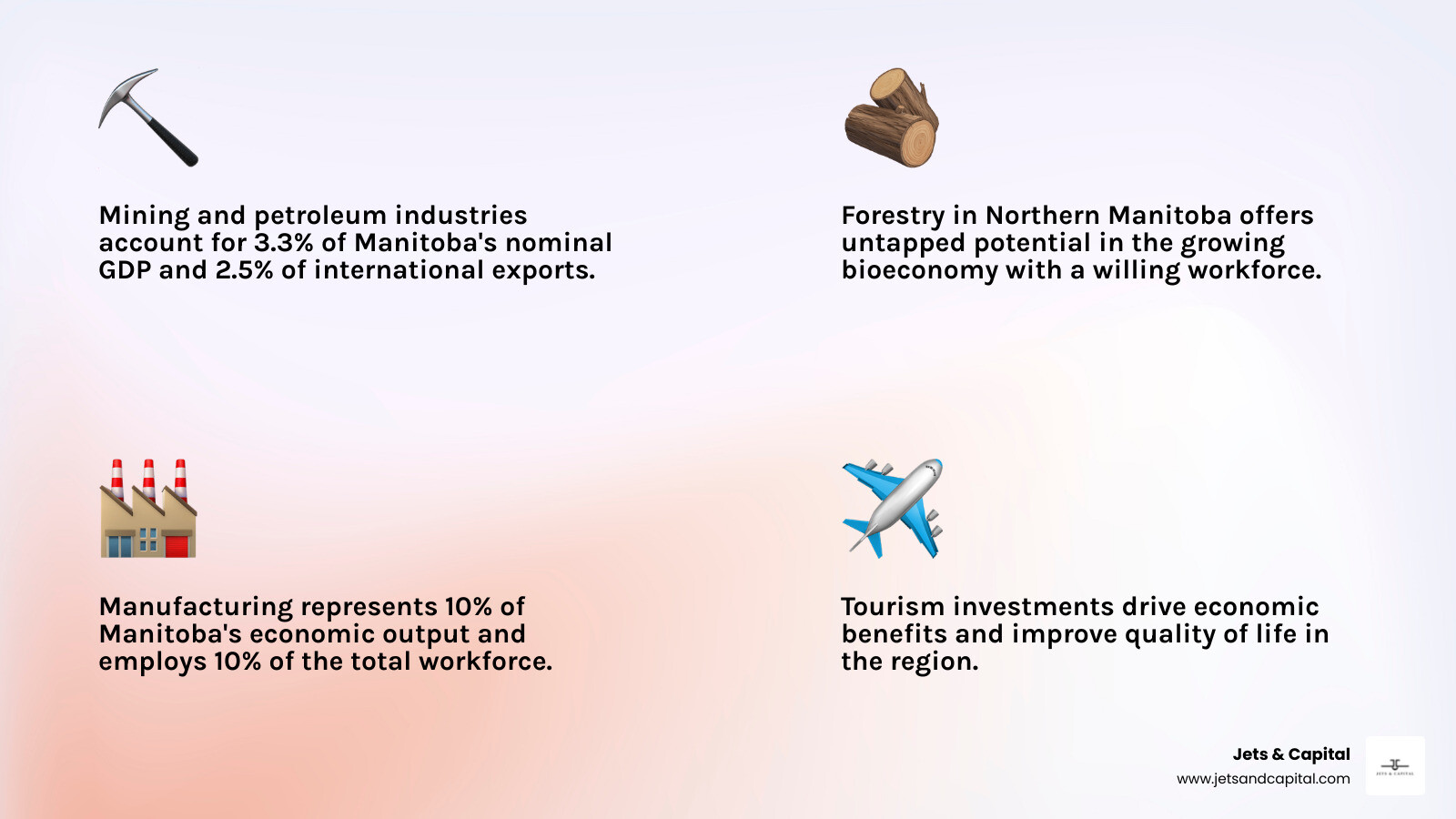
While we often think of Toronto or Vancouver, Manitoba is a "hidden gem" for resource-based investing. The province’s mining and petroleum industries accounted for 3.3% of the province's nominal GDP and 2.5% of international exports in 2017. In 2018 alone, mining and petroleum production totalled $2.5 billion.
Key sectors include:
- Forestry: Northern Manitoba’s forests are underutilized, offering a growing bioeconomy and a "willing workforce."
- Manufacturing: This sector represents about 10% of Manitoba's economic output and employs 10% of the total workforce.
- Tourism: Investing in tourism is seen as a way to make the region an even better place to live while driving economic benefits.
For investors interested in these regional plays, the Manitoba Economic Profiles provide deep dives into sector-specific data.
Global FDI Trends and Large-Scale Projects
The trend toward "Clean Growth" and "Sustainability" is driving billions in capital. Whether it’s the expansion of potash production in Saskatchewan or hydroelectric plants in Quebec, the focus is on long-term, stable infrastructure.
Even if you aren't a multi-billion dollar corporation, keeping an eye on where these giants move their money helps you discover investment opportunities in related sectors—like real estate in growing industrial hubs or service industries supporting new manufacturing plants.
If you are looking at international parallels, the UK Investment Support Directory shows similar trends in green tech and biomanufacturing that are mirrored in the North American market.
Frequently Asked Questions about Investment Options
What is the best way to start investing with little money?
You don't need a million dollars to start. Micro-investing apps and low-fee index funds allow you to start with as little as $50. The key is consistency. By utilizing compound growth and avoiding high-fee accounts, your small monthly contributions can grow significantly over time.
How do registered plans like TFSA and RRSP differ?
The main difference is when you get the tax break. With an RRSP, you get a tax deduction now, but pay tax on withdrawals later. With a TFSA, you pay with "after-tax" money now, but every dollar you withdraw later—including all the growth—is 100% tax-free. Generally, RRSPs are better for high-earners, while TFSAs are great for everyone due to their flexibility.
Where can I find vetted deal flow to discover investment opportunities?
For high-net-worth individuals, the "public" markets are only half the story. To discover investment opportunities in private equity, angel networks, and family office deals, you need access to exclusive circles. Most high-quality deal flow happens behind closed doors in vetted environments where allocators and founders can build real relationships.
Conclusion
At the end of the day, the best way to discover investment opportunities isn't just by staring at a screen—it's through strategic networking and high-quality relationships. While the banking tools and regional sectors we discussed provide a solid foundation, the most lucrative "deal flow" often comes from who you know.
At Jets & Capital, we specialize in bridging that gap. We organize exclusive, invite-only networking events in private jet hangars across locations like Las Vegas, Miami, Dallas, and San Francisco. Our strict vetting process ensures that 85% of our attendees are allocators, creating an environment optimized for serious deal-making and relationship building.
Whether you are looking for Family Office Deal Flow or simply want to connect with other UHNWIs and investors who are moving the needle, the right room makes all the difference.
Don't just watch the markets from the sidelines. Join us at our next event, like the upcoming Super Bowl Edition in San Francisco, and take your seat at the table.
Ready to elevate your network? Grab your tickets to upcoming events here and start making your money work as hard as you do.
