
How Family Offices Are Beating Private Equity at Their Own Game
Are Family Offices the New Kings of Private Equity?

Private equity family offices are quietly reshaping how the world's wealthiest families grow and protect their capital — and they're doing it on their own terms.
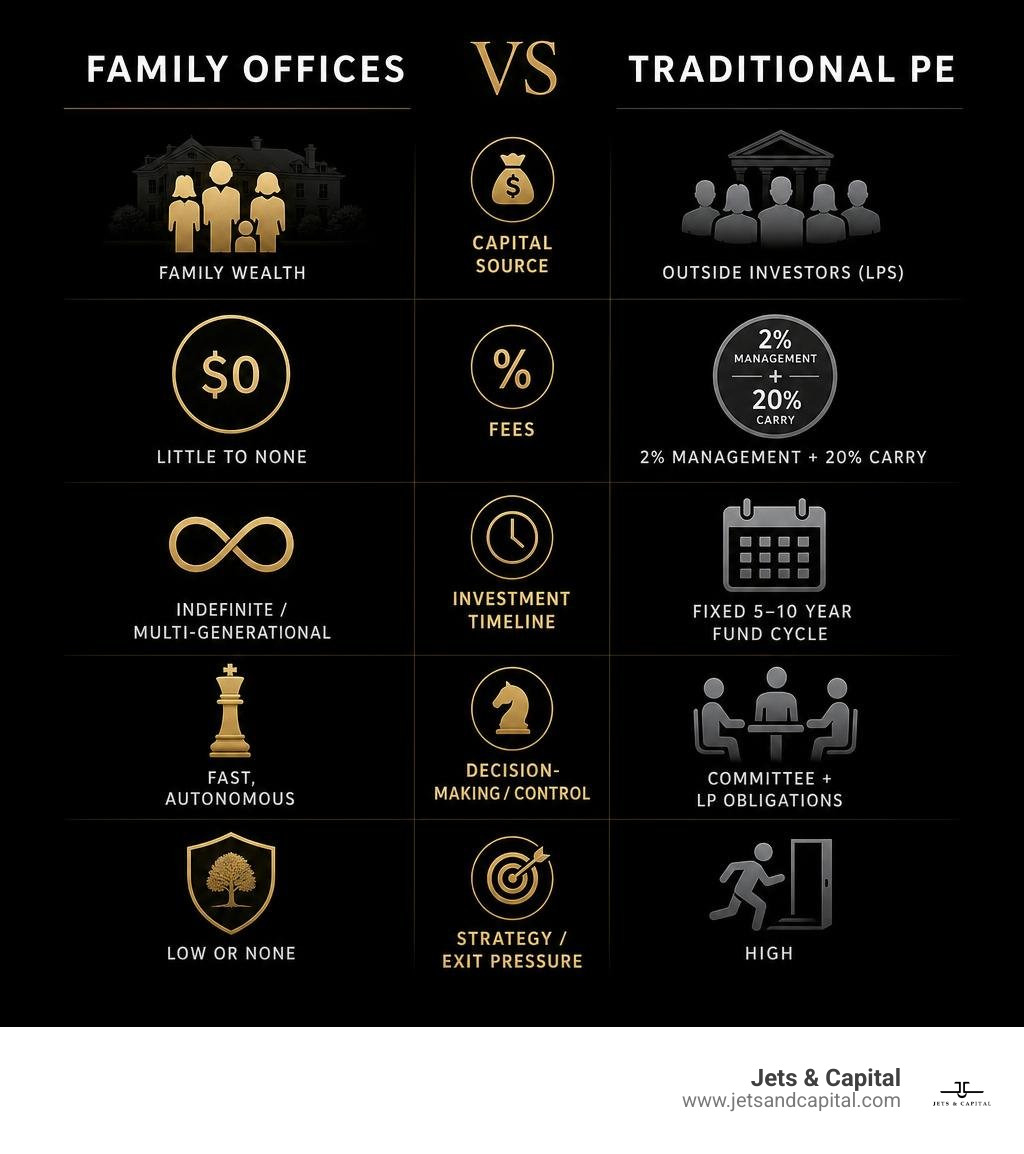
Here's the short answer to what separates them from traditional PE:
| Factor | Traditional PE Firm | Family Office |
|---|---|---|
| Capital source | Outside investors (LPs) | Family wealth |
| Fee structure | 2% management + 20% carry | Little to none |
| Investment timeline | Fixed 5-10 year fund cycle | Indefinite / multi-generational |
| Decision-making | Committee + LP obligations | Fast, autonomous |
| Exit pressure | High | Low or none |
| Values alignment | Investor-driven | Family-driven |
Family offices don't have to answer to outside limited partners. They don't pay the traditional 2-and-20 fee structure. And they can hold a great investment for decades if they want to.
That's a significant structural advantage.
What used to be a passive role — writing checks to big PE funds — has evolved into something far more aggressive. Family offices are now building internal deal teams, sourcing proprietary transactions, and co-investing alongside the very PE firms they once simply funded.
The numbers back this up. Family office private equity exposure jumped from 22% in 2021 to 30% in 2023. Direct investments now make up 17% of the average family office portfolio, outpacing PE fund allocations at just 10%.
This isn't a trend. It's a structural shift.
I'm Jordan Hutchinson — entrepreneur, investor, and a member of the family office that helped found Bridge Investment Group (NYSE: BRDG), giving me a view of how private equity family offices operate at the highest levels. Through Jets & Capital, I've built a network of the exact allocators and principals driving this shift, and I'll walk you through everything you need to know.
The Rise of Private Equity Family Offices

The modern landscape of wealth management is no longer dominated solely by Wall Street’s institutional giants. Today, the most sophisticated wealth preservation and creation engines are private investment arms operated directly by ultra-high-net-worth families. By establishing a dedicated UHNW Family Office, these entities have transitioned from passive investors to active, institutional-grade market makers.
This evolution is fundamentally a pursuit of absolute returns and multi-generational legacy. Rather than relying on third-party fund managers to dictate where their capital goes, families are taking control of their own destinies. This shift has birthed the modern era of private equity family offices — highly specialized structures designed to deploy capital directly into private operating companies.
How Private Equity Family Offices Differ from Traditional PE
To understand why this shift is happening, we must look at the structural mechanics of how these two entities operate. Traditional private equity firms are bound by rigid LP-GP (Limited Partner-General Partner) dynamics. They raise capital from outside investors, pool it into a fund with a hard 10-year expiration date, and charge a standard "2-and-20" fee structure (2% management fee, 20% performance carry).
This model creates a few inherent points of friction:
- Fixed Timelines: Traditional PE firms must buy, optimize, and sell a business within a 5-to-7-year window to return capital to their LPs. This pressure can force premature exits or short-term operational decisions.
- The Fee Drag: High management fees and performance hurdles eat into the net returns realized by the ultimate owners of the capital.
- Bureaucracy: Investment decisions must go through multi-layered investment committees, often constrained by strict fund mandates and LP covenants.
Family offices, by contrast, operate with "permanent capital." Because they are investing their own balance sheet, they have no external LPs to satisfy, no fixed fund lifecycles, and no mandate to sell. If a business is growing compounding cash flow at 15% a year, a family office can hold it for 30 years. Furthermore, their decision-making speed is unmatched; when the principal and the investment team sit across the hall from one another, a multi-million-dollar deal can be greenlit over a cup of coffee.
Single-Family vs. Multi-Family Office Structures
Within this ecosystem, we typically see two organizational models: Single-Family Offices (SFOs) and Multi-Family Offices (MFOs).
- Single-Family Offices (SFOs): These entities manage the wealth of a single family. They offer the ultimate level of investment discretion, absolute privacy, and complete customization. SFOs with substantial scale build out dedicated, in-house direct investing teams that rival mid-market PE shops.
- Multi-Family Offices (MFOs): For families that want the benefits of a dedicated office but prefer to share operational costs and access a broader pool of deals, MFOs offer a shared stewardship model. This structure provides the operational scale necessary to institutionalize deal sourcing, due diligence, and portfolio management.
Whether structured as an SFO or MFO, these organizations are united by a single goal: cutting out the middleman to maximize control, minimize fees, and build enduring value.
Why Family Offices are Allocating More Capital to Private Markets

The macroeconomic environment of June 2026 has made traditional public markets increasingly difficult to navigate. Persistent rate volatility and structural shifts have pushed allocators to rethink their playbooks. To build resilient portfolios, families are looking beyond public equities and fixed income, turning instead to sophisticated Capital Allocation Strategies centered around private markets.
A prime example of this institutional-grade approach is the Levine Leichtman Family Office, which has successfully deployed multi-asset strategies across private equity, venture, and credit since 1985. Their long-term success demonstrates that direct ownership and active management are the ultimate tools for capital preservation.
The Shift Toward Autonomy and Patient Capital
The numbers tell a compelling story of this asset class migration. Family offices’ private equity exposure increased from 22% in 2021 to 30% in 2023, representing billions of dollars moving directly into private enterprises.
This capital is highly strategic. Rather than placing all their bets in one region or factor, families are building highly diversified global portfolios. In fact, 74% of family offices aim to diversify their investments across different geographies, ensuring they are protected against localized economic downturns.
To manage this exposure, 81% of family offices use a sophisticated mix of active and passive investment strategies. This balance allows them to capture passive market returns where efficient, while aggressively pursuing active alpha through direct private equity plays.
Balancing Wealth Preservation with Growth-Oriented Strategies
One of the greatest challenges a family office faces is balancing the preservation of existing wealth with the generation of new growth. This dynamic often depends on the generation currently leading the office.
For instance, first-generation family offices — where the wealth-creator is often still active — tend to have a much higher risk tolerance. On average, first-generation family offices allocate 27% of their capital to buyouts and 11% to venture capital investments. They are builders at heart, comfortable with the J-curve of early-stage investing and the operational complexity of mid-market buyouts.
To mitigate the risks of these growth-oriented strategies, family offices employ precise portfolio construction. Rather than chasing speculative trends, 85% of family offices aim to split their investments across different factors, such as value, size, and momentum. This disciplined approach is championed by top-tier wealth managers like 8Six Ventures, which utilizes a structured framework balancing growth assets, real assets, and liquid preservation assets to ensure long-term stability across generations.
Direct, Co-Investments, and Funds: Navigating PE Strategies
When entering the private equity arena, family offices do not rely on a one-size-fits-all approach. Instead, they navigate three primary pathways: direct investments, co-investments, and fund allocations. Each strategy offers distinct trade-offs regarding control, fee mitigation, diversification, and operational burden.
To help visualize these trade-offs, we have mapped out the core characteristics of each strategy:
| Strategy | Fee Drag | Level of Control | Diversification | Operational Burden |
|---|---|---|---|---|
| Direct Investments | None | High (Controlling/Board Seats) | Low (Concentrated) | Very High (Requires Deal Team) |
| Co-Investments | Extremely Low | Medium (Passive Partner) | Medium | Moderate (Requires Rapid Vetting) |
| PE Funds | High (2-and-20) | None | High (Portfolio of Companies) | Low (Outsourced to GP) |
By blending these strategies, sophisticated allocators can build a robust private equity sleeve. For a deeper dive into structuring these blended portfolios, check out our Co-Investment Opportunities Complete Guide.
Direct Investing Criteria for Private Equity Family Offices
Direct investing is the ultimate expression of family office autonomy. Today, direct investments account for 17% of the average family office portfolio. However, successfully executing direct deals requires a level of operational rigor that matches traditional institutional buyers.
When evaluating deals, families look for specific alignment. According to the GP Intel deal-flow framework, family offices look for companies with strong recurring revenue, defensive market positions, and competent management teams already in place.
Furthermore, the scale of the family office heavily dictates its investment behavior:
- Under $1 Billion AUM: Smaller family offices tend to take minority positions, holding controlling stakes in just 30% of their direct investments. They often rely on management to run the business while providing strategic guidance.
- Over $1 Billion AUM: Larger, institutionalized family offices prefer control. They hold controlling stakes in 44% of their direct investments, allowing them to directly influence governance, capital allocation, and operational strategies.
Sector expertise also plays a massive role in direct investing. Families typically invest in what they know. This bias shows up clearly in global sector preferences, with healthcare (65%) and disruptive technology (61%) ranking as the top targets for direct capital.
Co-Investments and Fund Allocations
While direct investing offers maximum autonomy, it is highly concentrated and operationally demanding. To balance the scales, family offices heavily leverage co-investments and fund allocations.
Co-investments have emerged as a massive trend, with 42.5% of family offices globally co-investing alongside other family offices, venture capital, private equity, or real estate sponsors. This strategy allows families to participate in larger, high-quality deals sourced by institutional GPs while avoiding the heavy fee drag of a standard fund structure.
Meanwhile, traditional fund investments have faced a major cooling-off period. After reaching an all-time high in 2021, family offices’ fund investments in 2024 were more than 73% lower in both deal volume and value. While they still allocate roughly 10% of their portfolios to PE funds for broad diversification, families are increasingly picky. They prefer boutique, highly specialized managers or unique, regional syndicates like Rainmaker Private Equity, which brings together tailored family office syndicates to back high-potential middle-market companies.
Sourcing Deals and Building Proprietary Deal Flow
In the private equity world, capital is a commodity. The real battleground is deal flow. For a family office to succeed in direct investing, it must build a consistent engine for Investment Deal Sourcing that does not rely solely on highly competitive, broadly marketed investment banking auctions.
This is where the power of Family Office Networking becomes a competitive advantage. By building deep, trusted relationships with peer families, founders, and regional advisors, family offices can access high-quality, off-market opportunities before they ever hit the open market.
Leveraging Networks and Niche Expertise
The most effective sourcing strategies are deeply relational. Sophisticated family offices frequently leverage:
- Alumni and Operator Networks: Tapping into the personal and professional histories of the family members and their executive teams.
- Exclusive Industry Gatherings: Attending high-level, vetted Family Office Events where principals can share deal flow and discuss co-investment opportunities.
- Digital and Regional Directories: Utilizing curated deal platforms, such as Top California Family Offices with Recent Private M&A Activity | Axial, to identify and connect with active dealmakers in key regional hubs like San Francisco, Los Angeles, and Silicon Valley.
By maintaining a highly active presence in these networks, family offices can position themselves as the preferred capital partner for mid-sized businesses seeking growth or transition capital.
The Advantage of "Quiet Capital" in M&A
When competing against traditional private equity firms for a deal, family offices possess a unique secret weapon: they offer "quiet capital."
Many business owners are deeply protective of their legacy, their employees, and their brand. They are often hesitant to sell to a traditional PE firm that might slash costs, restructure the team, and flip the business in five years.
Family offices, such as the Sehgal Family Office, offer a highly attractive alternative. They provide patient capital, deep operational empathy, and a long-term horizon. Because they do not have artificial exit deadlines, they can partner with founders to build durable, sustainable businesses over decades. This philosophy of Partnering companies for long-term growth allows family offices to win highly competitive deals — often at more favorable valuations — simply because they are aligned with the founder's long-term vision.
Operational Excellence: Talent, Technology, and Infrastructure
Operating a direct private equity strategy is not a part-time job. It requires institutional-grade infrastructure to manage deal flow, perform institutional due diligence, and monitor portfolio companies post-acquisition. Without the right mix of talent and technology, family offices face significant operational and financial risks. For a complete look at managing these complex assets, consult our Alternative Asset Investments Guide.
Recruiting Institutional Talent for Direct Investing
To win deals and execute them flawlessly, family offices must recruit top-tier talent. Increasingly, they are poaching experienced professionals from top-bracket investment banks and traditional private equity firms.
To attract this institutional talent, family offices offer a compelling value proposition:
- Better Work-Life Balance: The standard day-to-day lifestyle is highly attractive. A typical schedule of 9 AM to 6 PM with minimal "facetime" requirements offers a massive quality-of-life upgrade compared to the grueling 80-hour weeks of traditional investment banking.
- Long-Term Alignment: Instead of being judged on short-term quarterly performance, investment professionals are aligned with absolute, long-term returns.
- Cultural Fit: Family offices operate with flat organizational structures, allowing professionals to work directly with decision-makers without navigating corporate bureaucracy.
While base salaries may occasionally be slightly lower than mega-fund PE, the combination of lifestyle, carry structures, and direct access to entrepreneurial capital makes family offices a highly sought-after destination for top finance talent.
Technology and Reporting Infrastructure
Managing a portfolio of direct investments, co-investments, and legacy fund commitments is incredibly complex. Unlike public equities, which can be tracked on a single brokerage dashboard, private equity assets require specialized reporting.
To maintain operational excellence, modern family offices invest heavily in advanced wealth tech platforms. These tools provide:
- Real-Time Portfolio Tracking: Aggregating performance metrics, cash flows, and capital calls across multiple private assets.
- Document Management and AI Reporting: Using automated tools to parse complex financial statements, capitalization tables, and tax documents.
- Risk and Liquidity Management: Modeling cash flow requirements to ensure the family office always maintains sufficient liquidity to fund capital calls and operational needs.
Frequently Asked Questions about Family Office Private Equity
What is the typical check size for a family office direct investment?
Check sizes vary wildly depending on the AUM of the family office and their investment mandate. Early-stage, venture-focused family offices may write checks ranging from $25,000 to $250,000 for pre-seed to Series A rounds, typically taking a 3% to 10% equity stake. Mid-market, buyout-focused family offices typically deploy between $10 million and $100 million per transaction, often targeting controlling stakes in profitable operating companies.
How do family offices manage the lack of liquidity in private equity?
Liquidity is managed through careful asset allocation and cash flow planning. Most family offices operate on a "one-third" asset allocation framework: allocating roughly one-third to growth (private equity/venture), one-third to real assets and alternatives, and one-third to highly liquid preservation assets (cash, public equities, fixed income). This ensures they always have the "oxygen" of liquid capital to fund operations, distributions, and opportunistic deals.
Why are family offices reducing their allocations to traditional PE funds?
The primary drivers are fee dissatisfaction and a desire for control. Many families dislike the traditional 2-and-20 fee drag, realizing that they can build their own internal capabilities to source and execute direct deals without paying millions in management fees. Additionally, direct investing allows families to align their capital with their personal values, industry expertise, and long-term legacy goals.
Conclusion
The shift is clear: family offices are no longer just passive sources of capital. They are active, sophisticated, and highly competitive players in the private equity landscape. By leveraging their permanent capital, rapid decision-making, and relational networks, they are consistently winning high-quality deals and building enduring, multi-generational value.
At Jets & Capital, we facilitate the high-level connections that drive this modern deal-making ecosystem. We organize exclusive, invite-only networking events for family offices, institutional allocators, and UHNWIs in private jet hangars across key hubs — including our highly anticipated Super Bowl Edition in San Francisco, California.
With a strict vetting process that ensures 85% of attendees are active allocators, we eliminate the noise and create an environment built for genuine relationship building and high-quality deal flow. Whether you are looking to build peer relationships, source co-investment opportunities, or deploy capital, our platform is designed to help you connect with the ultimate decision-makers.
Ready to expand your network and access exclusive, off-market opportunities? Discover our upcoming events and apply for an invitation through our exclusive networking events guide. Let's build the future of private wealth together.
