
Navigating Business Jet Airlines: A Smart Executive's Practical Guide
Choose the Right Business Jet Airline Model for Your Mission

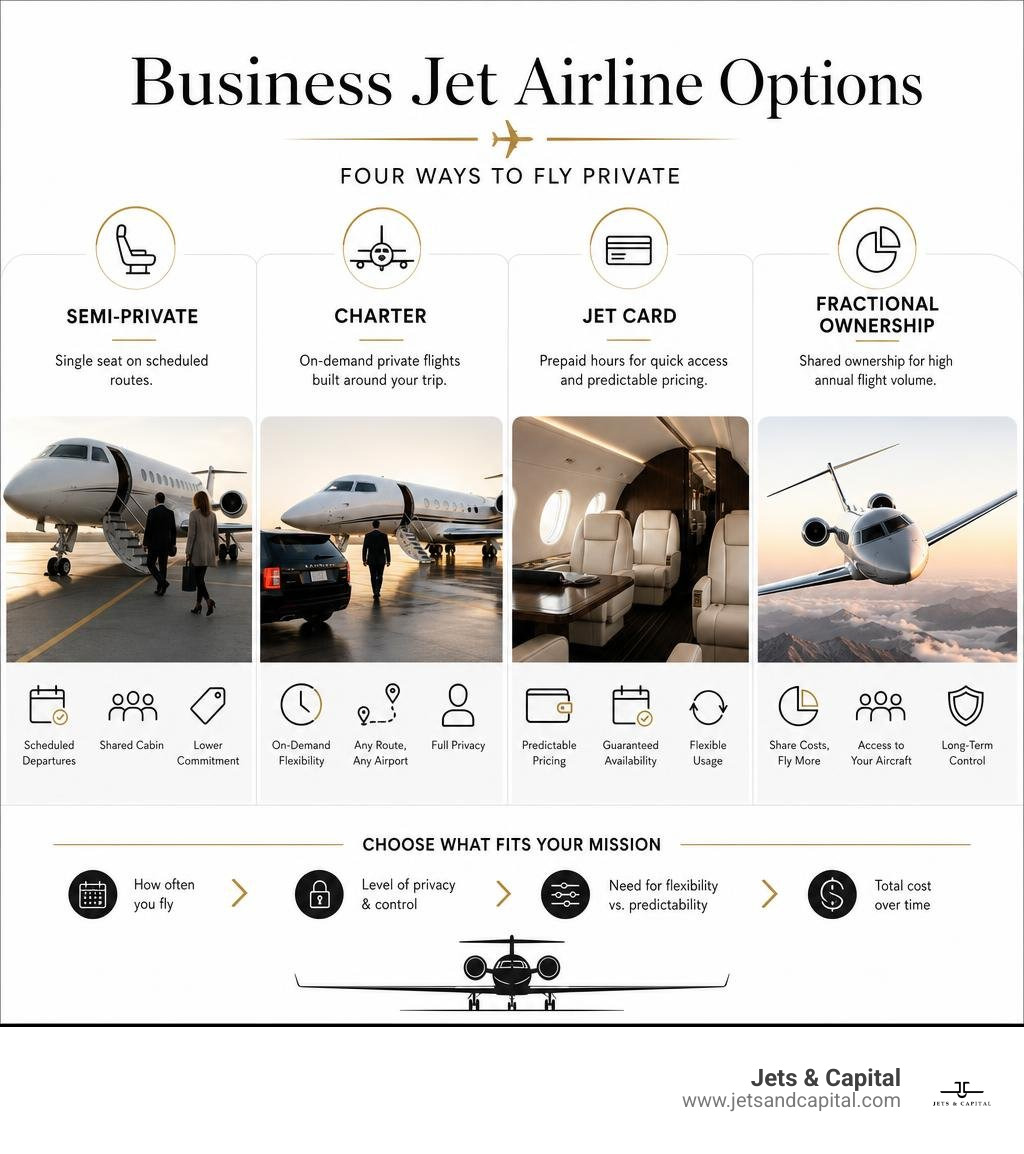
Business jet airlines are not one single service. They range from scheduled, by-the-seat semi-private flights to fully private charter, jet cards, fractional ownership, and company-operated aircraft. The right option depends on how often you fly, how much privacy and schedule control you need, and whether you value flexibility or predictable access.
For most executives and family offices, start with this simple filter:
- Choose a semi-private scheduled flight for a single seat on a fixed route and departure time.
- Choose on-demand charter for a bespoke trip without a long-term commitment.
- Choose a jet card for more predictable pricing and access across repeated trips.
- Consider fractional ownership or an in-house flight department when annual travel volume is high enough to justify shared or full aircraft costs.
The main advantage is not just cabin comfort. Private aviation can use private terminals, smaller airports, and direct routing that commercial first class cannot match. That can turn a multi-stop travel day into a practical same-day meeting trip - while keeping work, family, and sensitive conversations more private.
I am Jordan Hutchinson, an entrepreneur, investor, and founder of Jets & Capital, where I bring family offices and high-net-worth peers together in curated aviation-centered settings. My work around capital formation, executive travel, and private-jet networking has given me a practical view of how business jet airlines can support both better mobility and stronger relationships.
Understanding Business Jet Airlines and Modern Private Aviation Models
The business aviation landscape has shifted dramatically. While the sector once revolved almost exclusively around wholly-owned corporate flight departments, modern executives now leverage a spectrum of private flight solutions. Emerging hybrid models—often termed business jet airlines—blend the scheduled reliability of commercial carriers with the terminal speed, exclusivity, and elevated service of private aviation.
At its core, private executive aviation exists to solve a fundamental corporate problem: reclaiming lost time. When managing critical operations across business hubs like New York, Dallas, Miami, and San Francisco, reliance on commercial transit networks introduces scheduling friction, baggage delays, and severe productivity losses.
Modern private aviation models span four distinct structures:
- Semi-Private Scheduled Shuttles: Operators running scheduled, by-the-seat flights between high-density private terminals.
- On-Demand Charter: Tailored flight booking on a trip-by-trip basis through vetted charter operators or air brokers.
- Jet Card Memberships: Prepaid blocks of flight hours providing fixed hourly rates and guaranteed fleet access.
- Fractional & Whole Aircraft Ownership: Purchasing an equity share (or whole airframe) managed by a professional operating entity.
How Business Jet Airlines Differ from Commercial First Class
A common misconception among business travelers is that commercial first class is the pinnacle of aviation luxury. While a lie-flat first-class seat on a major international airline provides physical comfort, it fails to solve ground congestion.
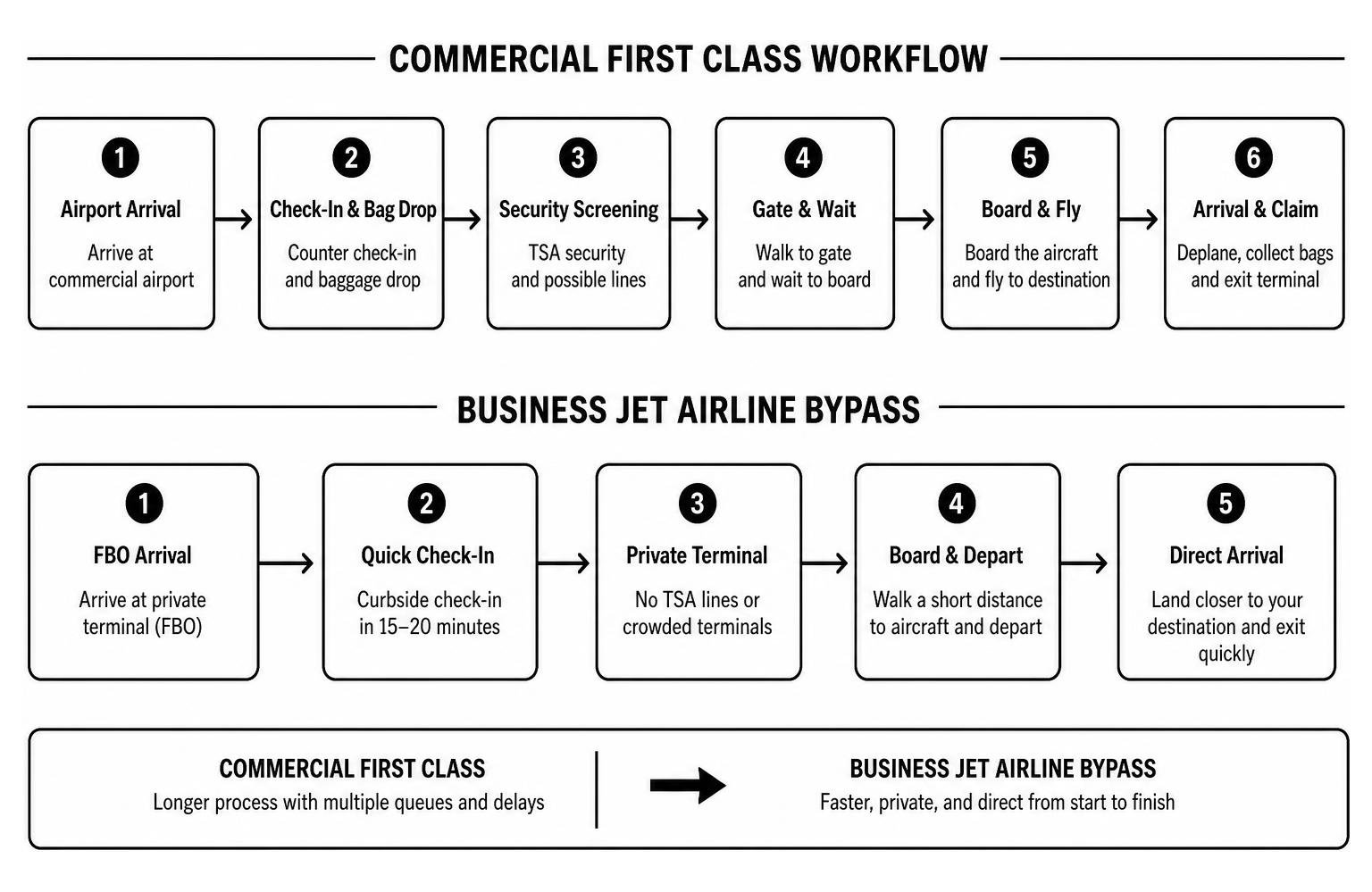
Business jet operators decouple travel from the traditional commercial airport terminal. Passengers arrive at private Fixed-Base Operators (FBOs), where curbside check-in takes as little as 15 to 20 minutes before engine start.
Key structural differences include:
- Terminal Bypass: Private FBO arrivals avoid public TSA queues, customs bottlenecks, and crowded gate lounges.
- Direct Ramp Access: Luggage transfers straight from your vehicle to the aircraft baggage hold, eliminating lost-bag risks.
- True Inflight Discretion: Cabin environments remain secure, allowing leadership teams to discuss confidential M&A data, legal terms, and strategic assets openly.
- Secondary Airport Utilization: Access to regional executive airfields (such as Dallas Love Field or Miami-Opa Locka) places travelers miles closer to end destinations than major commercial hubs.
Operational Frameworks: Part 91, Part 135, and Scheduled Semi-Private Shuttles
Understanding aviation regulatory frameworks ensures passenger safety and operational compliance. The Federal Aviation Administration (FAA) categorizes aircraft operations under specific regulations:
- FAR Part 91 (Non-Commercial / Corporate Flight Departments): Governs private, non-commercial operations where the business or individual owns and operates the aircraft directly. These flights cannot carry paying retail passengers.
- FAR Part 135 (On-Demand Commercial Charter): Regulates commercial charter flights. Operators must adhere to stringent maintenance cycles, pilot flight-hour limits, strict duty-time rules, and formal safety oversight.
- Scheduled Semi-Private Commuters: These services utilize Part 135 or commuter authority (Part 380 regulations) to sell individual seats on fixed executive itineraries.
For regional business corridors, utilizing California private charter access allows executives to bypass congested highway systems and commercial airline hubs alike.
Core Business Aircraft Classes: From Light Jets to VIP Airliners
Selecting the appropriate aircraft class is critical for optimizing capital efficiency, range, and passenger accommodation. Private aircraft are categorized across distinct operational tiers.
| Aircraft Class | Typical Passenger Capacity | Maximum Range (NM) | Typical Cruise Speed | Primary Use Case | Representative Models |
|---|---|---|---|---|---|
| Very Light Jet (VLJ) | 4 – 5 | 1,000 – 1,300 | 360 – 400 kt | Quick regional hops, single-pilot owner operations | Embraer Phenom 100, Cirrus Vision Jet |
| Light Jet | 6 – 8 | 1,500 – 2,000 | 420 – 460 kt | Inter-city business commuting, short runways | Embraer Phenom 300E, Citation CJ4 |
| Midsize Jet | 7 – 9 | 2,200 – 3,000 | 450 – 480 kt | Coast-to-coast flights with small teams | Citation Latitude, Hawker 900XP |
| Super-Midsize Jet | 8 – 10 | 3,200 – 4,000 | 470 – 500 kt | Nonstop transcontinental cross-country missions | Bombardier Challenger 3500, Citation Longitude |
| Large / Heavy Jet | 10 – 16 | 4,000 – 4,800 | 470 – 500 kt | Transoceanic travel with stand-up cabins | Bombardier Challenger 650, Falcon 900EX |
| Ultra-Long-Range Jet | 12 – 19 | 6,000 – 8,000 | Mach 0.85 – 0.95 | Nonstop global intercontinental travel | Bombardier Global 7500/8000, Gulfstream G700 |
| VIP Airliner (BBJ) | 18 – 50+ | 6,000 – 7,000+ | Mach 0.80 – 0.85 | Executive delegations, sports teams, multi-zone suites | Boeing Business Jet (BBJ 737 MAX, 787) |
Regional to Transcontinental: Light, Midsize, and Super-Midsize Platforms
For domestic travel between regional centers—such as flights linking Salt Lake City to Las Vegas or Dallas to Palm Beach—light and midsize jets deliver ideal operating economics.
The Embraer Phenom 300 series has remained a best-seller in the light-jet tier for over a decade due to its low operating overhead, high cruise speed, and capability on shorter runways. For travelers exploring acquisition rather than charter, reviewing options for a private jet under 30 million provides clear baseline parameters for range and cabin size.
Super-midsize jets represent the practical sweet spot for transcontinental missions (e.g., San Francisco to New York nonstop). With full stand-up cabins, expansive baggage capacity, and dedicated galleys, aircraft like the Challenger 3500 let executives conduct full board presentations while airborne.
Ultra-Long-Range Flagships and Bespoke VIP Jetliners
When corporate mandates require intercontinental range without fuel stops—such as connecting Miami to Dubai or New York to Tokyo—ultra-long-range flagships set the global standard.
Modern flagships operate with advanced aerodynamic engineering and low cabin altitude pressurization. For example, the Bombardier Global 8000 achieves a top speed of Mach 0.95, cementing its status as a premier candidate for the fastest private jet in the world. Cruising at 41,000 feet, its cabin altitude sits at an industry-low 2,691 feet, dramatically reducing passenger fatigue. Circadian rhythm lighting systems and zero-gravity seating allow teams to land fully prepared for immediate negotiations.
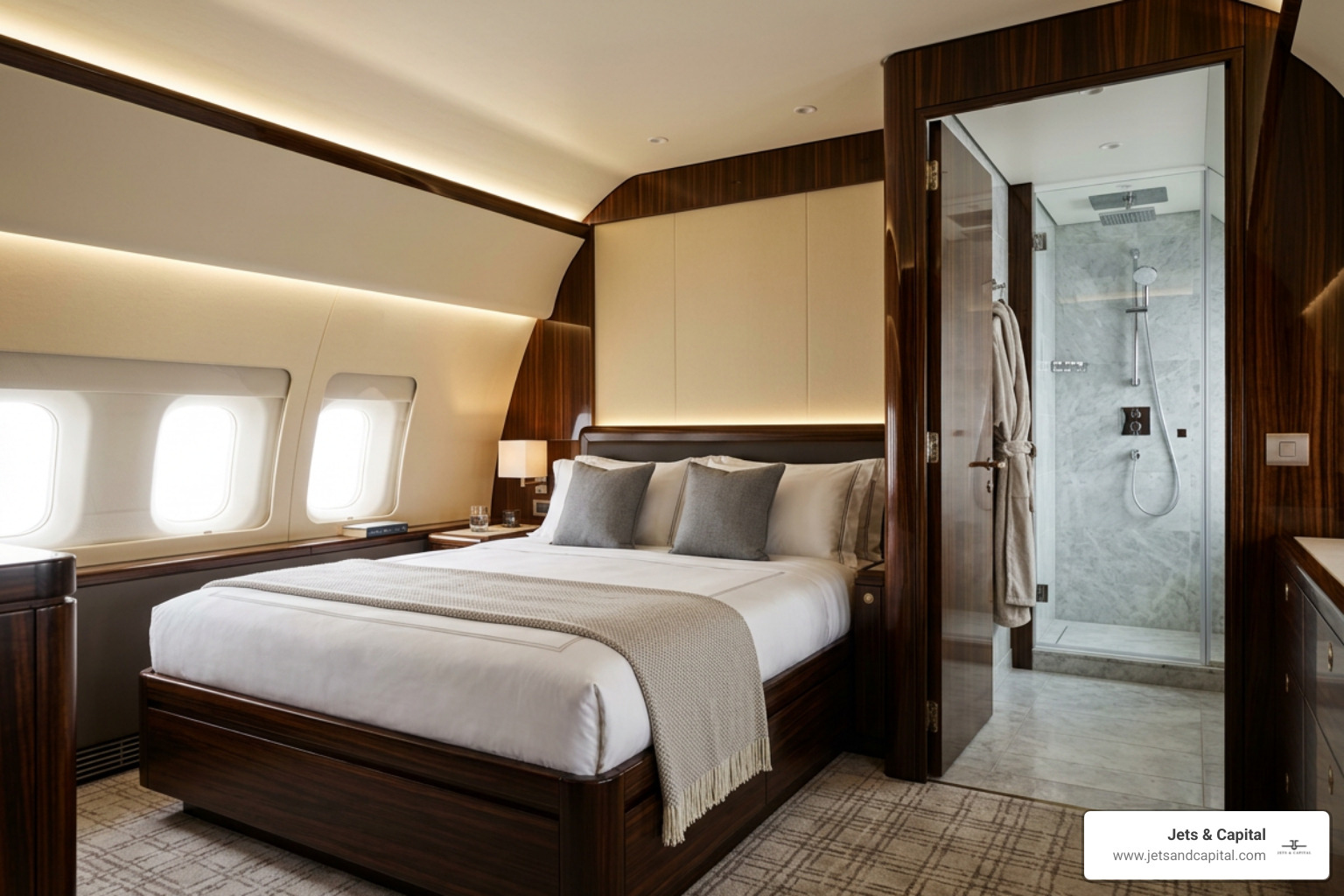
For high-capacity corporate missions, heads of state, and family offices, VIP airliners like Boeing Business Jets (BBJ 737 MAX, BBJ 787) offer true residential layouts. These aircraft feature private conference suites, formal dining areas, and luxury jets with bedrooms equipped with private en-suite showers.
Evaluating Pricing Models: Charter, Jet Cards, and Fractional Shares
Capital allocation in private aviation requires balancing annual flight hours against capital risk, depreciation, and dispatch reliability.
On-Demand Charter vs. Jet Card Memberships
On-demand charter delivers maximum flexibility with zero capital commitment. You pay on a trip-by-trip basis, with rates dictated by live market supply and positioning requirements. Estimated route pricing varies by aircraft tier:
- Light Jet (e.g., New York to Miami): Starts around $15,000
- Super-Midsize Jet (e.g., New York to Los Angeles): Starts around $34,000
- Large Jet (e.g., New York to London): Starts around $93,000
The trade-off with ad-hoc charter is dynamic peak pricing and potential aircraft availability bottlenecks.
Jet card memberships resolve this by locking in guaranteed availability (often with 24- to 48-hour call-out windows) and fixed hourly rates across pre-selected cabin tiers. Leading jet cards feature zero blackout dates and transparent fee structures, making them ideal for companies flying between 50 and 100 hours annually.
Fractional Ownership and Supplemental Enterprise Lift
When executive flight requirements exceed 100 hours annually, fractional ownership offers an equity-based solution. Buyers purchase a fractional share (e.g., a 1/16th share equivalent to 50 annual flight hours) in a dedicated fleet.
Key benefits of fractional structures include:
- Asset Depreciation: Opportunities to leverage tax depreciation frameworks (such as bonus depreciation) on capital assets.
- Guaranteed Cabin Consistency: Uniform interior appointments, flight deck configurations, and onboard Wi-Fi.
- Flight Hour Rollover: Modern contracts often include rollover provisions (e.g., carrying over up to 25% of unused annual hours).
- Supplemental Lift Coverage: Fractional providers seamlessly dispatch alternative tail numbers if an assigned aircraft encounters maintenance, ensuring continuous enterprise mobility.
Essential Safety Standards and Aircraft Management Services
Safety in private aviation extends far beyond baseline regulatory minimums. High-performing business jet operators invest heavily in third-party safety audits, continuous airworthiness protocols, and mature Safety Management Systems (SMS).
Vetting Flight Safety Benchmarks: ARGUS, Wyvern, and IS-BAO
Enterprise travel planners must verify third-party safety accreditations before entering an aircraft agreement. The three most respected global auditing bodies are:
- ARGUS (Aviation Research Group United States): Evaluates operational history, pilot records, and maintenance systems. The ARGUS Platinum rating represents the top tier of operators globally. Real-time TripCHEQ reports verify pilot flight hours and crew pairing for every flight.
- Wyvern: Renowned for its Wyvern Wingman standard, requiring operators to exceed statutory safety baselines through ongoing operational data tracking and risk profiling.
- IS-BAO (International Standard for Business Aircraft Operations): A code of best practices established by the International Business Aviation Council (IBAC), certifying operators across progressive stages of SMS implementation.
Top-tier operators also implement Flight Operations Quality Assurance (FOQA) systems to continuously capture flight telemetry data and identify potential operational variances before they become safety hazards.
Fixed-Base Operators, Maintenance Logistics, and Hangar Infrastructure

An executive flight’s operational integrity depends on ground support networks. Fixed-Base Operators (FBOs) function as private airport terminals, providing ramp space, passenger lounges, discrete meeting rooms, and planeside valet services.
Behind the scenes, comprehensive aircraft management companies coordinate:
- Continuing Airworthiness Management (CAMO): Tracking service bulletins, engine cycles, and airframe structural life.
- 24/7 AOG (Aircraft On Ground) Support: Mobilizing rapid-response technicians to resolve unexpected mechanical issues on the tarmac.
- Secure Hangarage: Protecting multi-million-dollar airframes from environmental degradation and securing ramp parking. For a detailed operational breakdown of hangar asset management, explore our private jet hangar guide 2026.
Strategic Enterprise Travel and Executive Mission Profiles
Business aviation is a tactical instrument for capital deployment, organizational continuity, and rapid enterprise response.
Roadshows, Board Mobility, and Specialized Business Jet Airlines Charters
High-stakes corporate initiatives require logistics that standard commercial travel cannot accommodate:
- M&A Roadshows: Enabling deal teams to visit facilities across three separate states in a single day, adjusting routes dynamically as talks progress.
- Synchronized Board Arrivals: Coordinating multiple aircraft departures from across the country to land executive leadership simultaneously at a central location.
- Specialized Group Charters: Utilizing VIP-configured airliners for international sports team tours, large corporate delegations, or live entertainment crews.
- Emergency Lift: Rapidly deploying medical evacuation aircraft or supplemental backup flights when owned corporate aircraft are grounded.
Executing regional trips—such as coordinating San Francisco executive flight logistics—demands specialized planning around urban airspace, runway lengths, and private terminal handling.
Beyond point-to-point transit, private aviation environments offer unmatched networking value. Connecting with fellow allocators, family offices, and executives within these exclusive settings is explored in our guide on private jet networking.
Fleet Decarbonization, Sustainable Aviation Fuels, and Market Outlook
The business jet market continues to evolve rapidly. In 2022, 712 business jets were delivered worldwide, led in billing volume by major aerospace manufacturers like Gulfstream and Bombardier.
As fleet deliveries expand, sustainability remains a central priority:
- Sustainable Aviation Fuel (SAF): SAF drops directly into conventional turbine engines, reducing lifecycle carbon emissions by up to 80% compared to conventional jet fuel.
- Aerodynamic Innovations: Clean-sheet wing profiles, such as advanced smooth-flex designs, minimize drag, optimize fuel burn, and provide a smoother ride through turbulence.
- Predictive Business Intelligence: Modern flight departments utilize automated data tools to optimize flight trajectories, forecast maintenance bottlenecks, and manage fuel reserves efficiently.
Frequently Asked Questions About Business Aviation
How far in advance do I need to book a business jet flight?
While booking 24 to 48 hours in advance is standard for securing specific aircraft categories, many Part 135 charter operators can prepare and dispatch an aircraft in as little as 2 to 4 hours for urgent domestic missions. Jet cards typically feature contractually guaranteed call-out windows of 24 to 48 hours with no peak surcharges.
What is the primary safety distinction between Part 91 and Part 135 operators?
FAR Part 91 governs private corporate flight operations where no commercial fare is charged. FAR Part 135 establishes strict federal safety regulations for commercial air charter, enforcing higher pilot flight-hour minimums, mandatory crew rest cycles, structured drug testing, and FAA-approved maintenance schedules.
What are the standard luggage and pet policies on business aircraft?
Luggage capacity depends on cabin class; super-midsize and heavy jets offer accessible in-flight baggage compartments holding multiple full-size bags and golf sets. Pet policies on private aircraft are exceptionally accommodating—pets are generally permitted to travel unrestrained in the cabin alongside passengers, subject to basic carrier size rules and DOT documentation.
Conclusion
Navigating private aviation requires matching your organization's mission profile to the right aircraft class and operational structure. Whether leveraging semi-private scheduled routes for swift regional hops, utilizing on-demand charters for dynamic corporate roadshows, or securing fractional shares for consistent transcontinental capability, private aviation remains an unparalleled catalyst for enterprise efficiency.
At Jets & Capital, we operate at the intersection of private aviation and private capital. We organize exclusive, invite-only networking events for family offices, institutional investors, and UHNWIs inside premier private jet hangars—including our upcoming Super Bowl Edition in San Francisco, CA. Through our strict vetting standard that maintains 85% allocators, we create an environment tailored for genuine deal-making and relationship building.
To evaluate how private aircraft platforms can elevate your enterprise travel framework, explore our comprehensive analysis of luxury corporate jets.
