
Detailed Guide to Private Jet Hangar Rental Options
Why a Private Jet Hangar Is One of the Most Important Decisions You'll Make as an Aircraft Owner
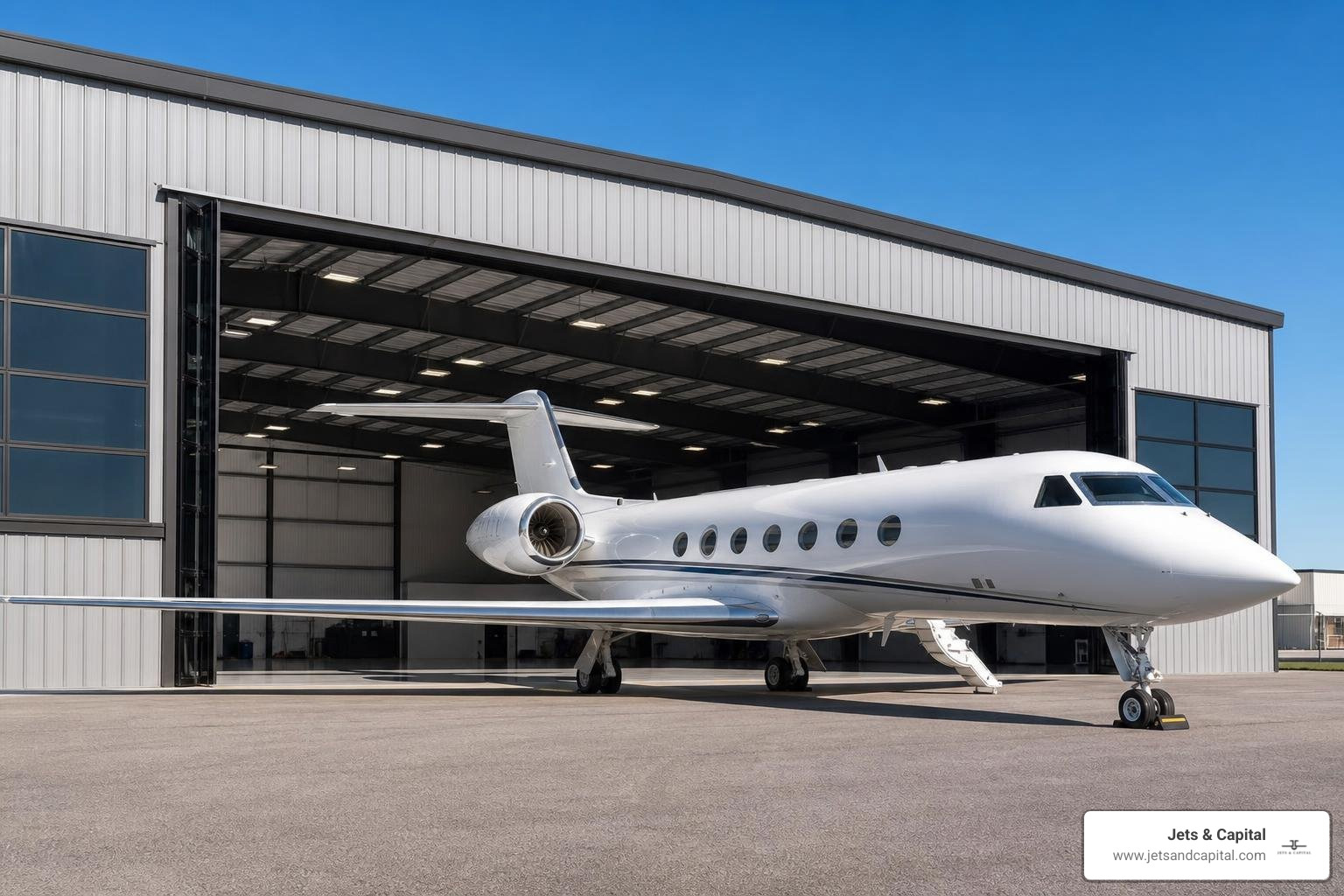
A private jet hangar is a secure, enclosed structure built specifically to protect your aircraft from weather, theft, and environmental damage — and it's one of the most consequential decisions you'll make after acquiring your jet.
Here's what you need to know at a glance:
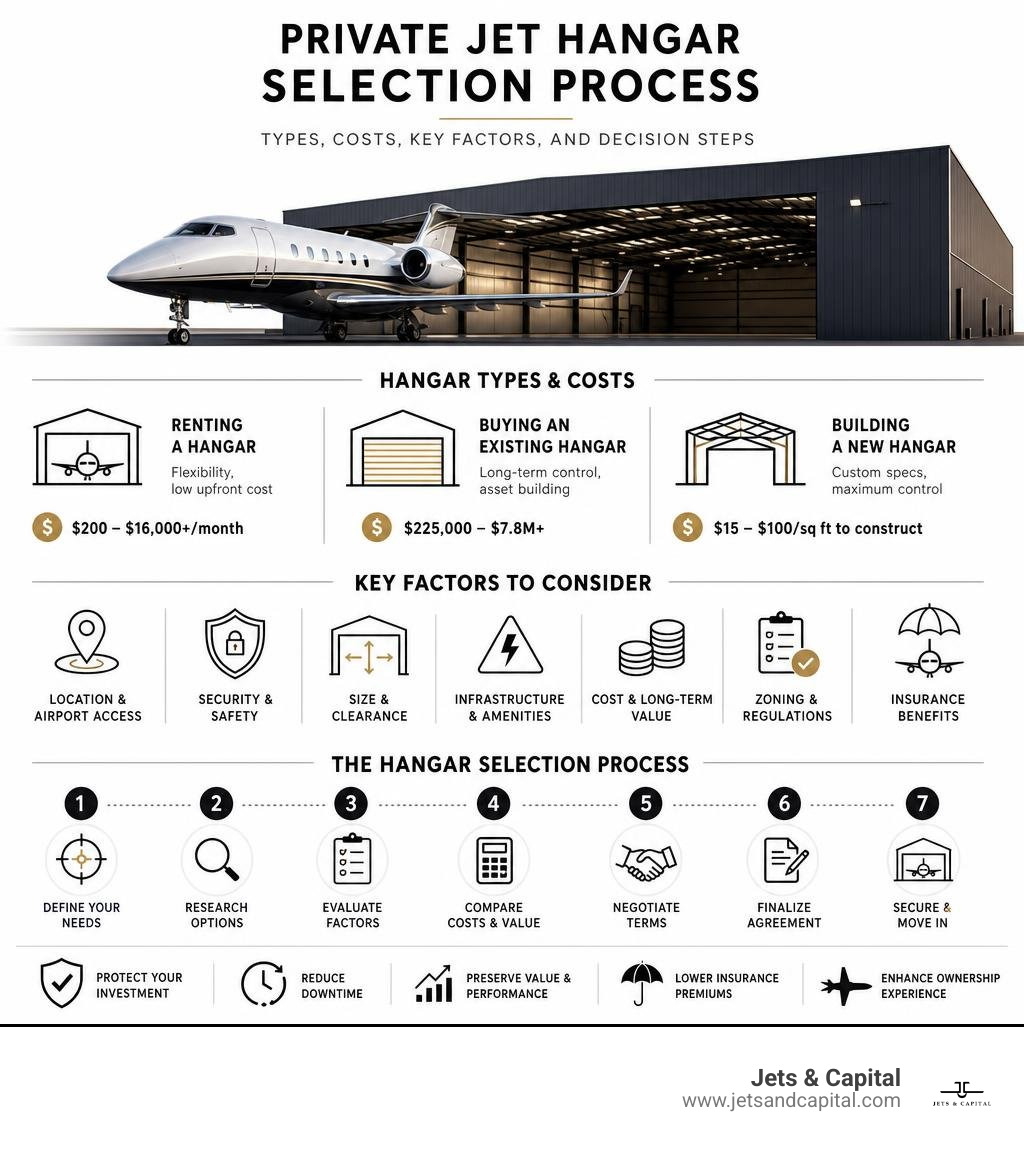
| Decision | Best For | Cost Range |
|---|---|---|
| Renting a hangar | Flexibility, low upfront cost | $200 – $16,000+/month |
| Buying an existing hangar | Long-term control, asset building | $225,000 – $7.8M+ |
| Building a new hangar | Custom specs, maximum control | $15 – $100/sq ft to construct |
A few key facts to orient you:
- Jet hangar rentals start around $3,000/month and can exceed $16,000/month in high-demand markets like Miami
- Annual storage fees range from roughly $36,000 for smaller jets to over $100,000 for large, long-range aircraft
- Construction costs typically fall between $15 and $100 per square foot for a new build
- The hangar market has a chronic supply shortage — finding quality space in major metro airports often requires industry relationships or specialized brokers
- Storing your aircraft in a private hangar can directly lower your insurance premiums, since insurers recognize reduced exposure to weather, theft, and ground damage
Beyond cost, the right hangar is about protecting a multi-million dollar asset. Leaving a jet exposed to UV rays, moisture, and temperature swings shortens its operational life and erodes its resale value. As one industry perspective puts it: your aircraft deserves more than just a parking spot.
I'm Jordan Hutchinson, founder of Jets & Capital, and through years of organizing elite events inside private jet hangars — from exclusive investor networking evenings to high-level deal conversations — I've seen how the right facility shapes not just aircraft protection, but the entire ownership experience. In this guide, I'll walk you through every cost, specification, and decision factor you need to find the right hangar for your aircraft.
Understanding the Private Jet Hangar: Protection, Types, and Benefits
When we think of a private jet hangar, we should view it as an asset preservation sanctuary rather than a simple garage. The physical environment directly impacts your aircraft's avionics, exterior paint, and interior leather. Left outside on a ramp, a multi-million dollar aircraft faces constant environmental exposure, including UV radiation, moisture, and extreme temperature swings.
Over time, this exposure accelerates wear and tear, leading to higher maintenance costs and a steep decline in resale value. Furthermore, a private hangar provides uncompromised peace of mind through restricted-access entry, advanced surveillance, and 24/7 on-site oversight, protecting your asset from physical tampering or accidental ground damage.
Renting vs. Buying vs. Building a Private Jet Hangar
Choosing how to secure your hangar space is a balancing act between capital expenditure, long-term operational control, and flexibility.
- Renting: This is the most flexible route. It requires minimal upfront capital and allows you to easily relocate your aircraft if your travel patterns or home base change. However, you are subject to lease renewals, rising rental rates, and the rules of the facility operator.
- Buying: Buying an existing hangar gives you immediate operational control and builds equity in a tangible real estate asset. It eliminates the risk of lease termination, though you must still navigate airport ground leases, which typically run for 25 years or more.
- Building: For those with highly specific requirements, constructing a custom facility is the ultimate option. While it demands significant development costs and lengthy airport approvals, it allows you to design a space tailored precisely to your fleet. For instance, high-end developments like the project at 5310 Fairmont Hangar Road demonstrate how a custom-built facility can integrate flight planning rooms, multi-level offices, and viewing decks to create a personalized corporate headquarters.
Key Benefits of Owning a Private Jet Hangar
Owning your hangar—whether by buying or building—unlocks several key operational advantages. First, it offers immediate, unrestricted access to your aircraft. You do not have to wait for an FBO (Fixed-Base Operator) crew to pull your jet out of a shared space, which minimizes pre-flight downtime.
Second, it allows you to provide personalized care for your fleet. You can customize the climate control, flooring, and maintenance bays to match the exact requirements of your Luxury Private Planes.
Additionally, storing your aircraft in a privately owned, highly secure hangar can lead to substantial insurance savings. Insurance underwriters recognize that a dedicated, climate-controlled environment significantly reduces the risk of weather-related claims, hangar rash, and theft, often rewarding owners with lower premiums.
Financial Breakdown: Costs to Rent, Buy, or Build
Understanding the financial commitment of hangar storage is essential for budgeting your overall aircraft operating costs. The market in July 2026 continues to see high demand, particularly in major corporate and luxury hubs.

To help you visualize the financial tradeoffs, we have outlined the standard cost structures below:
| Hangar Option | Upfront Capital | Ongoing Monthly Cost | Key Financial Factor |
|---|---|---|---|
| Renting | Minimal (Security Deposit) | $3,000 – $16,000+ | Subject to regional market inflation |
| Buying | $225,000 – $7.8M+ | Utilities, Maintenance, Taxes | Ground lease fees apply |
| Building | $15 – $100 per sq. ft. (Construction) | Utilities, Maintenance, Ground Lease | High initial development and soft costs |
Hangar Rental Rates and Influencing Factors
Hangar rental rates vary widely based on your aircraft's size, the region, and the length of your lease. While a small single-engine aircraft might rent space for $200 to $700 per month, a dedicated private jet hangar space starts at $3,000+ per month in standard markets. In high-demand metropolitan areas like Miami, New York, or San Francisco, monthly rental rates can easily exceed $16,000.
Your aircraft's physical dimensions are the primary driver of these costs. A large cabin jet requires significantly more clear span and vertical clearance than a light turboprop. To optimize these costs, many owners utilize specialized facilities like Jet 1 Suites: Premier Hangar Space by Royal Air, which offer private hangar suites paired with dedicated luxury lounges, offices, and NATA-certified ground handling.
Capital Costs for Buying or Building
If you choose to purchase or build, the capital requirements scale with the size and location of the facility. Small private hangars can start in the low- to mid-five figures, while large, executive-class facilities cost several million dollars.
For a new build, construction costs generally fall between $15 and $100 per square foot, depending on the complexity of the steel framing, foundation requirements, and local labor rates.
Furthermore, you must account for land development costs and the complex process of securing airport authority approvals. Premium corporate developments, such as the OPF Hangars - Business Aviation Group at Miami-Opa Locka Executive Airport, showcase the scale of these investments. These 21,000-square-foot facilities feature 28-foot door heights, heavy-duty epoxy floors, and integrated office spaces designed to accommodate ultra-long-range business jets.
Recurring Operational and Maintenance Fees
Owning a hangar does not stop at the purchase price or construction cost. Owners must budget for significant ongoing operational and maintenance expenses:
- Hangar Door Systems: Specialized doors, such as bifold or bottom-rolling systems, require regular inspections, track cleaning, and motor maintenance to prevent costly operational delays.
- HVAC and Climate Control: Keeping a massive clear-span space heated or cooled requires heavy-duty climate systems and high-volume low-speed (HVLS) fans.
- Ground Leases: Because airports are typically built on public land, you will likely own the building structure while paying a recurring ground lease fee to the airport authority.
- Property Taxes and Insurance: Commercial property taxes and comprehensive structural insurance are mandatory to protect your real estate asset.
Facilities like the LGB AVIATION CENTER demonstrate the scale of these operational requirements, utilizing massive 30-foot doors, fully insulated building envelopes, and extensive utility connections to service corporate fleets efficiently.
Overlooked and Hidden Hangar Expenses
Whether you rent or own, several hidden expenses can catch buyers and tenants off guard. For renters, FBO fees, towing charges, and mandatory fuel minimums can quickly inflate your monthly bill. For owners, compliance audits to meet strict FAA hangar use policies, environmental regulations (such as wastewater management for wash bays), and fire suppression system certifications are major recurring costs.
When acquiring a Private Jet Under 30 Million, budgeting for these operational layers is just as critical as the acquisition price of the aircraft itself.
Essential Design Features and Location Selection
Selecting or designing the perfect hangar requires a deep understanding of both structural specifications and geographic logistics.

Critical Hangar Specifications and Dimensions
A modern hangar must be engineered to match the exact wingspan and tail height of your aircraft. Standard private aircraft dimensions often include 30×40, 50×60, and 80×100 feet, while larger business jets require dimensions like 100×125 feet or even 240×250 feet for multi-aircraft fleets.
Beyond raw floor space, key specifications include:
- Door Type: Bifold doors (like Schweiss systems) offer excellent wind resistance and lift upward to maximize clear opening space, while bottom-rolling doors provide ultimate staging flexibility.
- Climate Control: Insulated, heated, and air-conditioned spaces protect sensitive avionics from moisture damage.
- Clear Span: A column-free interior structure is essential to maneuver aircraft safely without risk of wing clipping.
For example, the premium facilities at Home - Hangar V feature 10,000 square feet of insulated, heated storage with a 70-foot bifold door and 20 feet of vertical clearance, paired with a luxury pilot lounge.
Choosing the Right Airport and Location
Your choice of airport is just as critical as the hangar itself. You must evaluate runway length, airport operational hours, and the presence of Customs and Border Protection (CBP) for international flights. Furthermore, establishing strong relationships with local FBOs can yield significant savings on fuel and ground handling.
In busy metropolitan regions like California, facilities such as Jay's Air Center | John Wayne Airport provide sustainably built, prestigious hangar options with direct airfield access, allowing busy executives to bypass commercial traffic and transition seamlessly from the runway to their next meeting.
Simplifying the Search: Management Companies and Brokers
Navigating the highly competitive hangar market can be incredibly challenging for individual owners. This is where professional aviation management companies and specialized brokers become invaluable partners.
The Role of Aircraft Management Companies
An aircraft management company simplifies the entire process by leveraging existing relationships with airports and FBOs to secure off-market hangar space. They handle the day-to-day burdens of facility management, compliance tracking, and security monitoring.
Additionally, managing your hangar through a professional operator allows you to bundle real estate costs with operational savings. These companies often negotiate volume discounts on fuel, maintenance packages, and crew services, drastically improving the efficiency of operating Luxury Corporate Jets.
Frequently Asked Questions
What are the monthly rental rates for aircraft storage?
Monthly rental rates vary significantly by region and aircraft size. Small single-engine aircraft hangars typically cost between $200 and $700 per month. For private jets, standard hangar spaces start at $3,000+ per month, while premium, high-demand executive airports in metropolitan areas like Miami, New York, or San Francisco can exceed $16,000 per month.
What are the standard dimensions for aircraft hangars?
Common dimensions for private aircraft and light turboprops include 30×40, 50×60, and 80×100 feet. For larger corporate and business jets, standard hangar sizes expand to 100×125 feet or 240×250 feet to ensure adequate wingspan clearance, tail height, and clear-span maneuvering room.
Can these facilities be used for non-aviation purposes?
The FAA strictly regulates hangars on government-funded airfields, requiring them to be used primarily for aeronautical purposes like aircraft storage, maintenance, and flight planning. However, with proper approvals, private hangars can serve as prestigious venues for high-end corporate gatherings and Private Jet Hangar Events, blending industrial scale with luxury hospitality.
Conclusion
Securing the right private jet hangar is a strategic decision that directly impacts your aircraft's long-term value, operational readiness, and safety. Whether you choose the flexibility of renting, the equity of buying, or the customization of building, aligning your decision with your long-term aviation goals is paramount.
At Jets & Capital, we understand that a hangar is far more than just industrial storage—it is a secure base of operations and a premier venue for connection. We host exclusive, invite-only networking events inside luxury private jet hangars across prime locations like San Francisco, Miami, Las Vegas, and Dallas. By maintaining a strict vetting process that ensures our guest list consists of 85% allocators, we transform these impressive aviation spaces into high-quality environments for relationship building and deal-making.
To learn more about our upcoming exclusive gatherings and how we connect elite investors, explore our guide to Private Jet Networking.
