
What Does a $30 Million Private Jet Actually Get You?
What a Private Jet Under 30 Million Actually Gets You in 2026
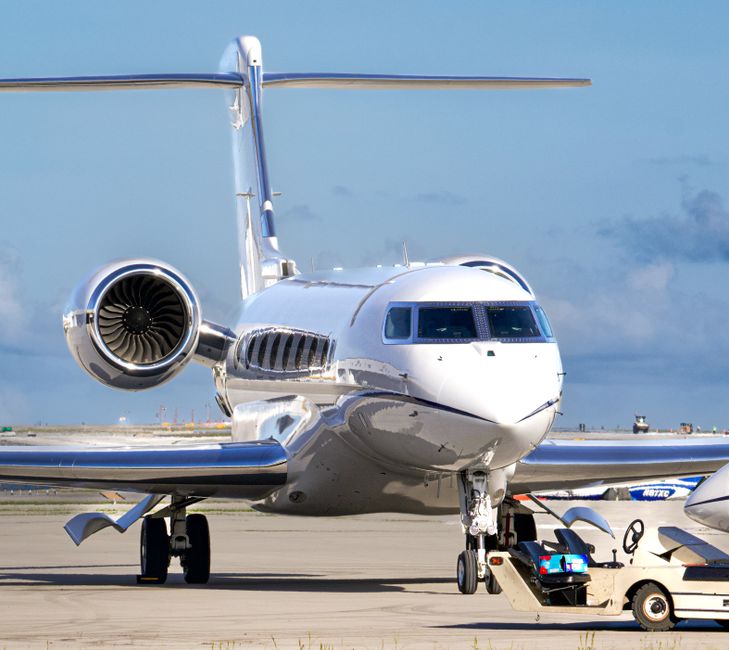
The $30 million budget is one of the most powerful sweet spots in private aviation. It opens the door to new super-midsize jets, lightly used large-cabin aircraft, and even pre-owned ultra-long-range jets — all from the world's top manufacturers.
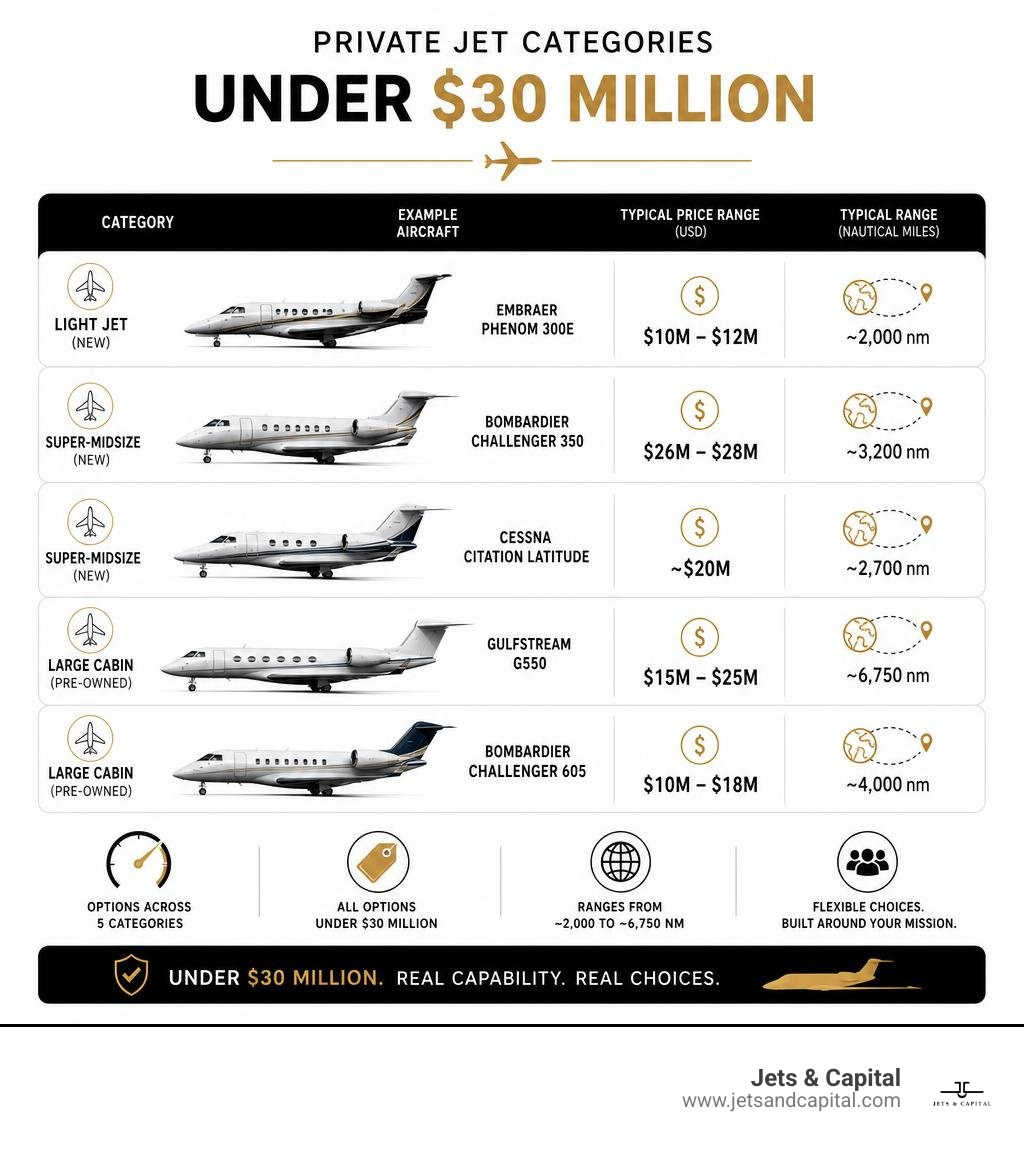
Here's a quick snapshot of what's available at this price point:
| Category | Example Models | Typical Price Range | Range |
|---|---|---|---|
| Light Jet (new) | Embraer Phenom 300E | $10M - $12M | ~2,000 nm |
| Super-Midsize (new) | Bombardier Challenger 350 | $26M - $28M | ~3,200 nm |
| Super-Midsize (new) | Cessna Citation Latitude | ~$20M | ~2,700 nm |
| Large Cabin (pre-owned) | Gulfstream G550 | $15M - $25M | ~6,750 nm |
| Large Cabin (pre-owned) | Bombardier Challenger 605 | $10M - $18M | ~4,000 nm |
Prices reflect approximate 2026 market values for new and pre-owned aircraft.
The $30 million ceiling used to mean settling for a midsize cabin or limited range. Today, it means real choices — and real trade-offs worth understanding before you sign anything.
There are over 24,000 private jets operating worldwide, with hundreds actively listed for sale at any given time. The pre-owned market alone offers significant value, with jets depreciating 5–10% annually in their first five years. That depreciation curve is your opportunity.
This guide cuts through the noise. We'll compare the top models, break down true ownership costs, and help you match the right aircraft to your actual mission.
I'm Jordan Hutchinson — founder of Jets & Capital, investor, and a longtime participant in the private aviation space where I've helped high-net-worth individuals and family offices evaluate private jet under 30 million acquisitions as both assets and lifestyle tools. My work connecting principals at exclusive aviation-focused events gives me a front-row seat to how serious buyers think about this market. Let's get into it.
Market Dynamics: Buying a Private Jet Under 30 Million in 2026
The market for a private jet under 30 million is highly dynamic as we cross into mid-2026. While ultra-long-range giants like the Gulfstream G700 command eye-watering price tags near $80 million, the $5 million to $30 million range remains the active engine of the business aviation industry.
Currently, global pre-owned inventory has stabilized after the wild fluctuations of the early 2020s. Buyers looking at Private jets for sale worldwide - AvBuyer.com will notice a healthier balance of clean, low-time aircraft compared to previous years. In the United States—which proudly plays host to roughly 63% of the world's 24,270 operational private jets—activity is highly concentrated around major financial and luxury hubs. Whether you are operating out of New York, Miami, Dallas, or Las Vegas, access to inventory has improved, but securing a premium tail number still requires speed and a vetted team.
Several key trends define the market today:
- The Flight to Efficiency: Rising corporate environmental mandates and fuel cost awareness have made highly efficient super-midsize and modern light jets incredibly popular.
- Smarter Mission Matching: Rather than buying the largest possible plane "just in case," family offices and corporate flight departments are buying for their 85% mission profile and chartering for the rest.
- Pre-Owned Superiority: A massive wave of aircraft delivered in the mid-2010s is hitting the pre-owned market. These jets have already absorbed their steepest depreciation hit but still feature modern avionics and highly efficient engines.
New vs. Pre-Owned Value for a Private Jet Under 30 Million
When allocating up to $30 million, you face a classic luxury aviation dilemma: Do you buy a brand-new, smaller jet with a factory warranty, or do you buy a larger, older, pre-owned jet with significantly more cabin space?
New aircraft bring immense peace of mind. Buying a factory-fresh light or midsize jet means you get the latest cockpit technology, a pristine interior customized to your tastes, and comprehensive manufacturer warranties that shield you from unexpected maintenance bills for the first few years. However, new jets also absorb a steep initial depreciation hit—often 5% to 10% annually during the first five years of operation.
On the flip side, the pre-owned market is where your $30 million can purchase massive capability. For instance, you could acquire a pre-owned heavy jet or ultra-long-range platform that cost $60 million new. While these older models have already stabilized on their depreciation curves, they carry higher ongoing maintenance risks. To mitigate this, smart buyers look for aircraft enrolled in hourly maintenance programs like Rolls-Royce CorporateCare or JSSI (Jet Support Services Inc.). These programs turn unpredictable maintenance events into predictable hourly operating costs, ensuring your asset remains a tool rather than a liability. For a deeper dive into how billionaires approach these asset decisions, check out our insights on Billionaire Luxury Private Jets.
Comparing Aircraft Classes: Light, Midsize, and Super-Midsize
Understanding the physical boundaries of each aircraft class is critical to making an informed purchase:
- Light Jets: Typically priced between $3 million and $12 million. These aircraft, such as the Embraer Phenom 300E, are perfect for regional trips under 2,000 nautical miles. They require shorter runways, meaning they can access smaller local airports closer to your final destination. They are often certified for single-pilot operation, which significantly reduces crew costs.
- Midsize Jets: Priced between $12 million and $20 million. This class offers a true stand-up cabin, an enclosed lavatory, and a range of up to 2,700 nautical miles. It is the sweet spot for transcontinental travel (e.g., New York to West Palm Beach or Dallas to San Francisco) with up to 8 passengers in comfort.
- Super-Midsize Jets: Priced between $20 million and $30 million. These represent the pinnacle of performance and efficiency under our budget ceiling. With ranges exceeding 3,200 nautical miles, they easily connect coast-to-coast destinations non-stop against strong winter headwinds, all while offering wide-body cabin comfort and full galleys.
Choosing the right class means matching your frequent routes to the runway capabilities of your local airports. For a comprehensive look at how cabin sizes and aircraft classes impact your overall travel experience, explore our guide to Luxury Private Planes.
Top Aircraft Models Under $30 Million

At the $30 million mark, the market opens up to some of the most celebrated and reliable aircraft ever built. Below, we compare the key performance metrics of the top models dominating this segment in 2026.
| Aircraft Model | Class | Typical Pre-Owned Price (2026) | Max Range (nm) | High-Speed Cruise (ktas) | Passenger Capacity |
|---|---|---|---|---|---|
| Bombardier Challenger 350 | Super-Midsize | $16M - $22M | 3,200 | 470 | 9 - 10 |
| Cessna Citation Latitude | Super-Midsize | $15M - $19M | 2,700 | 446 | 8 - 9 |
| Gulfstream G550 | Large / Heavy | $14M - $22M | 6,750 | 488 | 14 - 19 |
| Embraer Phenom 300E | Light | $9M - $11M (New: $12M) | 2,010 | 464 | 7 - 10 |
The Best Super-Midsize Private Jet Under 30 Million: Challenger 350 vs. Citation Latitude
The super-midsize category is fiercely contested, with two dominant forces occupying the space under $30 million: the Bombardier Challenger 350 and the Cessna Citation Latitude.
The Bombardier Challenger 350 is widely regarded as one of the best-selling business jets of the last decade, and for good reason. It offers a true flat-floor cabin, exceptional baggage capacity, and a robust 3,200-nautical-mile range. This allows you to fly from Miami to Seattle or New York to London with ease. Its cabin is incredibly quiet, making it a favorite for executives who need to stay productive in flight. Learn more about how the Challenger series ranks among the Best Jets in the World.
The Cessna Citation Latitude, by contrast, is the king of efficiency and runway performance. While it has slightly less range (2,700 nm) than the Challenger 350, it features a remarkably wide, bright cabin with large windows and a low cabin altitude that reduces travel fatigue. The Latitude can access shorter runways, giving you more flexibility when planning trips to tighter airports in places like Salt Lake City or Palm Beach. It also boasts lower hourly fuel burn rates, making it highly attractive to budget-conscious flight departments.
Large-Cabin Value: Pre-Owned Gulfstream G550
For buyers who need transoceanic range and a commanding ramp presence, a pre-owned Gulfstream G550 is an extraordinary value proposition under $30 million. Originally retailing for over $60 million, early-to-mid-2010s models can now be acquired well within our budget.
The G550 is a legendary ultra-long-range workhorse. With a range of 6,750 nautical miles, it can effortlessly fly you from San Francisco to Tokyo or Miami to Geneva non-stop. The cabin can be configured into up to four distinct living areas, including a dedicated crew rest area, a private stateroom, and a full-service aft galley.
However, operating a G550 is not for the faint of heart. Its physical size means higher hangar fees, dual-pilot type rating requirements, and significantly higher fuel burn compared to super-midsize options. But if your mission profile demands global reach and maximum cabin capacity, it stands as one of the Fastest Private Jet in the World options available at this price point.
Light Jet Leaders: Embraer Phenom 300E
If your typical mission involves flying 4 to 6 passengers on regional routes, a new or lightly used Embraer Phenom 300E represents the pinnacle of light jet luxury and efficiency.
The Phenom 300 series has held the crown of the world's best-selling light jet for over a decade. The "E" stands for Enhanced, bringing a completely redesigned cabin with state-of-the-art upper technology panels, more headroom, and an incredibly sleek design. It features a range of just over 2,000 nautical miles and can cruise at an impressive Mach 0.80.
A key advantage of the Phenom 300E is its single-pilot certification, which allows owner-pilots or operations with a single crew member to save significantly on annual crew expenses. On the pre-owned market, you can find excellent examples of this class—such as a well-maintained N505PJ - 2013 EMBRAER PHENOM 300 —for a fraction of the cost of a new super-midsize jet, leaving you with plenty of capital to fund your operating budget.
The Real Cost of Ownership: Operating Budgets and Financing

Acquiring a private jet under 30 million is only the first step. The true cost of ownership lies in the annual operating budget, which is divided into fixed costs and variable costs.
Annual Fixed Costs (Estimated)
These are the expenses you pay regardless of whether the aircraft flies 1 hour or 500 hours:
- Crew Salaries & Training: $150,000 to $350,000 per year (depending on whether you need one or two pilots and their experience level).
- Hangarage: $40,000 to $90,000 annually, depending on your home base (e.g., Dallas, Miami, or New York).
- Hull & Liability Insurance: $30,000 to $150,000 per year.
- Scheduled Maintenance & Subscriptions: $100,000 to $250,000 for avionics databases, tracking software, and basic airframe inspections.
Variable Costs (Per Flight Hour)
These costs scale directly with your utilization:
- Fuel Burn: The largest variable expense. A light jet might burn $1,200 of fuel per hour, while a heavy pre-owned G550 can easily burn $3,500+ per hour.
- Engine & Airframe Programs: $400 to $1,200 per hour to cover eventual engine overhauls.
- Landing & FBO Fees: Varying by airport, but generally $150 to $1,000 per stop.
For a detailed breakdown of hourly rates and how they translate to charter vs. ownership economics, review the Private Jet Rental | Cost & Hourly Rates (2026) guides.
Financing and Acquisition Strategies
Financing a $10 million to $30 million asset requires specialized aviation lenders who understand the unique depreciation curves and regulatory environments of business aircraft. Standard terms typically involve a 20% to 30% down payment, with 5 to 10-year amortization schedules and balloon structures.
For corporate buyers, the tax advantages can be substantial. Under current tax guidelines, businesses can utilize modified accelerated cost recovery systems (MACRS) to depreciate the asset rapidly, offsetting significant corporate tax liabilities. However, to qualify, the aircraft must be utilized primarily for business missions. For an in-depth analysis of corporate structures, leasing options, and tax depreciation strategies, read our guide on Luxury Corporate Jets.
Frequently Asked Questions About Jets Under $30M
How do operating costs compare to chartering?
As a general rule of thumb, full aircraft ownership becomes financially viable when your annual flight time exceeds 200 to 300 hours. If you fly less than 150 hours per year, utilizing jet cards or on-demand charter is almost always more cost-effective. Additionally, many owners choose to place their aircraft on a Part 135 charter certificate managed by a professional aircraft management company. This allows you to generate charter revenue when you aren't using the plane, helping to offset your annual fixed costs.
Can you buy a VIP airliner or ultra-long-range jet for under $30 million?
Yes, but proceed with extreme caution. Older Boeing Business Jets (BBJs) or early-generation Bombardier Global Express models can frequently be found on the pre-owned market for under $30 million. While the massive cabin space is incredibly tempting, the maintenance costs, fuel burn, and hangar requirements for these older airliners are astronomical. For instance, a major 10-year inspection on a VIP airliner can easily cost upwards of $3 million to $5 million. If you have the budget for a newer, high-efficiency aircraft, it is generally the safer financial play.
What are the key factors to consider before purchasing?
Before signing an acquisition agreement, you must thoroughly evaluate three critical areas:
- Your 85% Mission Profile: Do not buy a heavy jet because you plan to fly to Europe once a year. Buy the light or midsize jet that fits your weekly regional commutes, and charter a larger plane for the occasional long-haul trip.
- Runway Requirements: Ensure your preferred aircraft can safely land and take off from your most frequented local airports, taking into account summer heat and passenger weight loads.
- Pre-Buy Inspection: Never bypass a comprehensive pre-buy inspection at an authorized service center. Undisclosed corrosion or overdue engine inspections can instantly add millions to your acquisition cost.
Conclusion
Navigating the market for a private jet under 30 million is a complex but incredibly rewarding journey. Whether you choose the factory-fresh efficiency of a new light jet or the expansive, continent-spanning luxury of a pre-owned heavy jet, your choice will fundamentally change how you conduct business and manage your most valuable asset: time.
But buying the plane is only half the equation. The real magic of private aviation lies in the relationships, deals, and partnerships forged around these incredible machines.
At Jets & Capital, we host exclusive, invite-only networking events directly inside private jet hangars across our key locations, including Las Vegas, Dallas, Salt Lake City, Palm Beach, Miami, New York, and San Francisco. Our events feature a strict vetting process to ensure that 85% of our attendees are qualified allocators, family offices, and ultra-high-net-worth investors. It is the ultimate environment for high-quality deal-making and relationship-building.
Are you ready to connect with the ultimate network in private aviation? Join us at our next exclusive event in Las Vegas and experience the power of the Jets & Capital community firsthand.
