
The Best Jets in the World: Fighter Jets, Private Aviation, and What Sets Them Apart

The best jets in the world span two very different worlds — military fighters that dominate contested airspace, and private aircraft that redefine what long-range travel can feel like.
Here's a quick answer if you're short on time:
Top 10 Best Jets in the World (2025/2026)
| Rank | Jet | Type | Key Strength |
|---|---|---|---|
| 1 | Lockheed Martin F-35 Lightning II | 5th-gen fighter | Sensor fusion, stealth, 20+ nations |
| 2 | Lockheed Martin F-22 Raptor | 5th-gen fighter | Stealthiest jet, air dominance |
| 3 | Chengdu J-20 Mighty Dragon | 5th-gen fighter | Range, payload, scale |
| 4 | Sukhoi Su-57 Felon | 5th-gen fighter | Agility, low cost |
| 5 | Boeing F-15EX Eagle II | 4.5-gen fighter | Fastest, heaviest payload |
| 6 | Dassault Rafale | 4.5-gen fighter | Combat-proven, versatile |
| 7 | Eurofighter Typhoon | 4.5-gen fighter | Agility, NATO backbone |
| 8 | Sukhoi Su-35S | 4th-gen fighter | Supermaneuverability |
| 9 | Boeing F/A-18E/F Super Hornet | 4.5-gen fighter | Carrier ops, reliability |
| 10 | General Dynamics F-16 Fighting Falcon | 4th-gen fighter | Most widely deployed |
Best private jet: Bombardier Global 8000 — Mach 0.95, 8,000 NM range, fastest civilian aircraft since the Concorde.
Ranking the world's top jets isn't simple. No single aircraft dominates every category. A jet built for raw speed often trades away stealth. A platform optimized for weapons payload may lack the sensor systems that decide modern air battles before a pilot even spots the enemy.
What's changed the calculus in recent years is this: modern air combat is less about who flies fastest and more about who detects first, fuses data faster, and fires before the other side knows a fight has started. At the same time, in private aviation, the benchmark has shifted from raw speed to combining speed, ultra-long range, and cabin wellness into a single platform.
This guide covers both worlds — military fighters and elite private jets — using objective criteria like stealth, speed, payload, sensor systems, unit cost, and operational scale to explain what actually makes a jet dominant.
I'm Jordan Hutchinson, founder of Jets & Capital, and through years of organizing elite aviation and investment events — from private jet hangars to Formula 1 paddocks — I've developed a perspective on what separates the best jets in the world across both military and private aviation. Whether you're evaluating platforms or simply fascinated by what pushes aerospace to its limits, this breakdown cuts through the noise.
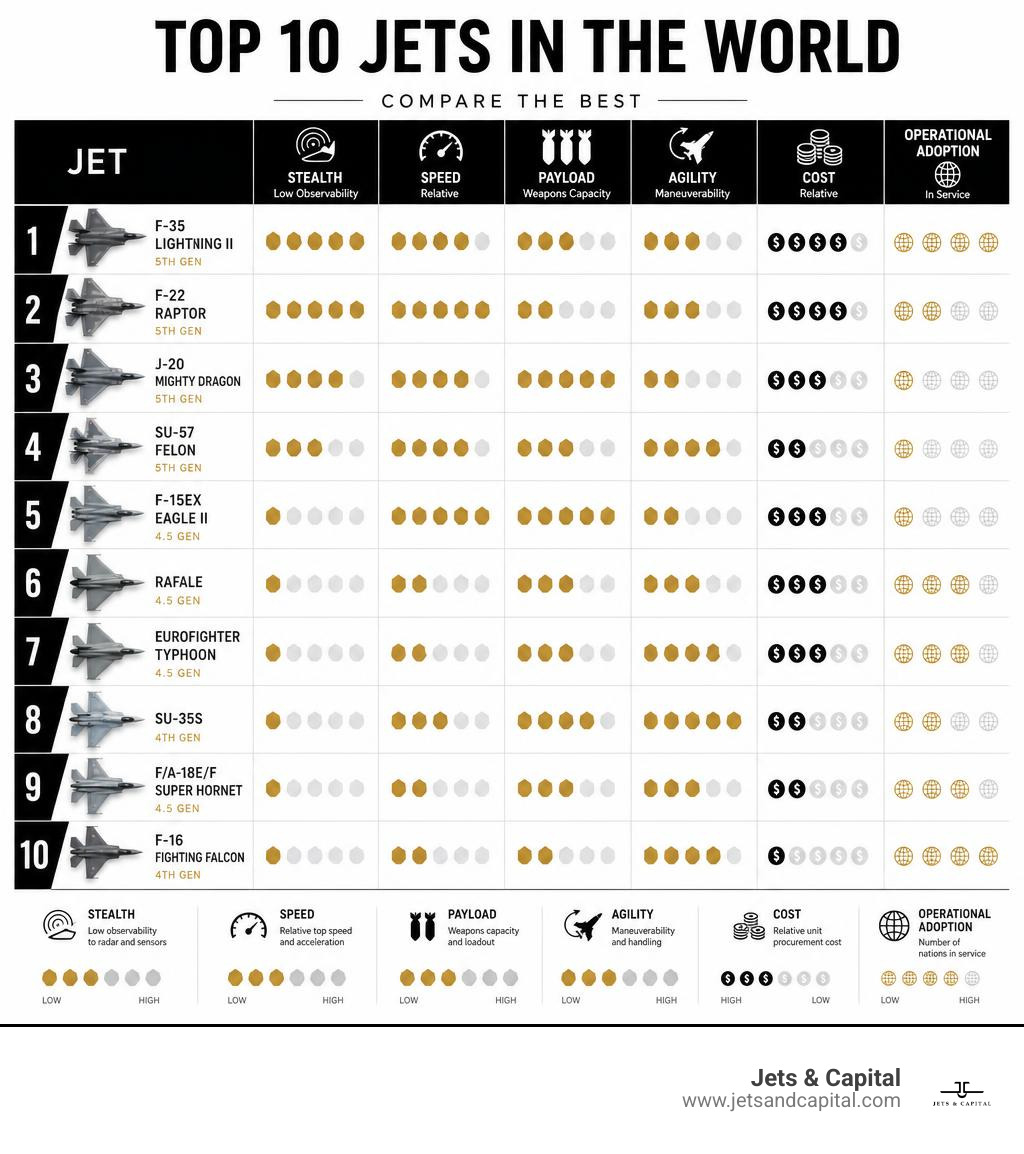
Top 10 Best Jets in the World for 2025/2026: Fighter Jet Ranking
To establish a definitive ranking of the best jets in the world in the military domain, we look beyond the brochures. We evaluate these marvels of engineering using a balanced scorecard that accounts for real-world operational readiness, stealth, speed, agility, weapons payload, unit cost, and combat adaptability.
For a deeper dive into how the global balance of power shapes these rankings, you can explore the Top 10 Fighter Jets in the World in 2026 — Where the U.S. Stands.
| Fighter Jet | Generation | Max Speed | Ferry Range | Max Payload | Radar Cross Section (RCS) | Est. Unit Cost | Active Fleet Size |
|---|---|---|---|---|---|---|---|
| F-35 Lightning II | 5th Gen | Mach 1.6 | 2,200 km | 18,000 lbs (Int. + Ext. "Beast Mode" up to 22,000 lbs) | 0.001 m² | $80M - $109M | 1,000+ delivered (700+ active US/Allied) |
| F-22 Raptor | 5th Gen | Mach 2.25 | 2,960 km | 18,500 lbs | 0.0001 m² | $143M | 178 operational |
| Chengdu J-20 | 5th Gen | Mach 2.0 | 3,400 km | 24,000 lbs | 0.05 m² | $110M | 270 - 300 estimated |
| Sukhoi Su-57 Felon | 5th Gen | Mach 2.0 | 3,500 km | 22,000 lbs | 0.1 - 1.0 m² | $50M | ~22 active (42 built) |
| F-15EX Eagle II | 4.5 Gen | Mach 2.5 | 2,400 km | 29,500 lbs | 25.0 m² | $97M | ~8 operational (scaling to 129+) |
| Dassault Rafale | 4.5 Gen | Mach 1.8 | 3,700 km | 20,900 lbs | 0.1 m² | $125M | 299 active |
| Eurofighter Typhoon | 4.5 Gen | Mach 2.0 | 2,900 km | 19,800 lbs | 0.5 m² | $117M | 533 active |
| Sukhoi Su-35S | 4th Gen | Mach 2.25 | 3,600 km | 17,600 lbs | 1.0 - 3.0 m² | $85M | 118+ active |
| F/A-18E/F Super Hornet | 4.5 Gen | Mach 1.8 | 2,346 km | 17,750 lbs | 1.0 m² | $73M | 827 active |
| F-16 Fighting Falcon | 4th Gen | Mach 2.0 | 4,220 km | 17,000 lbs | 5.0 m² | $80M (Modern Block 70) | 2,084 active |
How We Ranked the Best Jets in the World
Our scoring methodology doesn't rely solely on dogfighting metrics. In modern warfare, a jet's Radar Cross Section (RCS) determines whether it survives long enough to use its weapons. We also evaluate:
- Stealth & RCS: The smaller the radar signature, the higher the survivability.
- Sensor Fusion & Avionics: The ability of Active Electronically Scanned Array (AESA) radar and processors to synthesize battlefield data.
- Weapons Payload: How much ordnance the jet can carry internally (to preserve stealth) or externally.
- Thrust-to-Weight & Agility: Vital for close-in dogfighting and supercruise (flying supersonic without afterburners).
- Unit Cost & Production Scale: A perfect jet that only exists in single-digit quantities cannot win a war of attrition.
1. Lockheed Martin F-35 Lightning II
The F-35 Lightning II is widely regarded as the benchmark of modern multirole aviation. Powered by the Pratt & Whitney F135—the most powerful fighter engine in operational service—the F-35 combines low-observable stealth with an unmatched digital architecture.
Rather than focusing on raw speed, the F-35 is a "flying computer" designed to orchestrate the battlefield. Its sensor fusion capabilities integrate electro-optical, infrared, and electronic warfare data into a single, coherent picture on the pilot's helmet-mounted display. With the ongoing rollout of Block 4 upgrades, its software and processing power continue to grow.
With over 1,000 units delivered and an active presence across 20 allied nations, the F-35 has completely redrawn global defense maps. You can learn more about its development and global operations through the Official F-35 program overview and deep-dive technical insights in I Have Studied Warplanes For Over 20 Years. The F-35 Is More Than Just a Stealth Fighter - 19FortyFive.
2. Lockheed Martin F-22 Raptor
If the F-35 is the ultimate quarterback, the F-22 Raptor is the ultimate assassin. Designed purely for air dominance, the F-22 features a radar cross section of just 0.0001 m²—the smallest of any operational fighter.
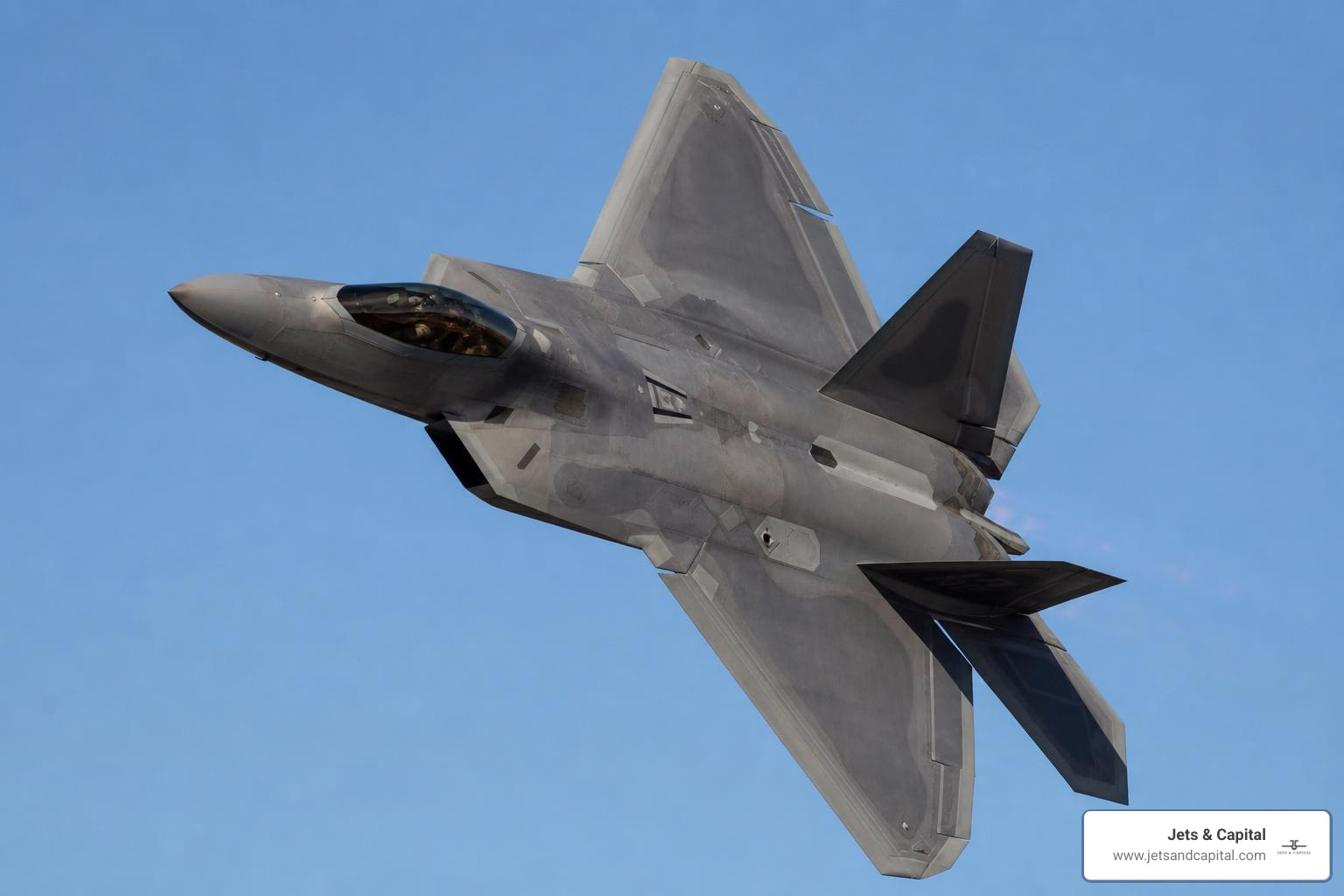
Its twin Pratt & Whitney F119 engines allow it to supercruise at Mach 1.76 without using afterburners, saving fuel while maintaining incredible speeds. Combined with two-dimensional thrust-vectoring nozzles, its agility in close-range combat remains unmatched. However, because production was halted at just 187 aircraft and export sales are strictly banned by U.S. law, the F-22 remains an elite, limited-fleet asset.
3. Chengdu J-20 Mighty Dragon
China's premier stealth fighter, the Chengdu J-20 Mighty Dragon, represents a massive leap in Indo-Pacific air power. With an estimated 270 to 300 units operational in the People's Liberation Army Air Force (PLAAF), production is scaling rapidly.
The J-20 was designed with a massive airframe to accommodate a large internal fuel capacity, compensating for China's historical lack of aerial refueling tankers. It boasts a massive 24,000-lb weapons payload and uses advanced AESA radar. Recent testing of the two-seat J-20S variant also indicates China is preparing the platform for manned-unmanned teaming with "loyal wingman" combat drones.
4. Sukhoi Su-57 Felon
Russia’s entry into the fifth-generation arena, the Sukhoi Su-57 Felon, is an incredibly agile, twin-engine fighter. Priced at an estimated $50 million per unit, it is one of the least expensive fifth-generation platforms ever built.
The Su-57 excels in raw flight performance, utilizing three-dimensional thrust vectoring for extreme maneuverability and reaching speeds of Mach 2. However, its stealth characteristics are widely considered inferior to its U.S. and Chinese counterparts. With only about 22 active units in service and ongoing delays in deploying its next-generation Izdeliye 30 engines, the Felon's impact remains limited by production constraints.
5. Boeing F-15EX Eagle II
The Boeing F-15EX Eagle II proves that stealth isn't the only way to dominate. As a "4.5-generation" heavy fighter, it can carry an astonishing 29,500 lbs of weapons payload—the highest capacity of any fighter jet in the world.
The Eagle II features the Advanced Display Core Processor II, which performs a staggering 87 billion operations per second. This computing power allows it to deploy advanced systems like the StormBreaker smart bomb and hypersonic standoff missiles. Cruising at Mach 2.5, it is faster than both the F-35 and the F-22, making it the ultimate heavy-ordnance "missile truck" for modern air wings. For a detailed breakdown of its speed advantages, read Boeing's F-15EX Eagle II Fighter Is Faster Than Both F-35 and F-22. That's No Typo. - 19FortyFive.
6. Dassault Rafale
France’s Dassault Rafale is a brilliant, combat-proven "omnirole" fighter that has enjoyed immense global export success, particularly in India and the Middle East. Able to carry over 20,000 lbs of ordnance and cruise at Mach 1.8, the Rafale is highly versatile, performing everything from carrier-based operations to nuclear deterrence.
Its SPECTRA electronic warfare suite is legendary for its ability to jam and spoof enemy air defenses, allowing the Rafale to survive in highly contested environments without relying on structural stealth. To understand how the Rafale compares to other elite international designs, check out Best Non-American Fighter Jets 2026: Global Military Aviation Excellence | TheDefenseWatch.com.
7. Eurofighter Typhoon
The Eurofighter Typhoon serves as the defensive backbone of NATO's European allies. With 533 units in service, this twin-engine delta-wing aircraft is optimized for high-altitude interception and dogfighting.
Equipped with the Captor-E AESA radar and capable of Mach 2, the Typhoon has been continuously upgraded with multirole air-to-ground capabilities. Its exceptional thrust-to-weight ratio and climb rate make it one of the premier interceptors in the sky today.
8. Sukhoi Su-35S
The Sukhoi Su-35S represents the absolute pinnacle of fourth-generation Russian aviation. Lacking stealth, the Su-35S compensates with "supermaneuverability" enabled by twin-plane thrust-vectoring nozzles. It can perform physics-defying maneuvers that can easily break an enemy radar lock in a close-range dogfight. It carries a heavy weapons load and remains a highly capable threat in visual-range engagements.
9. Boeing F/A-18E/F Super Hornet
The U.S. Navy’s workhorse, the F/A-18E/F Super Hornet, is a rugged, highly reliable carrier-capable multirole fighter. With 827 units in service, it forms the core of American carrier air wings. While it lacks the high-speed performance of the F-15 or the stealth of the F-35, its ease of maintenance, robust electronic attack ecosystem (via the EA-18G Growler variant), and proven combat record make it an invaluable asset for maritime power projection.
10. General Dynamics F-16 Fighting Falcon
First introduced in the 1970s, the F-16 Fighting Falcon remains the most popular and widely deployed fighter jet in active service, with 2,084 units flying globally.
Its single-engine design is highly cost-effective, easy to maintain, and incredibly agile. Modern Block 70/72 variants feature advanced AESA radars and updated cockpit avionics, keeping this legendary dogfighter highly relevant in modern conflicts, including its recent operational integration in Ukraine.
(And on a lighter note, while we love discussing these high-flying supersonic "Jets," if you are actually looking for a different kind of legendary lineup, you might enjoy checking out Who are the 10 greatest Jets players ever? - FOX Sports!)
What Makes the Best Jets in the World Fifth-Generation Fighters?
The transition from fourth-generation to fifth-generation aviation represents a total paradigm shift in how air wars are fought.

The Core Fifth-Generation Checklist
To be classified as a true fifth-generation fighter, an aircraft must natively integrate several key technologies:
- Very Low Observable (VLO) Stealth: Structural shaping, internal weapons bays, and radar-absorbent coatings that minimize radar reflection.
- Supercruise: The ability to sustain supersonic flight without using afterburners, preserving fuel and reducing the aircraft's thermal signature.
- Advanced Avionics & AESA Radar: Low-probability-of-intercept radar systems that can track targets without giving away the jet's own position.
- Sensor Fusion: Automatically combining data from radar, electronic warfare, infrared search-and-track (IRST), and external assets into a single, easy-to-read tactical map for the pilot.
- Networked Data Sharing: Operating as a node within a "combat cloud," sharing targeting data instantly with other aircraft, naval ships, and ground forces.
Which Aircraft Meet Fifth-Generation Criteria in 2026?
Currently, only five aircraft in the world are operationally recognized as fifth-generation fighters:
- F-22 Raptor (U.S. – Entered service in December 2005)
- F-35 Lightning II (U.S./Allies – Entered service in July 2015)
- Chengdu J-20 (China – Entered service in March 2017)
- Sukhoi Su-57 (Russia – Entered service in December 2020)
- Shenyang J-35 (China – Entered service in late 2025)
F-22 vs F-35 vs Su-57 vs J-20 vs J-35
While all five share the "fifth-generation" label, their design philosophies are vastly different. The F-22 remains the unmatched king of pure air-to-air dogfighting and stealth. The F-35 is a highly connected, mass-produced multirole platform built for coalition warfare.
China's J-20 focused on long-range intercept capabilities in the Pacific, while their newer J-35 is a smaller, carrier-capable stealth platform designed to challenge U.S. naval aviation. Meanwhile, Russia's Su-57 prioritizes raw maneuverability and low unit cost over true all-aspect stealth.
Why the F-35 Often Beats Faster Jets
In modern red-on-blue military simulations, the F-35 routinely achieves staggering kill ratios against faster, more agile fourth-generation fighters like the Eurofighter Typhoon and Su-35.
The secret is information overmatch. An F-35 pilot can detect, track, and target an enemy aircraft from hundreds of miles away, firing an AIM-120D AMRAAM long before the opponent even realizes an F-35 is in the area. This decisive technological advantage is exactly why nations like Switzerland chose the F-35 over legacy European platforms. You can read more about this strategic shift in 5th-Gen Overmatch: Why the F-35 Stealth Fighter Just Redrew the NATO Air War Map - 19FortyFive.
Fifth-Generation vs Older Fighters—and the Sixth-Generation Future
The gap between fifth-generation stealth and older legacy fighters is growing wider, even as sixth-generation platforms begin to appear on the horizon.
Why 4.5-Generation Jets Still Matter
Despite the superiority of stealth, 4.5-generation jets like the F-15EX, Rafale, and Typhoon remain absolutely vital. Stealth fighters are incredibly expensive to build and maintain, and their internal weapons bays limit how many missiles they can carry.
In a large-scale conflict, fifth-generation jets are deployed first to dismantle enemy air defenses. Once the airspace is relatively safe, "missile trucks" like the F-15EX are brought in to carry massive payloads of standoff weapons and heavy ordnance, providing the raw firepower that stealth jets cannot match.
What Sixth-Generation Jets Will Add
Looking ahead to the 2030s, programs like the U.S. Next Generation Air Dominance (NGAD), the Anglo-Italian-Japanese Global Combat Air Programme (GCAP), and Europe's Future Combat Air System (FCAS) are already defining the sixth generation. These platforms will introduce:
- Adaptive-Cycle Engines: Engines that can dynamically switch between high-thrust fighter performance and high-efficiency cruise modes.
- Broadband Stealth: Advanced geometric designs without tail fins to defeat low-frequency radars.
- AI Copilots & Autonomous Teaming: Operating alongside autonomous "loyal wingman" drone swarms.
- Directed Energy Weapons: Laser systems designed to intercept incoming missiles.
The Future Ranking Factors
As we transition into this new era, the criteria for the best jets in the world will shift from hardware performance to software agility. The winners will be defined by their cyber resilience, the speed of their software updates, and how seamlessly they can operate alongside autonomous, unmanned systems.
The Best Private Jets in the World Compared with Fighter Jets
While military fighters represent the peak of tactical dominance, the ultra-long-range business jets of today represent the absolute pinnacle of human comfort, engineering refinement, and executive mobility.
For those who travel at the highest levels, these aircraft aren't just luxury acquisitions—they are highly sophisticated, time-saving business tools.
Bombardier Global 8000
The Bombardier Global 8000 is the undisputed flagship of modern private aviation. Reaching a top speed of Mach 0.95, it is the fastest civilian aircraft to take to the skies since the Concorde.
With an industry-leading range of 8,000 nautical miles, it can seamlessly connect distant global hubs like New York and Singapore nonstop. Cruising at altitudes up to 51,000 feet, it features a Smooth Flĕx Wing technology that delivers an incredibly smooth ride while allowing the jet to access 30% more airports than its closest competitors.
Inside, passengers experience a cabin altitude of just 2,691 feet (at 41,000 feet cruise), drastically reducing jet lag. For more details on the engineering behind this lineup, explore the Global 7500 - Bombardier.
Bombardier Global 7500
The predecessor and sibling to the 8000, the Global 7500 remains a benchmark of ultra-long-range luxury. With a 7,700-nautical-mile range and a top speed of Mach 0.925, it was the first business jet to fly nonstop from New York to Hong Kong. Its four-zone cabin features the Nuage seat—the first zero-gravity seating position introduced in business aviation in 30 years—and the Soleil circadian lighting system designed to combat travel fatigue.
Gulfstream G700 and G800
Gulfstream’s flagship answers to the long-range market are the G700 and the newly introduced G800. The G800 matches the Global 8000 with an incredible 8,000-nautical-mile range at Mach 0.85 (or 7,000 NM at Mach 0.90).
The G700 features one of the most spacious cabins in the industry, utilizing Gulfstream’s signature panoramic oval windows to flood the cabin with natural light. Both aircraft feature ultra-low cabin altitudes and advanced flight decks that maximize safety and pilot situational awareness.
How Private Jets Compare to Military Fighters
While a fighter jet is built to withstand extreme G-forces and deliver ordnance, a business jet is built to deliver its passengers to their destination refreshed, connected, and secure.
| Feature | Military Fighter (e.g., F-35) | Ultra-Long-Range Private Jet (e.g., Global 8000) |
|---|---|---|
| Max Speed | Mach 1.6 - Mach 2.5 | Mach 0.925 - Mach 0.95 |
| Max Range | ~2,200 - 3,500 km (requires refueling) | ~14,800 km (8,000 NM) nonstop |
| Operating Ceiling | ~50,000 feet | ~51,000 feet |
| Cabin Environment | Pressurized oxygen mask, tight cockpit | Four living spaces, ultra-low cabin altitude, HEPA air |
| Primary Mission | Air defense, precision strike | Executive mobility, global business coordination |
For those who appreciate the finer details of high-end aviation, the lifestyle of private jet ownership is as much about productivity as it is about comfort. You can read more about these flying masterpieces in our guide to Billionaire Luxury Private Jets.
Experiencing the Skies: From Fighter Flights to Private Hangars
If you want to experience the thrill of military aviation firsthand, there are elite civilian programs that let you step into the cockpit. In California, you can book an L-39 Albatros Fighter Jet Flight — Los Angeles, California to feel the raw G-forces of a tactical jet. If you find yourself in Nevada, you can take to the desert skies with Sky Combat Ace Air Combat Over Las Vegas - Incredible Adventures for a taste of real dogfighting.
For those focused on private travel, accessing top-tier services across our key operating locations is seamless:
- Dallas, TX: Experience world-class FBO services at Private Jet Services Dallas - Award-Winning FBO & MoreMillion Air ....
- Salt Lake City, UT: Utilize premier handling and hangar space via Signature SLC | Fixed Base Operator (FBO) at Salt Lake City Int'l ....
- Palm Beach, FL: Arrange luxury charters through premier local providers to experience seamless regional travel.
- Miami, FL: Witness elite aviation flyovers and formations, such as the Best Formation Ever #news #miami #aviation #usaf - Instagram.
Frequently Asked Questions About the Best Jets in the World
What is the best fighter jet in the world in 2026?
The Lockheed Martin F-35 Lightning II is widely considered the best overall fighter jet in the world due to its unmatched sensor fusion, advanced stealth, and massive global deployment scale. However, for pure air superiority and dogfighting, the F-22 Raptor remains unmatched, while the F-15EX Eagle II is the premier heavy-payload missile truck.
What is the fastest jet on this list?
The Boeing F-15EX Eagle II is the fastest military jet listed, capable of reaching speeds of Mach 2.5. In the civilian category, the Bombardier Global 8000 is the fastest, reaching a top speed of Mach 0.95.
Are fifth-generation fighters always better than fourth-generation jets?
In a contested, high-threat environment, yes—fifth-generation stealth and sensor fusion are critical for survival. However, in less-contested airspace, modernized fourth-generation (or 4.5-generation) jets like the F-15EX or Dassault Rafale can carry far larger weapons payloads at a much lower operating cost.
Conclusion
The best jets in the world represent the pinnacle of modern technology. In the military arena, platforms like the F-35 Lightning II and the F-22 Raptor demonstrate how stealth, computing power, and sensor fusion have completely redefined air superiority. In the civilian world, the Bombardier Global 8000 sets a breathtaking new standard, combining near-supersonic speed with ultra-long-range luxury.
At Jets & Capital, we bring the passion for elite aviation and high-level deal-making together. We organize exclusive, invite-only networking events for family offices, investors, and ultra-high-net-worth individuals in private jet hangars across premier locations like San Francisco, Miami, Las Vegas, and Palm Beach.
Our strict vetting process ensures that 85% of our attendees are allocators, creating an unparalleled environment for relationship building and high-quality deal-making.
To learn more about our upcoming events and connect with a global network of leaders, explore our Private Jet Networking opportunities or visit us directly at Jets & Capital.
