
Luxury Corporate Jets: Why Fly First Class When You Can Own the Plane?
Why Luxury Corporate Jets Are Worth Comparing Before You Commit

If you're weighing your options for luxury corporate jets, here's a fast breakdown of the top choices and what sets them apart:
Top Luxury Corporate Jets at a Glance (2026)
| Aircraft | Category | Range | Max Passengers | Key Advantage |
|---|---|---|---|---|
| Bombardier Global 8000 | Ultra-Long-Range | 8,000 nm | 19 | World's fastest bizjet at Mach 0.95 |
| Gulfstream G700 | Ultra-Long-Range | 7,750 nm | 19 | Largest Gulfstream cabin, 5 living areas |
| Dassault Falcon 10X | Ultra-Long-Range | 7,500 nm | 19 | Widest purpose-built bizjet cabin |
| Bombardier Global 7500 | Ultra-Long-Range | 7,700 nm | 19 | First new seat architecture in 30 years |
| Airbus ACJ350 | VIP Widebody | 11,100 nm | 25+ | Up to 308 m² of floor space |
| Boeing BBJ 777X | VIP Airliner | Ultra-long | 40+ | Full airliner space, custom configured |
| Bombardier Challenger 3500 | Super-Midsize | 3,400 nm | 10 | Lowest cabin altitude and costs in class |
Flying first class sounds impressive — until you realize that owning the plane is a completely different category of travel.
The global business jet fleet crossed 22,000 aircraft, and demand continues to climb. That's not a coincidence. For high-net-worth individuals and family offices, time is the scarcest asset. A nonstop flight from New York to Hong Kong in a fully configured private cabin isn't a luxury — it's a productivity decision.
But the market is complex. The differences between a super-midsize jet and a VIP widebody, or between fractional ownership and full ownership, can mean millions of dollars in cost variance and a completely different operational experience.
This guide cuts through the noise. We'll compare the leading models, ownership structures, cabin technologies, and financial realities — so you can make a clear, informed decision.
I'm Jordan Hutchinson, founder of Jets & Capital, with deep experience connecting high-net-worth individuals and family offices through exclusive events held in private jet hangars and other elite settings — giving me a front-row seat to how serious principals think about luxury corporate jets as both a tool and an asset. In the sections below, I'll share what I've seen work, and what to watch out for.
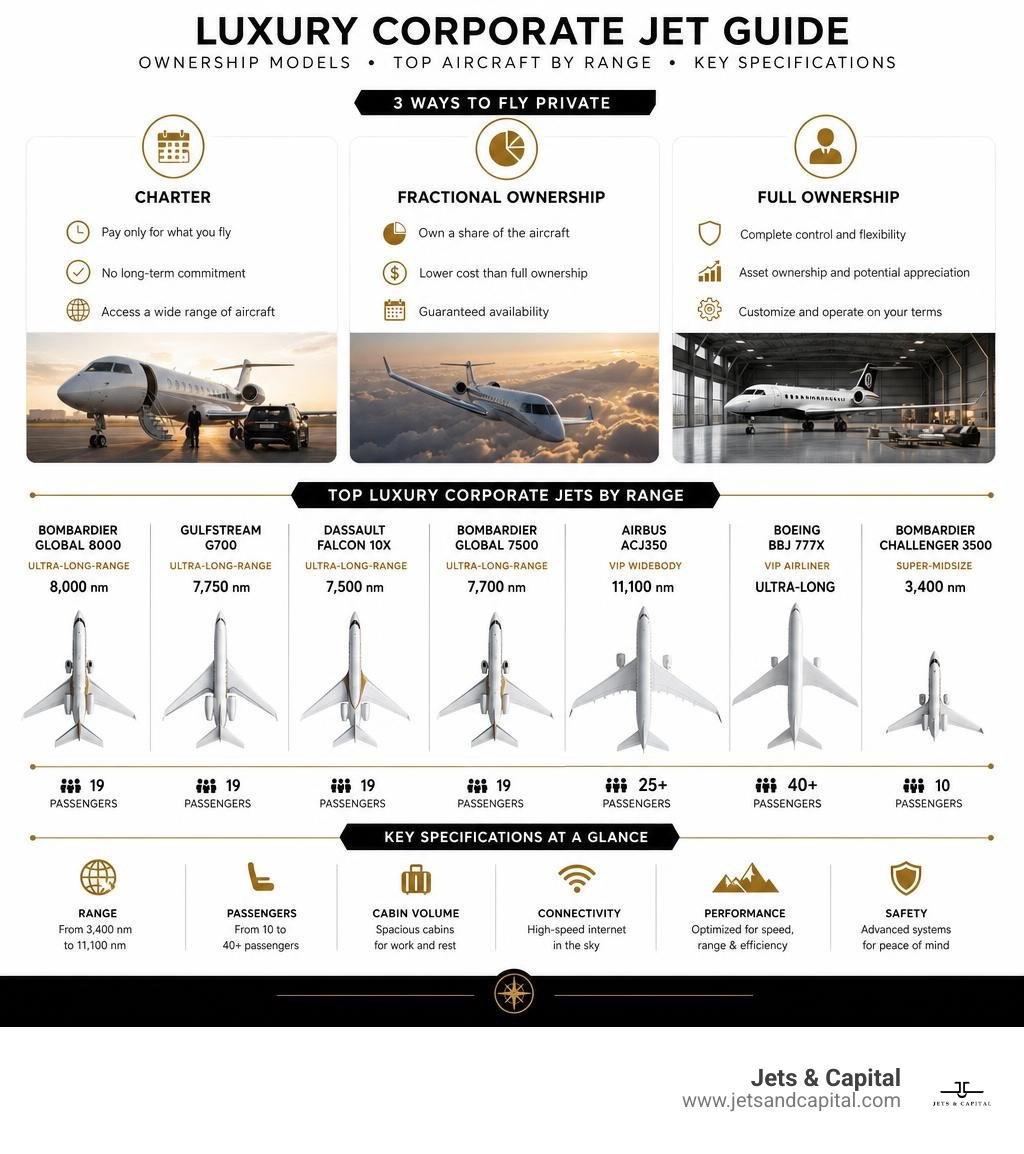
Ownership Models: Fractional, Charter, and Full Ownership of Luxury Corporate Jets
Choosing how to access luxury corporate jets is just as important as selecting the aircraft itself. The three primary avenues—charter services, fractional ownership, and full ownership—each serve distinct annual flight profiles, financial goals, and operational needs.
Charter Services: Maximum Flexibility, Zero Commitment
For individuals or corporate flight departments flying fewer than 50 hours per year, chartering is the most logical step. It offers the flexibility of private aviation without upfront acquisition costs, long-term asset depreciation, or ongoing management fees.
When you charter, you pay for the specific trip, avoiding the responsibilities of crew hiring, maintenance, and hangar storage. If you are planning travel to or from key business hubs, you can easily source localized charter services. For example, you can coordinate travel with a New York, New York Private Jet Charter Flights provider, secure a San Francisco Private Jet Charter Flights specialist, or arrange a West Palm Beach Private Jet Charter Quote - Solairus Aviation . For regional hops, options like a Book Private Jet Charter Salt Lake City | Silverair.com or a Miami Private Jet Charter and Aircraft Management Services | EJM service offer rapid regional connectivity. You can even easily Book Private Plane Charter Flights to and from Las Vegas to match your exact schedule.
Fractional Ownership: The Best of Both Worlds
If your annual flight time falls between 50 and 150 hours, fractional ownership becomes highly attractive. Under this model, pioneered by industry giants like NetJets | World's Leading Private Jet Company | Fractional Aircraft ... , you purchase a share of a specific aircraft (ranging from a 1/16th share up to a 1/2 share).
Fractional ownership guarantees you access to a fleet of Luxury Private Planes with as little as four to ten hours of notice. You benefit from the tax advantages of asset ownership, such as depreciation, while leaving the operational complexities—including pilot scheduling, safety audits, and maintenance—to a professional management company.
Full Ownership: Ultimate Control and Customization
For corporations and ultra-high-net-worth individuals (UHNWIs) logging more than 150 to 200 flight hours annually, full ownership of luxury corporate jets is the gold standard. It provides complete control over the aircraft’s schedule, crew selection, and safety standards. Most importantly, full ownership allows you to design a completely bespoke cabin tailored to your precise personal and business requirements.
Historically, North America has dominated this market, holding approximately 70% of the global business jet fleet at the beginning of the previous decade, with major corporate hubs in California, Texas, and New York continuing to lead global demand. When owning a whole aircraft, many principals partner with specialized firms like Business Jet | Comprehensive Aviation Solutions to handle day-to-day management, flight planning, and regulatory compliance.
| Ownership Model | Annual Flight Hours | Upfront Capital | Customization | Operational Responsibility |
|---|---|---|---|---|
| Charter Services | < 50 hours | None | None | None (Operator handles all) |
| Fractional Share | 50 - 150 hours | Moderate | Standardized | Shared (Managed by provider) |
| Full Ownership | 150+ hours | High | Unlimited | High (Usually outsourced) |
The Leading Flagship Models in Business Aviation
The market for large-cabin and ultra-long-range luxury corporate jets is defined by a fierce engineering rivalry. Manufacturers constantly push the boundaries of range, cabin volume, speed, and efficiency to capture the attention of corporate flight departments and global business leaders.
Ultra-Long-Range Luxury Corporate Jets
In the ultra-long-range category, three manufacturers lead the charge with aircraft capable of connecting distant global capitals nonstop.
Bombardier Global 7500 & Global 8000
The Global 7500 | Bombardier is a true masterpiece of business aviation, offering a baseline range of 7,700 nautical miles and a top speed of Mach 0.925. It stands out as one of the few platforms designed with four distinct living spaces, including a private master suite with a permanent bed and a stand-up shower. It also features the Nuage seat, the first entirely new cabin seat architecture in 30 years, which offers a zero-gravity neutral posture position.
Its sister ship, the Global 8000, pushes performance even further. Reaching a top speed of Mach 0.95, it is recognized as the Fastest Private Jet in the World. With an incredible 8,000-nautical-mile range and a Smooth Flĕx Wing designed to handle turbulence, it delivers an incredibly quiet and stable ride.
Gulfstream G700
As the flagship of Savannah-based Gulfstream Aerospace, the G700 - Gulfstream Aerospace is engineered for maximum space and performance. Powered by twin Rolls-Royce Pearl 700 engines, the G700 boasts a maximum range of 7,750 nautical miles and a high-speed cruise of Mach 0.90.
The cabin can be configured with up to five distinct living areas, including an ultra-large galley and a grand suite. Gulfstream is famous for its twenty signature Panoramic Oval Windows—the largest in business aviation—which flood the cabin with natural light and dramatically enhance the sense of space.
Dassault Falcon 10X
The upcoming Falcon 10X - Dassault Falcon is set to redefine cabin comfort. Dassault has designed the 10X with the largest cabin cross-section of any purpose-built business jet, measuring 109 inches wide and 80 inches tall.
With a range of 7,500 nautical miles and a top speed of Mach 0.925, the Falcon 10X features advanced military-derived flight technologies, including a Digital Flight Control System and the FalconEye Combined Vision System, allowing safe operations in low-visibility conditions.
Super-Midsize and Large Cabin Luxury Corporate Jets
For transcontinental missions that do not require global ultra-long-range capabilities, super-midsize and large-cabin jets offer excellent efficiency and comfort. These models are frequently featured in rankings of the Best Jets in the World.
Bombardier Challenger 3500
The Challenger 3500 | Bombardier is the leader in the super-midsize category. Winner of the prestigious Red Dot "Best of the Best" Award for Product Design, it offers a 3,400-nautical-mile range and a wide 7-foot-2-inch cabin.
The Challenger 3500 features the lowest direct operating costs in its class, alongside an industry-first voice-controlled cabin environment and patented Nuage seating, making it a favorite for high-frequency corporate flight departments.
Cessna Citation Series
Textron Aviation's Cessna Citation line remains the most delivered business jet family in history, with over 2,000 aircraft in active service. From light jets to midsize business tools, the Citation series is praised for its exceptional dispatch reliability, ease of maintenance, and highly functional cabins, making them a staple of corporate fleets worldwide.
VIP Airliners and Extra-Large Cabins
When standard business jets are simply not spacious enough, VIP airliners offer the ultimate in airborne luxury. These aircraft are the preferred choice for heads of state, corporate boards, and those seeking Billionaire Luxury Private Jets.
Airbus Corporate Jets (ACJ)
Airbus excels at converting its modern commercial airliners into ultra-spacious corporate sanctuaries. The ACJ TwoTwenty Program - Comlux , built on the highly efficient Airbus A220-100 platform, represents a brand-new category in the market. It delivers up to three times the cabin volume of traditional large business jets while maintaining comparable operating costs and a nonstop range of over 12.5 hours.
For the ultimate widebody experience, the ACJ350 | Airbus provides up to 308 square meters (over 3,300 square feet) of floor space, a 22-hour nonstop range, and an advanced "EasyFit" cabin outfitting concept that eliminates the need to drill into the carbon-fiber fuselage.
Boeing Business Jets (BBJ)
Boeing Business Jets brings the power, range, and support network of commercial aviation to private travel. From the BBJ 737 MAX to the massive twin-aisle BBJ 787 and BBJ 777X, these aircraft offer full-sized home amenities, including boardrooms, dining areas, and private master suites.
Boeing's "BBJ Select" program simplifies the customization process, allowing buyers to choose from pre-designed, pre-certified cabin layouts to accelerate delivery times while maintaining world-class luxury.
Advanced Technology, Cabin Customization, and Completion Centers
Modern luxury corporate jets are marvels of advanced engineering, designed to keep passengers healthy, connected, and productive at 51,000 feet.
Flight Decks and Flight Safety
Today's flagship cockpits are heavily influenced by military aviation and commercial safety advancements. The Gulfstream Symmetry Flight Deck, for example, utilizes active control sidesticks that provide tactile feedback between pilots, paired with extensive touchscreen displays to reduce pilot workload.
Advanced vision systems, such as Dassault's FalconEye, combine thermal imaging and synthetic terrain databases into a single Head-Up Display (HUD), allowing pilots to land safely in challenging weather and at airports with strict approach requirements.
Connectivity and Cabin Environment
In-flight connectivity has reached commercial-office speeds. High-speed Ka-band and Low Earth Orbit (LEO) satellite networks, such as Gogo Galileo and Starlink, now deliver bandwidth up to 195 Mbps, enabling seamless 4K video conferencing and live streaming.
Equally important is cabin air quality and pressurization. Flagship models now achieve exceptionally low cabin altitudes—such as 2,691 feet on the Global 7500/8000 when cruising at 41,000 feet. Low cabin altitude, combined with 100% fresh air systems that cycle through hospital-grade HEPA filters and plasma-ionization every two minutes, significantly reduces the physical toll of travel and helps prevent jet lag.
The Role of Completion Centers
When purchasing a VIP airliner or green aircraft (delivered with a bare metal interior), selecting a completion center is a critical step. Outfitters like Comlux America in Indianapolis specialize in transforming empty fuselages into bespoke flying residences.
Designing a custom interior requires highly specialized engineering. Completion centers must balance weight distribution, acoustic dampening, and strict FAA/EASA burn-resistance certifications. They use advanced lightweight materials, exotic wood veneers, and custom-tailored leathers to create quiet, beautiful spaces without compromising the aircraft’s range or fuel efficiency.
Financial and Operational Realities: Costs, Regulations, and Sustainability

While the performance and design of luxury corporate jets are captivating, the financial and regulatory realities of operating these assets require careful management.
Depreciation and Residual Values
A new business jet typically depreciates by approximately 50% within its first five years of service, after which the depreciation curve flattens between years 10 and 15. On average, the residual value for a five-year-old corporate aircraft hovers around 56% of its original list price.
Understanding this curve is crucial for corporate treasury departments. It is also why the second-hand market remains highly active, with approximately 11% of the global fleet historically listed for sale at any given time, offering excellent entry points for buyers looking to avoid initial depreciation.
Operating Costs and Maintenance
Operating a corporate jet involves both fixed and variable costs. Fixed costs include pilot salaries, hangar rental, insurance, and continuous crew training. Variable costs are driven by fuel consumption, landing fees, and scheduled maintenance.
Major engine manufacturers, such as Rolls-Royce (which powers over 42% of the global business jet fleet), offer comprehensive hourly maintenance programs to help operators predict and manage maintenance costs over time.
Regulatory Compliance and Safety
Corporate flight operations must adhere to strict regulatory frameworks. In the United States, private corporate fleets generally operate under Federal Aviation Administration (FAA) Part 91 regulations, while commercial charter operations must comply with the more stringent FAA Part 135 standards.
These regulations dictate crew flight-time limitations, maintenance intervals, and mandatory safety equipment. Additionally, airports hosting these aircraft must meet strict safety guidelines, such as FAA Part 139 and ICAO Annex 14 certifications, ensuring proper runway maintenance and emergency services are always available.
Sustainability and Sustainable Aviation Fuel (SAF)
Environmental responsibility is a primary focus for modern corporate aviation. Leading manufacturers have designed their newest aircraft to be fully compatible with Sustainable Aviation Fuel (SAF), which can reduce lifecycle carbon emissions by up to 80% compared to conventional jet fuel.
Aerodynamic innovations, such as winglet designs and high-bypass engines (like the GE Passport on the Global 7500), have delivered up to 33% fuel-efficiency gains over previous-generation models, helping corporations meet their environmental and sustainability targets.
Frequently Asked Questions about Luxury Corporate Jets
What are the typical operating costs and depreciation rates for luxury corporate jets?
Operating costs vary widely by aircraft size. A super-midsize jet like the Challenger 3500 typically incurs direct operating costs of $3,000 to $4,500 per hour, while a VIP widebody can exceed $15,000 per hour.
In terms of asset value, a new business jet depreciates by roughly 50% in its first five years, with the residual value averaging 56% of the initial list price before stabilizing.
How does Sustainable Aviation Fuel (SAF) impact modern corporate jet operations?
SAF is fully compatible with modern business jet engines and fueling infrastructure, requiring no modifications to the aircraft. It significantly reduces the carbon footprint of flight operations, helping corporations comply with evolving environmental regulations and corporate ESG goals without sacrificing range, speed, or performance.
What should a company look for when choosing a completion center for a VIP aircraft?
When selecting a completion center, look for extensive experience with your specific aircraft type, a proven track record of weight management, and strong engineering capabilities.
The center must hold proper regulatory approvals (such as FAA/EASA Part 145) and demonstrate the ability to integrate advanced cabin technologies—like quiet acoustic packages and high-speed satellite connectivity—while delivering flawless craftsmanship.
Conclusion
Whether you choose the unparalleled speed of the Global 8000, the spacious elegance of the Gulfstream G700, or the sheer scale of an Airbus ACJ, luxury corporate jets represent the absolute pinnacle of global mobility, time management, and business efficiency.
At Jets & Capital, we understand that private aviation is more than just transportation—it is a powerful tool for building relationships and securing opportunities. That is why we host exclusive, invite-only Private Jet Hangar Events and other high-end gatherings designed specifically for family offices, institutional investors, and ultra-high-net-worth individuals.
Our signature events, including our highly anticipated Super Bowl Edition in San Francisco, CA, feature a strict vetting process that ensures at least 85% of attendees are active allocators. This creates an exceptional environment for high-quality deal-making, strategic Private Jet Networking, and long-term relationship building. For more insights on how to leverage these unique environments, explore our Private Aviation Networking Guide and keep an eye on upcoming Private Aviation Events.
If you are ready to connect with an elite, vetted network of peers who appreciate the value of private aviation, we invite you to learn more about our upcoming events and reserve your place.
