
Inside the Private World of Dallas Family Offices and Big Texas Capital
Why Dallas Family Offices Matter to Private Investors

Dallas family offices are private firms that manage a wealthy family's investments, tax and estate strategy, philanthropy, and personal financial affairs. For investors and founders looking to connect with them, the best path is usually a trusted introduction through private networks, sector-aligned advisors, and invite-only events - not broad fundraising outreach.
Dallas-Fort Worth is now one of the country's important private-capital markets. FINTRX has identified 137 family offices in the region, while estimates place Texas family-office assets at roughly $320 billion across Dallas, Houston, and Austin. Dallas-area offices reportedly deployed $19.2 billion in 2024 alone.
These investors are often looking beyond public stocks. Many pursue direct stakes in operating companies, real estate, private credit, energy, healthcare, and newer areas such as AI infrastructure. Their capital can be patient, flexible, and closely tied to the family's long-term goals.
I am Jordan Hutchinson, an entrepreneur, investor, and family-office network builder with experience connecting principals around private deals, philanthropy, and strategic capital. Through Jets & Capital, I work with the kind of trusted peer networks that help Dallas family offices find aligned opportunities without turning every conversation into a pitch.
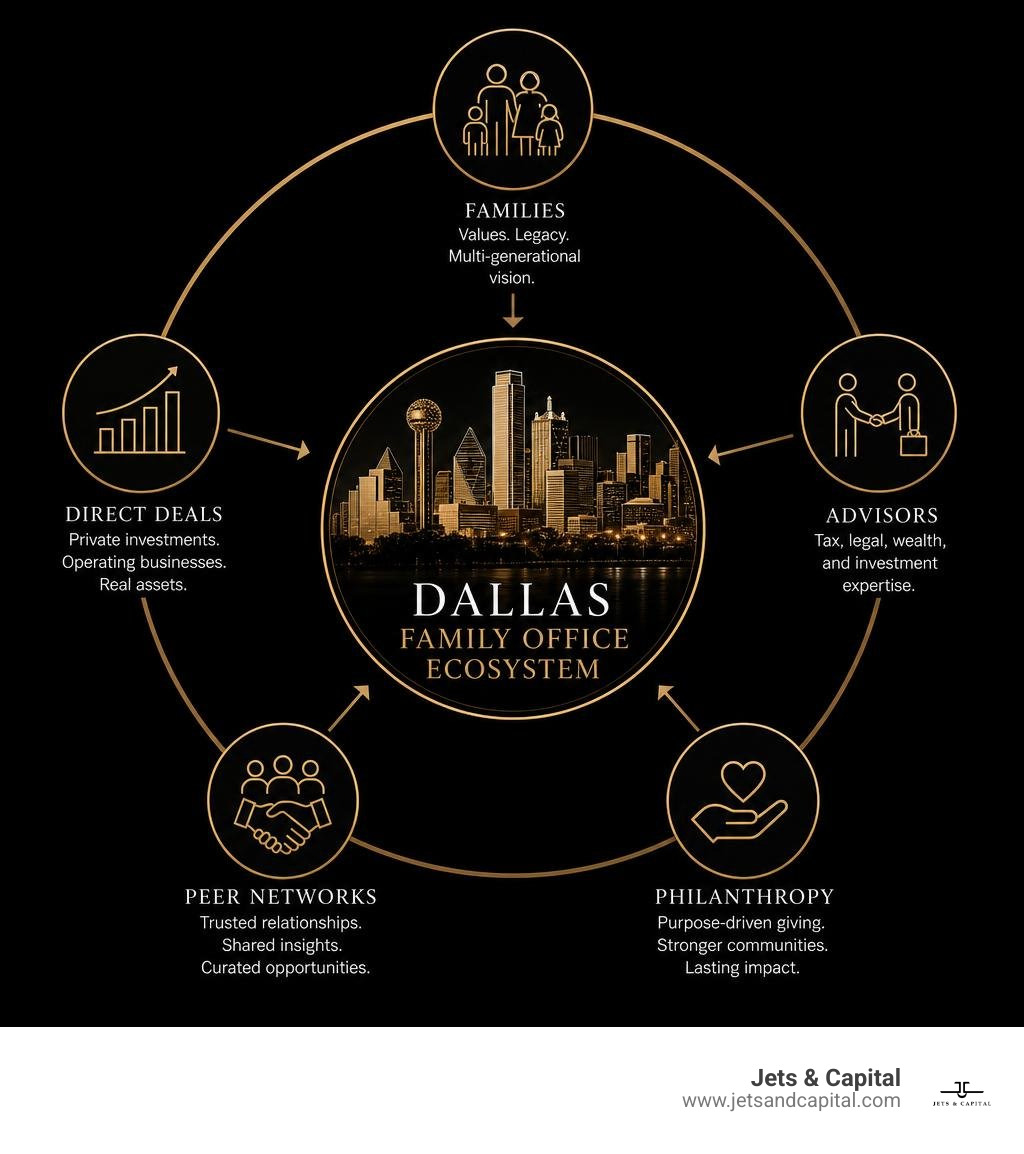
The Rise of Dallas Family Offices in the Texas Wealth Landscape
North Texas has quietly evolved from an energy and real estate powerhouse into one of the most dynamic private wealth hubs in the world. As corporate headquarters migrate south and generational liquidity events multiply, the concentration of private capital across the region has reached unprecedented heights.

Today, the ultrarich use family offices to invest billions in private markets, transforming North Texas into an elite center for direct investment. FINTRX data tracks 137 family offices headquartered in the Dallas-Fort Worth metroplex out of 2,387 across the United States. When looking at the broader state footprint, Texas family offices manage an estimated $320 billion in assets across Dallas, Houston, and Austin. In Dallas alone, roughly 190 private wealth groups deployed $19.2 billion into private markets in 2024, backing everything from lower-middle-market buyouts to cutting-edge technology ventures.
This surge is fueled by several converging factors:
- Zero State Income Tax: Texas provides an exceptional tax foundation that allows multi-generational wealth to compound efficiently without state-level capital gains or personal income taxes.
- Corporate and Executive Migration: An influx of business founders, Fortune 500 executives, and investment talent from coastal hubs like California and New York has injected fresh capital and sophisticated operational expertise into the local ecosystem.
- Liquidity Events: Historic enterprise exits across software, technology-enabled services, healthcare, and logistics have turned first-generation founders into liquid allocators seeking comprehensive management structures.
- Industrial Diversification: While legacy wealth stems from Texas oil, natural gas, ranching, and commercial real estate, modern Dallas allocators are aggressively backing AI infrastructure, medical device innovation, private credit, and advanced manufacturing.
Managing this degree of wealth requires tailored infrastructure. Depending on the size of the estate, operational complexity, and specific family goals, wealth creators typically select one of three operational structures when building a uhnw family office platform.
| Structure Type | Typical Asset Threshold | Governance & Team Model | Best Suited For |
|---|---|---|---|
| Single-Family Office (SFO) | $100M+ to $500M+ | Dedicated full-time staff (CIO, CFO, in-house legal, tax specialists, estate planners) serving one family. Complete operational control. | Families seeking bespoke investment control, complete privacy, direct operator hiring, and highly customized lifestyle administration. |
| Multi-Family Office (MFO) | $25M+ to $100M+ | Shared professional infrastructure, shared overhead costs, multi-client fiduciaries offering comprehensive institutional services. | Families wanting full-service wealth planning, co-investment syndicates, and sophisticated reporting without running an independent corporate entity. |
| Virtual Family Office (VFO) | $5M+ to $25M+ | Outsourced network of independent, fee-only fiduciary advisors, external CPAs, estate attorneys, and outsourced CIOs coordinated via a centralized platform. | Entrepreneurs post-liquidity needing institutional-grade coordination, tax mitigation, and asset protection without permanent internal payroll. |
Investment Playbooks: Direct Deals, Sourcing, and Private Capital
Dallas family offices have fundamentally altered how private capital is deployed. Rather than acting as passive limited partners (LPs) locked into rigid ten-year institutional private equity funds, North Texas allocators increasingly operate as direct deal-makers.
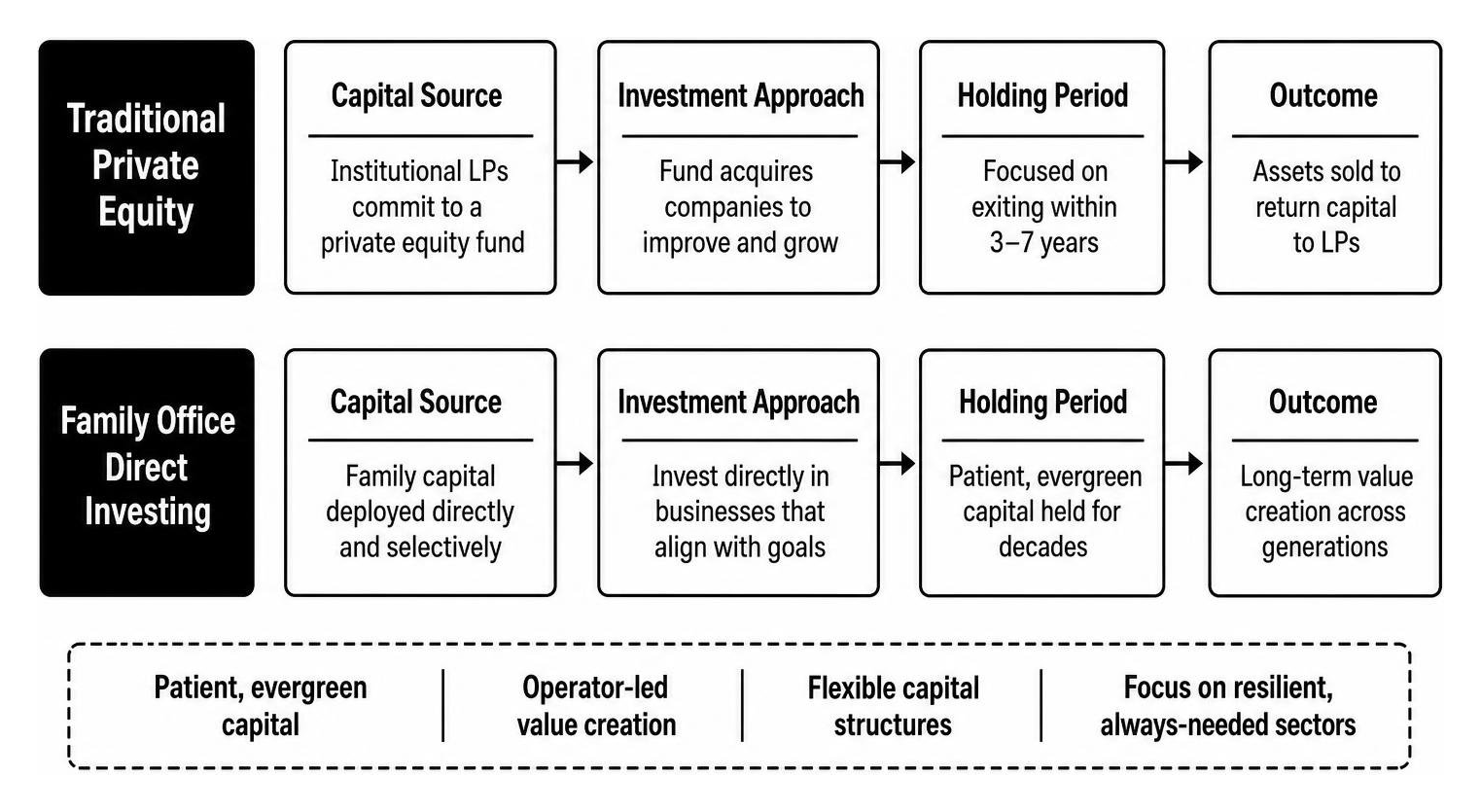
This evolution is driven by several key strategic advantages:
- Patient, Evergreen Capital: Unlike traditional private equity funds that must acquire, optimize, and flip companies within a 3- to 7-year fund lifecycle to return LP capital, single- and multi-family offices can hold investments for decades. This evergreen mindset allows portfolio companies to execute sustainable, long-term growth initiatives without artificial exit deadlines.
- Operator-Led Value Creation: Many Texas wealth creators built their fortunes as operators in construction, energy, distribution, or B2B services. They bring real-world operational playbooks, industry relationships, and board-level mentorship directly to founders.
- Flexible Capital Structures: Family offices can structure control buyouts, minority growth equity, structured debt, or bespoke private credit solutions based on what the operating business actually needs, avoiding rigid debt-to-equity mandates.
- Focus on Resilient Sectors: Investment mandates frequently target "always-needed" foundational industries, including specialty trades, infrastructure services, B2B services, asset-heavy distribution, and advanced healthcare delivery models.
How Dallas Family Offices Structure Private Equity and Direct Deals
When evaluating direct investments, Dallas family offices generally target lower-middle-market enterprises generating between $1 million and $20 million in EBITDA (or $5 million to $50 million in top-line revenue). These businesses are large enough to demonstrate proven product-market fit and stable cash flow, but small enough to benefit significantly from institutional governance and modern technology.
Direct transactions are typically structured through:
- Independent Sponsor Backing: Teaming up with specialized deal leads to acquire cash-flowing businesses with 90% to 100% equity commitments to close rapidly.
- Club Deals and Co-Investments: Partnering with two or three peer family offices to write larger checks, pool industry-specific diligence capabilities, and share post-close governance responsibilities.
- Platform Add-On Strategies: Acquiring a strong regional platform company in a fragmented market (such as HVAC, commercial roofing, or specialty logistics) and funding subsequent roll-up acquisitions to scale market share.
Mastering these acquisition frameworks requires systematic deal flow pipelines. For a deeper breakdown of how top allocators build their deal engines, review our family office deal sourcing guide 2026.
Key Hubs and Networks Connecting Dallas Family Offices
In Dallas, relationship-driven investing happens far away from public pitch stages. The epicenter of this ecosystem is the historic Old Parkland campus in the Oak Lawn and Uptown districts. Developed by Crow Holdings, Old Parkland houses a remarkable density of single-family offices, private investment firms, and boutique wealth advisories.

Old Parkland functions as a collaborative campus where principals, chief investment officers, and trusted advisors meet over coffee or private dinners to review opportunities before an investment bank ever publishes a confidential information memorandum (CIM). This environment creates significant advantages:
- Shared Diligence: Principals cross-examine complex technical deals with trusted peers who have operating backgrounds in those specific sectors.
- Pre-Banker Deal Flow: Founders and corporate executives often present proprietary recapitalization opportunities directly to campus tenants, bypassing broad public auctions.
- Syndication Speed: Co-investment consortiums are routinely formed over a single afternoon, allowing Dallas allocators to move with decisive speed.
Navigating these circles requires authentic peer alignment. Building genuine connections through family office networking is the cornerstone for uncovering high-conviction family office deal flow that never surfaces on public exchanges.
Governance, Succession, and the Great Wealth Transfer
As trillions of dollars transition between generations over the next decade, governance, estate architecture, and next-generation leadership have become central priorities for North Texas families. Preserving family legacy requires far more than achieving strong investment returns; it demands proactive operational structures that align family culture across multiple generations.
Long-term wealth preservation is organized around several structural pillars:
- Comprehensive Trust and Estate Architectures: Allocators utilize irrevocable dynasty trusts, family limited partnerships (FLPs), and grantor retained annuity trusts (GRATs) to minimize estate tax exposure while safeguarding family assets across multiple generations.
- Next-Generation (NextGen) Education: Successful offices actively integrate younger family members into investment committees, foundation boards, and operating company site visits to build financial literacy, fiduciary responsibility, and long-term stewardship skills early.
- Values-Aligned Philanthropy and Impact: Families are increasingly formalizing their community impact through dedicated foundations, donor-advised funds (DAFs), and focused impact vehicles that address regional education, healthcare access, and community development.
- Regulatory Privacy and Exemptions: Single-family offices operate under established SEC registration exemptions under the Dodd-Frank Act (the "Family Office Rule"), allowing them to maintain strict client confidentiality regarding their balance sheets, holdings, and internal governance.
- Sustainable Scaling: As family branches multiply, offices establish formal family councils, written charters, and dispute-resolution mechanisms to maintain cohesion and support ongoing family office growth.
Frequently Asked Questions About Texas Wealth Management
Why do wealthy families choose Dallas over traditional financial hubs?
Dallas combines a business-friendly economic environment with zero state personal income tax, a central geographic location with two major international airports, and world-class residential communities. The region provides access to sophisticated corporate infrastructure and legal talent alongside an established, collaborative culture of direct private deal-making.
Why are single-family offices exempt from SEC registration?
Under the Dodd-Frank Wall Street Reform and Consumer Protection Act, the SEC established the "Family Office Rule" (Rule 202(a)(11)(G)-1). Single-family offices are exempt from registration as investment advisers because they exclusively serve "family clients," do not hold themselves out to the public as investment advisers, and do not manage capital for non-family external retail investors.
How do family offices access off-market deal flow in North Texas?
Direct deals are primarily sourced through trusted peer-to-peer family office syndicates, personal relationships with entrepreneurs, boutique M&A intermediaries, and private, invitation-only gatherings. Allocators value closed-door environments where principals can evaluate strategic partnerships, share sector insights, and structure transactions away from broad market noise.
Conclusion
The private wealth ecosystem across North Texas has cemented its status as a powerhouse of patient capital, entrepreneurial value creation, and long-term economic influence. By combining deep operational roots with sophisticated direct investment strategies, family offices in the region continue to reshape the landscape of private enterprise.
At Jets & Capital, we host exclusive, invite-only gatherings in luxury private aviation hangars across premier markets, maintaining a strict 85% allocator ratio to foster high-conviction deal-making and meaningful peer relationships. Explore our private events and community initiatives in dallas to connect with leading principals and capital allocators shaping the future of private markets.
