
Family Office Growth: More Money, More Offices, More Problems
Family Office Growth: The Numbers You Need to Know First

Family office growth is accelerating at a pace few saw coming. Here's a quick snapshot of where things stand today:
| Metric | 2019 | 2024 | 2030 (Projected) |
|---|---|---|---|
| Single family offices (global) | 6,130 | 8,030 | 10,720 |
| Total AUM | - | $3.1 trillion | $5.4 trillion |
| Total family wealth | $3.3 trillion | $5.5 trillion | $9.5 trillion |
| US family offices | 2,210 | 3,180 | 4,190 |
The short answer: there are now over 8,000 single family offices worldwide, managing more than $3 trillion in assets — and both numbers are climbing fast.
Not long ago, family offices were quiet, behind-the-scenes operations built around one simple goal: don't lose the money. Today, that's changed completely. The world's wealthiest families are standing up sophisticated investment platforms, moving into direct deals, competing with private equity firms, and expanding across borders — all while navigating a once-in-a-generation transfer of both wealth and leadership.
Seventy-five percent of all family offices in existence today were set up after 2001. Half were created after 2012. This isn't a slow-moving industry — it's one of the fastest-growing corners of global finance, and it's reshaping how capital is deployed at the highest levels.
But with rapid growth comes real complexity. Talent wars, cyberattacks, governance gaps, and generational friction are testing even the most established offices.
I'm Jordan Hutchinson, a family office principal with experience in family office growth through my involvement in founding Bridge Investment Group and building Jets & Capital — an exclusive network connecting family offices and allocators through curated, high-trust events. That vantage point shapes everything in this breakdown.
The Explosive Trajectory of Global Family Office Growth
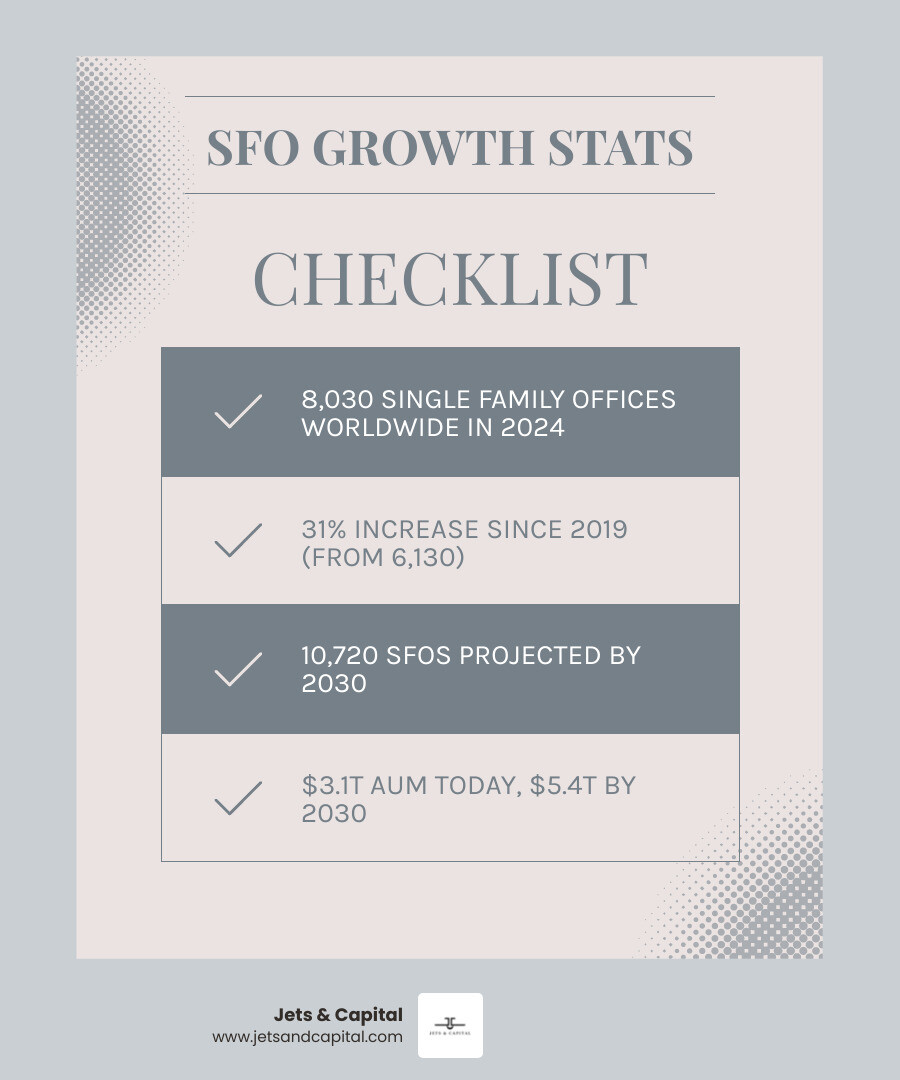
The landscape of private wealth has shifted from a quiet ripple to a tidal wave. As of 2024, there are an estimated 8,030 single family offices (SFOs) worldwide. To put that in perspective, that is a 31% increase from just 6,130 in 2019. We aren't just seeing more offices; we are seeing more significant offices.
By 2030, experts project this number will skyrocket by another 75%, reaching more than 10,720 SFOs globally. This isn't just a vanity metric—it represents a massive consolidation of investment power. Total Assets Under Management (AUM) held by these entities is expected to rise from $3.1 trillion today to a staggering $5.4 trillion by 2030. When you look at the total wealth of the families behind these offices, the numbers are even more eye-popping: a projected growth of 189%, from $3.3 trillion in 2019 to $9.5 trillion by the end of the decade.

This surge is documented extensively in the Dakota Global Family Office 2025 Report, which highlights how family offices are maturing from simple administrative hubs into institutional-grade powerhouses. At Jets & Capital, we see this evolution through our UHNW Family Office network, where the conversation has shifted from "how do we set this up?" to "how do we scale this into a global player?"
How Generational Transitions Fuel Family Office Growth
One of the most powerful engines behind this family office growth is the "Great Wealth Transfer." In the United States alone, an estimated $124 trillion is expected to pass down through 2048. This isn't just a change of bank account owners; it is a total reimagining of what a family office is for.
Currently, 87% of family offices have yet to pass the torch to the next generation. However, 59% expect a leadership transition within the next 10 years. This "Next-Gen" cohort often has very different priorities than the founders. While the first generation might have been focused on wealth preservation and traditional stocks, the incoming leaders are often more interested in impact investing, technology, and aggressive direct deals.
According to research on The Family Office in 2026: Governance and Human Capital Strategies That Drive Growth, this transition frequently leads to a "mission redefinition." When a principal is less involved, there is a 73% chance the next generation will change the office's core mission. This creates a massive demand for new structures, new talent, and more sophisticated governance to keep the family legacy intact while chasing new horizons.
The Role of Active Family Businesses in Wealth Expansion
A common misconception is that family offices only appear after a "liquidity event"—the big sale of the family company. In reality, 86% of family offices still have an active, operating family business at their core. Only 14% were founded solely from a cash event like a company sale.
This means that for most, the family office and the family business grow in tandem. They often share infrastructure, legal teams, and even office space. This "entrepreneurial DNA" is a hallmark of modern family office growth. These aren't passive investors; they are business builders who use their family office to generate ongoing income and find strategic synergies with their core enterprises. They aren't just looking for a 7% return; they are looking for "control capital" and strategic optionality.
Shifting Geographies and Investment Playbooks
While the growth is global, the map is being redrawn. North America remains the heavyweight champion, hosting over 7,800 family offices (including multi-family offices) managing an average of $2.9 billion in assets. In the U.S. specifically, the number of SFOs is expected to nearly double from 2,210 in 2019 to 4,190 by 2030—a 90% increase.
However, the real "boom town" energy is happening in Asia and specific gateway markets. Singapore has emerged as a titan, now hosting more than 2.5 times the number of family offices found in New York City and triple the count of London. Middle Eastern hubs like Dubai are also maturing rapidly, offering tax advantages and a central location for global capital deployment. For our community, Family Office Networking has become a cross-border sport, as families from San Francisco and New York look toward these emerging hubs for diversification.
The Pivot to Direct Deals and Alternatives
The "standard" 60/40 portfolio of stocks and bonds is increasingly viewed as a relic of the past within the family office world. To drive family office growth, principals are moving aggressively into private markets.
The venture capital share of family office portfolios rose from 17% in 2015 to 31% by 2025. There is also a massive resurgence in real estate, which rebounded to 39% of deal shares recently. But the most significant trend is the rise of the "Club Deal." Roughly 69% of family office investments are now structured as club deals, where multiple families pool their capital to take down a larger target without the high fees of a traditional private equity fund.
As outlined in The New Family Offices Investment Playbook for 2026, family offices are behaving more like disciplined institutional investors. They are looking for cash-flow engines and "real-world assets" (RWAs) that offer tangible value and downside protection in a volatile market.
Leveraging Technology for Sustainable Family Office Growth
You can't manage billions of dollars on a spreadsheet—at least not if you want to sleep at night. Technology adoption is no longer optional for offices looking to scale.
Currently, 57% of family offices are using AI for investment research and strategy. Automation is even more prevalent, with 76% using it for forecasting and 73% for portfolio modeling. Digital dashboards are the new "must-have" tool, with some offices reporting a 70% reduction in reporting time after implementing modern tech stacks. This efficiency allows small, lean teams to manage increasingly complex, global portfolios that would have required dozens of employees a decade ago. We often discuss these tech-forward strategies at our Family Office Investment Summit events, where the "S" in SFO is starting to stand for "Sophisticated."
The "More Problems" Phase: Operational and Governance Hurdles
As the old saying goes: "More money, more problems." The rapid expansion of the sector has created a massive talent shortage. In financial hubs like Hong Kong, we’ve seen bidding wars resulting in 30% pay increases for experienced family office executives. Finding people who understand both the technical side of alternatives and the "soft" side of family dynamics is becoming the primary constraint on growth.
Then there is the "invisible" threat: cybersecurity. Family offices are prime targets for hackers because they manage institutional-sized capital with often "home-office" level security. Roughly 43% of family offices have been hit by a cyberattack in the last 24 months. For larger offices, the impact can be devastating, yet 10% of offices managing less than $500 million still report having no formal cyber protections in place.
As explored in The Family Office of the Future - From Custodian to Value Creator, the transition from a passive "custodian" to an active "value creator" requires a level of professionalization that many families aren't prepared for.
Professionalizing Governance to Mitigate Risk
To survive the "More Problems" phase, family offices are adopting institutional-grade governance. This means moving away from "kitchen table" decision-making and toward formal structures.
Key strategies include:
- Independent Boards: Bringing in external experts to challenge assumptions and remove emotional bias.
- Family Charters: Drafting formal documents that define the family’s values, rules of engagement, and "how we disagree."
- Succession Planning: Only 53% of offices have a formal plan, yet 74% admit there is a massive gap in their readiness for a transition.
| Feature | Traditional Model (1990s) | Modern Model (2025+) |
|---|---|---|
| Primary Goal | Wealth Preservation | Active Value Creation |
| Investment Style | Passive (Funds/Stocks) | Active (Directs/Co-invest) |
| Technology | Spreadsheets/Manual | AI/Cloud Dashboards |
| Governance | Informal/Family Only | Independent Boards/Charters |
| Talent | Family Friends/Generalists | Specialized C-Suite/External Pros |
Frequently Asked Questions about Family Office Expansion
How many family offices are there worldwide in 2024?
There are approximately 8,030 single family offices globally as of 2024. This represents a 31% increase since 2019. By 2030, this number is expected to hit 10,720.
What is the projected AUM for family offices by 2030?
Total Assets Under Management (AUM) for family offices is projected to reach $5.4 trillion by 2030, a 73% increase from 2024 levels. The total wealth of the families behind these offices is expected to reach $9.5 trillion.
Which cities are emerging as the top hubs for family offices?
Singapore is the current "it" city, but Dubai, Miami, Abu Dhabi, and Zurich are all seeing significant growth. Miami, in particular, has become a massive hub for U.S. families relocating from New York and California.
Conclusion
The era of the "quiet" family office is over. We are witnessing a fundamental shift where these entities are becoming the most influential players in the global market. They are no longer just preserving wealth; they are creating it through direct investments, technological adoption, and institutional discipline.
However, as we've seen, family office growth isn't just about adding zeros to a bank account. It’s about managing the "More Problems" that come with scale—talent, security, and the delicate dance of generational transition.
At Jets & Capital, we believe the best way to navigate this complexity is through high-quality, vetted relationships. That’s why we host exclusive, invite-only events in private jet hangars, like our upcoming Super Bowl Edition in San Francisco, CA. With a strict 85% allocator ratio, we ensure that you are in a room full of peers, not just people looking for a handout.
If you are a family office principal or a senior allocator looking to expand your network and find high-quality deal flow in a high-trust environment, we invite you to join us.
