
How Family Offices Win at Direct Investing
Why Family Office Deal Sourcing Determines Who Wins in Private Markets

Family office deal sourcing is the process of identifying, evaluating, and accessing private investment opportunities — typically in the lower middle market — before they reach a broad auction process.
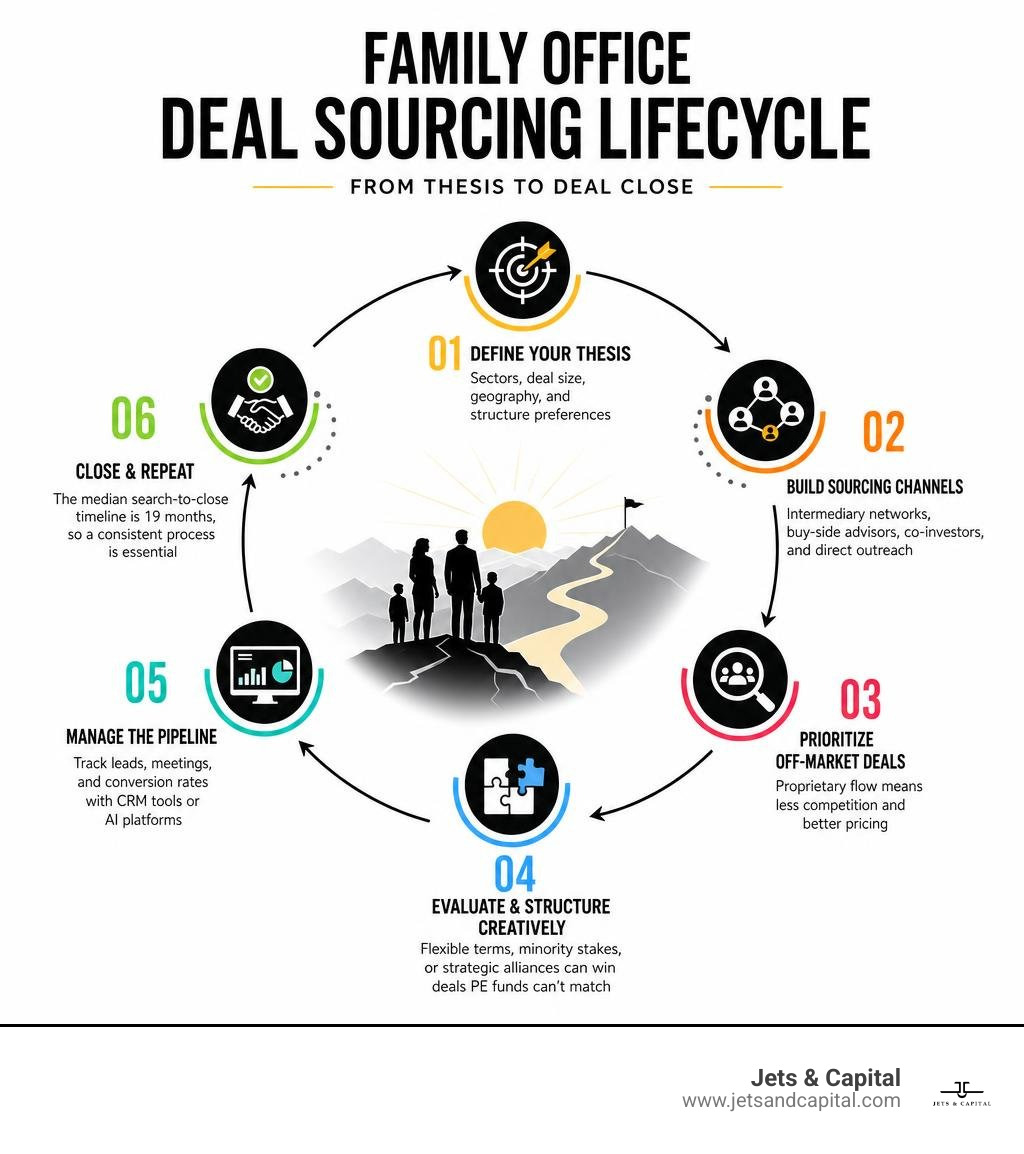
Here's a quick snapshot of how it works:
- Define your thesis — sectors, deal size, geography, and structure preferences
- Build sourcing channels — intermediary networks, buy-side advisors, co-investment relationships, and direct outreach
- Prioritize off-market deals — proprietary flow means less competition and better pricing
- Evaluate and structure creatively — flexible terms, minority stakes, or strategic alliances can win deals PE funds can't match
- Manage the pipeline — track leads, meetings, and conversion rates with CRM tools or AI platforms
- Close and repeat — the median search-to-close timeline is 19 months, so a consistent process is essential
The stakes have never been higher. Family offices' participation in private markets has risen 500% over the past decade, and today roughly 34% of family offices allocate more than 40% of their portfolios to private equity and venture capital. Yet the competition for quality deals is fierce. Private equity funds almost always outbid family offices in a standard auction — they have lower cost of capital, dedicated sourcing teams, and established intermediary relationships.
So the question isn't whether family offices can compete. It's whether they're competing smart.
The most successful family offices aren't trying to beat PE funds at their own game. They're winning by playing a different game entirely — building trust with business owners, moving faster on smaller deals, and offering something institutional investors simply can't: permanence.
I'm Jordan Hutchinson, a family office principal with deep roots in private equity through my family's role in founding Bridge Investment Group (NYSE: BRDG), and founder of Jets & Capital, where I've built an exclusive network of allocators and dealmakers specifically to improve family office deal sourcing for high-net-worth principals. The dynamics I'll walk you through in this guide come directly from that experience.
The Core Challenges of Family Office Deal Sourcing

When we step into the lower middle market (LMM), we leave the tidy, highly organized world of large-cap public equities and enter the wild west of private business. Sourcing high-quality deals in this space is notoriously difficult. Unlike mega-funds that can easily buy lists of every enterprise worth over $500 million, family offices looking for businesses with $2 million to $10 million in EBITDA face a highly fragmented ecosystem.
The core challenge of Family Office Deal Flow lies in a simple paradox: the best deals are almost always proprietary and off-market, but finding them requires a level of market visibility that many family offices actively avoid.
Many families value their privacy above all else. They do not want their names plastered on press releases or their investment mandates broadcasted across public databases. However, if no one knows you are looking to buy, your phone will never ring. Balancing this need for privacy with the necessity of maintaining a healthy volume of incoming opportunities is the ultimate tightrope walk.
Balancing Proprietary Deal Flow with Volume Requirements
To successfully close a direct transaction, you need volume. It is a simple numbers game. On average, a firm might review hundreds of opportunities just to issue a handful of Letters of Intent (LOIs) and close a single transaction.
For private equity and venture capital firms, managing this volume is a full-time, heavily staffed endeavor. Approximately 86% of US private equity and venture capital funds have at least one person tasked primarily with deal sourcing, and on average, these firms dedicate about 15% of their full-time staff to new deal origination.
Most single-family offices simply do not have the budget or desire to hire a five-person, full-time cold-calling army. Without that dedicated infrastructure, the search-to-close timeline stretches out significantly. The median amount of time from the start of a deal's search to its final closing is 19 months, with approximately 40% of deals taking over two years to cross the finish line.
To keep your pipeline healthy without drowning in administrative work, we must transition from passive "gatherers" who wait for deals to land in our inboxes to structured "hunters" who use targeted Investment Deal Sourcing strategies to find off-market gems.
Overcoming the Lower Middle Market Discovery Problem
The lower middle market is incredibly fragmented, particularly in major wealth hubs like Dallas, Miami, Palm Beach, New York, and California. In these regions, thousands of highly profitable, owner-operated businesses operate quietly under the radar.
Many of these business owners are reaching retirement age and face a pressing succession problem. They may not have a family member willing or able to take over the business, yet they are deeply hesitant to sell to a traditional private equity fund that might slash headcount, strip the brand, and flip the company in three years.
This is where the discovery problem becomes an opportunity. By learning How to Source Deals Like a Mega-Fund, family offices can proactively identify these owner-operated businesses before they ever hire an investment banker or enter an auction. The goal is to spot succession signals — such as a founder reaching their 60s without an apparent successor, or flatlining growth due to a lack of modern technology integration — and approach them with a relational, rather than transactional, mindset.
Strategic Sourcing Channels and Creative Deal Structuring

To build a robust pipeline of high-quality opportunities, we must diversify our sourcing channels. Relying on a single channel is a recipe for empty pipelines. Instead, successful family offices build a multi-pronged approach that leverages intermediary networks, boutique advisors, and exclusive, highly curated Deal Sourcing Events.
Intermediaries and business brokers play a massive role in the lower middle market. While large investment banks handle the mega-deals, boutique advisors and regional brokers hold the keys to the LMM. Building trusted relationships with these advisors in key regions — such as leveraging the Top Dallas Family Offices with Recent Private M&A Activity | Axial or the Top Miami Family Offices with Recent Private M&A Activity | Axial networks — ensures you are the first call when a business matching your mandate comes to market.
When working with outside referrers and independent sponsors, expect to pay standard finder's fees. Successfully closed deals typically command finder's fees averaging between 1.5% and 2% of the total purchase price. This is a small price to pay for proprietary access to a transaction that never goes to a highly competitive, price-inflating auction.
Co-Investing with Private Equity vs. Direct Investing Independently
One of the most important strategic decisions a family office must make is whether to pursue direct investments independently or co-invest alongside established private equity sponsors. Both paths have clear trade-offs, and many families choose a hybrid approach to balance their risk and operational capacity.
To help visualize these trade-offs, let's look at how they compare:
| Feature | Co-Investing with PE Sponsors | Direct Investing Independently |
|---|---|---|
| Operational Burden | Low (Sponsor handles diligence & management) | High (Family office must build internal deal team) |
| Fee Structure | Significantly reduced fees (often no fee/no carry) | No fees or carry paid to external sponsors |
| Governance & Control | Minority stake, typically no operational control | Majority control, board seats, direct decision-making |
| Investment Horizon | Bound to PE fund's 3-5 year exit timeline | Unlimited (can hold evergreen for decades) |
| Deal Access | High (Access to deals won by mega-funds) | Limited to proprietary sourcing capabilities |
Some family offices allocate as much as 15% to 20% of their portfolio to co-investments. This model allows them to deploy direct capital into high-quality companies without the massive overhead of building a 10-person internal investment team. They leverage the PE sponsor's deal sourcing, due diligence, and operational resources while enjoying reduced fee structures.
However, the trade-off is a complete loss of control. As a co-investor, you are almost always a minority shareholder. You will not have governance rights, you cannot block an exit, and you may find yourself "dragged along" in a sale when the PE sponsor decides it is time to exit — even if you would prefer to hold the asset for the long term.
Families who want to understand these dynamics deeper often look to regional roundtables, such as those hosted by the ACG Palm Beach Network Presents: Family Offices: Patient Capital ... or review regional directories like the Top California Family Offices with Recent Private M&A Activity | Axial and the Top Family Offices in San Francisco - Axial to see how peers are structuring their private equity allocations.
To read more about navigating these complex LP dynamics, consult resources like Deal Flow Options and the Single Family Office Investor and Family Office Private Equity: Find Funds That Match Your Mandate.
Positioning Patient Capital as a Competitive Advantage in Family Office Deal Sourcing
If we try to compete with private equity funds purely on price, we will lose. PE funds have cheap, institutional capital and a mandate to deploy it quickly. Where we win is by offering something PE funds cannot: patient capital.
Private equity funds are structurally bound by their fund life. They must buy a business, aggressively grow it (often through debt-heavy recapitalizations), and sell it within 3 to 5 years to return capital to their LPs. For a business owner who has spent 30 years building a company, treating their life's work like a short-term financial commodity can be deeply unappealing.
Family offices can structure deals using evergreen holding periods, flexible terms, minority stakes, and strategic alliances. We can tell a founder: "We don't have a five-year clock. If we buy your business, our favorite holding period is forever. We want to protect your legacy, keep your management team intact, and support your long-term growth."
This relational approach is highly effective. By positioning ourselves as Private Investment Groups focused on generational wealth preservation rather than short-term financial engineering, we can often win deals at more reasonable valuations than traditional PE buyers.
Modernizing the Sourcing Stack: AI, Data, and CRM Tools
Historically, family offices managed their deal pipelines using a fragmented mix of Excel spreadsheets, personal email folders, and physical address books. In 2026, that legacy approach is a competitive liability. To win at direct investing, we must modernize our sourcing stack by integrating AI, predictive data, and institutional-grade CRM tools.
The goal is not to replace human relationships with technology, but rather to use technology to supercharge our relationships. By automating the manual, administrative parts of deal sourcing, we free up our investment professionals to do what they do best: build trust with founders and close deals.
Automating Target Discovery with AI-Powered Family Office Deal Sourcing
AI-native deal sourcing platforms have completely transformed how we identify off-market opportunities. Instead of paying analysts to spend hours searching LinkedIn or scrolling through generic business directories, we can now use intelligent software agents to monitor live web signals, news reports, patent filings, and hiring trends to identify businesses that match our exact investment thesis.
For example, platforms like DealsByTed function as 24/7 digital sourcing analysts. You simply define your investment thesis — such as owner-operated manufacturing businesses in the Southeast with no clear successor — and the AI agent continuously scans the web to deliver verified, high-conviction targets directly to your inbox.
Similarly, platforms like OmniSource aggregate on-market, coming-to-market, and off-market proprietary deals into a single, unified funnel. These tools use predictive analytics to score businesses based on their likelihood of being open to an acquisition, giving family offices a massive "speed to insight" advantage over competitors who are still waiting for broker books to arrive in the mail.
Managing the Pipeline with Institutional CRM Systems
Once an opportunity is identified, managing it through the deal lifecycle requires institutional-grade discipline. Every interaction, email exchange, and due diligence document must be organized in a centralized, secure workspace.
Using dedicated private-market CRM systems allows family offices to move away from fragmented email threads and ad-hoc folders. Modern platforms provide unlimited, white-labeled virtual data rooms (VDRs) for every transaction, built-in decision-tracking systems, and automated workflows that ensure no deal slips through the cracks.
This level of organization is critical when you begin to Discover Investment Opportunities at scale. It ensures your investment committee has real-time visibility into the pipeline, maintains clear audit trails for compliance, and projects a highly professional, institutional image to potential sellers and co-investment partners.
Frequently Asked Questions about Family Office Deal Sourcing
What are the primary challenges family offices face when sourcing deals in the lower middle market?
The primary challenge is the extreme fragmentation of data and the lack of structured intermediaries in the LMM. Unlike the large-cap market, there is no centralized database of every profitable small business. This makes deal origination highly labor-intensive.
Additionally, family offices often struggle with intermediary coverage; because they do not have the massive, full-time sourcing teams that private equity funds maintain, they are frequently overlooked by boutique brokers who default to sending their best deals to the most active PE buyers.
How do family offices balance privacy with deal flow visibility?
Successful family offices solve the privacy puzzle by using a "hub-and-spoke" visibility model. They maintain a quiet, private profile for the family's core identity, while establishing a highly visible, branded investment vehicle or "spoke" to face the public market.
This branded vehicle clearly articulates their investment thesis, geographic preferences, and value proposition. When evaluating deals, they often use blind profiles and non-disclosure agreements (NDAs) early in the process, only revealing the family's true identity once a high degree of trust and interest has been established. This allows them to attract high-quality inbound opportunities without exposing the family's personal wealth to public scrutiny.
What is the average timeline for a family office to close a direct deal?
The search-to-close timeline for a direct transaction is famously lengthy. The median timeline from the initial launch of a search to the final closing of a deal is 19 months, with roughly 40% of deals taking over two years.
This timeline is driven by several factors: the time required to build relationships with founders, the complexity of negotiating creative deal structures, and the rigorous due diligence process required to ensure a business is a safe, long-term fit for the family's permanent capital.
Conclusion
Winning at direct investing requires family offices to stop acting like passive allocators and start behaving like strategic, modern dealmakers. By combining the power of AI-driven sourcing tools with the unmatched appeal of patient, generational capital, we can bypass highly competitive auctions and secure proprietary, off-market deals that protect and grow our wealth for decades to come.
But technology and data are only half of the equation. In the private markets, relationships are still the ultimate currency.
At Jets & Capital, we accelerate this relationship-building process by organizing exclusive, invite-only networking events for family offices, institutional investors, and ultra-high-net-worth individuals. Held in highly unique settings like private jet hangars — including our upcoming Super Bowl Edition in San Francisco, CA — our events feature a strict vetting process that guarantees at least 85% allocators in the room. This ensures you are connecting directly with peers, sharing proprietary deal flow, and building the trusted relationships that drive successful co-investments.
Ready to elevate your network and expand your deal sourcing capabilities? Get Tickets to our next exclusive hangar event and join the inner circle of modern private market allocators.
