
The Best Business Jets Flying High in Executive Comfort and Performance

How to Choose the Best Business Jets for Executive Travel
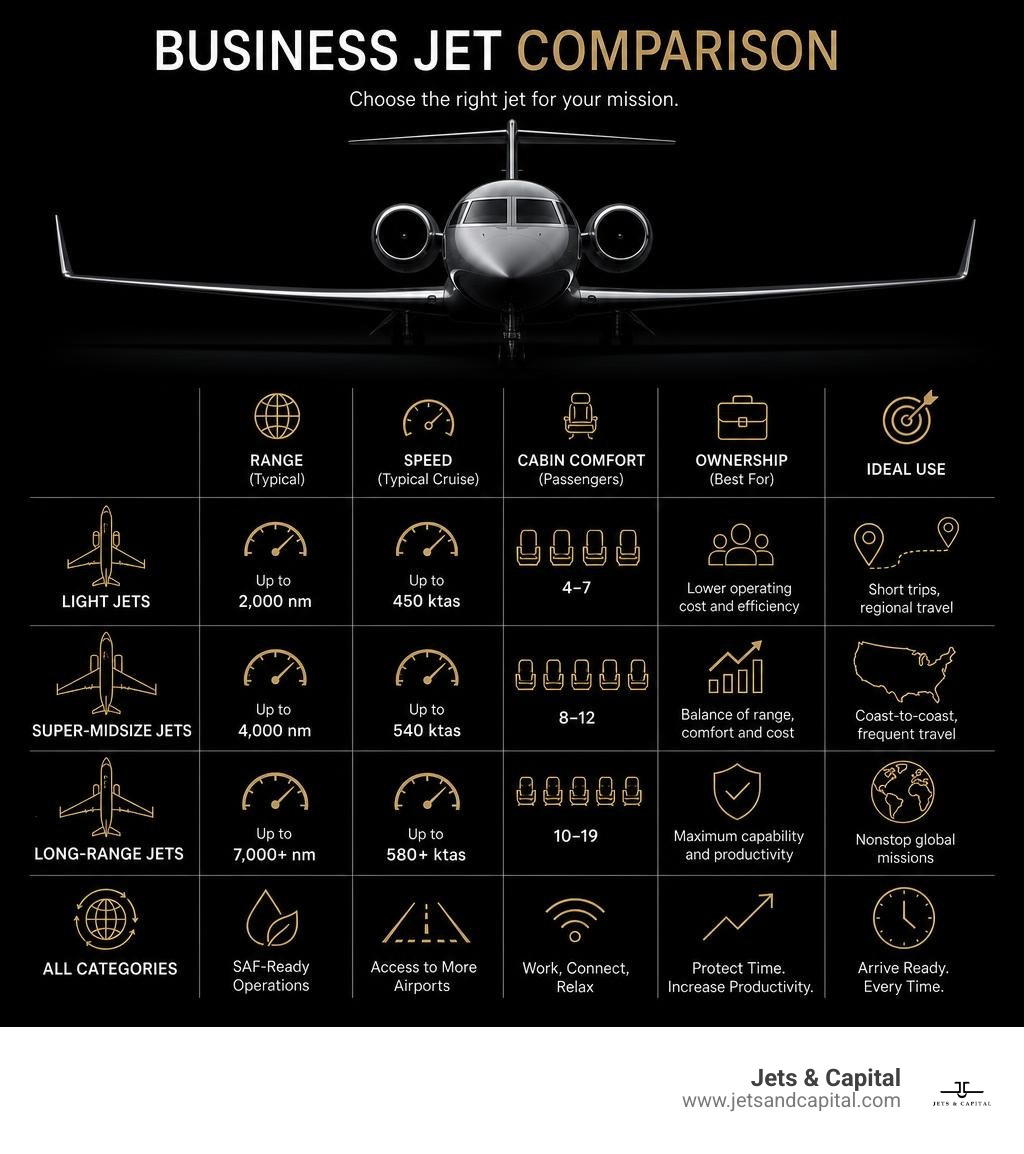
The best business jets depend on the mission, not simply the largest cabin or highest price. For regional trips, consider efficient light jets such as the Embraer Phenom 300E or Citation CJ4 Gen3. For frequent coast-to-coast travel, super-midsize aircraft like the Challenger 3500 and Citation Longitude offer a strong balance of range, cabin space, and operating cost. For nonstop global routes, the Gulfstream G700/G800 and Bombardier Global 7500/8000 lead on range, speed, and long-haul comfort.
Business aviation entered 2026 from a record year: 854 business jets were delivered in 2025, and industry billings reached $35.7 billion. That growth reflects a clear buyer priority: protect executive time, reach more airports directly, and arrive ready to work. This guide compares the aircraft that matter most by mission, cabin experience, performance, and ownership economics.
I am Jordan Hutchinson, an entrepreneur, investor, and founder of Jets & Capital, where I bring family offices and high-net-worth leaders together in curated aviation and investment settings. My experience working with these audiences informs this practical look at the best business jets for serious travel and capital-focused lifestyles.
State of the Business Aviation Market in 2026
The business aviation landscape has seen unprecedented growth. Following an 11.8% surge in deliveries during 2025 that pushed total shipments to 854 airframes, general aviation manufacturers recorded an all-time high of $35.7 billion in billings. Gulfstream Aerospace alone generated $7 billion in revenue, buoyed by strong demand for its clean-sheet flagships and family platforms.
Supply chains have stabilized significantly after years of post-pandemic bottlenecks, allowing OEMs to clear substantial order backlogs. At the same time, the transition toward sustainability has accelerated, with Sustainable Aviation Fuel (SAF) integration becoming a baseline operational requirement across flight departments in North America, particularly in hubs like Miami, Palm Beach, Dallas, and San Francisco.
Technological advancements have altered cockpits across every tier. Modern flight decks now routinely incorporate synthetic vision, predictive landing performance systems, and automated safety protocols such as Garmin Emergency Autoland. When examining the best jets in the world, buyers in 2026 evaluate whole-lifecycle value: mission range, cabin pressurization, fuel burn, and dispatch reliability.
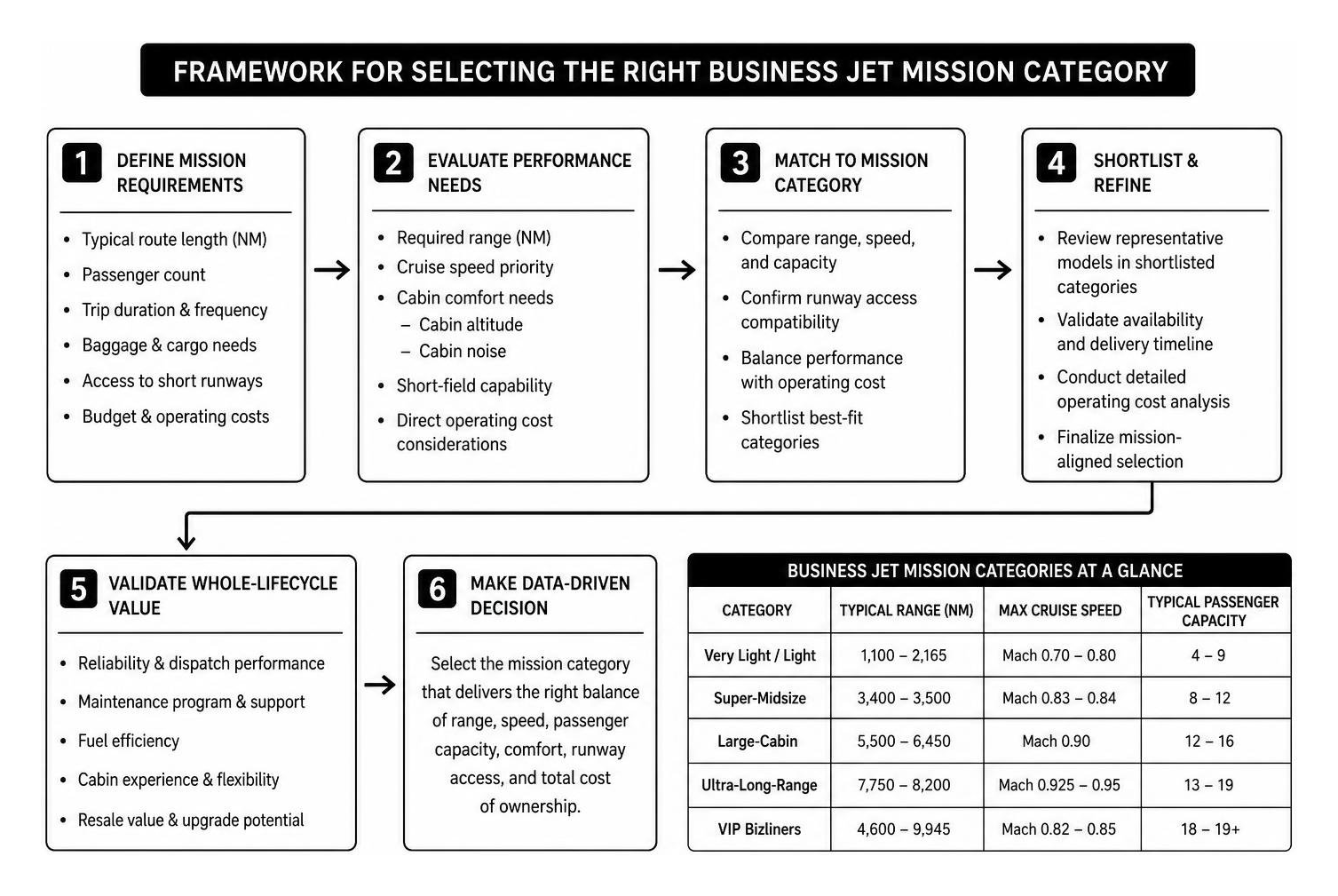
| Aircraft Category | Representative Models | Typical Range (NM) | Max Cruise Speed | Typical Passenger Capacity |
|---|---|---|---|---|
| Very Light / Light | Cirrus SF50, Embraer Phenom 300E, Citation CJ4 Gen3 | 1,100 – 2,165 | Mach 0.70 – 0.80 | 4 – 9 |
| Super-Midsize | Bombardier Challenger 3500, Cessna Citation Longitude | 3,400 – 3,500 | Mach 0.83 – 0.84 | 8 – 12 |
| Large-Cabin | Dassault Falcon 6X, Dassault Falcon 8X | 5,500 – 6,450 | Mach 0.90 | 12 – 16 |
| Ultra-Long-Range | Gulfstream G700/G800, Bombardier Global 7500/8000 | 7,750 – 8,200 | Mach 0.925 – 0.95 | 13 – 19 |
| VIP Bizliners | Boeing BBJ 787, Embraer Lineage 1000E | 4,600 – 9,945 | Mach 0.82 – 0.85 | 18 – 19+ |
Evaluating the Best Business Jets by Category and Performance

Selecting an aircraft requires balancing range and speed against real-world operational trade-offs. While sprint speeds grab headlines, standard cruise efficiency dictates fuel stops, maintenance schedules, and runway options. For owners balancing capital outlays against cabin quality, identifying a well-equipped private jet under 30 million often provides the sweet spot for domestic and regional itineraries.
Key performance variables include:
- Cabin Altitude Pressurization: Lower cabin altitudes (between 2,600 and 4,000 feet at cruise) reduce dehydration, fatigue, and jet lag on multi-hour flights.
- Acoustic Engineering: Cabin noise ratings below 50 dB SIL allow normal conversational tones without raising your voice.
- Short-Field Agility: Accessing runways under 4,000 feet opens thousands of regional airfields closer to final destinations, avoiding congested hub airports.
- Direct Operating Costs (DOC): Fuel consumption, engine reserves, and airframe maintenance programs vary dramatically from $2,200/hr on light platforms to well over $6,500/hr on heavy intercontinental jets.
The Best Business Jets for Ultra-Long-Range Global Travel
The flagship category represents the pinnacle of aerospace engineering, combining globe-spanning range with true multi-zone living spaces.
The G700 - Gulfstream Aerospace is engineered around spaciousness and speed, cruising up to Mach 0.935 with a maximum range of 7,750 nautical miles. Its cabin can be configured into up to five distinct living areas, featuring 20 signature panoramic oval windows, plasma-ionized fresh air circulation, and a cabin altitude of just 2,840 feet at 41,000 feet. For operators demanding unmatched distance, the Gulfstream G800 stretches maximum range to an industry-leading 8,200 nautical miles while retaining the Symmetry Flight Deck and Rolls-Royce Pearl 700 powerplants.
Bombardier's Global 8000 - The flagship for a new era | Bombardier, which saw initial deliveries arrive in late 2025, stands as the fastest private jet in the world with a certified top speed of Mach 0.95 and an 8,000-nautical-mile range. It offers an industry-low cabin altitude of 2,691 feet at 41,000 feet, Smooth Flĕx Wing shock absorption, and a four-zone layout featuring zero-gravity Nuage seating. Its sibling, the Bombardier Global 7500, continues as a proven long-haul workhorse with over 100 city-pair speed records and an upgrade path available to Global 8000 performance specifications.
Dassault Aviation approaches long-range efficiency through aerodynamic balance. The tri-jet Falcon 8X backgrounder - Dassault Falcon delivers a 6,450-nautical-mile range alongside steep-approach certification (up to 6 degrees), allowing direct access to constrained airfields like London City Airport. Meanwhile, the wide-body Dassault Falcon 6X provides the tallest and widest cross-section in its class, offering 5,500 nautical miles of range and unmatched low-speed handling. For executives flying 12- to 15-hour routes, these flagships can be configured as dedicated luxury jets with bedrooms and en-suite showers to ensure complete privacy and recovery in transit.
The Best Business Jets for Light and Super-Midsize Regional Routes
For missions under six hours, light and super-midsize jets deliver superior operational agility and lower hourly costs without sacrificing cabin refinement.
The Embraer Phenom 300E remains an industry benchmark, holding the title of best-selling light jet for over a decade with more than 800 deliveries. It pairs single-pilot capability with a 2,010-nautical-mile range and Mach 0.80 cruise speed. Competing closely is the Textron Aviation Citation CJ4 Gen3, which introduces the Garmin G3000 PRIME flight deck, Garmin Emergency Autoland, a 2,165-nautical-mile range, and an externally serviceable lavatory for rapid turnarounds.
In the super-midsize space, the Bombardier Challenger 3500 delivers a 3,400-nautical-mile range, a 99.8% dispatch reliability rate, and zero-gravity seating derived from the Global line. The Cessna Citation Longitude counters with a 3,500-nautical-mile range, seating for up to 12 passengers, and class-leading cabin acoustic quietness.
Versatility seekers often turn to the Pilatus PC-24, known as the "Super Versatile Jet" for its unique ability to operate on short, unpaved airstrips while retaining a cargo door and flat-floor interior. For entry-level private flight, the single-engine Cirrus SF50 Vision Jet leads volume shipments, with 106 units delivered in 2025 alone. Looking forward, the upcoming HondaJet Echelon aims to transform transcontinental light-jet missions by offering nonstop coast-to-coast capabilities with single-pilot operating economics.
VIP Bizliners and Extended Executive Suites
When standard corporate jet cabins prove too restrictive for large delegations or multi-room living, VIP converted airliners step in.
The Business Jets | Boeing portfolio—including the BBJ 737 MAX, BBJ 787, and BBJ 777X—offers residential-scale volume. The BBJ 787 delivers a range of roughly 9,945 nautical miles, capable of connecting virtually any two global destinations nonstop while providing full master staterooms, formal dining rooms, and active cabin humidification systems.
Similarly, the Embraer Lineage 1000E leverages an airliner airframe to deliver five distinct interior zones across a 4,600-nautical-mile range, accommodating up to 19 passengers in residential comfort. These aircraft represent the apex of billionaire luxury private jets, where standard business seating is replaced with master suites, conference rooms, and full-size galleys. Whether configured for corporate boards or family offices, these luxury private planes function as self-contained flying offices and homes.
Ownership Models, Operating Economics, and Acquisition Strategies

Acquiring a business jet requires evaluating capital structure, tax implications, and annual utilization.
- On-Demand Charter & Jet Cards (<150–200 hours/year): Ideal for lower utilization. It eliminates fixed capital overhead, maintenance liability, and repositioning exposure, though hourly rates are higher.
- Fractional Ownership (150–400 hours/year): Provides guaranteed asset availability, consistent cabin quality, and predictable hourly costs without direct flight department overhead.
- Full Ownership under FAR Part 91 / Part 135 (400+ hours/year): Delivers complete operational control, bespoke cabin configurations, and potential tax advantages (such as bonus depreciation). Managing ownership under a joint Part 91 (private flight) and Part 135 (charter revenue) framework helps offset fixed costs such as hangarage, insurance, and crew salaries.
Depreciation typically follows a structured curve: business jets experience their steepest depreciation (approximately 40–50%) over the first five years, before value stabilization occurs between years 10 and 15. Certain platforms, like the Embraer Phenom 300E, demonstrate exceptional residual value retention, holding nearly 68% of original value after 15 years.
Key Acquisition Decision Criteria:
- Mission Distance: Align 80% of your annual flight profiles to the jet's non-stop range with NBAA IFR reserves.
- Runway Limitations: Verify takeoff and landing field lengths for your most frequent primary and secondary airfields.
- Payload vs. Full-Fuel Range: Ensure the airframe can carry your required passenger load without sacrificing fuel capacity.
- Maintenance Network: Confirm OEM service center proximity and parts dispatch guarantees in your home operating regions.
Frequently Asked Questions About Business Jets
What is the fastest business jet available in 2026?
The Bombardier Global 8000 is the fastest civilian aircraft in operation since Concorde, featuring a top operating speed of Mach 0.95 and a standard high-speed cruise of Mach 0.92.
How many annual flight hours justify full private jet ownership?
Full ownership typically becomes cost-effective once an individual or corporation flies 400 to 500 hours annually. Below 200 hours, on-demand charter or fractional shares generally offer better financial efficiency.
Which business jet offers the longest non-stop flight range?
Among purpose-built corporate jets, the Gulfstream G800 leads the market with an NBAA IFR range of 8,200 nautical miles. In the VIP airliner category, the Boeing BBJ 787 can fly up to 9,945 nautical miles nonstop.
Conclusion: Choosing the Right Aircraft for Executive Missions
Finding the optimal aircraft requires matching realistic mission distances, payload demands, and cabin wellness priorities against total cost of ownership. From versatile light jets to globe-spanning flagships, modern business aviation offers unprecedented speed, connectivity, and efficiency.
At Jets & Capital, we operate at the intersection of private aviation and high-level finance. We organize exclusive, invite-only networking events for family offices, institutional investors, and UHNWIs directly inside premier private jet hangars across key hubs—including Las Vegas, Dallas, Salt Lake City, Palm Beach, Miami, New York, and San Francisco (including our upcoming Super Bowl Edition). With a strict vetting process that ensures 85% of attendees are capital allocators, our events create an ideal environment for meaningful deal-making surrounded by the world's finest aircraft.
Explore our comprehensive analysis of modern luxury corporate jets to discover the ideal platform for your organizational mission and investment portfolio.
