
The Ultimate Guide to Comparing Corporate Jet Charter Options
Understanding the Corporate Jet Ecosystem and Access Models
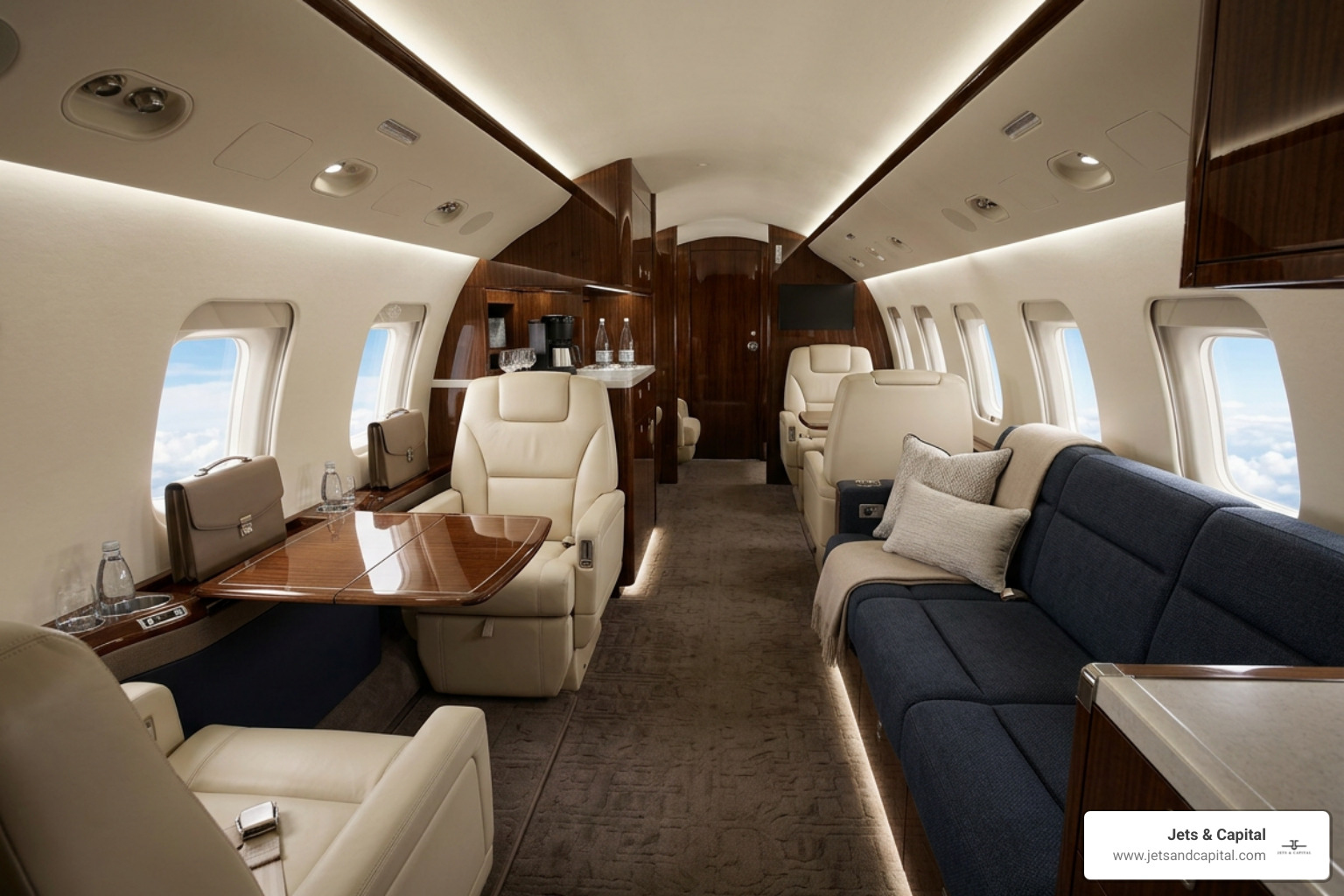
Evaluating corporate jet access models comes down to annual flight hours, capital commitments, and scheduling control. On-demand charter is the most cost-effective option for companies flying under 50 hours per year without upfront asset risk. Fractional ownership suits organizations requiring 50 to 200 annual flight hours, delivering guaranteed aircraft availability through equity shares. Whole aircraft ownership becomes financially prudent for operations exceeding 200 to 300 flight hours annually, granting absolute cabin and scheduling control alongside full fixed operational overhead.
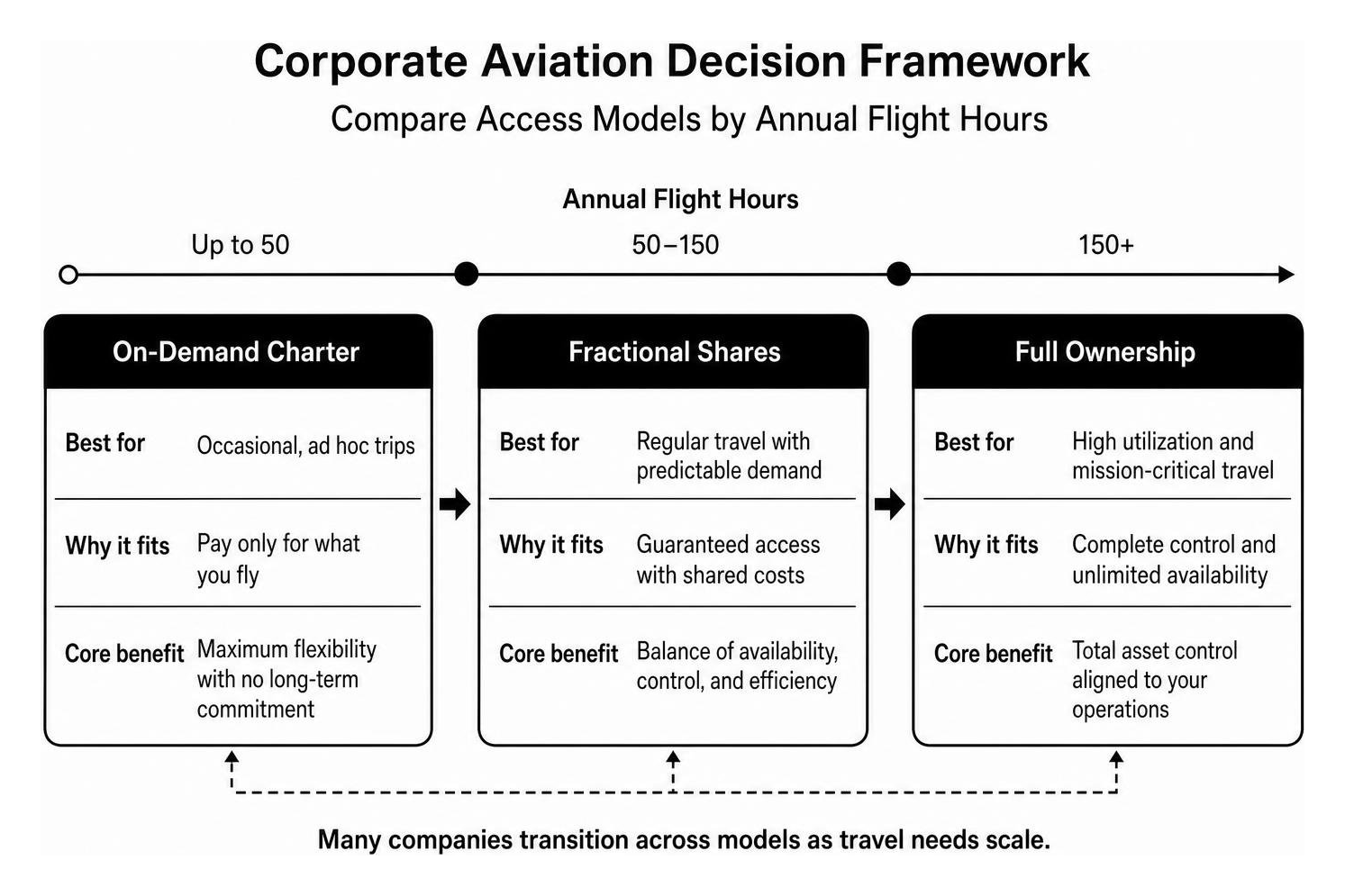
Many corporate leaders transition across access tiers as their travel footprint scales. Some begin by chartering private flights through dedicated brokers, while others rely on structured Business Jet Airlines or corporate shuttles for predictable, recurring executive routes. The goal is always to match operational governance to genuine travel demand.
On-Demand Charter vs. Fractional Shares vs. Full Ownership
Every access model presents a distinct balance between capital outlay, scheduling flexibility, and ongoing overhead:
- On-Demand Charter: You pay strictly for the hours you fly without upfront capital risk or ongoing storage and maintenance obligations. It is ideal for individuals and firms flying under 50 hours annually. Pricing fluctuates with seasonal demand and positioning legs (deadheads).
- Fractional Equity Ownership: Popularized by providers offering partial aircraft deeds (such as one-sixteenth or one-quarter shares), fractional ownership guarantees access with shorter call-out times (often 10 to 24 hours). You purchase an equity stake in an aircraft serial number, paying a monthly management fee and a fixed hourly rate. This model suits businesses flying between 50 and 200 hours per year.
- Whole Aircraft Ownership: Purchasing an aircraft outright under sole ownership delivers absolute control over the cabin interior, flight schedules, and security standards. However, whole ownership introduces substantial fixed expenses—including pilot salaries, insurance, hangar lease agreements, and scheduled inspections—making it financially prudent primarily for operations exceeding 200 to 300 flight hours annually.
| Access Model | Annual Flight Hours | Capital Outlay | Ongoing Fixed Overhead | Scheduling Control |
|---|---|---|---|---|
| On-Demand Charter | < 50 hours | None (Pay-as-you-fly) | None | Subject to fleet availability |
| Fractional Ownership | 50 – 200 hours | Moderate to High (Equity share) | Monthly management fee | Guaranteed with fixed call-out windows |
| Full Ownership | 200+ hours | High (Full asset purchase) | Full (Crew, hangar, maintenance) | Total control over asset availability |
FAR Part 91 Flight Departments vs. FAR Part 135 Charter Operations
In the United States, private aviation operates primarily under two regulatory frameworks established by the Federal Aviation Administration (FAA):
- FAR Part 91 (General Aviation / In-House Flight Departments): Governs non-commercial, owner-operated aircraft. Corporations operating under Part 91 maintain internal flight departments exclusively to transport their own executives and personnel. Because these flights cannot be sold to third-party retail clients for direct compensation, they enjoy operational flexibility in pilot duty days and runway dispatch minimums while adhering to strict internal safety protocols.
- FAR Part 135 (On-Demand Commercial Air Carrier): Governs commercial charter operations and air taxi services. Part 135 operators undergo rigorous ongoing surveillance, hold commercial air carrier certificates, and comply with strict FAA-mandated pilot rest limits, formal drug testing programs, and conservative runway safety buffers.
When corporate flight departments want to offset fixed costs, they frequently place their aircraft on a third-party FAR Part 135 certificate to sell idle flight hours to charter clients. When chartering flights through major hubs, such as utilizing premium FBO Services Palm Beach, FL or executive terminals in New York, Dallas, Miami, and Las Vegas, regulatory transparency mandates that air charter brokers clearly disclose the licensed Part 135 direct air carrier operating the flight.
Primary Aircraft Classes and Fleet Capabilities
Matching your mission profile to the right airframe class ensures you do not overpay for unused cabin volume or run into payload and range constraints. From short-runway hops to global nonstop routes, evaluating the Best Jets in the World requires reviewing cabin dimensions, runway performance, and cruise velocities.
Very Light and Light Corporate Jet Options
Very Light Jets (VLJs) and Light Jets represent the most agile, cost-effective category of executive aircraft. Built to operate under FAR Part 23 certification standards, many light jets are certified for single-pilot operations, offering owner-pilots and lean flight departments remarkable utility.
- Embraer Phenom 300 Series: The Phenom 300 has been the best-selling light jet for 13 consecutive years, with over 800 deliveries between 2011 and 2024. Delivering high-speed cruise performance and class-leading baggage space, it handles continental legs with ease.
- Cessna Citation Family: Over 2,000 Cessna CitationJets have been delivered worldwide, making it the most popular line of business jets in aviation history. The next-generation Citation CJ4 Gen3 offers a maximum range of 2,165 nautical miles (4,010 km) and a top cruise speed of 451 ktas, powered by Williams International FJ44-4A engines and Garmin G3000 PRIME avionics with Emergency Autoland safety systems.
For corporate buyers evaluating an acquisition, securing a high-performing Private Jet Under 30 Million in this segment provides low hourly operating costs and direct access to regional airstrips with runways under 4,000 feet.
Midsize and Super-Midsize Transcontinental Workhorses
Midsize and super-midsize jets bridge the gap between regional versatility and true transcontinental range. They feature stand-up flat-floor cabins, fully enclosed aft lavatories, and substantial baggage holds.
- Bombardier Challenger 350 / 3500: A benchmark in the super-midsize segment, offering true coast-to-coast endurance across North America, exceptional climb performance, and an ergonomic cabin equipped with low cabin altitude pressurization.
- Cessna Citation Longitude: Featuring clean-wing aerodynamics, a whisper-quiet cabin environment, and transatlantic capability from the East Coast, the Longitude remains among the Best Business Jets for transcontinental business travel.
Heavy and Ultra-Long-Range Corporate Jet Flagships
Flagship corporate aircraft allow multinational executive teams to conduct global business without intermediate fuel stops. These aircraft cruise at altitudes up to 51,000 feet, flying above commercial airline traffic and weather disruptions while providing ultra-low cabin altitudes to combat jet lag.
- Gulfstream G700: The flagship G700 - Gulfstream Aerospace achieves a maximum range of 7,750 nautical miles (14,353 km) at Mach 0.85, a high-speed cruise of Mach 0.90, and a maximum operating limit of Mach 0.935. Powered by twin Rolls-Royce Pearl 700 engines, its cabin maintains an ultra-low pressurization altitude of 2,840 feet while cruising at 41,000 feet, delivering 100% fresh, plasma-ionized air across up to five configurable living spaces.
- Bombardier Global 8000: Standing as the Fastest Private Jet in the World with a top speed of Mach 0.95 and an industry-leading range of 8,000 nautical miles, the Global 8000 provides four dedicated living spaces. It delivers a cabin altitude of just 2,691 feet at 41,000 feet and incorporates circadian lighting systems.
For long-haul executive missions requiring overnight sleep, these platforms are outfitted as Luxury Jets with Bedrooms, offering private en-suite staterooms with stand-up showers and ergonomic lie-flat beds.
VIP Airliners and Bizliners for Executive Delegations
When executive missions involve large delegations, heads of state, or family offices traveling with staff, commercial airliner conversions (bizliners) deliver residential-scale environments.
- Airbus Corporate Jets (ACJ): The widebody ACJ350 | Airbus offers up to 308 m² of floor area, non-stop flight endurance of up to 22 hours (11,100 nm range), and a 25% lower fuel burn compared to previous-generation platforms. The extra-large ACJ TwoTwenty provides three times the interior volume of traditional large business aircraft.
- Boeing Business Jets (BBJ): Adapting the 737 MAX, 787 Dreamliner, and 777X airframes, BBJ platforms provide bespoke master bedrooms, boardrooms, and dining suites, setting the standard for Billionaire Luxury Private Jets used for global intercontinental diplomacy.
Technical Specifications, Aerodynamics, and Lifecycle Maintenance
The engineering behind corporate jets differs from commercial air transport. Executive aircraft are optimized for rapid climbs to high cruising altitudes, short-field takeoff versatility, and sustained aerodynamic efficiency.

Maintaining these Luxury Private Planes requires disciplined lifecycle management to preserve resale value and maintain dispatch reliability.
Wing Engineering and Fuselage-Mounted Engine Configurations
Look closely at almost any dedicated corporate jet, and you will notice the engines are mounted on the rear fuselage rather than under the wings. This design approach serves critical operational functions:
- Foreign Object Damage (FOD) Reduction: Business jets frequently operate out of smaller regional airports where runways and taxiways may have loose debris. Fuselage-mounted engines provide higher ground clearance, keeping engine intakes away from ground contaminants.
- Aerodynamic Clean-Wing Performance: Rear engine placement leaves the wing uncluttered. This allows aerodynamicists to install continuous leading-edge slats and large trailing-edge flaps, generating high lift at low airspeeds for short-field takeoffs while keeping drag minimal at high-speed cruise.
- Cabin Noise Attenuation: Placing the engine nacelles aft of the passenger compartment directs engine noise and vibration behind the cabin, resulting in a quieter working environment.
These airframes are also adapted for specialized missions. Their high cruising ceilings, long endurance, and high electrical power generation make them ideal platforms for aeromedical evacuation, maritime surveillance, and airborne early-warning platforms.
Sustainable Aviation Fuels and Engine Care Programs
Sustainability and financial predictability are central priorities for modern flight departments. The business aviation sector is rapidly adopting Sustainable Aviation Fuel (SAF), which reduces lifecycle carbon dioxide emissions by up to 80% compared to conventional Jet-A fuel. Modern powerplants from manufacturers like Rolls-Royce, GE Aerospace, and Pratt & Whitney are certified to operate on SAF drop-in blends.
To manage maintenance expenses, operators enroll their aircraft into OEM-backed hourly engine programs such as the Rolls-Royce Tay Corporate CorporateCare® framework.
- Financial Risk Transfer: Comprehensive hourly maintenance programs cover scheduled overhauls, unscheduled shop visits, and line maintenance parts and labor, eliminating unexpected capital outlays.
- Engine Health Monitoring (EHM): Real-time telemetry tracks onboard parameters to identify mechanical issues before they cause flight interruptions.
- Rapid AOG Logistics: Global mobile repair teams and pooled loaner engines resolve Aircraft on Ground (AOG) events within 24 hours.
- Asset Value Retention: Aircraft enrolled in transferable, OEM-backed engine care programs command higher resale values and spend fewer days on the secondary market during divestment.
Frequently Asked Questions About Private Aviation
How does private charter pricing compare to jet cards?
On-demand charter pricing uses dynamic market rates that vary based on immediate aircraft availability, route popularities, seasonal spikes, and empty-leg repositioning costs. You pay only for the trip you book.
In contrast, jet card programs require purchasing blocks of flight time (typically 25, 50, or 100 hours) at a fixed hourly rate. Jet cards offer guaranteed aircraft availability within 24 to 72 hours, consistent cabin categories, and predictable costs, but they often incorporate membership initiation fees, monthly management charges, and peak-day surcharges.
What are the primary safety standards to verify before booking?
When vetting an air charter broker or Part 135 operator, verify their independent third-party safety accreditations:
- ARGUS International: Look for ARGUS Gold or Platinum ratings. Platinum certification requires an extensive on-site audit evaluating flight safety operations, maintenance history, and the operator's Safety Management System (SMS).
- Wyvern: Wyvern Wingman certification verifies that operators enforce higher pilot flight-time minimums, recurrent simulator training, and comprehensive crew background checks.
- Crew Experience: Ensure flight crews have minimum experience requirements (typically 3,000+ total flight hours and 500+ hours in type for the Pilot in Command) alongside recent simulator checkrides.
How much does a private aircraft depreciate over a five-year lifecycle?
A brand-new corporate aircraft typically follows a steep depreciation curve, losing approximately 50% of its initial acquisition value over its first five years of operation. Between years 10 and 15, the annual depreciation rate flattens considerably. Enrolling in guaranteed airframe and engine maintenance programs, strictly documenting flight logs, and hangaring the aircraft are essential practices to protect residual asset liquidity in the pre-owned market.
Conclusion
A corporate jet is a valuable tool for executive mobility, time optimization, and long-term business strategy. Selecting the ideal private aviation model requires balancing annual flight hours, mission distances, runway constraints, and financial risk profiles across charter, fractional, and whole-ownership options.
At Jets & Capital, we operate at the intersection of private aviation and private capital. We host exclusive, invite-only Private Jet Hangar Events that bring together single-family offices, institutional allocators, and ultra-high-net-worth investors in dynamic aerospace venues across San Francisco, New York, Miami, Palm Beach, Dallas, Las Vegas, and Salt Lake City. With a strict vetting process ensuring an 85% allocator presence, our events create an ideal environment for strategic deal-making, co-investment, and executive relationship building.
To evaluate top-tier aircraft options and explore our upcoming hangar gatherings, review our detailed guide to Luxury Corporate Jets.
