
Step Inside the Most Comfortable Small Private Jet Interiors
What to Expect From a Small Private Jet Interior

A small private jet interior is designed to make a short regional flight feel private, efficient, and comfortable. Most light jets seat four to six passengers in executive club seating, with fold-out worktables, a compact refreshment area, an enclosed lavatory, and storage built into nearly every usable surface.
For trips of roughly two to three hours, the best cabins focus on the details that matter most:
- Comfort: supportive leather seats, quieter cabins, practical lighting, and individual climate control
- Productivity: worktables, charging ports, Wi-Fi options, and seating that supports face-to-face meetings
- Privacy: no shared aisle with strangers, no crowded terminal experience, and a cabin reserved for your group
- Smart use of space: compact galleys, hidden storage, and furniture sized to preserve room to move
The trade-off is space. Many light-jet cabins are around 4 feet 10 inches high, so passengers generally remain seated rather than standing and walking around. Compared with midsize and large aircraft, they have fewer separate zones and less room for full meal service or sleeping. But for a principal, family, or small deal team traveling regionally, a well-designed light jet can offer a more focused experience than commercial first class.
I am Jordan Hutchinson, founder of Jets & Capital, where I bring together investors and family offices in curated aviation-centered settings. My work around private aviation and high-net-worth travel informs this guide to what makes a small private jet interior effective for comfort, privacy, and business use.
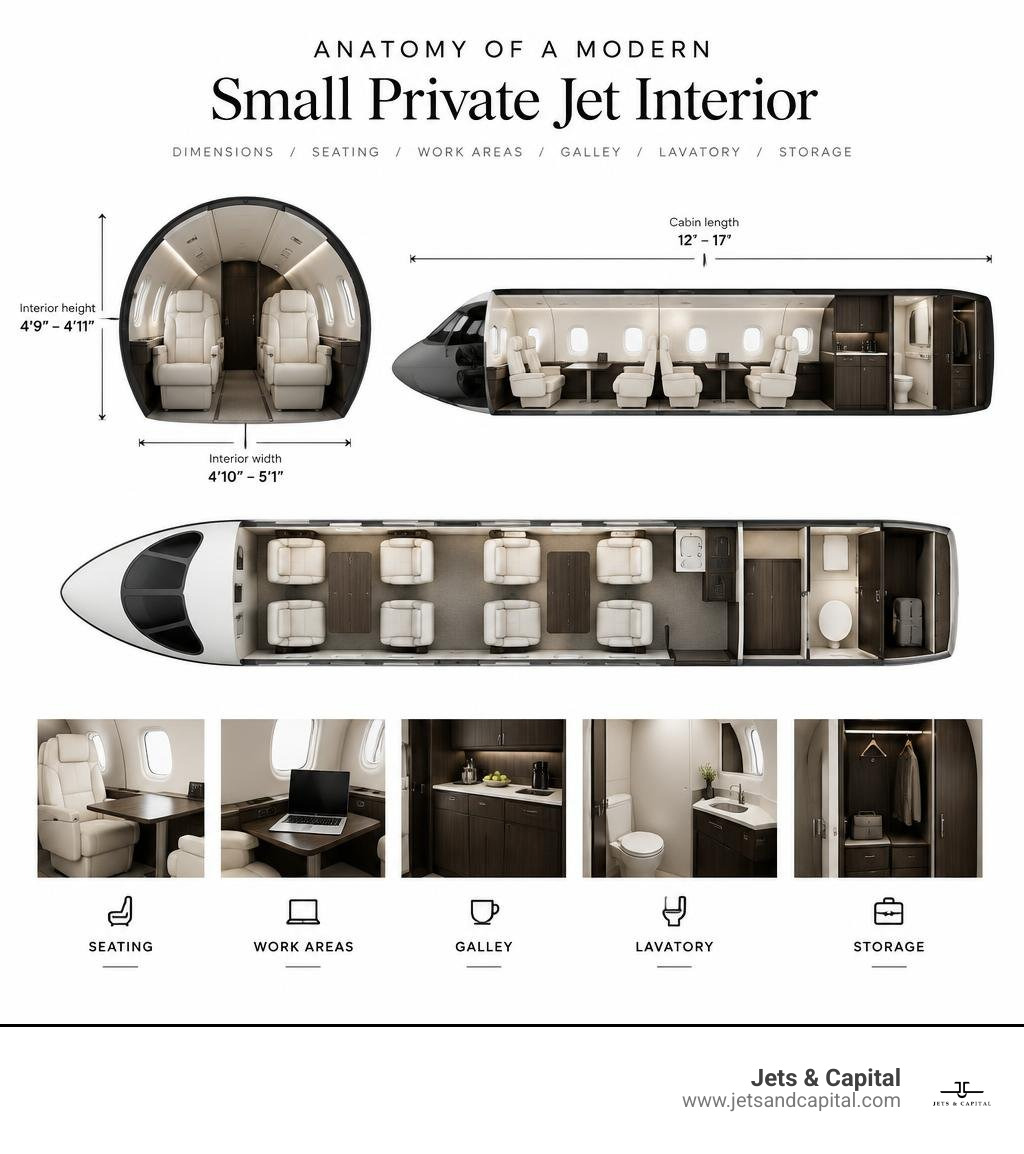
Anatomy of a Modern Small Private Jet Interior
Step inside a modern light jet, and you immediately see that every cubic inch has a dedicated purpose. Cabin designers treat the interior of a light aircraft much like naval architects approach a high-performance yacht: absolute precision, no dead space, and seamless ergonomic transitions.
A standard light jet cabin generally features an interior height hovering around 4 feet 9 inches to 4 feet 11 inches, a width of roughly 4 feet 10 inches to 5 feet 1 inch, and an overall cabin length between 12 and 17 feet. Because these aircraft are optimized for regional hops of 2 to 3 hours (such as flying between Miami and Palm Beach, or hopping from San Francisco to Las Vegas), the interior architecture focuses on seated luxury rather than multizone lounges.
The centerpiece of this layout is the classic executive four-club seating arrangement. Four contoured armchairs face one another in pairs across two flush-folding executive tables. This configuration lets executives hold discreet deal discussions, review presentations, or share a light meal without feeling cramped. Behind or forward of the club section, manufacturers frequently incorporate one or two forward-facing individual seats or a side-facing divan to comfortably accommodate four to six passengers.
To understand how small jets fit within the broader market of best business jets, consider how cabin dimensions and capabilities scale across categories:
| Jet Class | Typical Passenger Capacity | Average Cabin Height | Typical Mission Range | Dedicated Rest/Sleep Zones |
|---|---|---|---|---|
| Light / Small Jet | 4 – 6 (up to 8) | 4 ft 9 in – 4 ft 11 in | 1,200 – 2,000 nm (2–3.5 hrs) | None (Fully reclining club seats) |
| Midsize Jet | 7 – 9 | 5 ft 7 in – 5 ft 10 in | 2,200 – 3,200 nm (4–5.5 hrs) | Single club-to-bed conversion |
| Super-Midsize / Heavy Jet | 9 – 16+ | 6 ft 0 in – 6 ft 4 in | 3,500 – 7,500+ nm (7–14+ hrs) | Enclosed master bedrooms & divans |

Maximizing Space in a Small Private Jet Interior
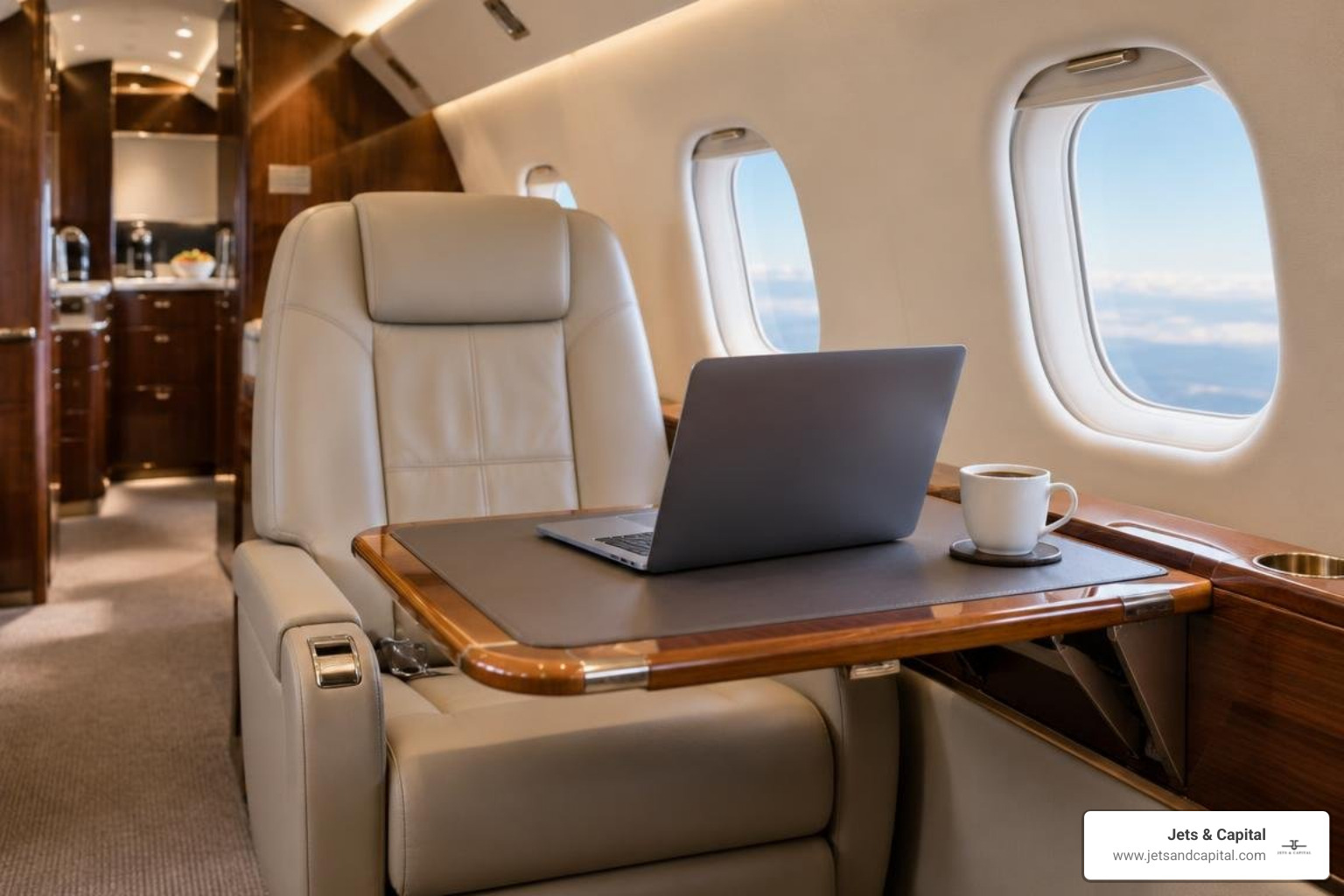
When working within a compact airframe, spatial efficiency becomes an art form. Modern light jet interiors rely on visual and structural tricks to eliminate any feeling of confinement.
Dropped-aisle designs are standard in aircraft like the Cessna Citation series, lowering the center walkway to maximize seated headroom and foot space. Meanwhile, contemporary aerospace studios frequently look to adaptive spatial design concepts to introduce multipurpose elements that transform on demand.
Key space-saving innovations in today's compact cabins include:
- Concealed Workstations: Executive tables fold completely flush into side ledges when not in use, supported by precision dampeners that allow one-handed deployment.
- Modular Storage Niches: Under-seat drawers, armrest storage wells, and magazine pockets built into the bulkheads ensure personal devices and documents stay organized.
- Acoustic and Thermal Insulation: Advanced composite multi-layer sound dampening keeps engine roar at bay, making conversational tones effortless across the club seats.
- Smart Ambient Lighting: Dimmable LED accent strips along the floor valance and headliner visually widen the cabin, shifting color temperature to reduce fatigue during evening flights.
Galley, Lavatory, and Luggage Solutions
Despite compact dimensions, light jets do not compromise on core necessities. Positioned directly opposite the main cabin entryway, you will find a compact refreshment center. This minibar setup includes insulated ice drawers, crystal glassware racks, chilled beverage storage, and dedicated compartments for catering platters and espresso makers.
At the rear of the cabin lies the enclosed lavatory. In modern light jets, this is far from a temporary chemical closet; it features solid pocket privacy doors, a flushed toilet, a lighted vanity mirror, and often a compact sink. Many models also certify the lavatory seat with an integrated seatbelt, allowing it to serve as a legal additional passenger seat during takeoff and landing.
Luggage logistics are handled through a combination of internal coat closets and external baggage compartments. Because light jets are built for short-range travel, their external heated and pressurized baggage holds easily swallow golf bags, garment bags, and multiple roll-aboards. When planning your aircraft acquisition using a comprehensive corporate jet buying guide 2026, evaluating baggage volume alongside passenger capacity is essential for real-world utility.
Luxury Materials and Engineering Behind Compact Cabins
Outfitting a small jet cabin is fundamentally an exercise in high-stakes aerospace engineering. Every textile, veneer, and composite panel must balance beauty with strict regulatory performance.
Interior designers working on luxury private planes must comply with rigorous FAA flammability standards. Every material—from the plush leather wrapping the armchairs to the silk threads in the carpets—undergoes strict vertical burn testing to verify self-extinguishing capabilities and low smoke toxicity.
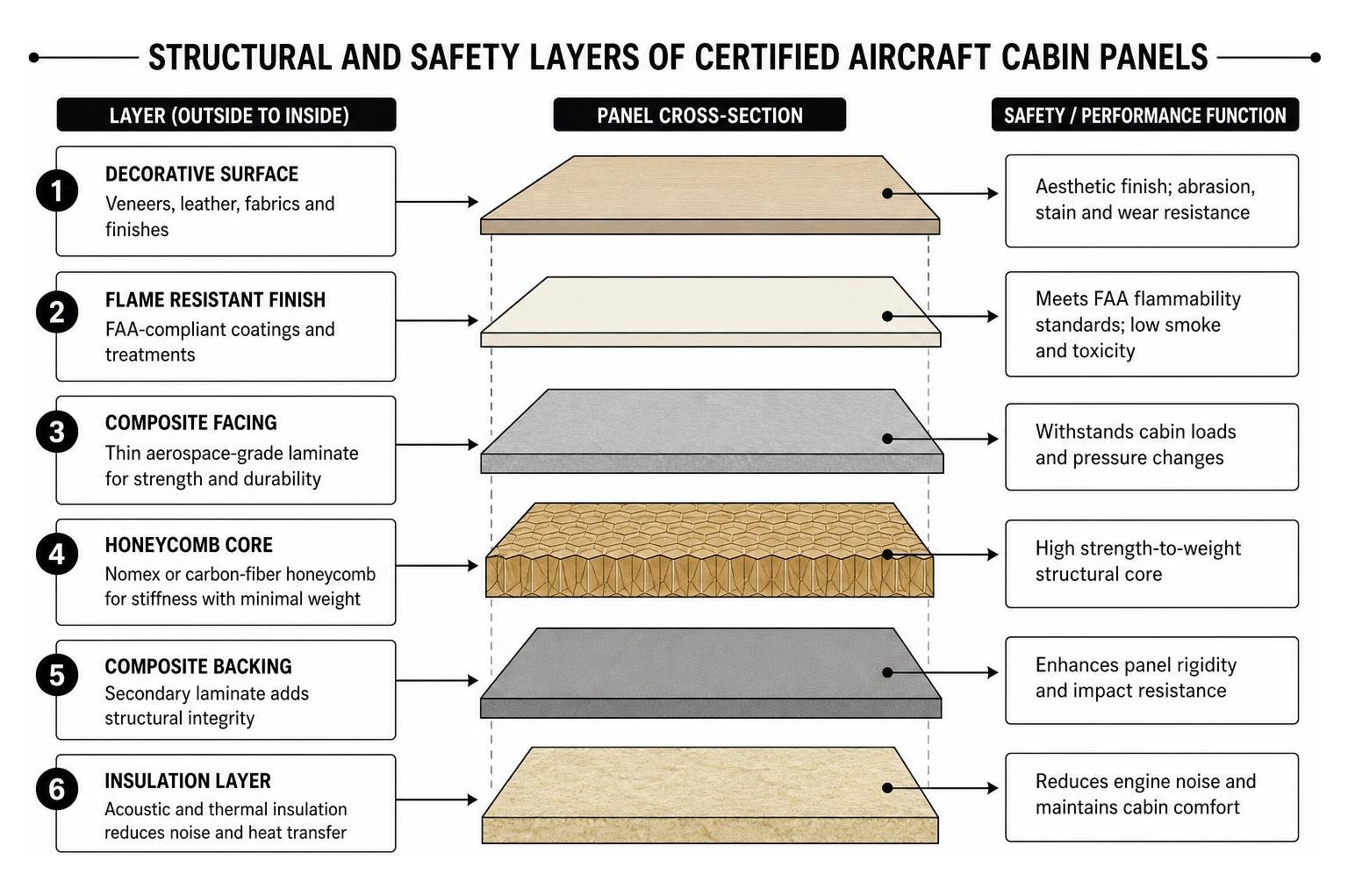
Weight management is equally critical. In a light aircraft, unnecessary pounds directly diminish flight range and fuel efficiency. To solve this, master completion centers utilize:
- Honeycomb Carbon-Fiber Bulkheads: Structural dividers and cabinetry cores made of featherweight carbon or Nomex honeycomb rather than solid wood.
- Micro-Thin Wood Veneers: Exotic woods sliced to fractions of a millimeter and bonded over aerospace-grade composite substrates.
- Engineered Ultraleathers: High-durability, lightweight synthetic and semi-aniline leathers that reduce seat weight by up to 30% compared to traditional automotive upholstery.
Customization Trends in Small Private Jet Interior Design
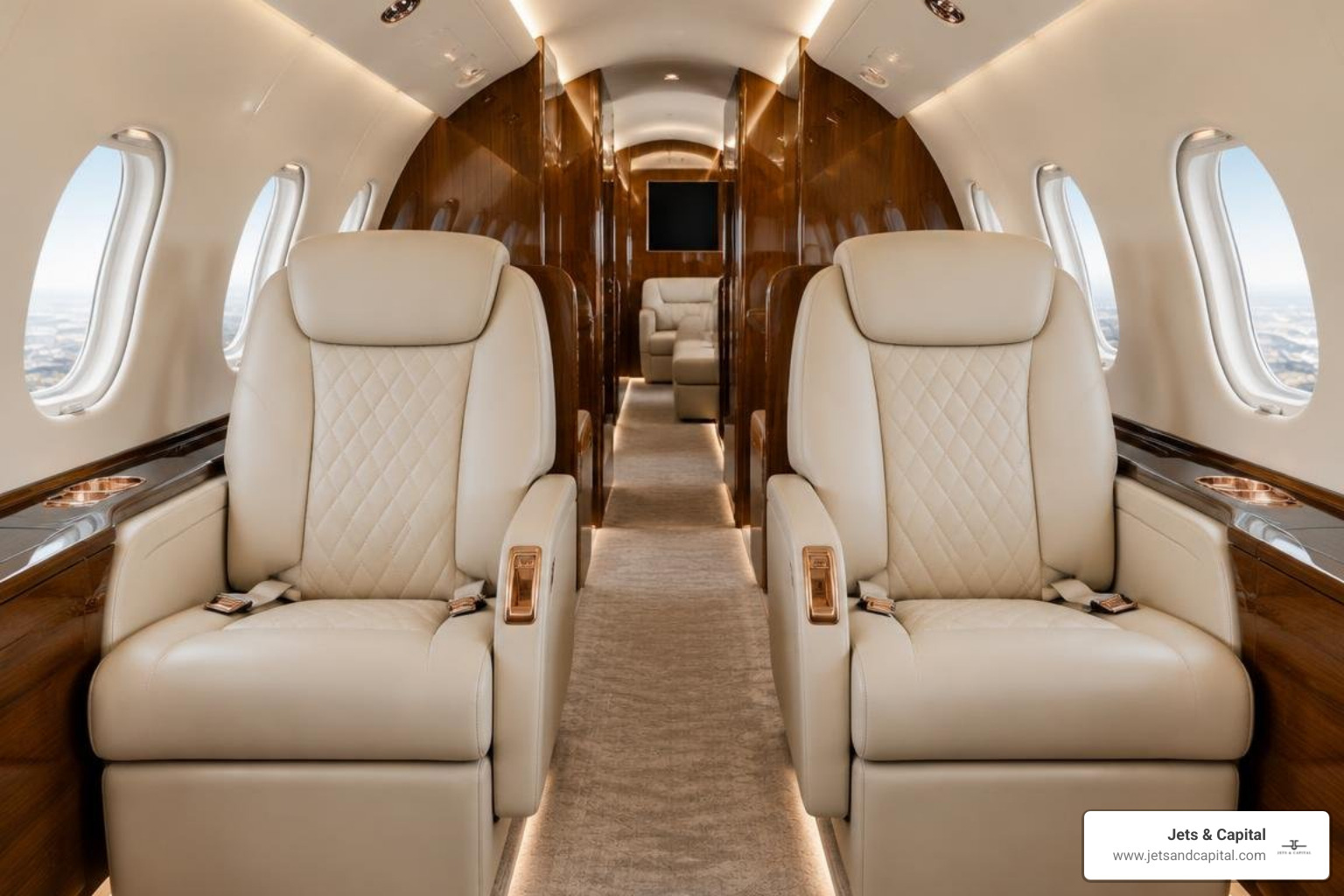
Gone are the days when light jet cabins were restricted to generic rental-car tans and corporate grays. Discerning aircraft owners are turning to elite completion centers to personalize their aircraft with bespoke architectural signatures.
Recent interior projects highlight striking bespoke cabin carpeting and finishes, including hand-tufted wool-and-silk floorings, rose-gold plated seat release hardware, and sustainable open-grain oak recon veneers. For principals acquiring a turnkey private jet under 30 million, bespoke customization allows a pre-owned or new light airframe to reflect the exact aesthetic of their private estate or family office.
Advanced Cabin Management Systems (CMS) have also trickled down into the light jet segment. Passengers can adjust lighting zones, set individual seat temperatures, and cue up high-definition streaming over Ka-band satellite Wi-Fi directly from their smartphones.
Top Small Private Jet Models Renowned for Interior Comfort
A few standout airframes consistently lead the category for interior comfort, ergonomics, and quietness:
- Embraer Phenom 300E: The undisputed benchmark in the light jet class. It features an exclusive "Bossa Nova" interior option, best-in-class cabin altitude (minimizing physiological jet lag), large windows that flood the aisle with natural light, and a flat-floor design that makes moving through the cabin seamless.
- Cessna Citation CJ3+: A favorite for executive owner-pilots and corporate flight departments. Known for its quiet acoustic profile, exceptionally reliable climate control, and an expansive 14-piece window arrangement that creates an open, airy feeling.
- Learjet 75 Liberty: Celebrated for introducing the forward "executive pocket door," which isolates the cabin from cockpit noise and galley activity. Its eight-seat double-club layout and legendary smooth ride make it one of the best jets in the world for short business sectors.
- HondaJet Elite II: Instantly recognizable by its Over-The-Wing Engine Mount (OTWEM) configuration. By mounting the engines outside the fuselage, HondaJet eliminates structural engine pylons, creating a remarkably quiet cabin, an extraordinarily spacious aft lavatory with dual skylights, and class-leading legroom.
Frequently Asked Questions About Small Private Jet Interiors
Do small private jets have fully enclosed bathrooms?
Yes. Unlike very light jets of past eras that used curtain dividers, virtually all modern small private jets (such as the Phenom 300E, Citation CJ3+, and Learjet 75) feature an aft enclosed lavatory with solid sliding pocket doors, an integrated flushing toilet, and a vanity sink.
Can you stand up inside a small private jet cabin?
Most small private jets have an interior cabin height between 4 feet 9 inches and 4 feet 11 inches, meaning adults will need to crouch slightly while moving along the aisle. Full stand-up cabin height (6 feet or taller) typically begins in the super-midsize and large jet categories.
How does a small jet interior compare to commercial first class?
While international commercial first-class suites may offer lay-flat beds, a small private jet provides complete personal privacy, an environment free of strangers, custom-set cabin air and lighting, zero terminal transit lines, and direct point-to-point routing.
Conclusion
The modern small private jet interior proves that true luxury does not require a commercial airliner fuselage. Through lightweight engineering, acoustic management, and ergonomic seat architecture, today's light cabins deliver an uncompromising environment for focus, rest, and business agility.
At Jets & Capital, we celebrate the intersection of top-tier aviation and private equity. We host exclusive, invite-only networking summits for family offices, institutional allocators, and UHNWIs inside elite private jet hangars across prime wealth centers—including San Francisco, Dallas, Palm Beach, Miami, Las Vegas, Salt Lake City, and New York. By bringing together curated deal-makers amidst the world's most impressive aircraft, we provide a launchpad for high-caliber partnerships.
To explore more about outfitting and acquiring premier business aircraft, review our comprehensive analysis of modern luxury corporate jets.
