
Boardrooms in the Clouds and the Art of Mid-Flight Dealmaking
Plan Private Jet Business Meetings That Move Deals Forward

Private jet business meetings work best when you treat the aircraft as a mobile deal room, not just transportation. Start by choosing an aircraft with face-to-face seating and dependable connectivity, invite only the decision-makers needed, protect sensitive files with a VPN and approved devices, and build the flight around a clear meeting agenda.
For a family office principal or executive team, the advantage is simple: travel time can become protected time for diligence, relationship building, and decisions. Private terminals also reduce airport friction, while access to smaller regional airports can place your group closer to a target company, site visit, or private gathering.
The economics depend on the mission. A private charter is rarely the lower-cost choice for one person on a major route. But for a group of five to eight executives, a multi-city schedule, or a time-sensitive negotiation, the per-person cost and the value of keeping the full team together may compare far more favorably with premium commercial travel.
I am Jordan Hutchinson, an entrepreneur, investor, and founder of Jets & Capital events, where I create curated settings for investors and family offices to build real relationships. My work in capital raising, private investment networks, and exclusive aviation-centered events informs this guide to planning private jet business meetings with purpose.
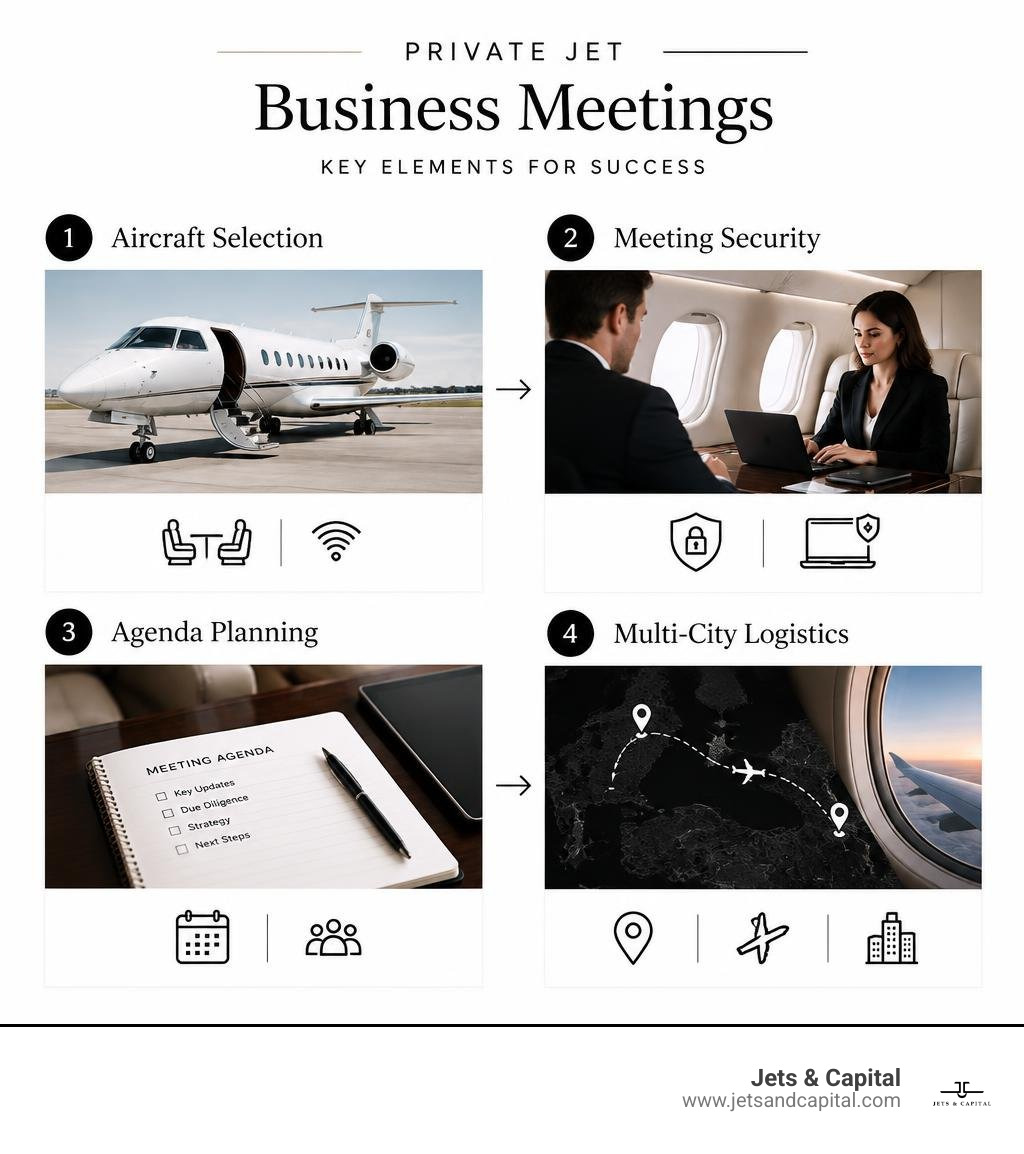
The Strategic Advantages of Private Jet Business Meetings
When high-stakes negotiations stall in conventional conference rooms, the friction often stems from an environment riddled with micro-distractions. Ringing phones, incoming staff, and the lingering pressure of daily operations dilute executive focus. Up in the sky, the dynamics shift fundamentally.
A modern business jet cabin delivers total acoustic isolation and a psychological detachment from ground-level noise. At cruising altitude, you enter a distraction-free environment where every participant shares the exact same physical space, timeline, and objective. There are no sudden exits to take another meeting, and the usual barriers that divide negotiating parties tend to soften.
This dynamic creates what many seasoned dealmakers recognize as the unique psychology of airborne dealmaking: conversations happen in mid-air that simply cannot occur anywhere else. Principals speak with greater candor, complex terms are ironed out in real time, and trust accelerates naturally.
We see this same powerful principle at work during private jet networking gatherings. When you bring the right allocators and founders into an intimate, exclusive atmosphere, high-value alignment happens organically. An airborne meeting transforms transit into the most productive work session on your corporate calendar.
Cabin Confidentiality and In-Flight Cybersecurity
For corporate development teams, private equity sponsors, and family offices, confidentiality is non-negotiable. Discussing a pending M&A transaction or sensitive intellectual property in a commercial first-class cabin or crowded airport lounge introduces massive corporate espionage risks.
In a private cabin, you control the perimeter entirely. Contemporary executive jets safeguard your data through robust, enterprise-grade protocols:
- WPA3-Enterprise In-Flight Wi-Fi: Modern corporate fleets employ satellite connectivity backed by WPA3 encryption, ensuring all transmitted emails, financial models, and diligence files remain secure against interception.
- Encrypted Satellite Communications: Voice channels and video feeds route through dedicated, secure satellite downlinks, allowing live syncs with ground counsel without eavesdropping risks.
- Clean Cabin Protocols: Flight crews operate under strict non-disclosure agreements (NDAs). After touchdown, cabins undergo physical and digital sweeps so that no printed term sheets, whiteboards, or local network caches are left behind.
- Controlled Passenger Manifests: No unauthorized ears share your flight path. Only vetted stakeholders board the aircraft, completely mitigating competitive leaks.
Unrivaled Multi-City Velocity and Same-Day Logistics
Commercial airline schedules remain vulnerable to cascading delays. With around 3% of scheduled commercial flights cancelled and more than 25% delayed, relying on standard carriers for tight roadshows is a major operational risk. Missing a critical connection can instantly kill a time-sensitive deal window.
Executive aviation eliminates these bottlenecks through direct point-to-point speed. Instead of navigating sprawling commercial terminals, your team utilizes Fixed-Base Operators (FBOs), where you can arrive on the tarmac and be wheels-up in under 15 minutes.
Furthermore, business jets can access over 5,000 public-use airports in the United States alone—compared to roughly 500 served by scheduled commercial airlines. Globally, that number expands to more than 10,000 airfields. This expansive reach allows deal teams to land at regional airfields minutes away from manufacturing plants, distribution hubs, or target headquarters in key business hubs such as Dallas, New York, Palm Beach, Miami, Las Vegas, Salt Lake City, and San Francisco.
Consider the practical impact: a corporate team can easily conduct morning diligence in Dallas, fly to an afternoon board presentation in Salt Lake City, and return to San Francisco for dinner. The strategic utilization of executive aircraft turns multi-day marathons into efficient single-day missions, eliminating hotel bills, executive burnout, and lost momentum.
Fleet Selection and Group Dynamics at 40,000 Feet

Choosing the correct platform is critical to hosting an effective airborne meeting. A common miscalculation is selecting an aircraft based solely on advertised passenger seat counts without factoring in luggage weight, payload restrictions, and working room.
When reviewing the best business jets for executive collaboration, consider both cabin geometry and passenger dynamics. If an aircraft is rated for eight passengers, filling every seat with adult executives carrying luggage for a three-day trip can strain payload margins and eliminate personal space. A reliable rule of thumb is to subtract one or two seats from the advertised maximum capacity to ensure your team has ample room to work, spread out documents, and review presentations comfortably.
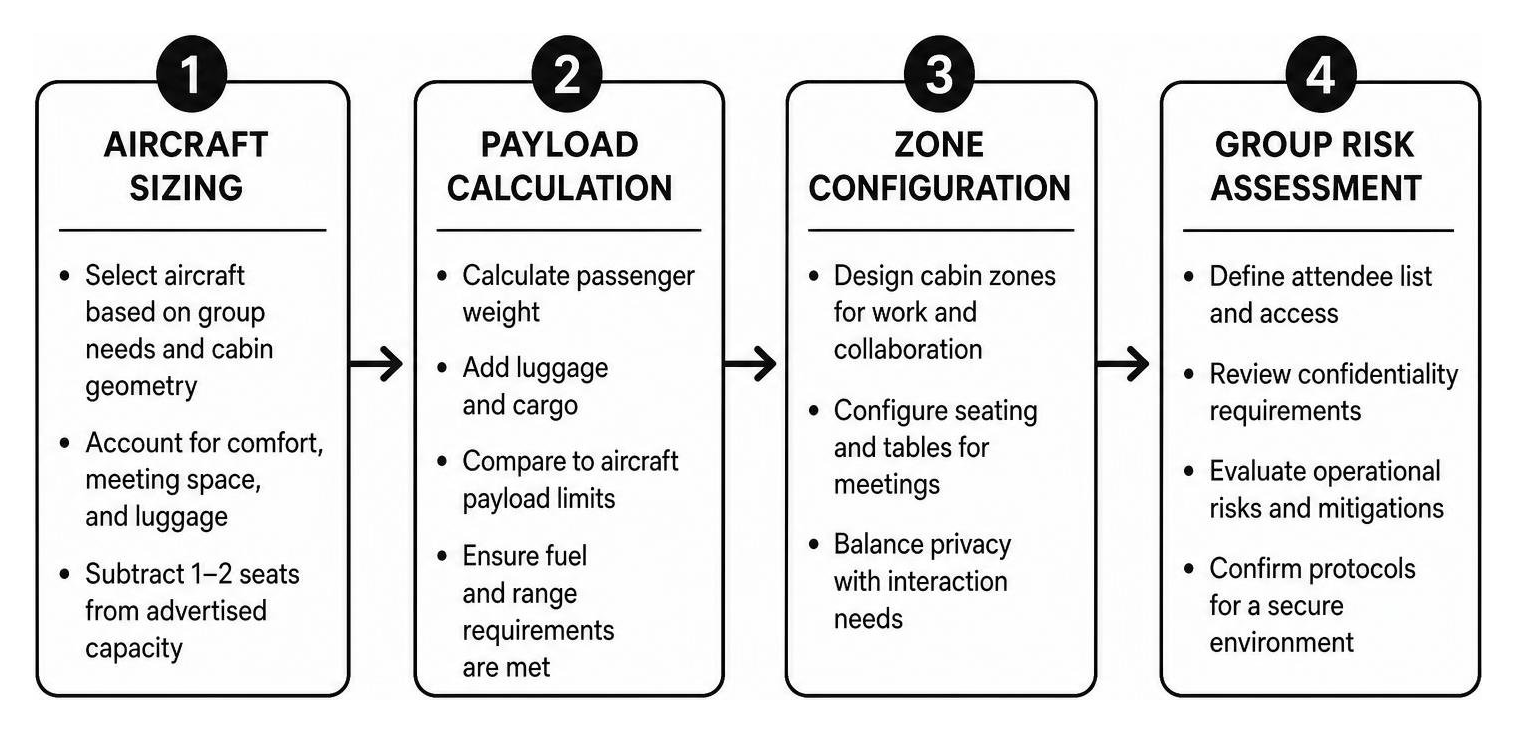
Structuring Private Jet Business Meetings for Executive Teams
The layout of your cabin dictates the rhythm and output of your discussions. Different aircraft classes cater to distinct group structures:
- Super-Midsize Jets (6–9 Passengers): Models like the Citation Longitude or Challenger 350 feature double-club seating layouts. These setups are ideal for four to six executives reviewing slide decks, holding financial diligence reviews, or conducting focused interview sessions across fold-out executive tables.
- Large-Cabin Jets (10–14 Passengers): Heavy jets such as the Gulfstream G650 or Bombardier Global series divide the cabin into distinct zones. You can run an active conference session in the forward section while maintaining a quiet, private stateroom aft for confidential one-on-one founder negotiations or rest.
- VIP Business Airliners (15+ Passengers): For full board assemblies or broad deal syndicates, converted VIP airliners (like a Boeing Business Jet) offer true corporate boardrooms equipped with conference tables, media screens, and lounge areas.
When deciding whether to charter a single VIP airliner or split a 14-person delegation across two heavy jets, strategic collaboration often trumps simple charter math. While two heavy jets might offer direct operational savings, splitting your leadership team introduces the risk of split arrivals if weather or mechanical holds affect one flight.
More importantly, for teams whose billable or strategic value exceeds thousands of dollars per hour, the ability to conduct four hours of unified strategy in a single cabin far outweighs any platform cost difference. Consulting a comprehensive corporate jet buying guide 2026 can help illuminate which ownership or charter models match your organization's recurring group collaboration needs.
Cost Modeling: Private Charter vs Commercial Business Class
Evaluating the cost of private aviation requires looking past headline charter rates to calculate true per-seat economics and opportunity costs.
For a solo executive flying a routine trunk route (such as New York to Miami), commercial business class is almost always the more economical choice on paper. However, as group size scales to five, six, or eight team members, the financial equation shifts dramatically.
| Trip Parameters | Commercial Business Class (8 Execs) | Midsize / Super-Midsize Charter | Strategic Difference |
|---|---|---|---|
| Route Example | New York (JFK) to Miami (MIA) | Teterboro (TEB) to Miami Opa-locka (OPF) | Private lands closer to downtown |
| Direct Travel Time | ~3.0 hrs flight + 2.5 hrs terminal | ~3.0 hrs flight + 15 min tarmac | Saves ~4.5 hours per person |
| Combined Airfare / Charter | $12,000 – $18,000 ($1,500–$2,250/seat) | $20,000 – $28,000 (Whole Aircraft) | Competitive per-seat delta |
| Lost Executive Hours | 36+ collective hours in terminals | Zero lost terminal hours | 100% productive in-flight work |
| Ground Travel Friction | High (Commercial Hub Congestion) | Minimal (Direct FBO Car Access) | Faster arrival to client site |
When planning multi-stop routes across secondary markets—such as flying between Palm Beach, Dallas, and Las Vegas within 36 hours—commercial itineraries require connecting hubs, overnight stays, and extensive downtime. Private aviation compresses the entire schedule into productive flight hours.
Understanding how much is it to rent a private jet across different aircraft categories helps financial officers budget accurately, especially when factoring in empty-leg availability to capture significant routing discounts.
How to Execute Flawless In-Flight Negotiations and Presentations

Running an efficient deal session at 40,000 feet requires precise preparation. An aircraft cabin is a self-contained ecosystem; once the cabin doors close, you cannot run down the hall for extra presentation adapters or printed materials.
A successful mission begins with a well-structured agenda shared with attendees ahead of time. Use our private aviation networking guide to structure executive interactions that balance formal deal points with relationship building.
Technical and Logistical Best Practices for Private Jet Business Meetings
To ensure uninterrupted workflow during flight, follow these technical and operational guidelines:
- Pre-Load Heavy Diligence Files: While high-speed Ka-band and Ku-band satellite connections allow real-time browsing and video conferencing, always sync large data rooms, financial models, and video assets to local drives before boarding to eliminate latency.
- Test Display Interfaces: Ensure your team carries universal HDMI, USB-C, and Apple AirPlay adapters to connect executive laptops directly to the cabin's bulkhead high-definition monitors.
- Configure Virtual Private Networks: Establish enterprise VPN tunnels across all participating devices prior to departure for seamless, end-to-end data encryption over the cabin Wi-Fi.
- Dial In Cabin Atmosphere: Ambient cabin noise and dry cabin altitude can tire participants over long flights. Coordinate with the flight crew to maintain cabin temperatures around 68–70°F and ensure steady cabin pressurization management.
- Maintain Rapid Dispatch Protocols: In fast-moving corporate negotiations, situations change quickly. Top operators maintain a four-hour wheels-up readiness capability, letting your deal team deploy swiftly when a closing window opens.
Elevated Cabin Service and Client Relationship Architecture
The service environment aboard an executive aircraft sends a subtle, powerful message about your organization's operational caliber. Flawless hospitality reinforces trust before contractual negotiations even begin.
Work closely with your flight coordinator to curate bespoke catering tailored to your guests’ exact dietary preferences and cultural expectations. Providing high-quality espresso, healthy dining options, and fine sommelier selections keeps energy levels high and signals meticulous attention to detail.
By treating every aspect of the flight—from cabin ambiance to service timing—with white-glove precision, you set a collaborative tone that carries right through to the final signature.
Frequently Asked Questions about In-Flight Business Meetings
How quickly can an aircraft be dispatched for an urgent business negotiation?
Under standard on-demand charter and Jet Card programs, an aircraft can typically be wheels-up within four hours of contract execution and payment confirmation. Global flight operations teams operate 24/7 to secure flight clearances, position aircraft from nearby hubs, and brief flight crews. For pre-funded corporate accounts with active passenger manifests, dispatch times can occasionally be compressed even further depending on aircraft positioning.
How do corporate teams maintain data security during in-flight meetings?
Corporate teams maintain strict security by leveraging closed-door private cabins, WPA3-Enterprise encrypted satellite networks, and verified VPN connections. Flight crews operate under formal confidentiality agreements, and modern operators follow strict "Clean Cabin" protocols—ensuring all physical whiteboards, notes, and local digital caches are wiped upon arrival.
At what passenger threshold does private charter rival commercial business class costs?
The direct financial breakeven typically occurs when five to eight executives travel together on the same itinerary. While single commercial business-class tickets are cheaper for solo travel, pooling executive tickets across a private charter on multi-city or regional routes offsets the charter cost. When factoring in reclaimed billable hours, eliminated hotel nights, and ground transportation savings, private charter often yields a superior overall return on investment.
Conclusion
High-stakes dealmaking requires control over your time, your environment, and your relationships. Private aviation is far more than a luxury convenience—it is a purpose-built operational platform that turns dead travel hours into decisive corporate momentum.
At Jets & Capital, we design premier environments where capital allocators, family offices, and leading founders forge meaningful partnerships. Whether we are hosting exclusive gatherings in private jet hangars in world-class cities or helping executives structure airborne boardrooms, our focus remains on high-caliber relationship architecture.
For leadership teams planning extensive long-range missions or overnight cross-country roadshows, exploring luxury jets with bedrooms provides the ultimate combination of high-level productivity by day and restful recovery by night. Plan your next flight with clear strategic intent, and turn your time in the clouds into your firm's greatest competitive advantage.
