
What You Actually Pay to Fly Private for a Weekend
What You Actually Pay to Rent a Private Jet for a Weekend

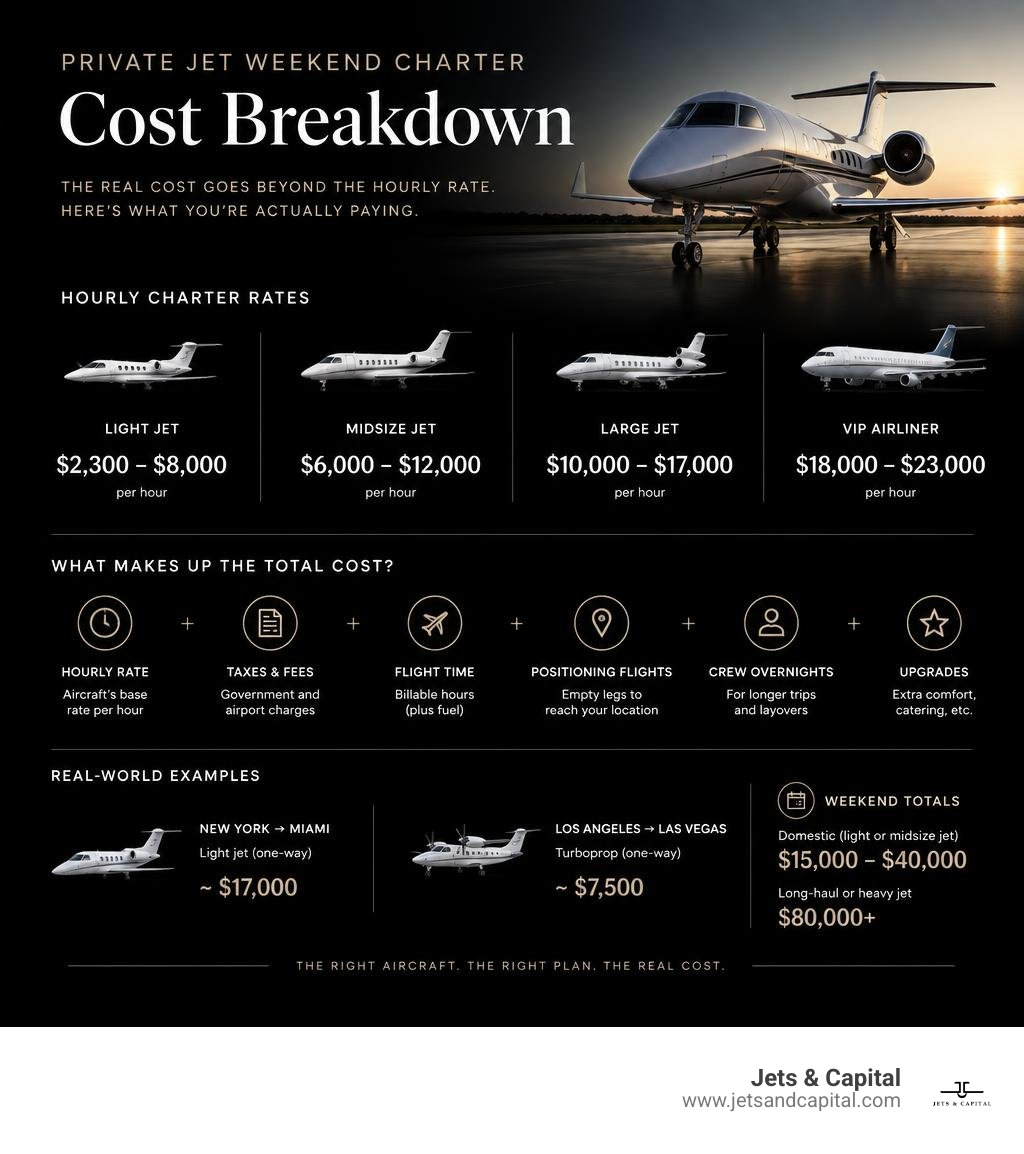
How much is it to rent a private jet? Expect roughly $2,300 to $17,000 per flight hour, depending on aircraft size, with VIP airliners reaching $18,000 to $23,000 per hour. For a weekend trip, a realistic all-in budget is often $15,000 to $40,000 for a domestic light or midsize jet itinerary, while long-haul or heavy-jet missions can quickly exceed $80,000.
Start with the aircraft's hourly rate, multiply it by billable flight time, then add taxes, airport charges, positioning flights, crew overnights, and any upgrades. For example, a light-jet one-way charter from New York to Miami is commonly around $17,000, while a turboprop from Los Angeles to Las Vegas may be about $7,500.
The hourly rate is useful, but it is not the final number. A jet that must fly empty to meet you, a peak-event weekend, de-icing, or international handling can change a quote by thousands of dollars.
I am Jordan Hutchinson, an entrepreneur, investor, and founder of Jets & Capital events, where I work with high-net-worth individuals and family offices who value efficient, well-planned private travel. In this guide, I will break down how much is it to rent a private jet so you can assess the real cost of a weekend mission before you book.
How Much Is It to Rent a Private Jet by Aircraft Size and Category?
When planning a weekend trip, the physical platform you choose dictates the baseline rate. Pricing varies based on cabin dimensions, passenger capacity, non-stop range, and operating economics.
A comprehensive 2026 private jet hourly rates guide shows that turboprops and very light jets are most economical for short hops, while heavy jets and VIP airliners carry premium pricing for their range and cabin space. The table below outlines typical charter rates across the primary aircraft categories:
| Aircraft Category | Typical Hourly Rate | Non-Stop Flight Range | Typical Passenger Capacity |
|---|---|---|---|
| Turboprops | $2,300 – $3,500 | 1,000 – 1,500 nm | 4 – 8 |
| Very Light Jets (VLJ) | $2,900 – $3,400 | 1,000 – 1,200 nm | 4 – 5 |
| Light Jets | $3,750 – $4,200 | 1,400 – 1,800 nm | 6 – 7 |
| Midsize Jets | $4,700 – $5,500 | 2,000 – 2,800 nm | 7 – 8 |
| Super Midsize Jets | $6,200 – $7,500 | 3,000 – 3,600 nm | 8 – 10 |
| Large / Heavy Jets | $8,500 – $10,000 | 3,800 – 4,800 nm | 10 – 14 |
| Ultra Long Range Jets | $12,000 – $17,000 | 5,500 – 7,700 nm | 12 – 16 |
| VIP Airliners | $18,000 – $23,000 | 6,000 – 8,000+ nm | 18 – 50+ |
Selecting the right platform from among the best business jets requires balancing your passenger head count, luggage requirements, and the nonstop range necessary to eliminate time-consuming fuel stops.
Entry-Level Options: Turboprops to Light Jets
Turboprops such as the Pilatus PC-12 and Beechcraft King Air series represent an economical solution for flights under two hours. With charter rates running between $2,300 and $3,500 per hour, they can access short municipal runways that many jets cannot reach.
Very light jets, including the Cessna Citation Mustang ICP, offer jet speed at an accessible $2,900 to $3,400 per flight hour. Moving up to light jets like the Beechjet 400 or Embraer Phenom 300E adds enclosed lavatories relaxed cabins and seating for six to seven passengers, with rates averaging $3,750 to $4,200 per hour.
Midsize to Ultra-Long-Range Heavy Jets
For cross-country routes or larger family groups, midsize and super midsize jets like the Bombardier Challenger 300 deliver stand-up cabins and transcontinental capability at $6,200 to $7,500 per hour.
Large heavy jets, including the Gulfstream G450, can carry 10 to 14 passengers and offer true intercontinental range at $8,500 to $10,000 per hour. When non-stop intercontinental missions are required, ultra-long-range jets such as the Falcon 7X and Global 6000 command $12,000 to $17,000 per hour and may feature private bedrooms for restful travel. A detailed review of 2025 private jet trip costs confirms these baseline figures.
Real-World Weekend Route Scenarios and Total Cost Breakdown

Charter pricing involves more than multiplying flight time by an hourly rate. The total invoice accounts for round-trip aircraft positioning, passenger taxes, ground handling, and minimum daily flight commitments.
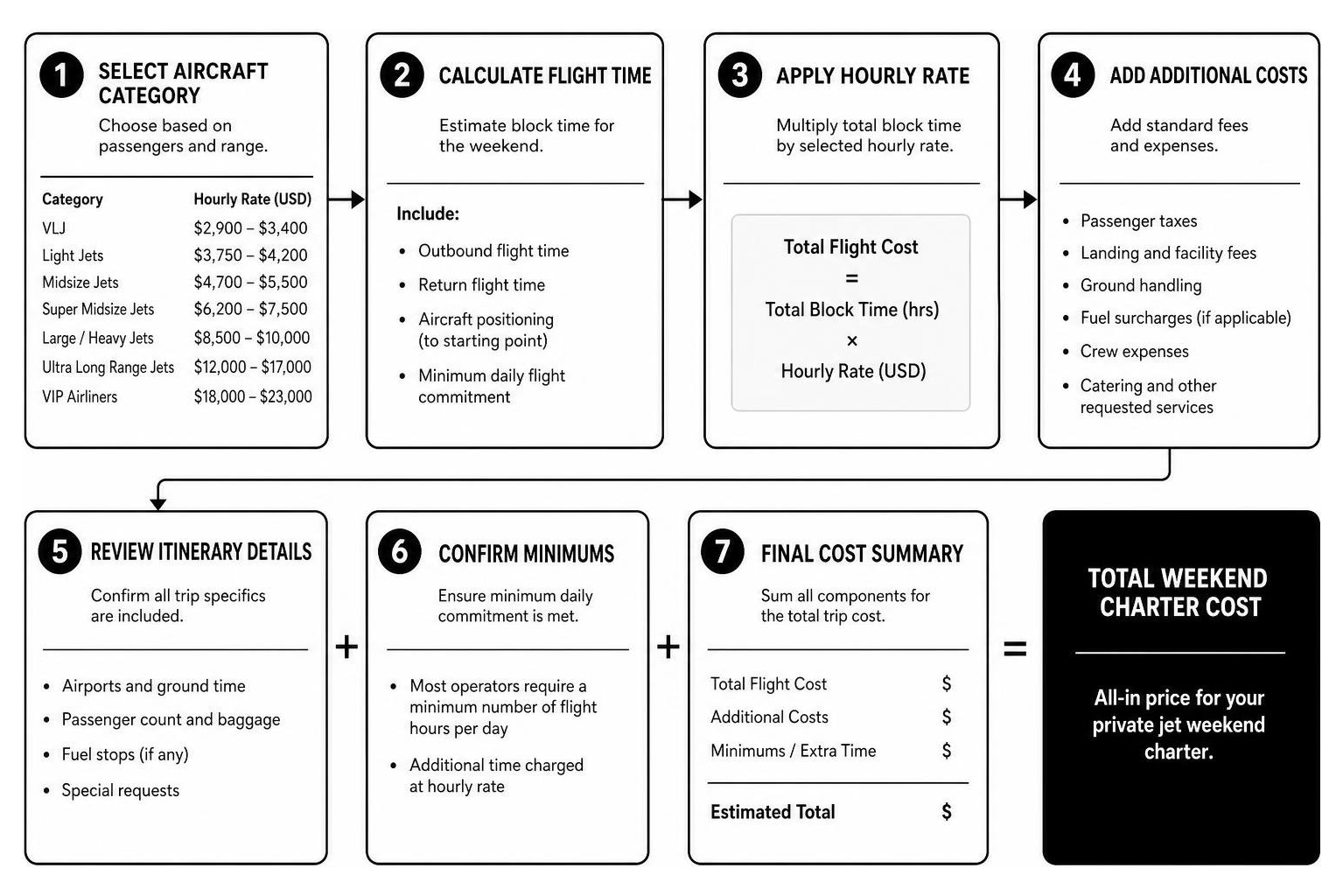
Understanding the total cost on some of the best jets in the world is clearest when reviewing real-world itineraries across our core domestic and transcontinental hubs.
Exactly How Much Is It to Rent a Private Jet on Popular Weekend Itineraries
Here is how popular private jet charter routes price out across different aircraft classes:
- Los Angeles to Las Vegas (Turboprop / King Air 350): Approximately $7,500 one-way (or ~$11,000 on a light jet). Flight time is under one hour, but operator daily minimums set the price baseline.
- New York (Teterboro) to Palm Beach (Light Jet / Phenom 300E): Typically $15,000 to $20,000 one-way for a 2.5-hour hop, making it a staple corridor for winter weekend departures.
- New York to Miami (Light to Midsize Jet): Approximately $17,000 one-way on a light jet, or $22,000 on a midsize jet.
- New York to Los Angeles (Super Midsize / Challenger 300): Approximately $40,000 one-way for a 5.5-hour coast-to-coast mission.
- New York to London (Heavy / Ultra-Long-Range Jet): Running between $80,000 and $90,000 on a Gulfstream G450, and up to $95,000 (or $87,000 on a Global 5000 configured for 13 passengers).
For complex group missions, total charter invoices scale with multi-stop handling:
- Multi-Leg Day Trip: A regional Colorado and Midwest flight circuit on a light jet (Denver to Amarillo to St. Louis to Denver) totals approximately $36,952 including handling fees and FET.
- Domestic Round-Trip Weekend: A corporate retreat flying Minneapolis to Phoenix on a midsize jet over three days tallies roughly $40,118 when including crew overnights and ramp parking.
- Cross-Border Round-Trip: An executive round-trip from Dallas to Toronto on a heavy jet reaches approximately $93,812 with international handling, customs fees, and overnight parking charges included.
One-Way vs. Round-Trip Weekend Charter Economics
A common misconception is that a one-way flight costs exactly half of a round-trip. In private aviation, if an operator does not operate a "floating fleet" (aircraft constantly repositioning across the country), they must fly the aircraft back to its home base.
If you fly from San Francisco to Las Vegas on Friday and return Sunday, chartering the same aircraft to stay parked at the FBO is generally cost-effective because daily minimum flight charges (typically 2 hours per day) are satisfied across the weekend. However, if your trip extends beyond four days, the operator will likely charge you for four separate flight legs—flying you there, returning the empty jet to base, flying back to pick you up, and flying you home.
Hidden Fees, Taxes, and Ancillary Costs Behind Charter Quotes
Reviewing charter invoices requires understanding the incidental expenses that appear alongside the base flight rate.

When preparing an aviation budget or consulting a corporate jet buying guide 2026, accounting for statutory taxes and operational incidentals prevents billing surprises.
- Federal Excise Tax (FET) & Segment Fees: U.S. domestic commercial air charter incurs a mandatory 7.5% Federal Excise Tax on the total amount billed. Additionally, domestic legs include a $5.30 per-passenger segment fee, while international departures carry international head taxes (approximately $23.40 per passenger).
- Repositioning (Ferry) Charges: If your aircraft must fly empty from Dallas to Austin just to pick your party up, you pay for that repositioning flight hour and fuel burn. Repositioning can add $3,000 to $15,000 to an unvetted quote.
- Airport Landing and Ramp Fees: Fixed Base Operators (FBOs) and municipal airports charge landing and facility ramp fees ranging from $250 at regional airfields to over $2,500 at major hubs like San Francisco International (SFO) or New York JFK.
- Crew Overnight Expenses & Per Diems: If the flight crew stays at your destination over the weekend, you will be billed for their hotel accommodation, ground transportation, and daily meal per diems (typically $300 to $600 per crew member per night).
- De-Icing Charges: A significant variable during winter flights to destinations like Salt Lake City. De-icing fluid costs anywhere from $1,500 to $12,000+ per spray application depending on aircraft surface area and weather severity.
- In-Flight Amenities & Connectivity: While standard soft drinks and light snacks are complimentary, premium custom catering (caviar, sushi, vintage wines) is billed at cost plus a concierge handling margin. In-flight Wi-Fi over satellite networks may be billed at $5 to $10 per megabyte unless the aircraft is equipped with high-speed flat-fee connections like Starlink.
- Pet Cleaning & Special Handling: Bringing pets aboard is standard practice in private aviation, but detail-cleaning and cabin fumigation fees typically range from $250 to $1,000 if interior detailing is required post-flight.
Factors Determining How Much Is It to Rent a Private Jet for Short Hops
Short flights under 90 minutes carry unique pricing dynamics:
- Daily Flight Minimums: Most charter operators enforce a 2-hour daily flight minimum. A 35-minute hop will still be billed at the 2-hour minimum rate.
- Aircraft Age & Refurbishment: Airframes manufactured in the early 2000s often rent for 15% to 25% less per hour than factory-new models, though cabin amenities and avionics in recently refurbished jets offer comparable comfort.
- Peak Demand & Event Surcharges: Flying into major sports championships or peak holiday weekends can incur temporary rate spikes of 20% to 50% due to congested slot allocations and limited ramp parking.
Practical Strategies to Save on Your Private Jet Rental
Private jet travel provides substantial time savings, and strategic booking practices ensure you maximize capital efficiency on every route:
- Book Empty Leg Flights: When an aircraft must reposition with no passengers, brokers sell these "empty legs" at discounts of 40% to 75% off standard charter rates. If your weekend schedule offers departure flexibility, empty legs provide premium private travel at a fraction of standard cost.
- Right-Size Your Aircraft: Do not book a super midsize jet for a four-passenger regional trip. Match your cabin size strictly to passenger count and baggage needs.
- Utilize Secondary and Reliever Airports: Instead of flying into high-density international hubs with steep ramp and landing fees, land at executive reliever airports (e.g., Van Nuys or Burbank instead of LAX; Teterboro or Westchester instead of JFK; Opa-locka instead of Miami International). This strategy saves thousands in ground handling and eliminates runway taxi delays.
- Leverage Floating Fleet Operators: On one-way itineraries, book operators with floating fleets that do not charge round-trip repositioning back to a home base.
- Evaluate Jet Cards vs. On-Demand Charters: If you fly fewer than 25 to 50 hours annually, on-demand charter eliminates upfront six-figure capital commitments. Above 50 hours, jet cards offer locked hourly rates and guaranteed availability. For non-stop transcontinental missions, reviewing the performance of the longest range corporate jet platforms ensures you avoid the added expense of fuel-stop handling.
Frequently Asked Questions About Private Jet Charter Costs
What is the cheapest private jet option for a short trip?
Turboprop aircraft (like the Pilatus PC-12 or King Air 350) and Very Light Jets (like the Citation Mustang) are the most economical options for short regional hops. Turboprop charter rates start between $2,300 and $3,500 per flight hour, making short hops under 500 miles significantly more affordable than reserving midsize or heavy jets. That operators generally enforce a 2-hour daily flight minimum.
Are fuel surcharges and taxes included in private jet charter quotes?
Base quotes typically incorporate projected fuel burn based on current fuel indices, but volatile oil prices can introduce fuel surcharges of $200 to $800 per flight hour. Furthermore, all domestic U.S. charter flights are subject to a mandatory 7.5% Federal Excise Tax (FET) plus domestic passenger segment fees ($5.30 per leg), which are added to the final charter contract.
How much does aircraft age impact private jet rental pricing?
Aircraft age directly affects hourly charter pricing. Well-maintained charter aircraft that are 15 to 20 years old often rent at a 15% to 25% discount compared to factory-new airframes of the same category. As long as the operator holds certified third-party safety ratings (such as ARGUS Platinum or Wyvern Wingman) and features a modern refurbished interior, older airframes offer exceptional travel value without compromising safety.
Conclusion
Understanding the components that determine private jet rental pricing—from base hourly fees to repositioning legs, Federal Excise Tax, and FBO handling—allows you to structure weekend travel efficiently. Whether you are reserving a light jet for a quick weekend escape from New York to Palm Beach or mobilizing a heavy jet for a multi-city corporate roadshow, transparent cost calculations ensure you fly on your own terms with complete financial clarity.
At Jets & Capital, we bridge the worlds of private aviation and high-level finance. We organize exclusive, invite-only networking summits for family offices, institutional investors, and UHNWIs inside private jet hangars across prime hubs including San Francisco, Dallas, Las Vegas, Salt Lake City, Miami, Palm Beach, and New York—such as our upcoming Super Bowl Edition in San Francisco, CA. With our strict vetting process ensuring an 85% allocator attendance, our events offer an elite environment for genuine relationship building and deal-making.
Explore our insights on luxury corporate jets to discover how top-tier private aviation platforms drive executive productivity and expand investment horizons.
