
How to Choose a Global Investment Meet for Better Deal Flow

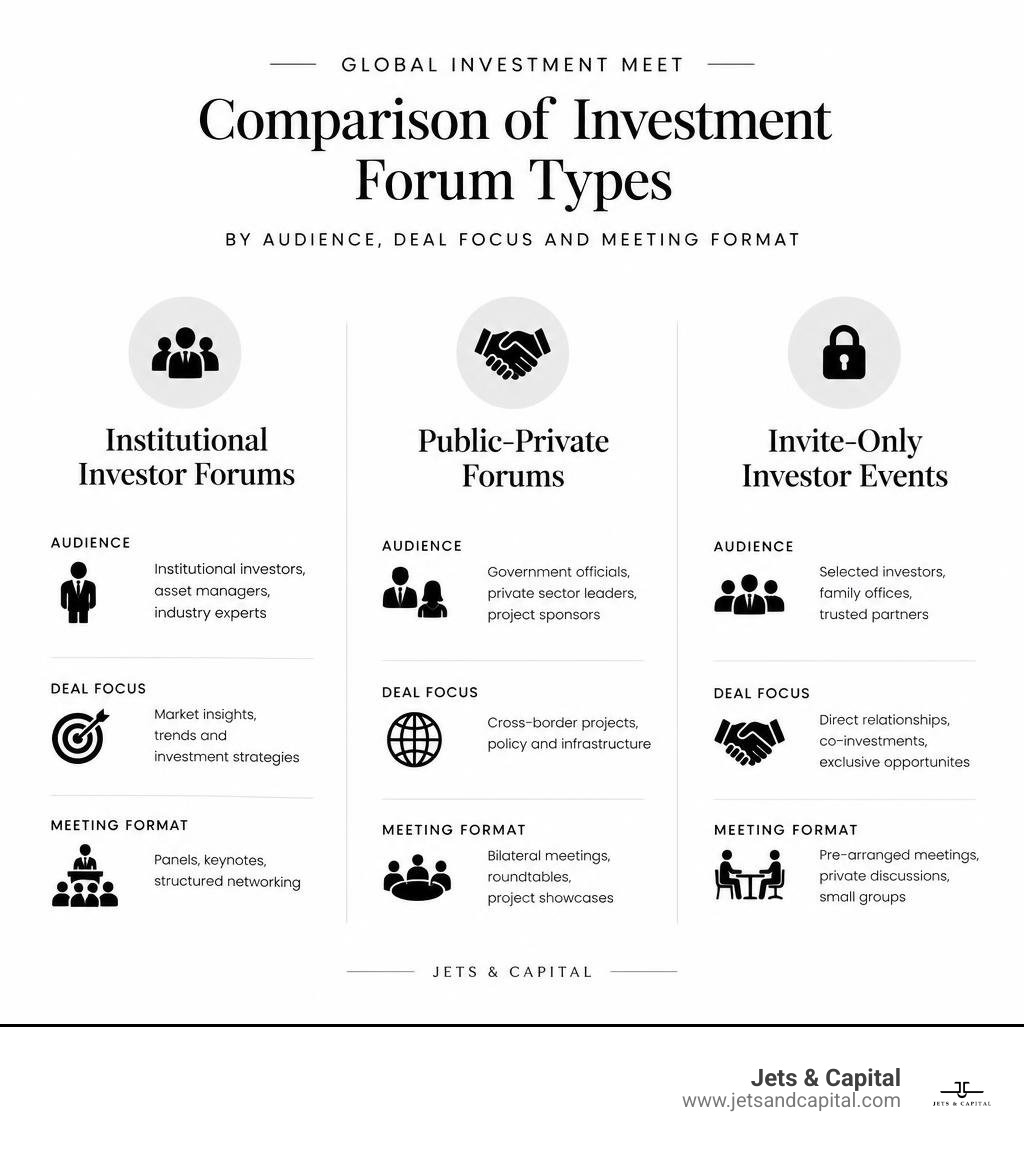
The best global investment meet for you depends on the people you need to meet. Shortlist institutional investor forums for market insight, public-private forums for cross-border projects, and invite-only investor events for direct relationships. Then check who attends, how meetings are arranged, and whether the audience fits your investment goals.
A large crowd can offer reach. A carefully vetted room may be more useful when you want candid talks with fellow allocators and potential deal partners.
I'm Jordan Hutchinson, founder of Jets & Capital, and I organize exclusive networking events for family offices and investors. My family-office background shapes how I assess a global investment meet: by the quality of the connections it helps people build.
Key Themes Shaping the Modern Global Investment Meet in 2026

As we navigate the economic landscape of October 2026, the structure and substance of major summits have evolved dramatically. Macroeconomic uncertainty, shifting monetary policies, and sovereign wealth realignments mean capital allocators no longer attend conferences simply to listen to generic market recaps. Instead, attendees want actionable deal flow and clear strategies to discover investment opportunities that provide resilient, inflation-protected yield.
The conversation has moved toward cross-border liquidity management and long-term capital deployment. Today’s premier summits focus heavily on two structural drivers: navigating fragmented global markets and funding the hardware behind technological and green transformations.
Geopolitics and the Expansion of Private Markets
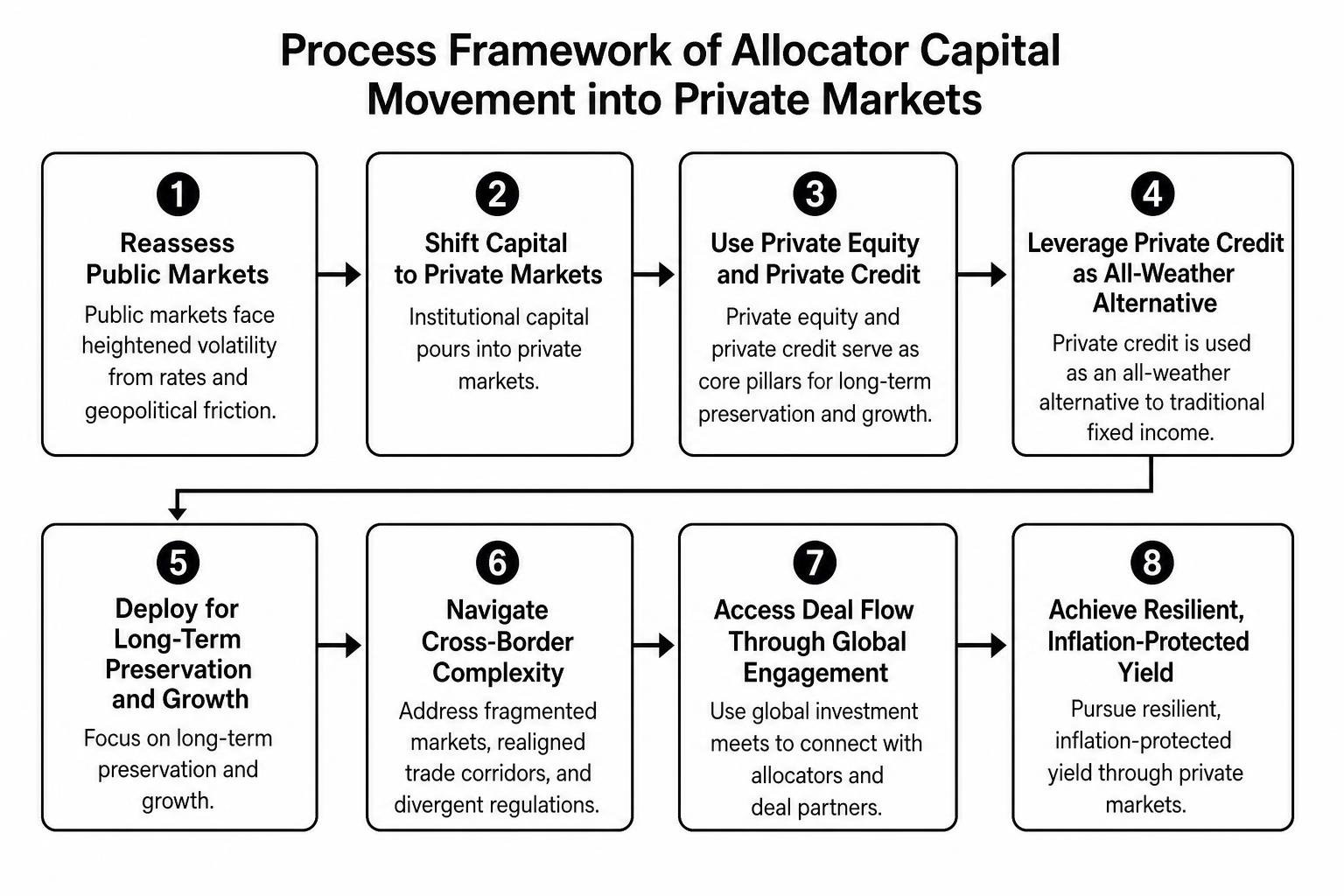
Global trade corridors are realigning. De-globalization pressures, shifting supply chains, and divergent regional regulatory regimes have led allocators to reconsider their public equity exposures. As public markets face heightened volatility from shifting central bank rates and geopolitical friction, institutional capital has poured into private markets.
Private equity and private credit now serve as core pillars for long-term preservation and growth. At major international summits, allocators frequently discuss using private credit as an all-weather alternative to traditional fixed income. For insights on navigating these asset classes, exploring an Alternative Asset Investments Guide can help clarify how private debt and special situations hedge against public volatility.
AI Integration and Climate Finance
Technology and decarbonization dominate agenda tracks worldwide. Rather than discussing software concepts abstractly, allocators are assessing the tangible infrastructure required to power generative AI, high-performance compute clusters, and neurotechnology.
At the same time, the transition toward net-zero demands vast capital. Investors are mobilizing catalytic capital for:
- Grid-scale battery storage and geothermal projects
- Decentralized renewable generation and microgrids
- Next-generation data centers with dedicated low-carbon power feeds
- Smart mobility platforms and circular industrial supply chains
Connecting cross-border capital with high-impact green infrastructure has become a defining mission for forward-looking investment forums.
Top Global Investment Summits for Cross-Border Capital

Finding the right international forum requires understanding the mandate of each gathering. Different events serve distinct profiles—ranging from multilateral policy platforms to private wealth gatherings.
| Summit Category | Primary Audience | Core Focus Sectors | Key Deal Formats |
|---|---|---|---|
| Bilateral & Trade Platforms | Government Ministers, Sovereign Wealth, DFIs | Greenfield Infrastructure, SEZs, Trade Corridors | Government MoUs, Concessions |
| Institutional Wealth Summits | Pension Funds, Asset Managers, Endowments | Private Equity, Private Credit, Secondaries | LP Commitments, Fund Allocations |
| Impact & Transition Forums | Impact Allocators, Family Offices, Foundations | Energy Transition, Agri-tech, Circular Economy | Co-investments, Blended Finance |
| Bespoke Private Networks | Family Offices, UHNWIs, Principal Investors | Direct Deals, Pre-IPO Tech, Venture Assets | Direct Co-Investments, Club Deals |
Comparing Flagship Global Investment Meet Platforms
Major global hubs serve as vital conduits for foreign direct investment (FDI). Across international finance hubs from North America to the Middle East and Asia, institutional asset managers connect through curated Investor Networking Events to construct cross-border investment syndicates.
These platforms unite family offices, sovereign funds, and institutional allocators seeking global diversification.
Institutional and Public-Private Development Forums
Multilateral events focus heavily on regulatory harmonisation, special economic zones (SEZs), and blended finance. Participating in a dedicated Institutional Investor Forum provides valuable insight into how sovereign entities and multilateral development banks structure de-risking mechanisms for emerging market assets.
Global cross-border capital relies on these venues to negotiate policy safeguards and tax treaties before deploying hundreds of millions into long-horizon infrastructure.
Private Wealth and Impact Investor Summits
Private wealth conferences focus on direct impact, intergenerational legacy, and alignment with Article 9 sustainability standards. These forums attract High Net Worth Investors seeking exposure to energy transition technologies, natural capital preservation, and food security innovations.
By integrating rigorous impact metrics with commercial returns, these gatherings demonstrate that sustainable investing is an active driver of long-term alpha.
Regional vs. Global Investment Meets: Unlocking Emerging Market Deal Flow
While global summits shape broad capital trends, regional and subnational meets offer direct access to project execution on the ground.
Regional Economic Magnets: The Subnational Global Investment Meet Model
Subnational and state-level investment summits have emerged as powerful engines for direct capital deployment. Rather than discussing abstract macroeconomic policy, these events focus on shovel-ready projects across targeted industrial verticals:
- Electric Mobility & Clean Transport: Setting up manufacturing hubs and charging corridors.
- Aerospace and Advanced Defense: Siting precision manufacturing plants and assembly facilities.
- Renewable Energy Installations: Finalizing land-lease rights for utility-scale solar, wind, and offshore power.
- Digital & Semiconductor Infrastructure: Sourcing reliable clean power and incentives for fabrication facilities.
By matching regional government support directly with corporate and institutional balance sheets, subnational meets provide a streamlined pipeline for real-economy capital deployment.
Outcomes, Pledged MoUs, and Investor Follow-Through
While regional meets frequently announce massive sums in pledged Memorandums of Understanding (MoUs), seasoned allocators understand that signed intent is merely the starting line. Translating an MoU into capital realization requires careful attention to:
- Regulatory Clearances: Navigating local land permits, environmental licenses, and zoning rules.
- Grid and Logistics Bottlenecks: Ensuring transport links and power interconnects are functional.
- Policy Continuity: Structuring agreements that remain stable across election cycles and administrative changes.
Investors who excel at subnational deal-making combine initial summit commitments with disciplined on-the-ground execution.
Portfolio Adaptation: How Institutional Allocators Leverage Summit Insights
Attending international summits helps allocators stress-test their assumptions against peer strategies, leading to proactive portfolio adjustments.
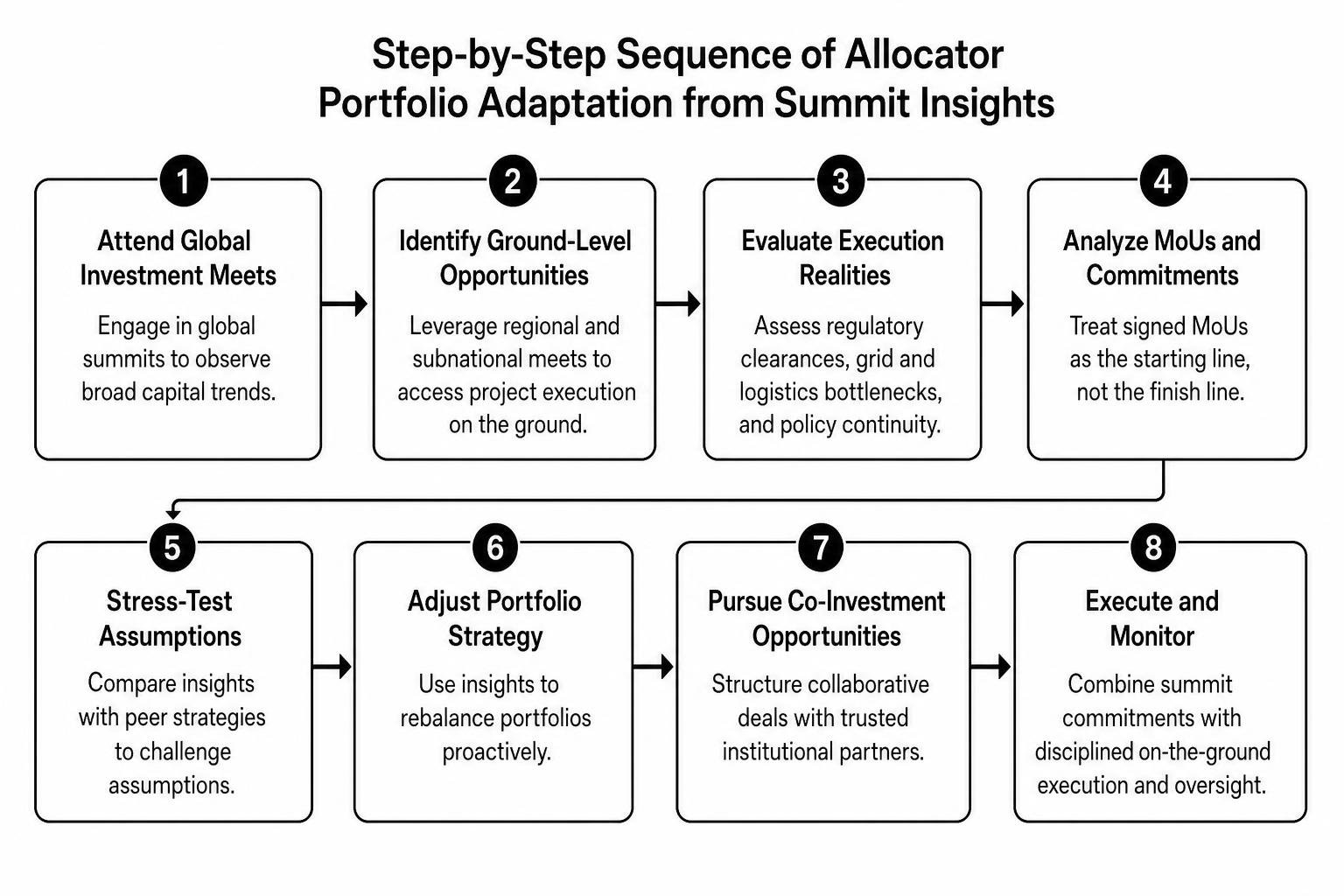
Savvy allocators use these insights to rebalance portfolios, often by reviewing our Co-Investment Opportunities Complete Guide to structure collaborative deals alongside trusted institutional partners.
Navigating Risks, Valuations, and Macro Uncertainty
Discussions among allocators highlight several shared concerns:
- Valuation Realism: Ensuring private tech and infrastructure valuations reflect sustained interest rate environments.
- Exit Horizons: Managing extended hold periods in private equity by leveraging LP-led and GP-led secondary markets.
- Currency Volatility: Implementing hedging strategies when investing in emerging market assets.
Addressing these issues directly allows funds to deploy capital while safeguarding portfolio liquidity.
Sourcing Direct Co-Investments and Alternative Assets
Direct co-investing has emerged as a favored strategy for single family offices and boutique institutions aiming to reduce fee drag. By building relationships at vetted meets, allocators discover direct deals across venture capital, private debt, and real asset platforms. Our comprehensive Family Office Deal Sourcing Guide 2026 outlines proven strategies for securing access to these off-market opportunities.
Frequently Asked Questions about Global Investment Summits
How do regional investment meets differ from multilateral global summits?
Regional meets focus primarily on subnational project execution, specific industrial zoning, and direct state-level MoUs in manufacturing or energy. Multilateral global summits focus on macro-level policy frameworks, international capital flows, trade treaties, and multi-country development initiatives.
What asset classes dominate global investment summits in 2026?
Private credit, energy transition infrastructure, generative AI physical infrastructure, and secondary private equity assets command the highest interest among institutional allocators seeking risk-adjusted returns.
How can fund managers maximize deal conversion at international summits?
Fund managers should prioritize events with dedicated, pre-vetted matchmaking systems. Securing one-on-one meetings with targeted allocators weeks in advance and preparing concise, transparent track records consistently outperforms passive networking on open exhibition floors.
Conclusion
Maximizing the return on your time at an international summit comes down to the caliber of the room. While massive conventions provide a broad view of market sentiment, high-conviction transactions require trusted, private environments.
At Jets & Capital, we host exclusive, invite-only networking events for family offices, institutional investors, and ultra-high-net-worth individuals in private jet hangars across premier hubs like San Francisco, Miami, New York, Dallas, Salt Lake City, and Las Vegas. With a strict vetting process ensuring an 85% allocator ratio, we create an intimate environment designed for genuine relationships and direct deal-making.
Ready to elevate your international deal flow? Join the Jets & Capital Private Investor Network today to connect with principal allocators shaping the future of global wealth.
