
Why Most Alternative Investment Networks Aren't Worth Your Time (And Which Ones Are)

Alternative investment networking is how capital allocators, fund managers, and family offices build the relationships that drive real deals - but not every network delivers equal value.
Here are the alternative investment networking models worth your attention in 2026:
| Network / Platform Type | Best For | What to Look For |
|---|---|---|
| Invite-only allocator events | Family offices, UHNWIs, and institutional allocators | Strict vetting and a high allocator ratio |
| Peer family office circles | Principals sharing private deal flow | Closed-door, non-solicitous environments |
| Curated capital introduction programs | Managers seeking mandate-aligned LPs | Pre-qualified meetings and clear fit criteria |
| Secure digital deal-flow platforms | Year-round LP and GP discovery | Strong data privacy, filters, and follow-up tools |
| Regional private market chapters | Local allocators and managers | Consistent in-person access in key wealth hubs |
| Sector-specific summits | Real estate, private credit, venture, and other niches | Deep strategy alignment rather than broad attendance |
| Professional education forums | Advisors and investment professionals | Market intelligence and compliance-aware programming |
| Co-investment syndicates | Investors seeking shared opportunities | Transparent governance and trusted peer participation |
| Advisor-focused alternatives education | Wealth managers and independent advisors | Practical manager access and portfolio construction insight |
| Jets & Capital private hangar events | UHNW and family office principals in curated settings | Invite-only access, 85% allocators, and high-quality deal-making |
The problem most investors run into is simple: too many events, not enough signal. Open conferences fill rooms with vendors and pitches. Invite-only networks filter for actual decision-makers. The difference in outcomes - deals closed, capital deployed, partnerships formed - is significant.
In 2026, the alternative investment landscape has grown more crowded and more sophisticated at the same time. Technology platforms now run AI-powered matchmaking. Regional hubs are building dedicated private-market infrastructure. And the most exclusive networks have moved well beyond the conference ballroom.
I'm Jordan Hutchinson, founder of Jets & Capital, with deep roots in alternative investment networking through my family office background and my work connecting high-net-worth individuals at elite, curated events - from private jet hangars to Formula 1 races. That experience is the lens through which I've evaluated the networking models and platforms in this guide.
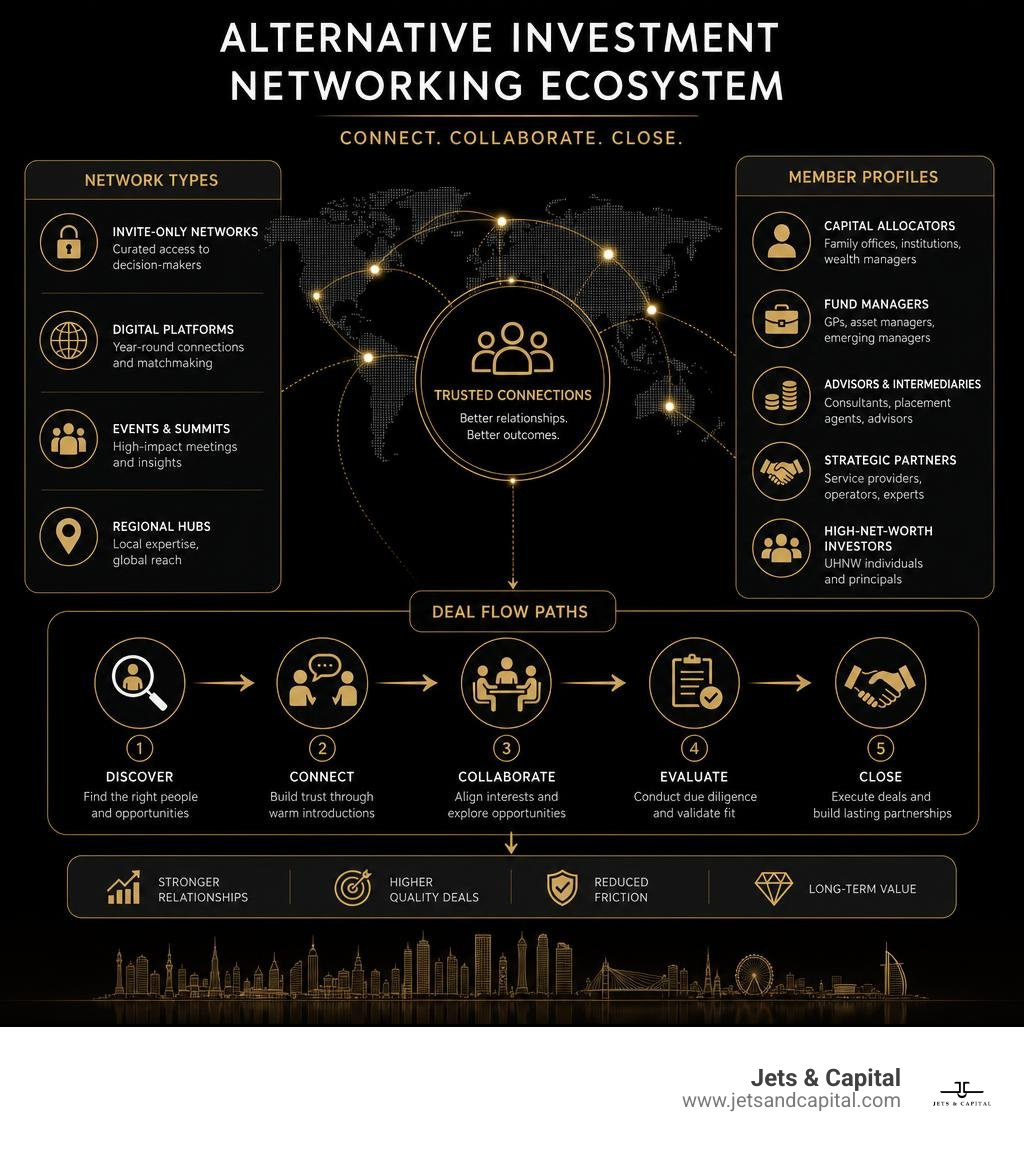
The Evolution of Alternative Investment Networking in 2026

The landscape of alternative investment networking has shifted dramatically. Gone are the days when networking simply meant trading business cards over lukewarm coffee in a crowded hotel lobby. In 2026, the market demands efficiency, curation, and deep alignment.
As private markets have expanded, the sheer volume of funds has made it incredibly difficult for allocators to filter the noise. Conversely, emerging managers face an uphill battle trying to get in front of the right family offices and institutional allocators. To survive, modern Investor Networking Events and communities have had to adapt.
Today's networks are highly specialized. Rather than trying to be everything to everyone, they focus on specific segments of the market. For instance, family offices increasingly seek peer-to-peer environments where they can share deal flow without being constantly pitched. Emerging managers look for structured Capital Introduction Events that match them with allocators who have active mandates for their specific strategy, asset class, and ticket size.
Curated vs. Open-Access Models
The industry has bifurcated into two distinct models: open-access events and invite-only, curated networks.
Open-access events are fantastic for broad industry education, service provider visibility, and high-volume top-of-funnel marketing. However, they suffer from a low "signal-to-noise" ratio. For a family office principal or a senior allocator, attending an open-access event often means being inundated with unsolicited pitches.
On the flip side, invite-only, curated models have become the gold standard for high-value relationship building. These networks employ strict vetting processes to ensure a balanced ratio of allocators to managers. Many of the most successful groups maintain an 85% allocator ratio, ensuring that every conversation has the potential to lead to a meaningful partnership. By restricting access and utilizing multi-tiered membership models, these networks protect the time of their participants and elevate the overall quality of deal flow.
If you want to understand how to navigate these exclusive circles, our Ultimate High Net Worth Networking Guide dives deep into the social codes and strategies required to build trust with ultra-high-net-worth individuals and family offices.
Measurable Outcomes of High-Value Alternative Investment Networking
Why do busy investment professionals commit their time to these networks? Because the measurable outcomes are undeniable.
High-value networks do not just facilitate "connections"—they catalyze capital deployment. Participants regularly report raising millions in seed and follow-on capital directly through relationships formed within these curated ecosystems. For instance, structured networks have reported significant capital raised through their exclusive investor gatherings.
Beyond capital raised, these networks facilitate:
- Strategic Partnerships: Co-investments, joint ventures, and operational partnerships that would never have materialized through cold outreach.
- Knowledge Exchange: Direct access to peer insights regarding regulatory changes, tax strategies, and market trends.
- Vetted Deal Flow: Access to proprietary, off-market opportunities that are only shared within trusted, closed-door circles.
To maximize these outcomes, many managers rely on structured Capital Introduction Services Complete Guide to prepare their pitch, refine their materials, and target the exact allocators who align with their investment thesis.
Top Global and Regional Alternative Investment Networks

Whether you are looking for local deal sourcing or global sovereign wealth connections, joining the right Private Investment Groups can completely change your fundraising and investment trajectory. The key is not joining every group available. It is identifying the networks that match your geography, asset class, check size, and relationship-building style.
Regional Associations and Local Chapters
Local market dynamics and unique regional regulations mean that regional networks play a vital role in the alternative investment ecosystem. In the United States, the strongest localized groups tend to share a few traits:
- California: West Coast alternatives communities often concentrate around venture capital, growth equity, real estate, private credit, and technology-driven private markets. For managers raising capital in San Francisco, Los Angeles, or broader California, local credibility and repeat in-person access matter.
- Texas: Dallas and Austin have become increasingly important for family offices, operating-company wealth, energy investors, and entrepreneurs allocating into private markets. Regional networks in Texas can be especially useful for managers who understand founder-led wealth and relationship-driven capital.
- New York: New York remains one of the deepest markets for hedge funds, private credit, private equity, institutional allocators, and professional service providers. The best New York forums balance high-level market education with discreet, senior-level relationship building.
- Florida: Palm Beach and Miami continue to attract family offices, UHNW investors, and private-market professionals seeking tax-efficient, lifestyle-driven hubs with strong access to global capital.
- Mountain West and Southwest: Markets such as Las Vegas and Salt Lake City can offer more intimate access to investors, entrepreneurs, and family-office principals who may be harder to reach in larger financial centers.
These regional associations offer excellent entry points for localized Investor Networking Events where you can build deep, face-to-face relationships with local allocators.
Global Communities and Investment Clubs
For those looking to expand beyond their local borders, global peer-to-peer networks and investment clubs offer broader reach. The most valuable global communities usually focus on trust, selectivity, and cross-border alignment rather than sheer attendee volume.
Strong global communities often include:
- Peer-to-peer family office groups: Useful for principals who want to compare opportunities, governance structures, and manager references with other allocators.
- Cross-border co-investment clubs: Valuable for investors seeking direct access to opportunities outside their home market, especially when local partners can help validate risk.
- Institutional allocator networks: Helpful for managers who need to understand mandate cycles, portfolio construction priorities, and diligence standards across pensions, endowments, foundations, and sovereign-style capital pools.
- Private-market operator circles: Effective for investors who prefer opportunities connected to founders, entrepreneurs, and operating executives rather than purely financial intermediaries.
By participating in the right global Private Investment Groups, managers and allocators can syndicate larger deals, compare diligence perspectives, and access opportunities that would otherwise remain outside their immediate relationship map.
How Technology Platforms Facilitate Capital Connections
While face-to-face handshakes will always be the foundation of trust, technology platforms have become the engine that powers modern capital introduction. In 2026, technology is no longer just a digital address book - it is an active facilitator of Deal Sourcing Events and year-round capital matchmaking.
AI-Powered Matchmaking and Digital Deal Flow
Leading secure investor portals and private-market platforms have integrated advanced AI and sophisticated filtering tools to streamline the fundraising process.
Modern systems allow allocators and managers to filter by strategy, geography, AUM, track record, sector focus, ticket size, liquidity profile, and investor eligibility. When those filters are combined with AI-assisted search, participants can identify relevant relationships far more efficiently than they could through cold outreach or unstructured conference attendance.
The best platforms do three things well:
- Improve fit: They help allocators avoid irrelevant manager outreach and help managers focus on investors with genuine mandate alignment.
- Shorten the meeting cycle: They support scheduling, pre-meeting research, and structured follow-up so qualified conversations move faster.
- Protect confidentiality: They use secure profiles, permissioned data rooms, and controlled access to sensitive materials.
By leveraging these databases, investors can turn traditional, scattered Investment Deal Sourcing into a structured, highly predictable pipeline.
Year-Round Engagement in Alternative Investment Networking
One of the biggest shifts in 2026 is the transition from episodic networking - attending one or two large conferences a year - to always-on, year-round engagement.
Technology platforms allow managers and allocators to maintain momentum long after an in-person event ends. Through pipeline management boards, users can track their conversations, store meeting notes, and manage follow-ups.
Furthermore, these platforms have integrated travel planning tools. If a fund manager is planning a trip to Miami, Palm Beach, San Francisco, Dallas, Las Vegas, or New York, they can use a secure relationship platform to identify relevant allocators in those cities, check availability, and pre-schedule meetings before they even board their flight.
This continuous engagement is particularly valuable for venture capitalists. For a deeper look at how to optimize this process, check out our Venture Capital Networking Guide, which outlines how to blend digital tools with in-person touchpoints to build a robust investor pipeline.
Additionally, for those looking to collaborate on specific transactions, our Co-Investment Opportunities Complete Guide provides the framework for structuring and syndicating deals with peer investors year-round.
Premier Conferences and Summits Shaping the Industry
While digital platforms keep the engine running, premier in-person conferences and summits remain the marquee moments where the industry gathers to set agendas, debate macro trends, and finalize major deals. If you are planning your calendar, these are the Alternative Investment Events that deserve a spot.
Sector-Specific Summits and Niche Gatherings
Depending on your strategy, broad-market conferences may not offer the depth you need. Sector-specific summits allow for highly technical discussions and targeted networking:
- Broad-market alternatives: Large allocator summits can be useful for understanding macro sentiment, portfolio allocation trends, and institutional demand across hedge funds, private equity, private credit, real assets, and venture capital.
- Regional institutional forums: City-specific and regional gatherings can help investors and managers understand local capital bases, regulatory context, and regional deal flow. This is especially valuable in hubs such as New York, San Francisco, Dallas, Miami, Palm Beach, Las Vegas, and Salt Lake City.
- Professional education and standards: Educational forums help investment professionals stay current on research, risk management, and compliance expectations. Allocators and managers should also monitor investor education and regulatory updates from authoritative sources such as the SEC Office of Investor Education and Advocacy.
- Geographic hubs: Localized gatherings provide opportunities to connect with family offices, entrepreneurs, wealth managers, and private-market investors who may not attend national conferences.
These niche gatherings ensure you are in the room with people who speak your exact investment language, making your Alternative Investment Events calendar highly efficient.
Tailored Benefits for Managers, Allocators, and Service Providers
Different participants go to these events with completely different goals, and the best summits design their programming to cater to each group:
- Fund Managers: Managers benefit from structured capital introduction formats, curated one-on-one meetings, and opportunities to present their strategy to qualified LPs.
- Institutional Allocators & Family Offices: These groups benefit from private, buy-side-only spaces, educational panels on portfolio construction, and the ability to discreetly screen multiple managers in a concentrated period of time.
- Service Providers: Law firms, administrators, fund platforms, and technology providers gain brand exposure and direct access to decision-makers when the event design keeps sponsorship visible but not intrusive.
Frequently Asked Questions about Private Market Events
What are the most effective alternative investment networking platforms for emerging managers?
For emerging managers, the most effective platforms are those that offer a blend of educational support and highly targeted capital introduction.
Emerging managers should look for nonprofit manager communities, allocator-heavy private events, and secure digital platforms that help them refine their materials, communicate their edge, and access investors with relevant mandates. The best options provide more than a room full of contacts. They help managers understand institutional standards, prepare for diligence, and build a realistic LP pipeline.
Additionally, emerging managers should leverage structured Capital Introduction Services Complete Guide to build their initial LP pipeline and ensure their marketing materials meet institutional standards.
How do invite-only networks compare to open-access events?
The primary difference lies in the vetting criteria and the allocator-to-manager ratio.
Open-access events are open to anyone who purchases a ticket, which often leads to an over-saturation of service providers and fund managers, making it difficult for allocators to navigate the room.
Invite-only networks, such as Jets & Capital, employ a strict vetting process to ensure that at least 85% of the attendees are active capital allocators - including family offices, institutional LPs, and UHNWIs. This high-density allocator model dramatically increases deal-making efficiency, protects the privacy of the investors, and ensures that every conversation is highly relevant.
What role does AI play in modern investor matchmaking?
In 2026, AI acts as a force multiplier for deal flow optimization. Platforms use AI algorithms to analyze an allocator's historical investment patterns, current mandates, and asset class preferences. The AI then suggests more compatible fund managers, supports the meeting scheduling process, and helps both parties prepare by highlighting areas of mutual interest. This reduces guesswork and helps make in-person meetings more productive.
Conclusion
At Jets & Capital, we believe that the setting of an event dictates the quality of the relationships built within it. That is why we steer clear of crowded hotel ballrooms. Instead, we organize exclusive, invite-only networking events for family offices, institutional investors, and ultra-high-net-worth individuals in highly unique environments—specifically, private jet hangars.
Our strict vetting process guarantees an 85% allocator ratio, ensuring that you are only sharing the room with genuine peers and serious decision-makers. Whether you are joining us for our upcoming Super Bowl Edition in San Francisco, CA, or connecting with us at our hubs in Las Vegas, Dallas, Palm Beach, or Miami, we design every event to foster trust, discretion, and high-value deal-making.
Ready to elevate your network and experience alternative investment matchmaking at the highest level? Apply for an invite to our next exclusive gathering at Jets & Capital Las Vegas.
