
How Venture Capital Investments Work

Venture capital investments fund startups with strong growth potential in exchange for ownership. Investors usually commit money to a fund, whose managers choose startups and invest in rounds as those companies grow. Returns may come when a startup is acquired, goes public, or its shares are sold. Many startups fail, though, and investors may wait years to get their money back.
This guide explains the funding stages, how investors judge opportunities, and where the risks lie. I’m Jordan Hutchinson. I’ve launched and exited businesses and advised investment funds, experience that shapes how I approach venture capital investments.
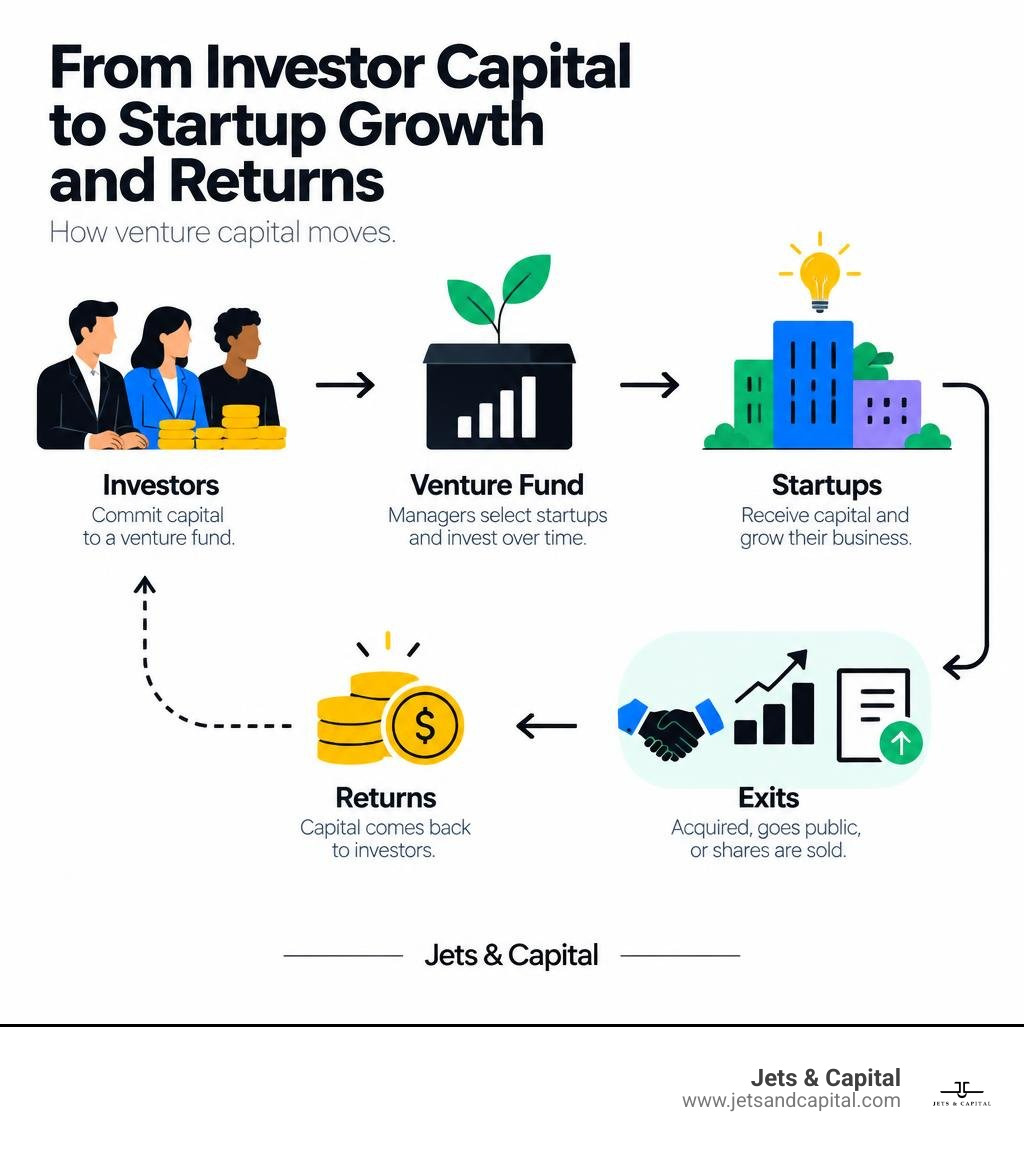
What is Venture Capital and How Does It Work?
At its core, venture capital is a form of private equity financing designed to fuel early-stage, high-potential enterprises. Unlike traditional corporate lending, which relies on steady cash flow or tangible collateral, venture financing provides non-recourse capital in exchange for direct equity ownership. This means if a startup goes out of business, the founders do not owe the capital back, making it an inherently high-risk, high-reward model.
The venture structure operates around two primary groups:
- Limited Partners (LPs): The external investors who supply the capital. These typically include institutional pension funds, university endowments, foundations, sovereign wealth funds, and high net worth investors.
- General Partners (GPs): The venture fund managers responsible for sourcing companies, negotiating terms, conducting due diligence, sitting on boards, and managing the overall fund lifecycle.
Venture funds are generally structured as blind-pool limited partnerships with a fixed life of 10 to 12 years. During the initial 3 to 5 years, the GPs identify promising startups and deploy capital through scheduled capital calls rather than drawing down the entire fund balance upfront. As these assets mature, funds sit alongside broader alternative asset investments in an allocator's portfolio. Institutional funds also adhere to strict regional compliance standards, such as state-level financial transparency under the California DFPI VCC reporting program to protect market participants.
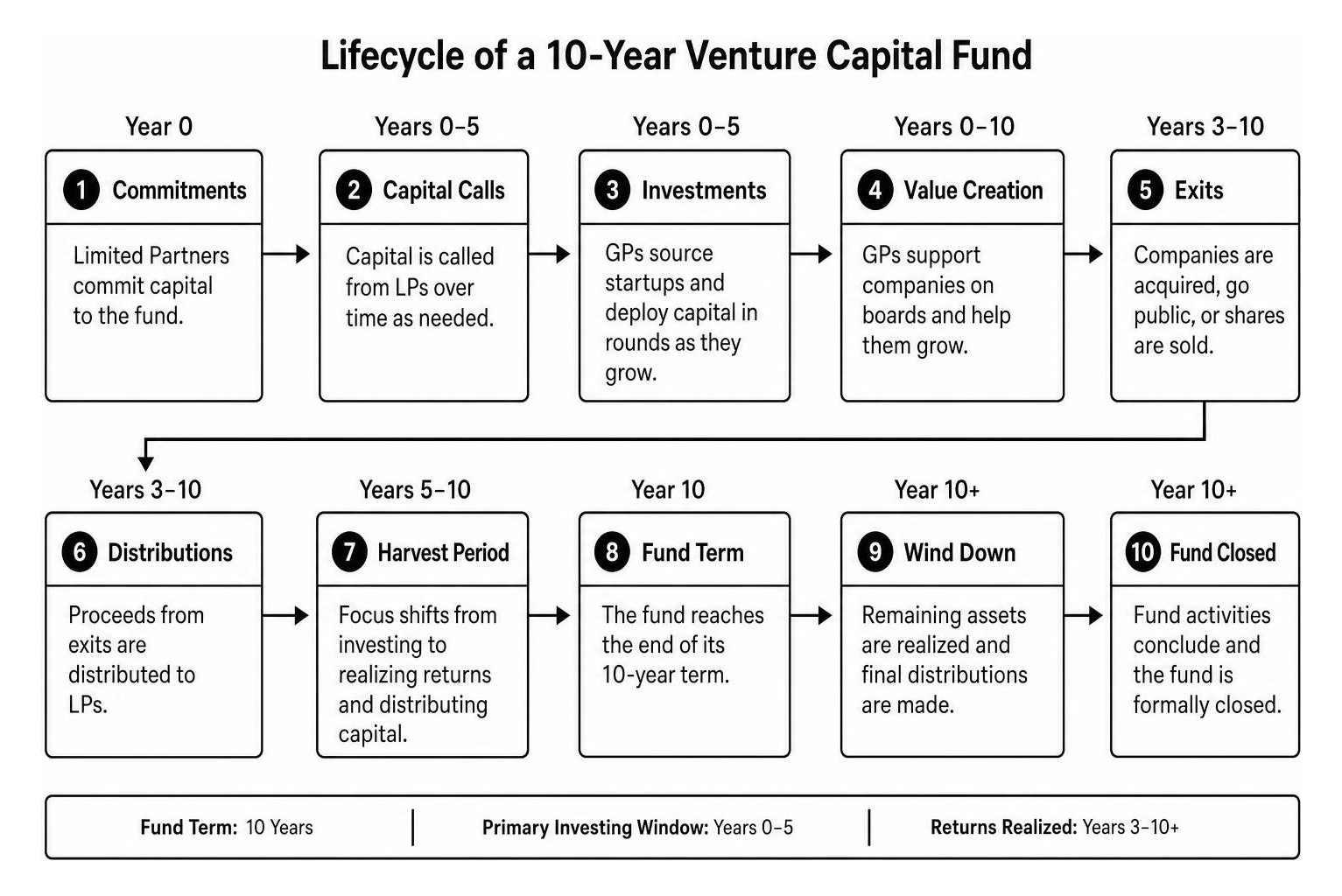
Fund Mechanics and the 2-and-20 Compensation Model
Venture capital firms sustain operations and generate profits through a time-tested economic framework known as the "2-and-20" compensation structure.
- Management Fee (2%): Fund managers charge an annual fee, typically 2% of total committed capital during the active investment period. This fee covers overhead, team salaries, legal audits, travel, and operational expenses. Over time, this fee may step down as the fund moves from active investing into harvest mode.
- Carried Interest (20%): Carried interest (or "carry") represents the GP’s share of fund profits, usually set at 20%. Before managers receive carry, they must return all invested capital back to their LPs. Many funds also incorporate a preferred return or hurdle rate (often 6% to 8%), meaning the fund must generate a minimum baseline return before the GPs participate in the profit split.
Once portfolio companies exit via public offerings or acquisitions, cash or liquid shares are distributed back to LPs, realizing the fund's returns.
Venture Capital vs. Traditional Financing and Angel Investing
Navigating startup capital requires choosing the right vehicle for growth. Venture capital is not simply larger angel funding or an expensive bank loan; it involves distinct check sizes, governance rights, and strategic involvement.
| Metric | Venture Capital (VC) | Angel Investors | Bank Loans | Private Equity (PE) |
|---|---|---|---|---|
| Typical Check Size | $1M to $50M+ | $10k to $250k | Variable (Asset-backed) | $50M to $1B+ |
| Stage of Company | Seed to Pre-IPO | Idea to Early Traction | Mature, Cash-Flowing | Established, Profitable |
| Equity Dilution | High (15% - 25% per round) | Low to Moderate (5% - 15%) | None (Debt instrument) | Controlling / Buyout (51% - 100%) |
| Risk Profile | Very High | Extremely High | Low | Low to Moderate |
| Governance & Board | Active (Board seats & voting) | Passive / Advisory | None (Covenants only) | Complete Control |
| Return Mechanism | M&A, IPO (10x+ target) | Early exits, M&A | Principal + Interest | Operational margin expansion, Buyout |
While angel investors deploy personal net worth and often make rapid decisions without institutional fiduciary duties, VCs deploy pooled institutional capital. Consequently, VCs require board seats, protective provisions, information rights, and regular milestones to manage risk.
The Lifecycle and Stages of Venture Capital Investments

Venture capital relies on staged financing. Instead of providing all required growth capital on day one, investors fund startups in discrete tranches tied to operational milestones. This protects capital while rewarding founders with higher valuations as they de-risk their business models.
Pre-Seed and Seed Rounds: Validating the Concept
The earliest stages are dedicated to proving feasibility.
- Pre-Seed: Often funded by founders, friends, family, and early syndicates, pre-seed capital ($100k to $1M) allows an entrepreneur to build a minimum viable product (MVP) and assemble a core team.
- Seed: Seed rounds ($1M to $4M) focus on finding product-market fit. Founders use this runway to test customer acquisition, refine feature sets, and secure initial commercial traction. At this stage, a dedicated early-stage investor evaluates founder resilience, vision, and market necessity above financial history.
Series A to Growth Capital: Scaling Operations
Once product-market fit is validated by consistent revenue and high user retention, companies enter the institutional scaling phase:
- Series A ($5M - $15M): Focuses on optimizing unit economics and building a predictable sales engine. Investors analyze metrics like Customer Acquisition Cost (CAC) and Lifetime Value (LTV).
- Series B ($15M - $40M): Geared toward market expansion, defending market share against competitors, and scaling the executive team.
- Series C and Beyond ($50M+): Known as growth or late-stage rounds. These checks help companies acquire smaller competitors, expand into international markets, and prepare for a public market debut. At this stage, institutional participants often partner alongside family office venture capital divisions that seek larger allocations in late-stage winners.
Exit Pathways: IPOs, M&A, and Secondary Markets
Venture capital is an illiquid asset class; gains remain theoretical until a liquidity event occurs. The primary exit pathways include:
- Mergers & Acquisitions (M&A): A strategic corporate buyer or private equity buyout firm purchases the startup. Tech incumbents frequently acquire VC-backed startups to integrate cutting-edge IP or absorb skilled engineering teams.
- Initial Public Offering (IPO): The company lists its shares on a public exchange (such as NASDAQ or the NYSE), allowing both institutional and retail investors to trade shares freely.
- Secondary Market Transactions: Private liquidity has grown significantly. Early employees, angels, and fund managers can sell existing equity to secondary funds or late-stage allocators without waiting for an official IPO, creating liquidity earlier in the company's lifecycle.
How Investors Evaluate and Select Opportunities
Securing venture funding is highly competitive. A standard institutional fund evaluates hundreds of opportunities just to back a single company.
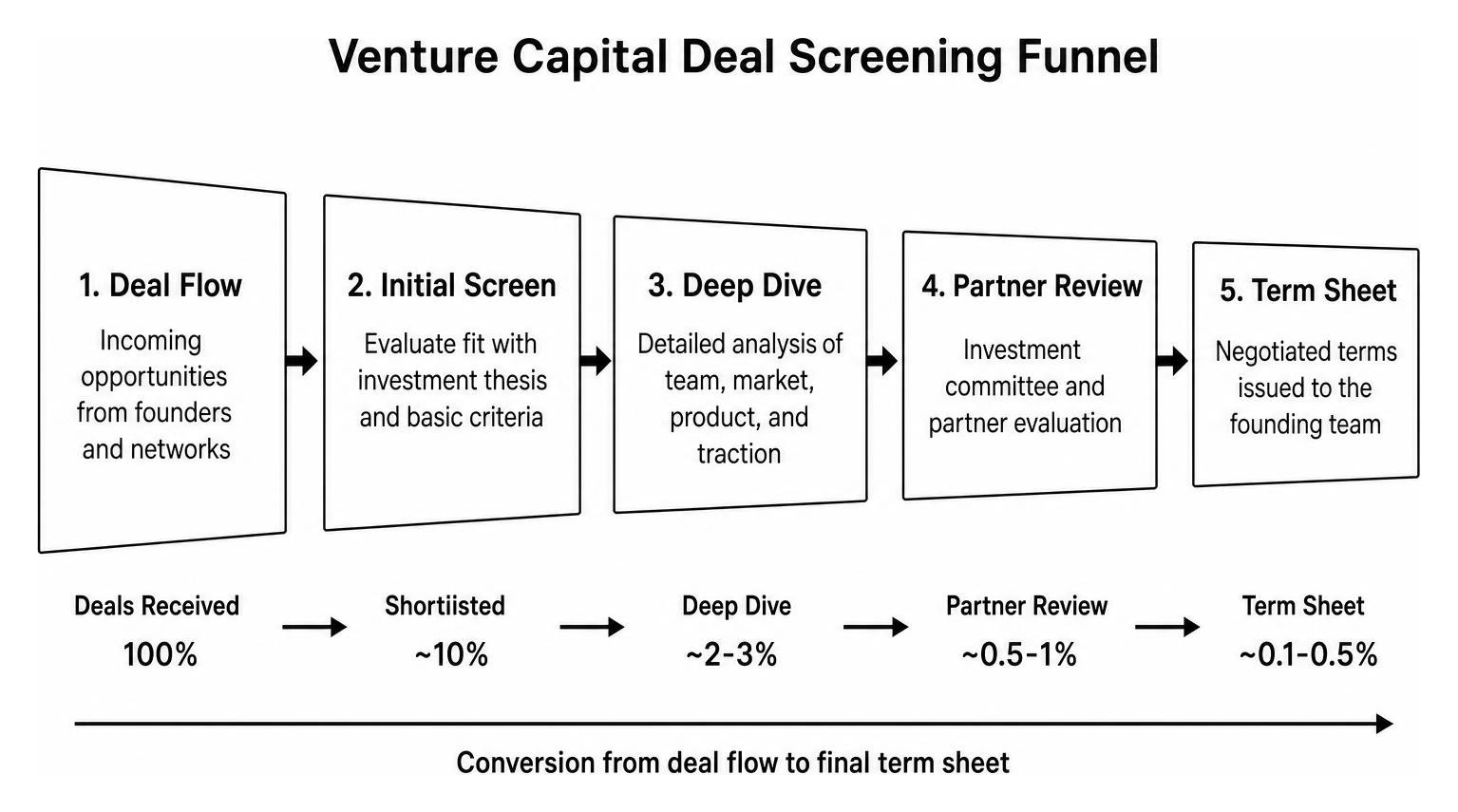
How Investors Evaluate Venture Capital Investments
Venture partners use disciplined screening frameworks during investment deal sourcing to filter through pitches. Research indicates that VCs view the founding team as the single most critical factor in over 90% of positive investment decisions.
During due diligence, investors dissect:
- Founder-Market Fit: Does this founding team possess unique insights, technical prowess, and the resilience required to navigate market downturns?
- Total Addressable Market (TAM): Can this business realistically achieve $100M+ in annual recurring revenue? Small niche markets rarely support venture-scale returns.
- Defensibility (Moats): Are there proprietary algorithms, intellectual property, high switching costs, or network effects that prevent competitors from cloning the service?
- Cap Table Hygiene: Is there enough founder equity remaining to keep leaders motivated through multiple rounds of future dilution?
Institutional allocators often structure syndicated rounds or join structured co-investment opportunities to pool capital with domain experts, sharing the diligence workload while broadening domain coverage.
Risk Profiles and Return Expectations in Venture Portfolios
Venture portfolio economics do not follow a normal bell curve; they are defined by a power-law distribution. A small fraction of investments generate the vast majority of fund returns.
Industry data reveals that roughly 50% of VC-funded startups fail to return investor capital. Another 30% to 40% produce modest returns, merely breaking even or returning small multiples. Consequently, the top 5% to 10% of portfolio companies (the "fund returners" or unicorns) must generate 20x to 100x returns to cover losses across the portfolio and hit target fund-level net internal rates of return (net IRR) of 20% or higher.
Managing this dynamic requires deliberate capital allocation strategies that reserve 40% to 60% of a fund’s total pool for follow-on checks into their fastest-growing winners.
Market Dynamics, Economic Impact, and Future Trends

Venture capital drives an outsized share of economic innovation. In the United States, VC-backed companies support roughly 11% of all private-sector jobs and generate revenue equal to roughly 21% of US GDP. These businesses also lead in private corporate research and development, committing hundreds of billions annually toward scientific, technological, and medical breakthroughs.
Emerging Global Trends in Venture Capital Investments
The venture landscape is undergoing several major structural shifts:
- The AI Megacycle: Artificial intelligence continues to transform enterprise workflows, cloud architecture, and automation. In 2025, AI startups accounted for 61% of all global venture capital investments ($258.7 billion out of $427.1 billion total deployed capital). In the US alone, total venture capital investment reached a historic high of $321.6 billion that year.
- Geographic Expansion: While established tech hubs like San Francisco and New York remain cornerstones of global deal flow, thriving ecosystems have expanded rapidly in cities such as Dallas, Miami, Salt Lake City, Las Vegas, and Palm Beach. Regional tax advantages, shifting talent bases, and dynamic commercial policies continue to distribute capital more broadly.
- Corporate Venture Capital (CVC): Established corporations are investing directly in startups through dedicated venture arms. Industry leaders like Salesforce Ventures actively fund enterprise software, cloud infrastructure, and AI ecosystems to generate strong financial returns while gaining early insights into disruptive technologies.
- Addressing Gender and Diversity Gaps: Disparities in capital allocation remain an industry-wide challenge. In 2021, all-female founding teams secured only 2% of total US venture capital funding. Increasing diversity among fund decision-makers is gradually expanding access for underrepresented founders, unlocking overlooked market opportunities.
Alternatives to Traditional VC: Venture Debt, Crowdfunding, and Bootstrapping
Venture capital is not the right fit for every company. Founders have several viable alternative funding paths:
- Venture Debt: Specialized loans extended to VC-backed startups with active institutional backing. This provides non-dilutive runway between equity rounds without requiring founders to surrender additional board seats or substantial equity.
- Equity Crowdfunding: Enabled by modern securities regulations, platforms allow everyday investors to pool small checks into early-stage companies, democratizing access to startup equity.
- Bootstrapping and Revenue-Based Financing: By focusing on early profitability and customer cash flows, bootstrapped founders scale organically. Revenue-based lenders provide upfront growth capital that is repaid through a fixed percentage of ongoing top-line receipts.
Frequently Asked Questions about Venture Capital
What is the typical failure rate of venture-backed startups?
Approximately 50% to 60% of all venture-backed startups fail to return the capital invested into them. Because venture investing relies on power-law returns, funds expect most portfolio companies to fail or break even, relying on a small handful of breakout winners to generate the fund's overall profit.
How long does a venture capital investment take to realize returns?
Venture capital is a long-term, illiquid asset class. The average timeline from an initial seed-stage check to an exit (via IPO, acquisition, or secondary share sale) is typically 8 to 12 years. Investors should expect their committed capital to remain locked for the duration of the fund's operational lifespan.
What should founders prepare before pitching to a VC fund?
Before meeting with prospective investors, founders should have:
- A concise, 10-to-15-slide pitch deck highlighting the problem, proprietary solution, market sizing (TAM), business model, and founding team pedigree.
- A detailed 3-to-5-year financial model with clear unit economics and operational milestones.
- A comprehensive data room that includes their cap table, customer traction data, customer references, and intellectual property documentation.
Conclusion
Understanding the mechanics of venture capital—from fund structures and milestone-driven financing to power-law portfolio math—is essential for any allocator or entrepreneur navigating private markets. As capital continues to drive technological transformation across artificial intelligence, enterprise software, and sustainable infrastructure, building the right relationships remains the foundation of successful deal-making.
At Jets & Capital, we curate exclusive, invite-only environments designed to foster high-level partnerships. We host private gatherings for family offices, institutional investors, and ultra-high-net-worth individuals in luxury private jet hangars across key hubs—including San Francisco, Dallas, Miami, Palm Beach, Las Vegas, Salt Lake City, and New York. With a strict vetting process ensuring an 85% allocator presence, our events deliver direct access to meaningful deal-making, co-investment discussions, and lasting relationships.
To connect with leading allocators and founders shaping the next era of private investment, view our upcoming events on the Jets & Capital Event Calendar.
