
How to Start a Private Investment Club Without Losing Your Friends
What Is a Private Investment Club — and Is It Right for You?

A private investment club is a group of vetted investors who pool capital, share research, and make collective investment decisions — typically in alternative assets like real estate, private equity, and venture capital.
Here's what you need to know at a glance:
| Topic | Quick Answer |
|---|---|
| What it is | A member-only group that pools capital for joint investing |
| Who can join | Usually accredited investors ($1M+ net worth or $200K+ income) |
| Common investments | Real estate, private equity, venture capital, private debt |
| Legal structure | Typically a partnership or LLC |
| Key rule | Stay under 100 members to avoid SEC investment company registration |
| Main benefit | Access to deals, lower fees, and shared due diligence |
Interest in these clubs has grown sharply — and for good reason. Individual high-net-worth investors increasingly struggle to access the same deal flow, reduced minimums, and institutional-grade research that large family offices and endowments take for granted. A well-structured private investment club levels that playing field.
But there's a catch: combine money, friendships, and high-stakes decisions, and things can get complicated fast. Regulatory missteps, conflicts of interest, and poor member vetting have derailed more than a few clubs before they ever made their first investment.
This guide walks you through how to start or join a private investment club the right way — protecting both your capital and your relationships.
I'm Jordan Hutchinson, founder of Jets & Capital and a member of a family office instrumental in founding a publicly listed private equity firm, giving me experience navigating the deal flow, trust dynamics, and member structures that define a successful private investment club. That background shapes every insight in this guide.
Defining the private investment club: Beyond the Basics
At its core, a private investment club is more than just a group chat about stocks. In the sophisticated circles of San Francisco, Dallas, and Miami, these clubs function as tightly knit partnerships where members actively collaborate on sophisticated assets. Unlike a retail investment club where members might pick a few tech stocks, a private club focuses on Private Investment Groups that target high-barrier-to-entry opportunities.
The legal definition is critical. To avoid being classified as a "security" under the Securities Act of 1933, the club must emphasize active participation. If members simply hand over money and expect a profit from someone else's work, the SEC might view that membership interest as a security. Successful clubs thrive on the "sweat equity" of their members—everyone brings a different expertise to the table, whether it’s real estate law, medical technology, or logistics.
To remain exempt from the Investment Company Act of 1940, most clubs adhere to the 100-member rule. By keeping membership under 100 people and avoiding any public offering, the club can qualify as a "private investment company." This allows us to operate with much more flexibility than a mutual fund or a publicly traded entity.

Why a private investment club Outperforms Solo Investing
Why go through the trouble of organizing a group? The answer lies in collective bargaining. When we approach a sponsor as a single entity representing $50 million in combined capital, the conversation changes. We can access Co-Investment Opportunities Complete Guide that are simply not available to a single investor writing a $100,000 check.
The benefits are measurable:
- Reduced Fees: Many clubs negotiate institutional-class shares or "friends and family" rates, saving members millions in management fees over time.
- Shared Due Diligence: Instead of one person spending 40 hours vetting a venture capital deal, five members can split the workload, leveraging their specific professional backgrounds.
- Synergy: A real estate developer, an attorney, and a tech founder in the same room can spot risks and opportunities that a solo investor would miss.
Distinguishing Private Clubs from Public Groups
It is vital to distinguish these elite circles from public investment groups. A private investment club does not solicit the general public. You won't find their meetings advertised on a billboard in Las Vegas or a public Facebook group. Instead, they rely on UHNW Family Office connections and peer-to-peer referrals.
While public groups are often educational or "pay-to-play" for sponsors, top-tier private clubs are member-led. The deal flow is sourced by the members themselves, ensuring that no one is being paid a commission to "sell" a deal to the group. This neutrality is the hallmark of a high-trust environment.
Navigating Legal Structures and Tax Compliance
Setting up the right legal "bucket" for your capital is the first step in ensuring the club's longevity. Most clubs in California and Texas opt for either a General Partnership (GP) or a Limited Liability Company (LLC).
| Feature | General Partnership | Limited Liability Company (LLC) |
|---|---|---|
| Liability | Partners share personal liability | Liability limited to the entity |
| Complexity | Simple to form | Requires formal operating agreement |
| Taxation | Pass-through | Pass-through |
| Best For | Small, high-trust groups | Larger clubs with higher AUM |
While the Securities Act of 1933 governs how you "sell" membership, the Investment Advisers Act becomes relevant if the club grows. Generally, if the club's assets under management (AUM) exceed $25 million, registration with the SEC may be required, though many private clubs stay below this or use specific exemptions. State-specific regulations in places like New York or Florida can also vary, so consulting a local securities attorney is non-negotiable.
Tax Implications for a private investment club
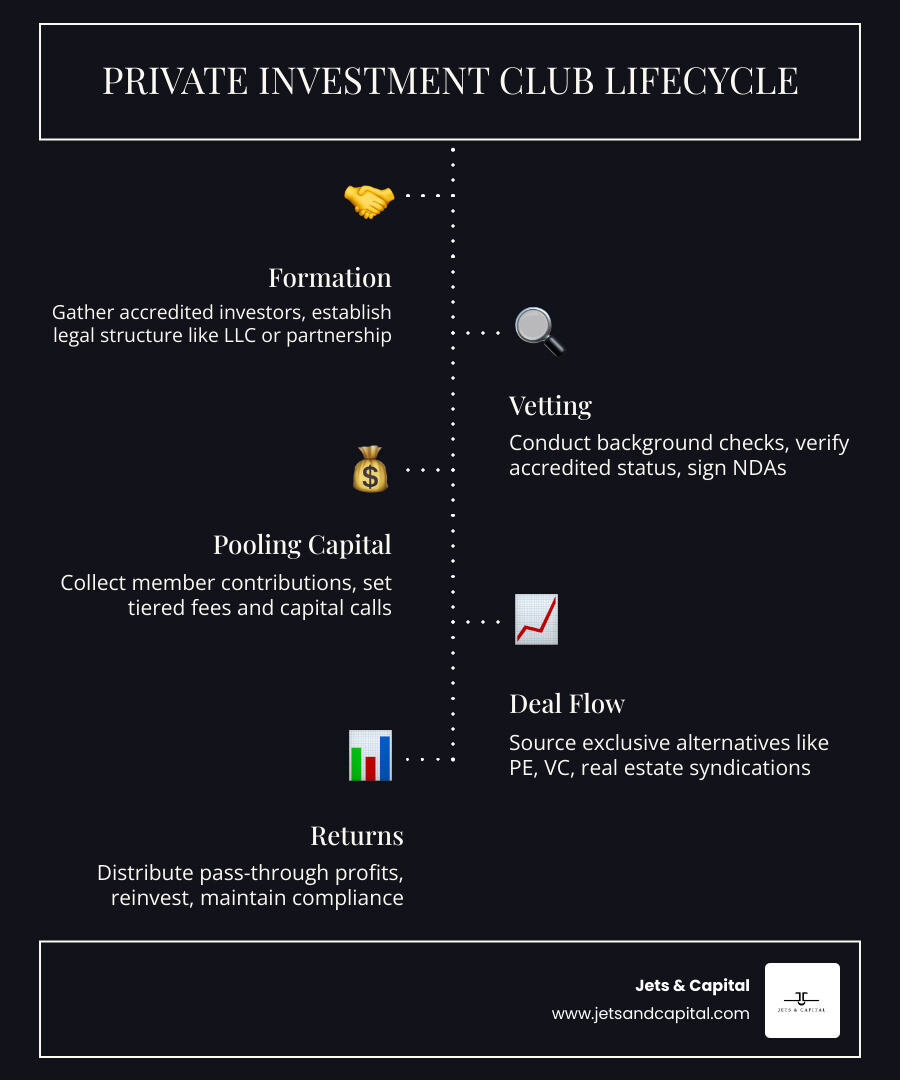
One of the greatest advantages of a private investment club is its tax efficiency. Most are structured as pass-through entities. This means the club itself doesn't pay corporate income tax. Instead, all income, gains, and losses "pass through" to the individual members.
Each year, the club files IRS Form 1065 and issues a Schedule K-1 to every member. This K-1 details your share of the profits or losses, which you then report on your personal tax return. This structure is particularly beneficial for long-term capital gains and tax-efficient wealth transfer, as members can often offset gains with specific club-level expenses or depreciation from real estate holdings.
Regulatory Safe Harbors and Registration Exemptions
To stay on the right side of the law, clubs often utilize "Safe Harbors." Using a Capital Introduction Services Complete Guide can help ensure that the way you bring in new members doesn't look like a public solicitation.
Most clubs operate under Rule 506(b) of Regulation D. This allows the club to raise an unlimited amount of money from an unlimited number of accredited investors, provided there is no "general solicitation" (no public advertising). This is why the vetting process—which we’ll cover next—is so rigorous. You must have a pre-existing relationship with a member before joining.
Structuring Membership and Vetting for Success
The quality of a private investment club is entirely dependent on the quality of its members. In our experience at Jets & Capital, a "bad apple"—someone who is overly aggressive, litigious, or purely self-interested—can destroy the group's chemistry.
Membership is almost always restricted to Accredited Investors (net worth of $1M+ excluding primary residence or $200k+ annual income). Some elite clubs go further, requiring members to be Qualified Purchasers (typically $5M+ in investable assets). This ensures that every person in the room can afford the risks associated with alternative investments.

Establishing the Vetting and Onboarding Process
A robust vetting process usually looks like this:
- Initial Application: Proof of accredited status and a professional bio.
- Interview Stages: A 30-minute video or in-person meeting to assess "cultural fit."
- The "Room" Test: Attending a Family Office Networking event or a Family Office Investment Summit to see how the candidate interacts with the group.
- NDA Signing: A strict Non-Disclosure Agreement is the bedrock of the club, protecting the proprietary deal flow and the privacy of other members.
High retention rates (often above 90% in successful clubs) are usually the result of this slow, deliberate onboarding. We aren't just looking for capital; we are looking for partners.
Managing Member Contributions and Fees
While some clubs are volunteer-run with no dues, most sophisticated groups use a tiered fee structure to cover administrative costs, due diligence software, and legal fees.
- Associate Tier: Basic access to research and forums ($10k - $25k annually).
- Professional Tier: Full deal flow access and voting rights ($50k - $75k annually).
- Premier/Founding Tier: Dedicated account managers and first-look at co-investments ($100k+ annually).
Capital calls are the other side of the coin. When a deal is approved by the group, members are "called" to contribute their share of the capital. Clearly defining the minimum and maximum contribution per deal in your operating agreement prevents any single member from having too much—or too little—skin in the game.
Accessing Institutional-Grade Alternative Investments
The primary reason to join a private investment club is the deal flow. We focus on assets that aren't available on E*Trade or Schwab. This includes real estate syndications, venture capital rounds for pre-IPO tech companies, and Family Office Deal Flow in niche sectors like litigation finance or GP stakes (buying a piece of a fund manager's business).
Leveraging Collective Buying Power
Individual investors often get "priced out" of the best funds. A top-tier private equity fund might have a $10 million minimum. However, by pooling capital, a private investment club can meet that minimum and gain access.
Furthermore, we use our collective size to negotiate better terms. This might mean:
- Lower Management Fees: Moving from a "2 and 20" structure to a "1 and 15."
- Preferred Returns: Ensuring the club members get paid their initial investment plus a 8-10% hurdle before the fund manager takes a carry.
- Co-Investment Rights: The ability to invest directly into a specific company alongside the main fund without paying double fees.
Attending Capital Introduction Events is one of the best ways for a club to build the relationships necessary to secure these institutional terms.
Managing Conflicts and Ensuring Long-Term Trust
The biggest threat to a private investment club isn't a bad investment—it's a conflict of interest. If the club's founder is secretly getting a "kickback" from a sponsor to pitch a deal to the members, the trust evaporates.
The best clubs are sponsor-neutral. This means they do not accept payments, marketing fees, or commissions from the companies they invest in. Instead, the club is funded entirely by its members. This ensures that when we review a deal, our only goal is the highest possible return for our capital.
To maintain this, we recommend:
- A Strict Code of Ethics: Signed by all members and organizers.
- Voting Transparency: Every member has a voice, and major decisions require a majority or super-majority vote.
- Conflict Vetting: Before a deal is presented, the "lead" on that deal must disclose if they have any personal or professional connection to the sponsor.
A Private Aviation Networking Guide can even be a useful resource for understanding the high-level etiquette and trust-building required in these ultra-exclusive environments.
Evaluating Club Legitimacy and Performance
How do you know if a club is legitimate? Look at their due diligence library. A serious club will have hundreds of pages of research, third-party audits, and historical performance data available for members to review.
Real-world statistics show the power of these groups. One prominent club reported over $26 billion in combined investable assets with thousands of members, while another saved its members over $50 million in fees through collective negotiation. When evaluating a club, ask for their historical IRR (Internal Rate of Return) and their "renewal rate"—if people are staying, they are likely making money.
Frequently Asked Questions about Private Investment Clubs
How many members can a private club have to remain exempt?
To qualify for the private investment company exclusion under the Investment Company Act of 1940, a club must generally have no more than 100 members and must not make a public offering of its securities.
What are the typical investment minimums for members?
While it varies by club, most private groups look for a minimum commitment of $50,000 to $100,000 per deal. Annual membership dues can range from $2,500 for small local groups to $150,000 for elite global networks.
How are investment decisions finalized within the group?
In most high-functioning clubs, decisions are made via a majority vote after a formal presentation and a due diligence period. Some clubs use a "opt-in" model where the club vets the deal, but individual members decide whether or not to participate in that specific capital call.
Conclusion
Starting or joining a private investment club is a powerful strategy for wealth preservation and growth. By pooling capital, sharing the burden of due diligence, and leveraging collective bargaining power, you can access the world’s most exclusive deals while significantly reducing your fee drag.
However, the "private" in private investment club is there for a reason. Success requires a foundation of trust, a rigorous vetting process, and a commitment to transparency. Whether you are in San Francisco, Dallas, or Palm Beach, the goal remains the same: to build a community of A-players who help each other win.
At Jets & Capital, we specialize in creating the "rooms" where these connections happen. Our exclusive, invite-only events are designed to bring together the top 85% of allocators in high-trust environments like private jet hangars, ensuring that your next partnership is built on a solid foundation.
Are you ready to stop investing in isolation? Join the elite network and see how the right room can change your portfolio forever.
