
Networking for the One Percent
Why an Accredited Investor Network Is the Gateway to Private Market Wealth

An accredited investor network is a curated community of high-net-worth individuals, family offices, angel groups, and institutional players who pool access, knowledge, and deal flow to invest in private market opportunities unavailable to the general public.
Here's what you need to know at a glance:
| What It Is | Who Qualifies | What You Can Access |
|---|---|---|
| A vetted community for private investing | Net worth over $1M (excluding primary residence) | Private equity & venture capital |
| Connects investors with entrepreneurs | Individual income over $200K/year | Pre-IPO shares |
| Facilitates syndicated deals | Joint income over $300K/year | Real estate syndications |
| Ranges from online platforms to elite in-person groups | Certain professional license holders (Series 7, 65, 82) | Early-stage startups & hedge funds |
Only about 13% of Americans qualify as accredited investors. That small group gains access to a fundamentally different class of investment — one where the deals, the relationships, and the returns operate by a different set of rules entirely.
These networks range from digital platforms connecting thousands of investors globally, to intimate, invite-only groups where a handshake in the right room can move millions. The common thread? Verified status, curated access, and the kind of peer-to-peer intelligence you simply cannot find on public markets.
I'm Jordan Hutchinson, founder of Jets & Capital and a longtime participant in the accredited investor network space through my work with a family office that co-founded Bridge Investment Group (NYSE: BRDG) — experience that has given me a front-row seat to how elite capital formation actually works. In the sections ahead, I'll break down everything you need to know to navigate these networks with confidence.
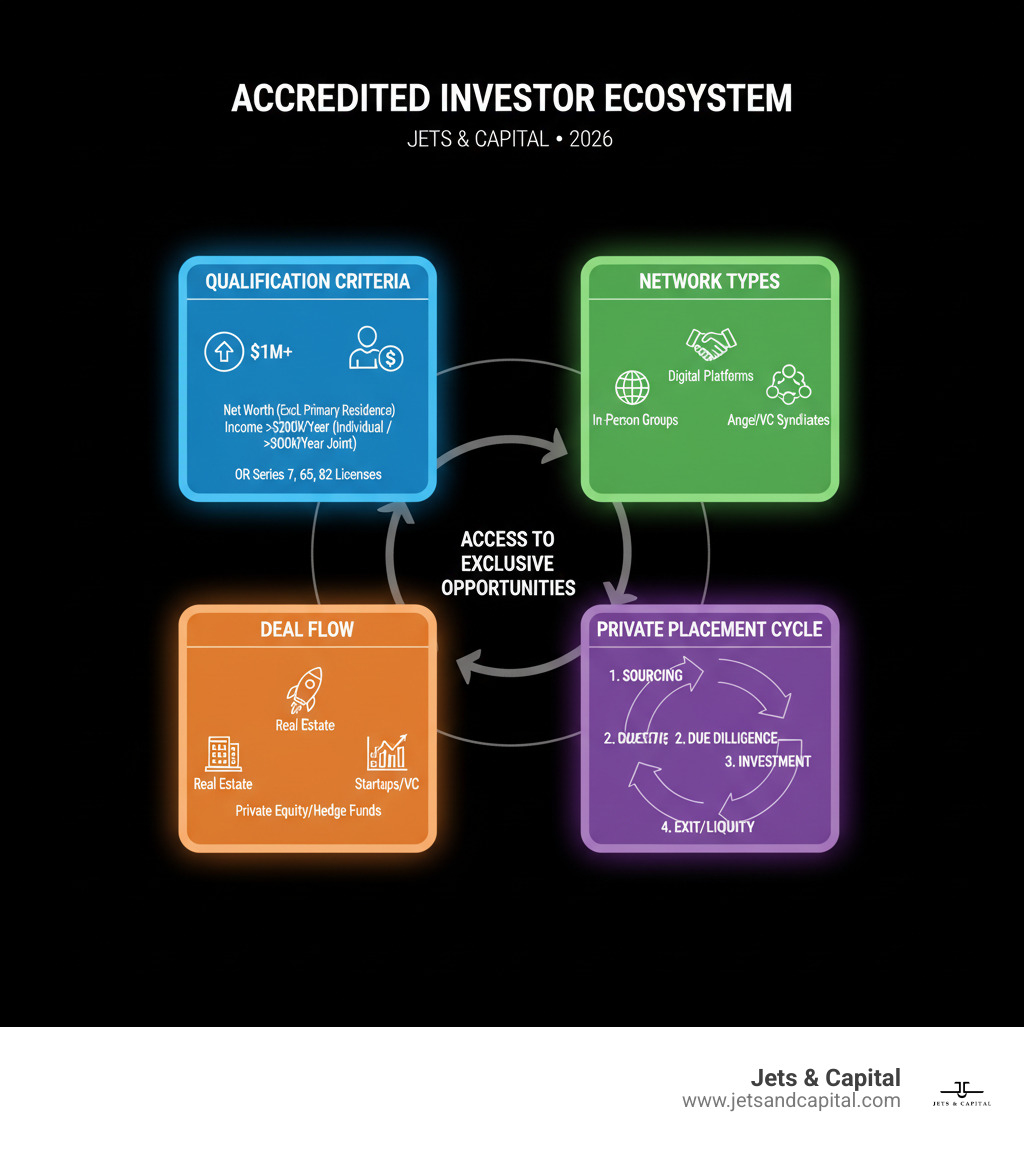
Defining the Modern Accredited Investor Network
The landscape of private capital has shifted dramatically as we move through 2026. No longer is an accredited investor network just a Rolodex of names in a dusty office. Today, it is a dynamic ecosystem where SEC Rule 501 meets high-speed digital syndication. These networks function as the primary bridge between ambitious entrepreneurs and the sophisticated capital they need to scale.
At its core, a Private Investor Network | Connect With Accredited Investors serves as a filter. In a world of infinite "noise," these groups provide a signal by pre-screening both the investors and the opportunities. This ensures that when you enter the room—whether that room is a digital dashboard or a private jet hangar in San Francisco—you are surrounded by peers who have the "dry powder" and the legal standing to execute on Discover Investment Opportunities.

Accessing Institutional Deals via an Accredited Investor Network
One of the most significant shifts we have seen is the democratization of institutional-grade deals. Traditionally, the most lucrative private equity and venture capital rounds were reserved for massive pension funds or multi-billion dollar endowments. However, by joining a network, individual accredited investors can leverage collective buying power.
This collective approach allows members to access Family Office Deal Flow that typically requires $1 million minimums. Through syndication, a network might negotiate these minimums down to $25,000 or $50,000 per member, allowing for better portfolio construction across:
- Pre-IPO Shares: Gaining equity in "unicorns" before they hit the public exchanges.
- Real Estate Syndications: Investing in multi-family or commercial developments in high-growth hubs like Miami or Las Vegas.
- Growth Capital: Providing the fuel for established companies to expand their market share.
The Digital Transformation of the Accredited Investor Network
Technology has removed the geographic barriers to elite investing. We now see platforms utilizing "The PitchTV" models, where entrepreneurs deliver video-based pitches that are cataloged by industry, location, and funding needs. This allows an investor in Dallas to review a biotech opportunity in San Diego or a fintech startup in New York with the click of a button.
These digital hubs often host Venture Capital Conferences and virtual "demo days," ensuring that the flow of information is constant. However, while digital tools provide the "what," elite in-person events still provide the "who" and the "why" that truly cement a deal.
SEC Criteria and Qualification Standards
To participate in these exclusive circles, you must meet the specific legal definitions set by the Securities and Exchange Commission (SEC). These rules are designed to ensure that participants have the financial sophistication to weather the risks associated with private placements.
If you are asking yourself, Are You an Accredited Investor? Here's How to Know! - Launch NY, you need to look at three primary pathways: wealth, income, or professional expertise. This status is vital for High Net Worth Investors who want to move beyond the volatility of the S&P 500.
Financial Benchmarks for 2026
As of April 2026, the primary financial thresholds remain consistent, though the scrutiny on verification has increased. To qualify as an individual, you must meet one of the following:
- Net Worth: Over $1,000,000, either alone or with a spouse/partner. Crucially, your primary residence cannot be included in this calculation.
- Individual Income: Over $200,000 in each of the two most recent years, with a reasonable expectation of reaching the same level in the current year.
- Joint Income: Over $300,000 with a spouse or partner for the same period.
For those utilizing UHNW Private Banking, these benchmarks are often just the starting point for more complex investment structures.
Professional and Institutional Designations
The SEC has recognized that wealth does not always equal financial literacy. Therefore, you can also qualify based on professional credentials. This includes individuals holding Series 7, 65, or 82 licenses in good standing.
Furthermore, entities can qualify as accredited investors. This includes:
- Family Offices: Those with at least $5 million in assets under management.
- Allocators: Professional Allocators who manage capital for institutional funds.
- Knowledgeable Employees: Staff members of private funds who are intimately involved in the investment process.
Strategic Advantages for Sophisticated Allocators
Why bother joining an accredited investor network when you could simply find deals on your own? The answer lies in the power of the group. When you invest as a lone wolf, you have limited leverage. When you invest as part of a Private Investment Group, you gain a seat at a much larger table.
One of the most compelling reasons to join a network like the Alliance of Accredited Investors | Access Private Equity & VC Opportunities is the reduction of entry barriers. Many top-tier venture funds won't even pick up the phone for an investment under $500,000. Networks aggregate smaller checks into one large "SPV" (Special Purpose Vehicle), giving you access to the same terms as the big players.
Diversification Beyond Public Markets
In 2026, the traditional 60/40 portfolio is often seen as insufficient for true wealth preservation. Our members frequently look to an Alternative Asset Investments Guide to find assets that don't move in lockstep with the stock market.
By utilizing a network, you can diversify into:
- Hedge Funds: Utilizing sophisticated strategies to hedge against inflation.
- Impact Investing: Funding companies that solve global challenges while providing a return.
- Early-Stage Tech: Getting in on the "ground floor" of AI and energy breakthroughs in hubs like Silicon Valley or Salt Lake City.
Peer-to-Peer Knowledge Exchange
The most underrated benefit of these networks is the "Mastermind" effect. When you engage in Family Office Networking, you aren't just looking at a pitch deck; you are talking to other successful founders and investors who have already done the due diligence. We have found that the collective intelligence of a group often spots red flags that a single investor might miss.
Due Diligence and Risk Mitigation Strategies
Private market investing is not without its perils. Unlike public stocks, private companies do not have the same rigorous daily reporting requirements. This makes due diligence the most critical skill for any member of an accredited investor network.
When we host Investor Networking Events, the conversation inevitably turns to how we vet opportunities. It isn't just about the numbers; it's about the "moat" and the management.
Vetting Private Market Opportunities
A professional Early Stage Investor looks for several key indicators before committing capital:
- PPO and Disclosures: Reviewing the Private Placement Offering and all legal disclosures to understand the share structure and exit rights.
- Founder Charisma and Experience: Does the leadership have a track record of success, or at least the "grit" to survive a pivot?
- Market Share Dominance: Is the company solving a real problem in a way that is difficult for competitors to copy?
Regulatory Compliance and Verification
Compliance is the backbone of any reputable platform. Most networks today require third-party verification to confirm your accredited status. This protects the "issuers" (the companies raising money) from legal trouble with the SEC. Whether it's through Reg D (private offerings) or the newer Reg CF (crowdfunding) rules, maintaining UHNW Networking standards ensures that the entire ecosystem remains healthy and legally sound.
Frequently Asked Questions about Accredited Investing
What is the typical ROI for angel network investments?
While every deal is different, many angel investors target a 20-50% ROI in their business plans. However, it is important to remember that these are high-risk, illiquid investments. A typical portfolio might see several "zeros," a few modest returns, and one "home run" that pays for all the others. Diversification is the only way to play this game effectively.
How do network fees and costs function?
Fees vary wildly depending on the level of service.
- Online Platforms: May charge a small percentage (1-2%) on successful investments or a flat annual membership fee (ranging from $500 to $5,000).
- Elite Clubs: Often have annual dues and might take "carried interest" (a percentage of the profits) on syndicated deals they bring to the table.
- Events: High-end networking events often have a per-event registration cost to cover the venue and vetting process.
Can non-accredited investors join these networks?
Generally, no. Most of these networks are strictly for accredited investors to comply with SEC safe harbor rules. However, there are some "sophisticated investor" exceptions for certain types of offerings, and Reg CF (Crowdfunding) has opened some doors for non-accredited individuals to invest smaller amounts in startups. That said, the "elite" deal flow remains firmly behind the accredited curtain.
Conclusion
The world of private investing is moving faster than ever. Whether you are looking for the next big tech breakthrough in San Francisco or a stable real estate play in Miami, your success often depends on the strength of your accredited investor network.
At Jets & Capital, we believe that the best deals aren't found on a screen—they are found in conversation. By maintaining a strict 85% allocator ratio and hosting our events in exclusive private jet hangars, we ensure that you aren't just "networking," you are building the relationships that define a legacy.
If you are ready to move beyond the standard investment options and join the 13% who are shaping the future of capital, we invite you to join us at our next summit.
