
Why Joining a High Net Worth Club is the Ultimate Power Move
Why a High Net Worth Club Can Change Your Deal Flow

A high net worth club is a vetted private community where wealthy investors, founders, executives, and family office leaders build trusted relationships, exchange ideas, and sometimes evaluate private opportunities together.
Unlike a standard luxury or social club, the best wealth networks are built around peer quality, discretion, and shared decision-making - not just dining rooms, events, or status. Entry can range from accredited-investor qualifications to ultra-high-net-worth thresholds. Some communities are digital and global; others center on private properties, invitation-only gatherings, or small advisory circles.
- Who joins: Entrepreneurs, senior executives, investors, and family office principals.
- What members seek: Trusted peers, private-market education, better due diligence, and curated introductions.
- How access works: Applications, referrals, financial verification, interviews, and clear non-solicitation rules.
- What separates the best clubs: Fewer pitches, stronger vetting, and relationships that hold up beyond a single deal.
For people deploying meaningful capital, the real advantage is not simply getting into an exclusive room. It is finding a room where candid conversations, aligned incentives, and long-term relationships can improve the quality of the decisions made there.
I am Jordan Hutchinson, an entrepreneur, investor, and founder of Jets & Capital, where I create private networking experiences for high-net-worth individuals and family offices. Through investor events in settings such as private jet hangars and major global gatherings, I have seen how the right high net worth club environment can turn a warm introduction into a lasting capital relationship.

Defining the Modern High Net Worth Club
When we talk about a modern high net worth club, we are describing far more than an elite country club or a prestigious downtown social enclave. Traditional luxury social clubs prioritize hospitality, fine dining, golf, and social status. While those amenities are pleasant, they rarely solve the strategic challenges faced by individuals managing tens or hundreds of millions of dollars in net worth.
A true high-net-worth community focuses on intellectual capital, sovereign decision-making, and high-trust peer exchange. These organizations function as curated spaces where wealth creators, legacy family office leaders, and top-tier allocators connect on equal footing. Rather than acting as passive social venues, modern investor ecosystems operate as active hubs for peer-to-peer insights and private capital alignment.
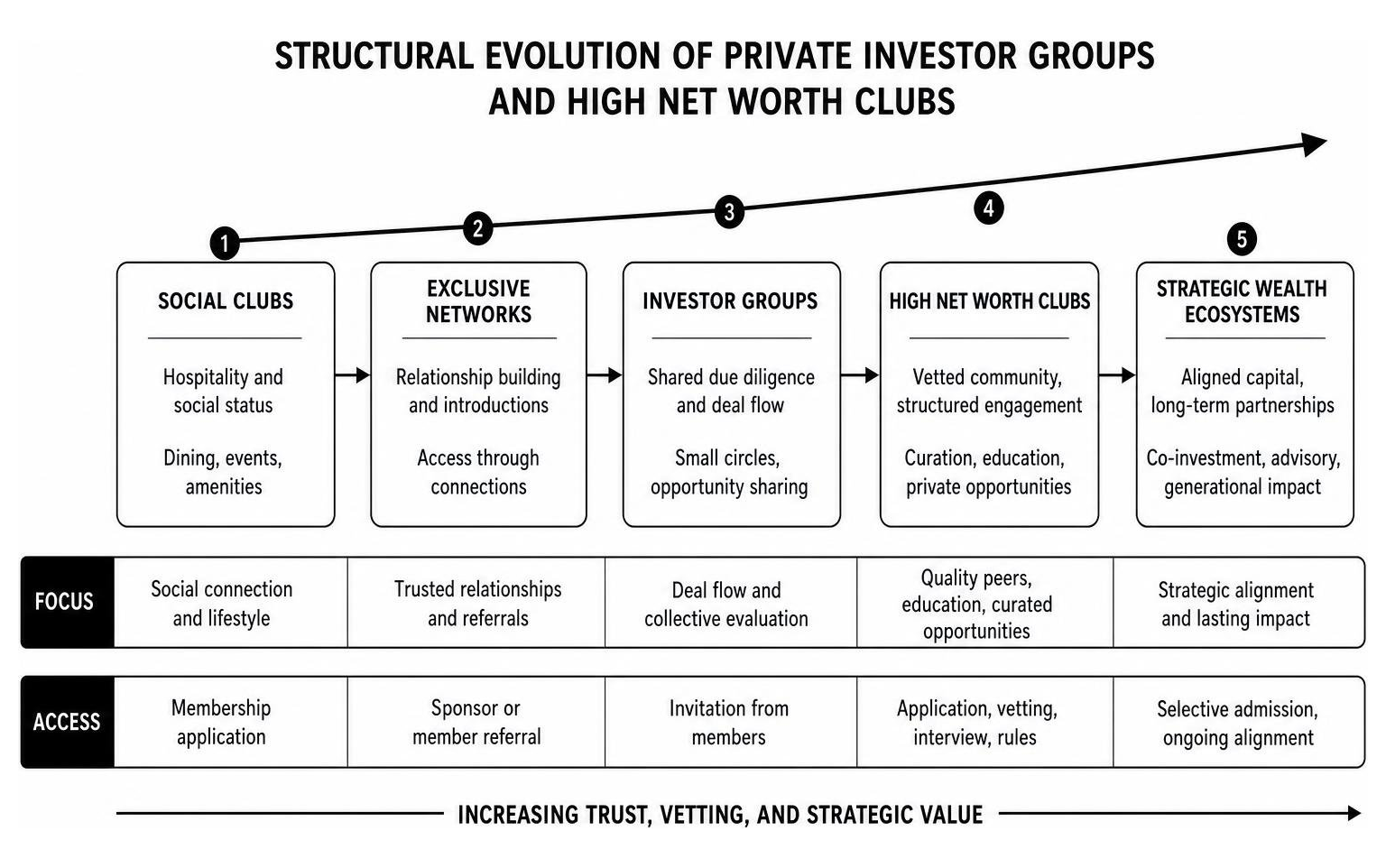
A fundamental pillar of any premier wealth network is the strict enforcement of non-solicitation protocols. In traditional business environments, high-net-worth individuals (HNWIs) and ultra-high-net-worth individuals (UHNWIs) are constantly targeted by financial advisors, pitchbooks, and transactional sales efforts. Modern Private Investment Groups neutralize this friction by creating dynamic "safe harbors" where active selling is strictly prohibited. This ensures that every dialogue is grounded in genuine relationship-building, collaborative due diligence, and objective advice.
Whether operating in financial epicenters like New York, tech innovation hubs like San Francisco, or booming wealth centers across Miami, Palm Beach, Las Vegas, Dallas, and Salt Lake City, modern wealth clubs filter for alignment rather than mere status.
Key Features of an Exclusive High Net Worth Club
What elevates an exclusive peer network above standard networking groups? We consistently observe four defining features that set top-tier wealth networks apart:
- Rigorous Vetting Mechanisms: Prospective members undergo comprehensive background checks, liquidity verification, and interview processes. This guarantees that every individual in the room brings substantial value, experience, and capital.
- Confidential Dialogue: Conversations regarding tax structures, multi-generational family dynamics, estate governance, and private market performance remain entirely private.
- Non-Transactional Environment: By establishing zero-solicitation environments, members engage as collaborative peers rather than buyers and sellers.
- Focus on Capital Preservation and Growth: Members share real-time operational insights, macroeconomic assessments, and portfolio strategies designed to preserve generational wealth across shifting economic cycles.
Financial Criteria and Wealth Thresholds
Entry into an elite investor group is defined by precise financial benchmarks designed to preserve peer equilibrium. These criteria ensure that members share comparable levels of financial complexity and capital allocation responsibilities. For a public regulatory overview of one common eligibility category, the U.S. Securities and Exchange Commission provides an explanation of accredited investor requirements.
- Accredited Investors: Generally defined as individuals with a net worth exceeding $1 million (excluding primary residence) or annual income exceeding $200,000 ($300,000 for joint filers).
- Qualified Clients & Qualified Purchasers: Advanced networks often require Qualified Client status ($2.2 million+ in investable assets) or Qualified Purchaser status ($5 million+ to $25 million+ in investments).
- Core HNWI Networks: Many premier communities maintain an average member net worth of $15 million, creating a dense concentration of experienced wealth allocators.
- Ultra-HNW & Legacy Communities: Elite tiers enforce higher qualification barriers, such as a minimum net worth threshold of $100 million with total global membership capped at just 1,000 individuals worldwide.
These clear financial boundaries ensure that whether members are discussing direct private equity syndications or complex tax mitigation strategies, everyone in the group operates with a similar scale of investable liquidity and strategic perspective.
Core Benefits and Value Propositions for Elite Members

Joining a curated wealth group opens doors to opportunities that simply do not exist within public markets or mass-market investment platforms. The true value proposition lies in aggregating collective intelligence, institutional-grade deal access, and tailored lifestyle integration.
Peer Advisory Circles and Unbiased Advisory
One of the most transformative elements of an exclusive wealth community is participation in structured peer advisory circles. These small, confidential groups—often comprising 8 to 12 vetted members—meet regularly to act as an unvarnished "personal Board of Directors."
In traditional wealth management, advice is frequently tied to products, management fees, or corporate mandates. Within a peer advisory circle, members receive completely unbiased feedback from fellow founders and family office principals who have already navigated similar challenges. Whether evaluating a business exit strategy, restructuring a multi-generational estate, or addressing complex leadership succession, these trusted circles deliver radical candor and strategic clarity.
Direct Co-Investing and Member-Led Due Diligence
For active investors, access to proprietary, off-market deal flow is a principal driver of membership. Through an established Accredited Investor Network, members aggregate their capital and expertise to evaluate direct private equity, venture capital, commercial real estate, and alternative asset opportunities.
By forming Special Purpose Vehicles (SPVs) and syndicate groups, members leverage significant collective bargaining power. This structure provides distinct advantages:
- Lower Management Fees: Direct member-led syndication bypasses standard 2-and-20 fund fee structures, drastically reducing friction costs.
- Rigorous Peer-Led Diligence: Members pool specialized domain knowledge—such as biotech, software, or real estate development—to conduct exhaustive due diligence that individual family offices might lack the bandwidth to perform alone.
- Investor Security & Blacklists: Experienced networks maintain internal, member-updated watchlists and platform blacklists to protect capital and prevent exposure to underperforming or bad-faith deal sponsors.
Multi-Generational Wealth and Legacy Planning
Wealth preservation is fundamentally about people, legacy, and stewardship. A comprehensive UHNW Family Ultimate Guide highlights that financial capital is only one pillar of a family's long-term enterprise; human, intellectual, and social capital are equally critical.
High net worth communities organize specialized workshops and family retreats focused on holistic legacy architecture. These programs help members address:
- Family Office Governance: Structuring formal family councils, mission statements, and constitutional guidelines.
- Next-Gen Education: Preparing heirs to manage substantial wealth responsibly through financial literacy, leadership training, and philanthropic initiatives.
- Holistic Well-Being: Balancing financial success with personal fulfillment, health optimization, and purposeful impact.
Curated Experiences and Lifestyle Privileges
Beyond strategic wealth management, elite membership offers unparalleled lifestyle access and experiential rewards. Luxury private clubs and bespoke networks curate experiences that money alone cannot easily buy.
Members gain access to private aviation fleets, exclusive maritime collections, and curated VIP access at major cultural and sporting occasions. Prominent regional sanctuaries—such as exclusive private city clubs in Las Vegas and premier coastal sanctuaries in West Palm Beach—provide physical spaces where ultra-high-net-worth individuals relax, network, and entertain guests in complete privacy.
From private jet hangars in San Francisco and Dallas to premier private estate gatherings in Miami and Palm Beach, these environments blend high-level deal-making with world-class hospitality.
Digital Networks vs Brick-and-Mortar High Net Worth Club Models
The landscape of high-net-worth networking has evolved into two distinct structures: digital-first peer communities and traditional brick-and-mortar private member clubs. Understanding the nuances of each model allows investors to choose the format—or hybrid approach—that best aligns with their operational style and geographic footprint.
Digital-first networks prioritize global scalability, continuous online discussion, and rapid deal aggregation. Members living across California, Texas, Nevada, or Florida can interact daily via private community portals, analyze co-investment documents, and join niche interest groups (such as tax optimization or alternative asset classes) without leaving their offices.
Conversely, physical brick-and-mortar clubs emphasize physical real estate, tangible luxury amenities, high-end dining, and local community prestige. These clubs serve as central social anchors within major cities.
| Feature / Dimension | Digital-First Peer Communities | Traditional Brick-and-Mortar Clubs |
|---|---|---|
| Primary Focus | Peer knowledge exchange, deal flow, & diligence | Hospitality, local social networking, & leisure |
| Geographic Reach | Global (45+ countries, major metro hubs) | Localized (specific city or clubhouse location) |
| Cost Structure | $0 fee models up to moderate annual dues | High initiation fees + substantial monthly/annual dues |
| Engagement Style | Asynchronous forums, Zoom circles, regional meetups | In-person dining, private lounges, & physical events |
| Deal Allocation | High density of member-led SPVs & syndicate deals | Informal personal networking & opportunistic connections |
| Privacy & Vetting | Strict digital identity verification & financial audits | Traditional committee reviews & member sponsorships |
Many investors discover that the most effective strategy combines both models: leveraging digital platforms for global deal flow and specialized knowledge exchange, while utilizing regional private physical clubs or local outposts in key hubs like San Francisco for face-to-face entertaining and regional networking.
Evaluating Cost Structures and Community Alignment

When evaluating potential wealth networks, prospective members encounter a wide array of cost structures and financial models. Pricing can range from completely free, peer-driven investment groups to exclusive luxury communities requiring six-figure initiation investments.
- Zero-Membership-Fee Models: Certain forward-thinking peer networks operate entirely without annual dues or entry fees. These communities sustain operations by offering optional value-add services or taking micro-fractions on syndication deal setups. This model eliminates financial barriers to entry for highly qualified members, prioritizing authentic, non-transactional peer engagement.
- Subscription & Tiered Dues: Many prominent organizations charge tiered annual membership dues ranging from $1,000 to over $10,000 per year. These subscriptions fund dedicated concierges, digital portal infrastructure, secure member hubs, and year-round educational programming.
- Six-Figure Ultra-Exclusive Enclaves: Premier physical luxury communities and elite UHNW organizations often require initial capital outlays exceeding $100,000, combined with significant ongoing annual dues and real estate ownership commitments.
To determine which network best fits your personal and financial goals, consider reviewing our comprehensive Ultimate High Net Worth Networking Guide and evaluating groups against three primary benchmarks:
- Member Quality Over Quantity: Does the group enforce rigorous background checks and liquidity verifications to ensure true peer status?
- Alignment of Incentives: Is the platform designed to facilitate objective, peer-driven exchange, or is it structured primarily to sell financial products?
- Geographic and Sector Relevance: Does the club hold strong footprints in your primary business hubs—whether in New York, Miami, Dallas, Las Vegas, or San Francisco?
Frequently Asked Questions About High Net Worth Clubs
What is the financial threshold required to join a high net worth club?
Financial requirements vary based on the club's specific focus and target demographic. Standard high-net-worth networks typically require members to meet Accredited Investor status ($1 million+ net worth) or Qualified Purchaser thresholds ($5 million+ in investable assets), with many communities averaging $15 million in member net worth. Ultra-exclusive communities catering strictly to multi-family offices and ultra-high-net-worth individuals enforce minimum entry thresholds of $100 million in net worth and cap total global membership to maintain intimacy and discretion.
How do private clubs maintain a zero-solicitation environment for members?
Elite clubs enforce strict non-solicitation covenants embedded in their membership agreements. Members are prohibited from pitching products, soliciting investments for personal commission, or distributing marketing collateral to fellow peers. If a member violates these rules, their membership is revoked immediately without refund. This strict governance ensures that all interactions remain collaborative, authentic, and free from sales pressure.
What is the main difference between digital-first networks and brick-and-mortar wealth clubs?
Digital-first networks focus heavily on global connectivity, structured peer advisory groups, digital forums, and member-led direct private equity deal flow. They offer high efficiency and scalable global access, often with low or zero membership fees. Brick-and-mortar wealth clubs center on physical real estate, providing luxury amenities, fine dining, private meeting rooms, and local social prestige. Many UHNWIs choose to participate in both to balance global investment access with premium physical hospitality.
Conclusion: Capitalizing on Elite Wealth Networks
Joining a high net worth club is far more than a lifestyle upgrade—it is a strategic move that fundamentally transforms how you access capital, evaluate private market opportunities, and build enduring legacy relationships. In an increasingly complex global economy, the ability to collaborate with vetted peers inside a high-trust, non-solicitation environment provides an undeniable competitive edge.
At Jets & Capital, we take wealth networking out of traditional boardrooms and bring it directly into high-energy, world-class environments. We organize exclusive, invite-only networking events for family offices, institutional allocators, and UHNWIs held inside private jet hangars across top US wealth hubs—including San Francisco, Las Vegas, Dallas, Salt Lake City, Palm Beach, Miami, and New York.
Our standout commitment is a strict vetting process that guarantees at least 85% allocators in the room at every event. Whether attending our premier gatherings—such as our upcoming Super Bowl Edition in San Francisco, CA—or engaging with our broader investor ecosystem, you step into an environment engineered specifically for frictionless capital alignment and relationship building.
Ready to elevate your deal flow and connect with pre-vetted peer allocators? Explore the Jets & Capital Allocators Platform today to request an invitation to our next private jet hangar experience.
