
Why Business Growth Networking Is the Highest-ROI Activity You're Not Doing Enough Of

Business growth networking is one of the most powerful — and most misunderstood — tools available to investors, entrepreneurs, and business owners today.
Here's what you need to know upfront:
- What it is: Building deliberate, trust-based relationships that generate referrals, deals, and partnerships over time
- Why it works: Word-of-mouth referrals are the preferred customer acquisition method for 85% of small businesses, and structured referral networks like BNI convert those referrals to revenue 55% of the time
- Who benefits most: Business owners, investors, and family office principals who want curated deal flow and peer connections — not just a stack of business cards
- The key difference from casual networking: It's relationship-first, not transaction-first. You give value before you expect to receive it
- The bottom line: Networking done right has a higher ROI than most traditional marketing channels
Most people think networking means working a room, collecting contacts, and following up with a mass email. It doesn't. As one industry observer put it simply: "Networking isn't just about swapping names and numbers — it's about building real relationships that last."
The difference between networking that grows a business and networking that wastes your time comes down to one thing: intentionality. The right room, the right relationships, and the right follow-through change everything.
I'm Jordan Hutchinson — founder of Jets & Capital and an entrepreneur with experience across private equity, capital raising, and business growth networking at the highest levels, including exclusive events at Formula 1 races, private jet hangars, and Mar-a-Lago. In this guide, I'll break down exactly how structured, relationship-driven networking generates real business results — and how to make it work for you.
What is Business Growth Networking?
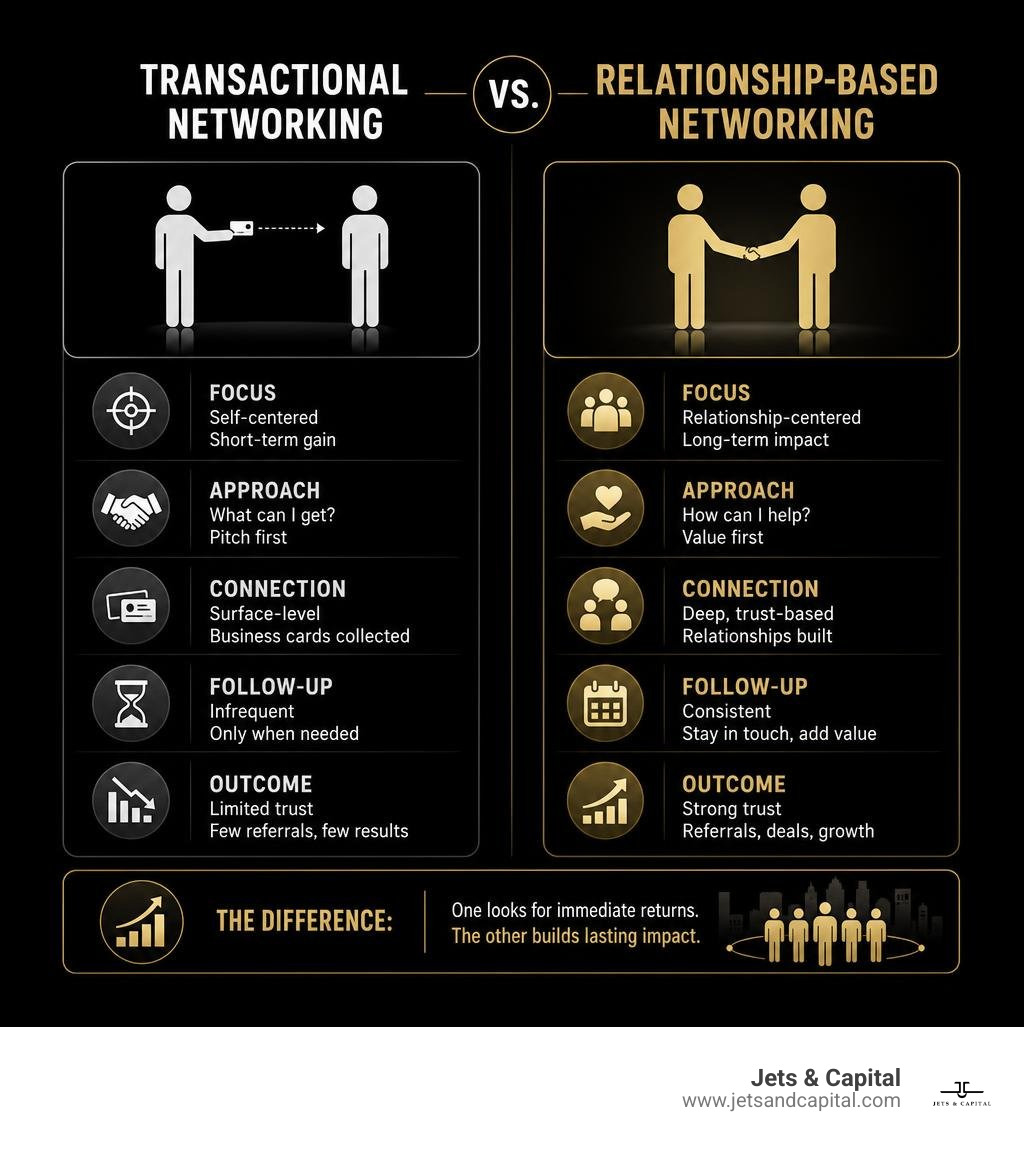
To understand how to leverage networking for your bottom line, we first have to separate transactional networking from true business growth networking.
Traditional networking is often a numbers game. You walk into a crowded hotel ballroom, hand out thirty business cards, pitch your services to anyone who makes eye contact, and head home hoping the phone rings. It rarely does. This "who can I sell to?" approach creates instant resistance. It treats people as leads to be closed rather than partners to be cultivated.
In contrast, business growth networking is a deliberate, relationship-based strategy. It shifts the primary question from "Who can I sell to?" to "Who can I help, and who can help me solve complex business challenges?" It is built on the foundation of the "know, like, and trust" principle. In a highly automated, AI-driven digital landscape, authenticity has become a premium asset. Real business still happens through real relationships.
According to research on Why Relationship-Based Networking Still Wins in a Digital World, shifting from a hard-sell mindset to a value-first mindset naturally lowers walls and invites collaboration. This approach is highly effective because word-of-mouth referrals remain the single best way for 85% of small businesses to acquire local customers. When you build deep, trust-based relationships with a curated group of peers, you effectively build an external sales force that champions your brand.
Whether you are navigating local business ecosystems through the Manhattan Chamber of Commerce networking programs or attending high-energy Miami Eventbrite networking events, the core rule remains identical: target high-quality, intentional environments where mutual support is the default expectation.
The Tangible Benefits of Structured Referral Networks
While organic networking has its place, joining a structured business growth network accelerates your results. Structured groups remove the randomness of networking by implementing systems, vetting members, and establishing clear expectations of reciprocity.

Accelerating Revenue Through Business Growth Networking Referrals
The most immediate and measurable benefit of structured networking is a steady stream of high-quality referrals. Because these referrals come with an implicit stamp of approval from a trusted mutual connection, they bypass the typical cold-outreach friction.
The numbers back this up:
- Referrals received through highly structured networks like BNI convert to closed business 38% faster than leads acquired from other marketing sources.
- Once a referral is made within these trusted environments, it converts to actual revenue an impressive 55% of the time.
- This systematic approach to word-of-mouth marketing has enabled BNI to help 1.9 million businesses generate over $164 billion USD in cumulative revenue since its inception in 1985. You can read more about their massive global footprint in this report on how BNI surpasses 300,000 members globally.
To achieve these results in your own business, you need a blueprint. Learning How to Build a Strong B2B Referral Network requires moving past casual interactions and establishing formal feedback loops with your partners. For those seeking to scale their local business connections, participating in regional business associations and structured local groups offers excellent frameworks to build these consistent referral pipelines.
To maximize this revenue acceleration, business owners must also understand the nuances of engaging with high-value partners. For a deeper dive into this segment, explore our Ultimate High Net Worth Networking Guide and learn how to position your brand to appeal directly to High Net Worth Investors who can fund your next stage of growth.
Unlocking Strategic Partnerships and Deal Sourcing
Beyond direct client referrals, structured networks open doors to high-level strategic partnerships, joint ventures, co-branding opportunities, and shared resources.
When you network with non-competitive businesses that serve the same target demographic, you can create highly profitable alliances. For instance, a commercial real estate broker, an estate planning attorney, and a private wealth manager share the exact same client profile. By aligning their networking efforts, they can pass multi-million dollar opportunities back and forth seamlessly.
For institutional allocators, family offices, and corporate development executives, this type of structured ecosystem is essential for sourcing high-quality, off-market deals. Attending dedicated Deal Sourcing Events and Capital Introduction Events allows you to bypass the noise of public auctions and find vetted investment opportunities directly through trusted intermediaries.
These strategic relationships are often nurtured within exclusive, private circles. Joining Private Investment Groups ensures you are collaborating with peers who have the capital, operational expertise, and desire to execute complex transactions.
If you are looking to build these connections locally, utilizing regional resources is highly effective. In Nevada, you can learn The Art of Networking in Henderson and Las Vegas to connect with fast-growing Western enterprises. In California, leveraging the resources of the California SBDC can help you bridge the gap between early-stage growth and institutional partnership.
Comparing Formats and Measuring ROI
Not all networking environments are created equal. To protect your most valuable asset — your time — you must choose the right format for your specific goals and rigorously measure the return on your investment.
Tracking Key Metrics for Business Growth Networking
If you cannot measure it, you cannot manage it. Many business owners write off networking as an unmeasurable "soft" activity, but that is a mistake. By treating networking as a core marketing channel, you can track its performance using your existing CRM systems (such as HubSpot or Salesforce).
To calculate the true ROI of your business growth networking efforts, we recommend tracking the following Key Performance Indicators (KPIs):
- Cost of Attendance: Include membership dues, event tickets, travel, and the opportunity cost of your time.
- New Referral Leads Generated: The raw number of introductions made to potential clients or partners.
- Lead-to-Opportunity Conversion Rate: How many of those raw introductions turn into active sales conversations or vetted deals.
- Closed-Won Revenue: The total dollar value of contracts or investments secured directly from networking referrals.
- Strategic Partnership Value: The estimated financial impact of joint ventures, co-branding initiatives, or shared operational resources.

By systematically tagging the source of every new deal in your CRM, you will quickly identify which rooms yield the highest returns. For more advice on optimizing these metrics, consult our Exclusive Networking Events Guide and discover how to maximize your presence at high-value Investor Networking Events.
Comparing In-Person, Virtual, and Mastermind Formats
Different networking formats yield vastly different results depending on your objectives. While virtual events offer unmatched convenience, they rarely match the deep trust built during face-to-face interactions. Conversely, high-level masterminds offer unparalleled strategic depth but require a significant time and financial commitment.
Here is a direct comparison of the most common networking formats:
| Format | Pros | Cons | Ideal Use Case | Average Results |
|---|---|---|---|---|
| In-Person Meetings | Deep trust, high engagement, strong local presence | Time-consuming, geographic limitations | Local service providers, regional B2B sales | High referral conversion (up to 55%) |
| Virtual & Speed Networking | Exceptional time efficiency, global reach, low cost | Lower relationship depth, screen fatigue | Initial screening, broad geographic outreach | Moderate lead volume, lower conversion |
| Executive Masterminds | Peer problem-solving, high-level strategy, deep bonds | High cost, strict qualification criteria | CEOs, founders, and institutional allocators | Transformational business scaling, joint ventures |
| Trade Shows & Expos | High volume of industry-specific prospects in one place | High travel costs, noisy environment | Product launches, market research, brand awareness | 5% to 20% of new customer acquisition |
For business owners seeking a structured online approach, utilizing vetted virtual networks can offer a premium, owners-only environment that combines the efficiency of digital platforms with strict member standards. If you prefer a hybrid model that blends local structured meetings with digital reach, look for regional business development networks that provide a flexible framework without forced attendance while maintaining high relationship standards.
To experience these formats in our key markets, explore local calendars such as the Dallas Chamber Events for regional corporate networking, search for active business meetups via Salt Lake City Meetup Networking, or secure tickets to major regional exhibitions like the San Francisco Small Business Expo 2026.
To understand why elite operators are increasingly turning to peer advisory formats, read about The Rise of Executive Masterminds and Peer Networks on Forbes.
Frequently Asked Questions About Business Growth Networking
Why is face-to-face networking still effective in a digital world?
While digital outreach tools, LinkedIn automation, and AI email campaigns can scale your message, they cannot scale trust. In fact, the sheer volume of digital noise has made face-to-face interaction more valuable than ever.
In-person networking allows you to read body language, share shared experiences, and build genuine human connections that are impossible to replicate over Zoom or email. When you break bread or share a conversation in an intentional environment, you move past the transactional "pitch" and build the foundational trust required for high-stakes business and investment deals.
How do structured referral networks protect member value?
The best structured networks protect their members by implementing two key mechanisms: member vetting and category exclusivity.
By limiting membership to one representative per business category (e.g., one commercial banker, one IP attorney, one IT consultant), these groups eliminate internal competition. This gives members the confidence to share leads and strategies openly without worrying about competing with their peers. Furthermore, a rigorous vetting process ensures that every member in the room is a high-caliber professional capable of delivering excellent service, protecting the reputation of anyone who makes a referral.
This level of curation is particularly vital in elite investment circles. In Family Office Networking, for example, maintaining a strict ratio of allocators to service providers is the only way to ensure the environment remains focused on high-quality deal-making rather than aggressive sales pitches.
What is the best way to follow up after a networking event?
The old saying is entirely accurate: the fortune is in the follow-up. If you do not follow up consistently and promptly after an event, you have wasted your time and money.
The best follow-up strategy is prompt, personalized, and value-first:
- The 24-Hour Rule: Send a personalized message via email or LinkedIn within 24 hours of the event while the conversation is still fresh.
- Send a Personalized Video: Stand out from the crowd by recording a short, one-minute video on your phone or via Loom. Keep it casual, mention a specific topic you discussed, and express your gratitude for their time.
- Provide Value First: Do not ask for a sales meeting right away. Instead, send them a helpful article, introduce them to a valuable connection, or invite them to an upcoming event that aligns with their interests.
Conclusion
At the end of the day, business growth networking is not about collecting contacts; it is about cultivating a community of trusted allies who are invested in your success. Whether you are running a growing local business or managing a family office, the quality of your network will ultimately dictate the ceiling of your growth.
At Jets & Capital, we take this philosophy to its logical conclusion. We don't host generic networking mixers. Instead, we organize exclusive, invite-only networking events for family offices, institutional investors, and ultra-high-net-worth individuals (UHNWIs) in unique, high-energy venues like private jet hangars.
Our upcoming Super Bowl Edition in San Francisco, CA, is a prime example of our model in action. With a strict vetting process that ensures at least 85% of the room consists of qualified allocators, we eliminate the noise and create an unparalleled environment for high-quality deal-making and genuine relationship building.
Are you ready to step into the right room? Join our exclusive network of allocators and family offices today and experience the power of intentional, high-stakes business growth networking.
