
San Francisco Accredited Investor Events You Cannot Afford to Miss
The Best San Francisco Accredited Investor Events to Know in 2026

San Francisco accredited investor events draw some of the most active capital deployers in the world - from angel networks and family offices to institutional LPs and venture funds.
Here is a quick look at the top event formats happening in and around San Francisco right now:
| Event Format | Focus | Best For |
|---|---|---|
| AI and tech investment summits | AI, deep tech, healthtech | Startups, angels, VCs |
| Angel investor roundtables | Angel investing, due diligence | Accredited angels |
| Alternative investment conferences | Alternatives, PE, hedge funds, ESG | Allocators, advisors |
| Private equity and venture forums | Growth equity, VC, secondaries | GPs, institutional LPs |
| Curated founder pitch showcases | Life sciences, tech startups | Founders, family offices |
| Thematic private markets summits | Impact, thematic investing | LPs, impact allocators |
| Investor pitch and deal flow nights | AI, Web3, healthtech | Angels, early-stage VCs |
| Accredited investor coffee gatherings | Public markets, peer networking | Vetted accredited investors |
The Bay Area has long been the center of gravity for early-stage capital in the U.S. But the sheer volume of events - ranging from intimate vetted coffee gatherings to multi-day institutional forums - can make it hard to know where your time and money are best spent.
Whether you are a founder looking for your next check or an investor hunting for quality deal flow, not all events are created equal. The right room changes everything.
I'm Jordan Hutchinson, founder of Jets & Capital and a family office principal with deep roots in private equity and high-net-worth investor communities - and I've made it my mission to identify and create the San Francisco accredited investor events worth your time. In the sections below, I'll break down exactly what's available, what each format offers, and how to get the most out of every room you walk into.
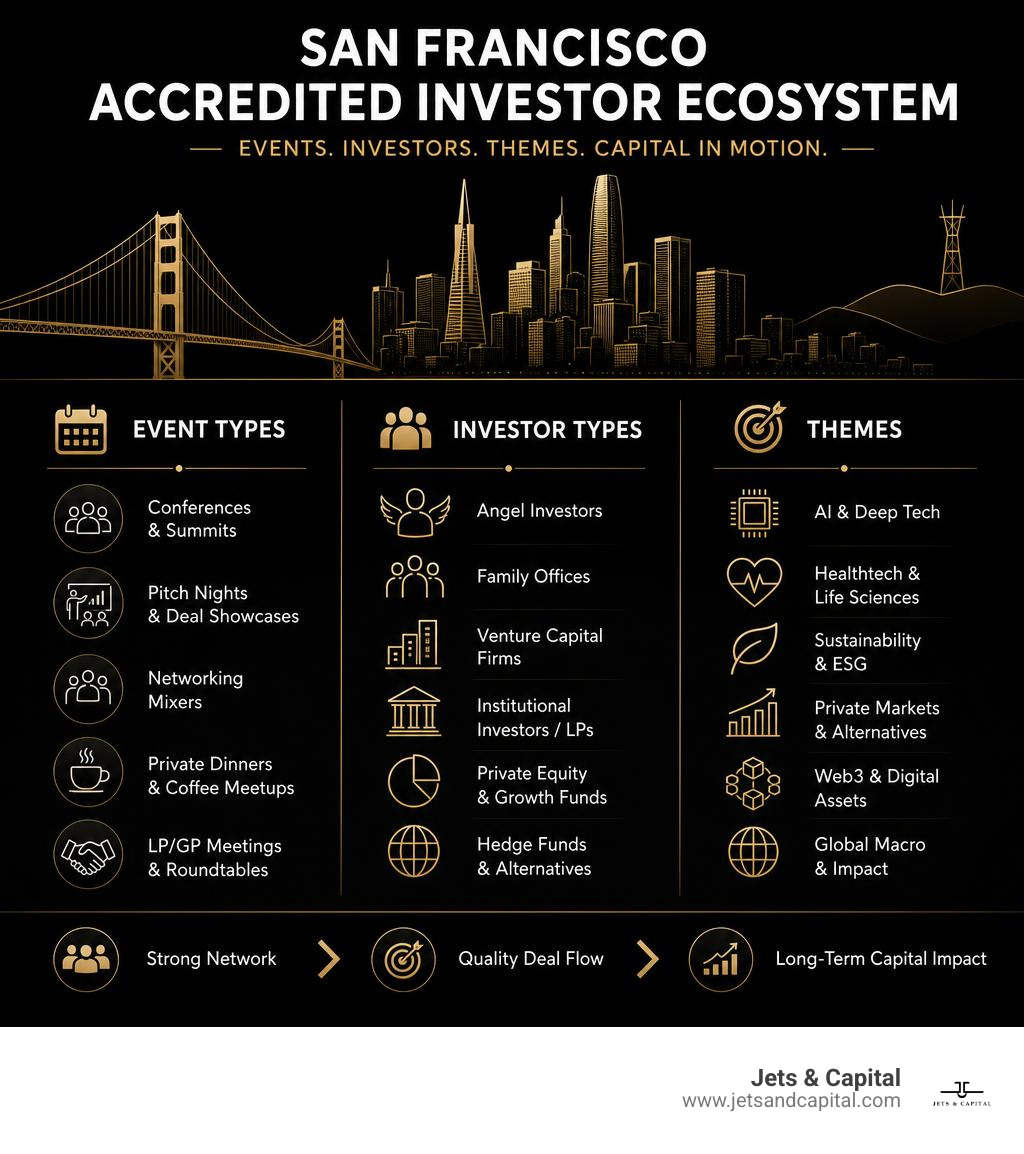
The Landscape of San Francisco Accredited Investor Events

San Francisco sits at the intersection of venture capital, family office wealth, public market sophistication, and private market innovation. That makes it one of the strongest U.S. markets for accredited investor gatherings.
The best events usually fall into a few categories:
- Founder pitch events for startups raising seed, Series A, or growth capital
- Angel investor network meetings built around member-led due diligence
- Private wealth and family office receptions focused on relationship building
- Alternative investment conferences for private equity, credit, hedge funds, and real assets
- Thematic summits covering AI, climate, healthtech, and impact investing
- LP and GP forums focused on capital allocation, fund selection, and liquidity
For a broader primer on how these networks function, see our guide to building an Accredited Investor Network.
What makes San Francisco different is the density of capital and expertise. A single room can include angel investors writing $25,000 checks, venture partners sourcing institutional deals, family offices considering direct investments, and LPs evaluating fund managers. That is exciting. It can also be noisy. The key is choosing events where the attendee mix matches your objective.
Key Investment Themes: AI, Climate Tech, and Healthtech
In 2026, the most active Bay Area investor conversations are centered on AI, deep tech, climate resilience, healthtech, and private market liquidity.
AI and technology investment summit formats are especially relevant for founders in:
- Generative AI
- Cybersecurity
- Semiconductors
- Frontier technology
- Climate tech
- Digital health
- Biotech
- Medtech
- Therapeutics
One notable feature of some Bay Area summit formats is that healthtech and AI/tech programming may be grouped into the same day, giving one ticket access to both a health-focused session and an AI/tech session. For founders, this is efficient. For investors, it creates broader deal flow without requiring three coffees, two rideshares, and a minor existential crisis.
Healthtech events tend to attract life sciences founders, biotech investors, family offices with healthcare exposure, and sector-focused funds. AI events bring more angels, early-stage VCs, technical operators, and corporate innovation teams.
Climate and impact themes are also becoming more sophisticated. Investors are not only asking whether a company supports a mission. They are asking:
- Can this scale commercially?
- What policy risk affects the model?
- Is there a real buyer with budget?
- Does the technology reduce cost, increase resilience, or unlock efficiency?
- Can private capital underwrite the risk?
That shift matters. In today's market, mission alone rarely gets funded. Mission plus margin has a much better chance.
Structuring the Deal: Private Markets and Liquidity Solutions
The San Francisco investor scene is not just about finding the next AI startup. A growing share of events now focus on private markets, alternative assets, and liquidity.
Common topics include:
- Secondary market liquidity
- Continuation vehicles
- Private credit
- Venture fund secondaries
- Co-investments
- Direct investments
- Portfolio construction
- Real assets
- Hedge fund strategies
- Impact and ESG integration
- Risk management in volatile markets
Alternative investment conferences in San Francisco are generally designed for people who manage, advise, allocate to, or oversee alternative investments. Topics often include private equity, hedge funds, private debt, ESG, crypto, global asset allocation, and risk management.
Private equity and venture-focused forums tend to focus more directly on growth equity, venture capital, tech-sector valuations, secondaries, late-stage financing, and fundraising in a higher-rate environment.
For investors comparing private market access points, our guide to Alternative Investment Events explains how these gatherings differ from general networking events.
Top Formats for San Francisco Accredited Investor Events
Not every event is built for the same outcome. Some are designed for education. Some are designed for capital raising. Some are designed for quiet, high-trust conversations where no one is wearing a lanyard the size of a dinner napkin.
Here is a practical comparison:
| Event Format | Typical Attendees | Best Use | Common Access Model |
|---|---|---|---|
| Private investor salons | Family offices, angels, UHNWIs, fund managers | Relationship building, co-investment discussion | Invite-only or vetted |
| Founder showcases | Startups, angels, VCs, scouts | Pitching, deal discovery, feedback | Paid pitch slots or application |
| Angel network meetings | Accredited angels, sector experts, founders | Due diligence, syndicated angel investing | Member-based |
| Alternative investment conferences | LPs, GPs, advisors, service providers | Market education, allocator access | Investor comp, paid manager/vendor passes |
| Family office receptions | Principals, CIOs, private wealth advisors | Long-term trust, private deal flow | Highly curated |
| Investor-only coffees | Accredited investors, public market investors | Peer exchange, market views | Vetted registration |
| Private jet hangar events | Family offices, investors, founders, UHNWIs | Premium networking and deal-making | Invite-only, strict vetting |
For a deeper breakdown of formats, see our guide to Investor Networking Events.
Private Investor Salons and Curated Networking Receptions
Private salons are often the most valuable and least visible events in San Francisco.
These gatherings are usually smaller, more selective, and more relationship-driven. There may be no stage, no formal pitch, and no giant conference agenda. Instead, the value comes from curated introductions and high-quality attendee density.
Typical attendees include:
- Family office principals
- Private wealth allocators
- Angel investors
- Fund managers
- Entrepreneurs with existing traction
- Strategic advisors
- Select service providers
This format is ideal when the goal is trust. A founder may not leave with a term sheet that evening, but they may leave with a warm introduction to a family office principal who becomes relevant three months later.
If your focus is private wealth and Bay Area capital, our San Francisco Family Office guide is a useful next read.
Founder Showcases and Curated Pitch Sessions
Founder showcases are more direct. The point is to put startups in front of investors and let the room evaluate quickly.
Examples in the San Francisco ecosystem include investor pitch nights, AI and tech founder showcases, and healthtech pitch sessions. These events typically include:
- Pre-screened startups
- Short pitch slots
- Investor Q&A
- Follow-up discussions
- Demo tables or informal showcases
- Optional investor judging panels
Some formats use 3- to 12-minute pitch options, with fees increasing for longer presentation time. In some summit models, pitch options may range from low-cost short presentations to more expensive extended presentation packages. That can be worthwhile for founders who are ready, but expensive for those who are still figuring out their ICP, pricing, or why their slide 7 has 19 logos and no revenue.
Smaller investor pitch nights may feature a handful of pre-screened startups, short presentations, Q&A, and ongoing deal flow introductions for approved investors.
Founders should review our Investor Pitch Events guide before paying for a pitch slot.
Family Office and Private Wealth Gatherings
Family office events are different from VC pitch nights. The tempo is slower, the questions are broader, and the decision-making process can involve more than one generation or advisor.
Common topics include:
- Portfolio diversification
- Tax-aware investing
- Direct deals
- Co-investments
- Private credit
- Real estate
- Venture allocation
- Manager selection
- Philanthropy and impact
- Legacy planning
At these events, founders and fund managers should avoid sounding transactional. Family office capital is often relationship-based. The first conversation may be about values, risk, governance, and trust rather than valuation and check size.
For more on this audience, see our guide to Family Office Events.
How Founders and Investors Can Maximize Event Value

The best event strategy is simple: know your goal before you enter the room.
If you are a founder, your goal may be:
- Raising a seed round
- Finding strategic angels
- Meeting sector-specific investors
- Getting feedback before a formal raise
- Building relationships for a future round
If you are an investor, your goal may be:
- Finding early deal flow
- Meeting co-investors
- Evaluating managers
- Comparing market views
- Sourcing direct opportunities
- Building family office relationships
Our guide to Deal Sourcing Events explains how to evaluate events based on signal quality, not just attendee count.
Pitching Formats, Costs, and Registration Strategies
Founders usually register in one of three ways:
- Open registration
- Application-based selection
- Invitation through a network, accelerator, or investor
Open registration can be fast, but quality varies. Application-based events tend to be more selective. Invite-only events are harder to access but often more valuable.
Costs vary widely:
| Event Type | Founder Cost | Investor Cost | Notes |
|---|---|---|---|
| AI/tech summit pitch slot | About $195-$1,495 | Often free or low-cost for qualified investors | Longer pitch slots cost more |
| Small pitch networking event | About $37-$64 | Often free or discounted if approved | May include deck access or intros |
| Alternatives conference | Often not founder-focused | Complimentary for qualified LPs; managers/vendors may pay | Manager and service provider passes can be significantly higher than investor passes |
| Private equity forum | Usually GP/LP focused | Complimentary for qualified LPs and some GPs | Sponsorship may be available |
| Invite-only salon | Varies | Usually vetted | Access depends on fit |
Some summit formats allow founders to self-register without approval, which is convenient. But founders should still be honest about readiness. If you are not prepared for investor questions, a longer paid pitch slot simply gives you more time to be unprepared in public. We say that with love.
Before registering, founders should have:
- A clean 10-12 slide deck
- A short version of the pitch
- A clear fundraising ask
- Current traction metrics
- Cap table basics
- Use of funds
- Market size and go-to-market plan
- A simple data room
- A follow-up email template
For broader conference strategy, see our guide to Venture Capital Conferences.
Ticket Tiers: Free, VIP, and Investor-Only Passes
Ticket types matter because they define access.
Common tiers include:
- Free approved investor passes
- General admission
- VIP admission
- Founder pitch tickets
- Manager or service provider passes
- LP-only or allocator-only access
- Sponsor packages
At some startup summits, a low-cost VIP ticket may include lunch while basic attendance does not. That may sound small, but lunch is often where the best unscheduled conversations happen. Never underestimate sandwiches as a capital formation tool.
At institutional events, the pricing model flips. Qualified LPs and allocators may attend free, while managers, vendors, and service providers pay higher rates. Qualified investors and institutional or private wealth LPs may receive complimentary registration.
Investor-only coffee events may be free or low-cost but require vetting through professional profiles such as LinkedIn. These events often limit attendance to maintain quality.
For more on access tiers and private rooms, see San Francisco Exclusive Events.
Due Diligence Before and After the Event
A great event is only the beginning. The real work happens before and after.
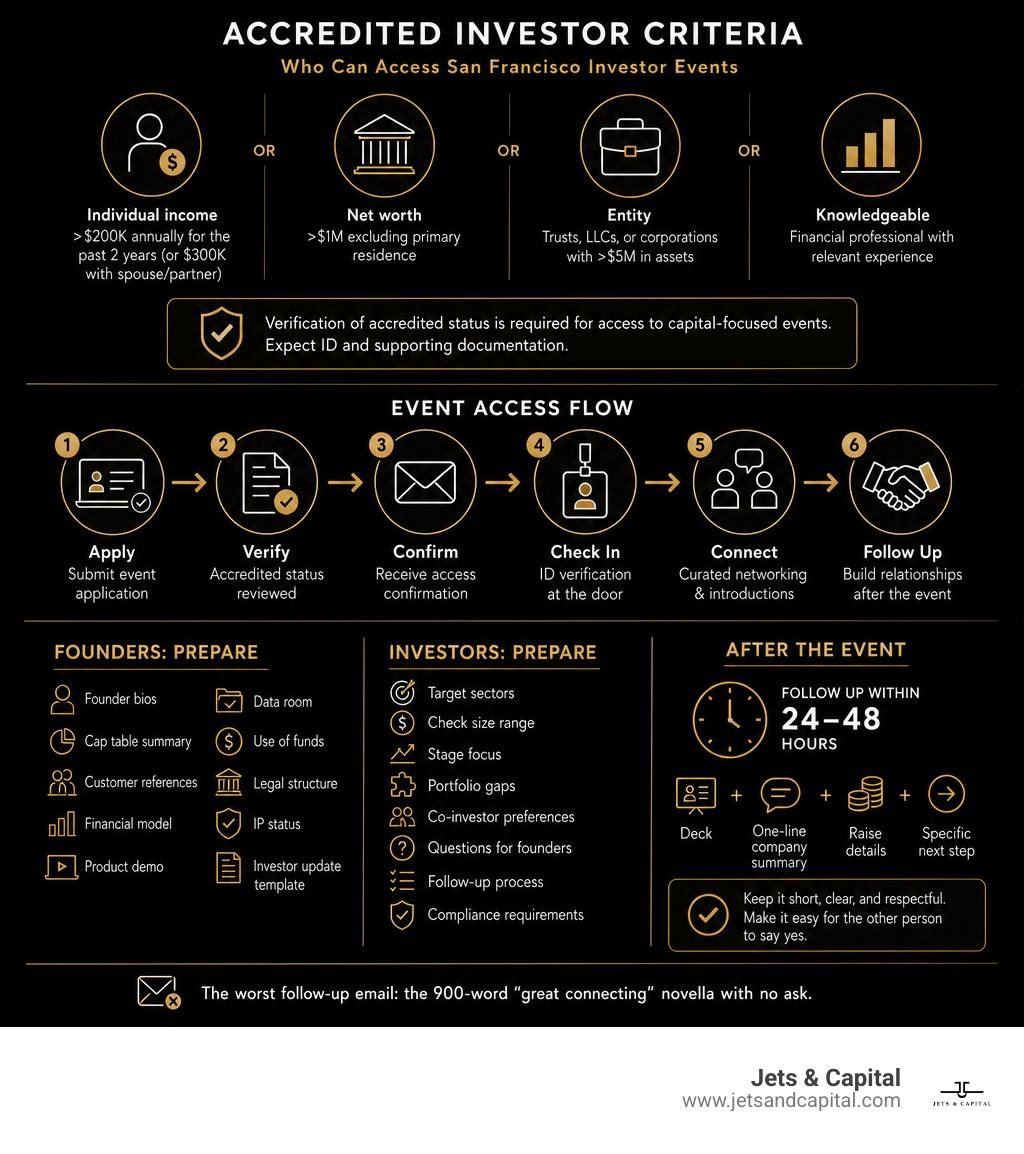
Founders should prepare:
- Founder bios
- Cap table summary
- Customer references
- Financial model
- Product demo
- Data room
- Use of funds
- Legal structure
- IP status
- Investor update template
Investors should prepare:
- Target sectors
- Check size range
- Stage focus
- Portfolio gaps
- Co-investor preferences
- Questions for founders
- Follow-up process
- Compliance requirements
After the event, follow up within 24-48 hours. Keep it short. Include the deck, one-line company summary, raise details, and specific next step. The worst follow-up email is the 900-word recap with no ask. Be clear, be respectful, and make it easy for the other person to say yes.
Frequently Asked Questions about San Francisco Accredited Investor Events
Accredited investor events can feel opaque, especially for first-time founders. The rules are not impossible, but they do matter.
For capital introductions and compliance-aware networking, see our guide to Capital Introduction Events.
What defines an accredited investor at these Bay Area events?
Under SEC Rule 501 of Regulation D, an individual generally qualifies as an accredited investor if they meet one of the following standards:
- Annual income over $200,000 in each of the two most recent years, with a reasonable expectation of the same in the current year
- Joint income with a spouse or spousal equivalent over $300,000 in each of the two most recent years, with a reasonable expectation of the same in the current year
- Net worth over $1 million, excluding the value of the primary residence
- Certain professional certifications or licenses, such as Series 7, Series 65, or Series 82
- Certain knowledgeable employees of private funds
Entities may also qualify under separate asset or ownership tests.
Events may verify status in different ways. Some rely on self-attestation. Others review professional profiles, investor applications, fund affiliations, or third-party verification. More formal investment processes may require documentation from an attorney, CPA, investment adviser, broker-dealer, or other qualified verifier.
This is not legal advice. If you are raising capital, talk to securities counsel before discussing investment terms publicly.
How do startups secure a spot to pitch to active allocators?
Startups usually need to do one or more of the following:
- Submit an application
- Upload a pitch deck
- Provide company traction metrics
- Share funding stage and raise amount
- List industry category
- Explain use of funds
- Confirm founder availability
- Pay for a pitch slot if the event uses paid pitching
The strongest applications are specific. A vague statement about building the future of AI is not enough. Everyone in San Francisco is building the future of AI, including the espresso machine.
A stronger submission includes:
- What you do
- Who pays
- Current revenue or traction
- Why now
- Why your team
- How much you are raising
- What milestones the capital unlocks
Founders targeting family offices should also understand that these investors may care about governance, downside protection, and long-term alignment. Read our Family Office Events guide before pitching that audience.
What networking formats are most effective for deal-making?
The most effective formats are usually curated rather than purely open.
High-value formats include:
- One-on-one meetings
- Speed networking
- Private dinners
- VIP receptions
- Demo showcases
- LP-only roundtables
- Invite-only salons
- Founder-investor matchmaking
- Post-event warm introductions
Speed networking is useful for volume. Private dinners are better for trust. Demo showcases help technical products. One-on-one meetings are best when both parties are already qualified.
The ideal structure depends on the deal. A seed-stage AI startup may benefit from a pitch night. A private credit fund may be better served by allocator dinners. A family office exploring co-investments may prefer a private salon.
For more frameworks, see our Exclusive Networking Events Guide.
Why Jets & Capital Is Built for San Francisco Accredited Investor Events
Jets & Capital exists because we saw a gap in the market.
Many investor events optimize for attendance. We optimize for room quality.
Our private jet hangar events are designed for family offices, investors, founders, and ultra-high-net-worth individuals who want a more intentional environment for relationship building and deal flow. The setting matters, but the guest list matters more.
Our model focuses on:
- Invite-only access
- Strict attendee vetting
- A target of 85% allocators
- Curated founder-investor matchmaking
- Premium private aviation environments
- High-trust relationship building
- Private market conversations without conference chaos
San Francisco is a natural fit for this approach. The city has capital, founders, and global attention. What it often lacks is time-efficient curation.
The Jets & Capital Approach to Curated Deal Flow
We believe deal flow is not just about more introductions. It is about better introductions.
That means we look at:
- Investor fit
- Founder stage
- Sector relevance
- Capital needs
- Check size alignment
- Relationship quality
- Long-term value
- Trust and discretion
Our events are not designed to be giant expo halls. They are designed to create the kind of room where a family office principal, an active allocator, a founder, and a fund manager can have a real conversation.
That is also why we are careful with access. When too many service providers, spectators, or unqualified attendees enter a room, the signal drops quickly. Our strict vetting process protects the value of the room for everyone.
For readers comparing private capital gatherings, our guides to Investor Networking Events, Deal Sourcing Events, and Alternative Investment Events are useful companions.
Upcoming Jets & Capital Opportunities in San Francisco
Our San Francisco programming includes exclusive private capital gatherings, curated founder showcases, family office networking, and private jet hangar experiences.
The upcoming Super Bowl Edition in San Francisco, CA is built for high-quality relationship development among investors, family offices, UHNWIs, and founders. It is not a typical business mixer. It is a curated capital environment designed around access, trust, and meaningful conversations.
To explore upcoming opportunities, visit Register for Jets & Capital Events.
You can also browse our broader Events San Francisco page and related guides on Super Bowl Networking San Francisco, San Francisco Exclusive Events, and the Ultimate High Net Worth Networking Guide.
If you are comparing investor ecosystems across other Jets & Capital cities, focus on how each market differs by capital concentration, industry specialization, family office presence, and the level of event curation. The same basic principle applies everywhere: the best rooms are not necessarily the largest rooms. They are the rooms where the attendee mix, access model, and follow-up process are aligned with your goals.
Conclusion
The best San Francisco accredited investor events are not always the biggest. They are the ones where the right people are in the room, the access is intentional, and the follow-up leads somewhere real.
In 2026, the strongest opportunities cluster around AI, healthtech, climate tech, private markets, liquidity solutions, alternative investments, and family office capital. Founders should choose events based on investor fit, not just stage time. Investors should prioritize curated rooms over crowded rooms. Sponsors and service providers should look for events where their expertise matches the audience, not where their logo is simply added to a brochure.
At Jets & Capital, we are building the kind of San Francisco investor experiences we believe the market needs: private, vetted, allocator-heavy, and designed for real relationship building.
If you want access to curated private capital gatherings, private jet hangar events, and our Super Bowl Edition programming in San Francisco, start here:
Register for Jets & Capital Events
And if you want to sharpen your broader networking strategy before you enter the room, read our Ultimate High Net Worth Networking Guide and our guide to Super Bowl Networking San Francisco.
