
The Best Investor Pitch Events to Get Your Startup Funded
Why Investor Pitch Events Are the Fastest Path to Startup Funding

Investor pitch events are structured gatherings where founders present their startups to investors — angels, venture capitalists, and family offices — in a competitive format designed to accelerate funding and connections.
Here are the most important things to know:
- What they are: Timed presentations (typically 5-10 minutes) to panels of active investors, followed by Q&A
- Who they're for: Early-stage to growth-stage founders seeking capital, feedback, and visibility
- What you can win: Cash prizes, investment commitments, cloud credits, mentorship, and media exposure
- Why they matter: Top pitch events have seen participating startups collectively raise billions of dollars within two years of pitching
- Where to start: Look for events aligned with your sector, stage, and round size — not just the biggest name
The startup funding landscape is crowded. Getting in front of the right investors — fast — can mean the difference between scaling and stalling. Pitch events compress that process into a single room (or screen).
They are not just about winning a prize. The real value is the feedback, the relationships, and the credibility that comes from being on that stage.
I'm Jordan Hutchinson, founder of Jets & Capital and an active investor with deep roots in private equity and family office deal-making — I've seen how the right investor pitch events can open doors that cold outreach never could. In the sections below, we'll break down exactly which types of events are worth your time and how to make the most of them.
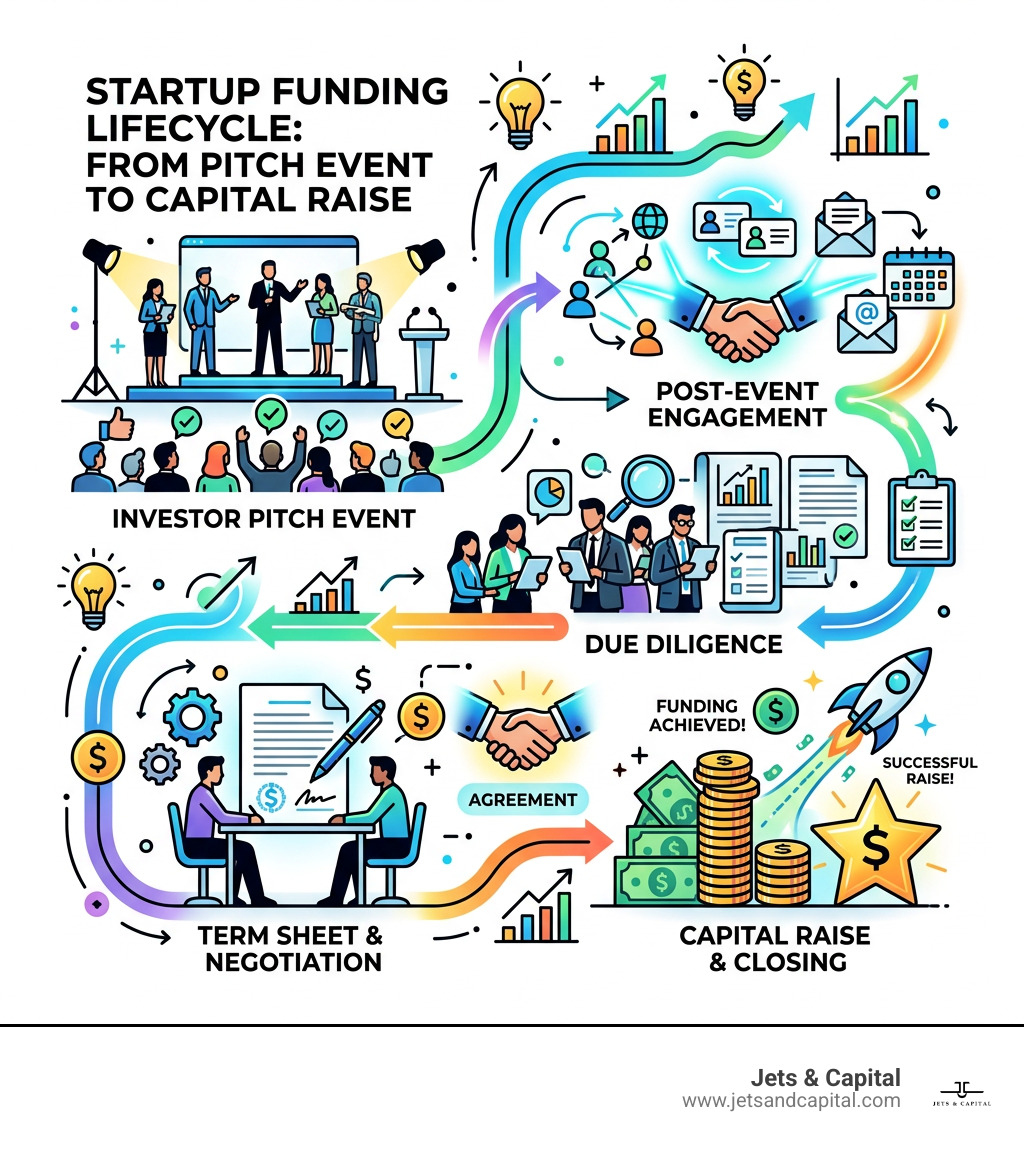
Why Startups Prioritize Investor Pitch Events
For any founder, capital access is the lifeblood of growth. However, in today's market, simply having a great product isn't enough. We are currently living in what many experts call the golden era of venture capital. With university endowments minting billions and private wealth reaching record highs, the "fear of missing out" (FOMO) among investors is palpable. Investor pitch events leverage this dynamic by putting multiple high-caliber startups in a room with hungry allocators, creating a competitive environment that can trigger rapid investment.
Beyond the check, these events serve as a primary engine for strategic partnerships. When you stand on a stage in Miami or San Francisco, you aren't just talking to a checkbook; you are talking to potential mentors, future board members, and strategic partners who can provide market validation.
Participating in Investor Networking Events also creates a vital feedback loop. Even if you don't walk away with a term sheet that day, the questions asked by a panel of seasoned VCs will expose the holes in your business model before they become fatal. At Jets & Capital, we've observed that the visibility gained from a single high-profile pitch can lead to months of follow-on meetings and organic brand exposure.
Navigating Different Types of Investor Pitch Events
Not all investor pitch events are created equal. Depending on your startup's stage and industry, you might find success in different formats:
- Virtual Competitions: Ideal for early-stage founders looking for global reach without the travel costs. Many virtual pitch competitions offer a multi-stage advancement process from local chapters to international finals.
- In-Person Summits: These are the "heavy hitters" where the most significant UHNW Networking happens. These events often take place in major hubs like New York, Miami, or San Francisco and prioritize face-to-face relationship building.
- Sector-Specific Tracks: Some events focus exclusively on one niche, such as healthtech, energy, or fintech.
- Accelerator Demo Days: Highly curated events where a cohort of startups presents to a room full of top investors after completing an intensive program.
- Regional Battles: Localized events that focus on building the local startup and investor ecosystem in cities like Dallas, Las Vegas, or Palm Beach.
Top Global Investor Pitch Events for 2024-2026
If you are looking for the "Big Leagues" of pitching, several categories of prestigious events dominate the calendar. These events are known for their rigorous selection processes and high-stakes rewards.
| Event Type | Typical Location | Focus Area | Key Prize/Benefit |
|---|---|---|---|
| University-Backed Challenges | Major University Cities | Student/General Tech | Prizes ranging from $100K to $1.6M+ |
| Global Pitch Competitions | San Francisco, International | AI, Health, Robotics | Grand prizes up to $1,000,000 |
| Innovation Summits | Austin, New York, Miami | Multi-category Tech | High Media Visibility & Exit Potential |
| Sector-Specific Showcases | Denver, Boston, Various | Energy, Healthtech, Fintech | Deep industry connections & capital access |
| Equity-Free Accelerator Events | Global/Various | Early-stage Sector Agnostic | Equity-free support & billions raised by alumni |
One of the most significant success stories in the energy sector comes from major energy-focused pitch forums. Startups selected to pitch at leading energy innovation events have collectively raised billions of dollars within just two years post-pitch. Top events in this space can facilitate thousands of one-on-one meetings between founders and investors in a single gathering.
For student entrepreneurs and recent graduates, university-backed pitch competitions are a powerful entry point. Many offer streamlined application processes — some as simple as a 90-second video submission — making them accessible for those just starting their journey. These competitions provide massive platforms for student-led teams to secure the resources they need to scale.
Industry-Specific Investor Pitch Events
Generic pitch events are great, but sometimes you need to be in a room where everyone speaks your "language." Industry-specific forums offer deep Family Office Deal Flow because the investors attending are already experts in that vertical.
- AI and Deep Tech: Flagship AI pitch competitions in cities like San Francisco attract investors looking for the next breakthrough in agentic systems, applied AI, and deep tech. Inception-stage founders can find dedicated programs offering VC-backed capital specifically for AI ventures.
- Healthtech and Medtech: Dedicated healthtech pitch events can raise up to $2 million annually for winners. The best of these feature applicants in their networks and promote finalists to hundreds of industry executives and family offices.
- Energy and Sustainability: Energy-focused pitch forums are among the most impactful in the space. For those fighting climate change, several corporate and government-backed sustainability funds consider projects ranging from early concepts to fully operational companies.
- Fintech: Fintech-focused accelerator programs connect startups with large financial institutions and investors. Their networking receptions can be prime spots for meeting sector-specific allocators.
Note: Always verify current dates, eligibility, and terms directly with each event organizer before applying.
How to Prepare for a Successful Pitch

Preparation is the difference between a "thanks, but no thanks" and a follow-up meeting. We recommend a multi-step approach to ensure your founder readiness:
- Visual Storytelling: Your pitch deck should be a supplement, not a script. Keep slides visual and avoid text-heavy layouts. Investors at investor pitch events often see dozens of decks a day; yours needs to stand out in seconds.
- The Hook: You have roughly 30 seconds to capture the room's attention. Start with a compelling problem or a surprising statistic.
- Traction Metrics: Don't just talk about what you will do. Show what you have done. Whether it is $5K/month in revenue (a common threshold for Seed Round Capital) or a successful pilot, data builds trust.
- Practice and Iteration: Look for low-stakes environments to refine your delivery and get structured feedback (local founder meetups, angel group office hours, and practice nights are all useful options).
- Research the Judges: Know who is sitting on the panel. If they specialize in SaaS and you are pitching hardware, you need to adapt your language to bridge that gap.
Common Mistakes to Avoid at Investor Pitch Events
Even the best ideas can be sunk by poor execution. Through our work with Family Office Events, we have identified several "pitch killers":
- Ignoring the Q&A: Many founders nail the presentation but crumble during the 5-minute Q&A. This is where investors test your depth of knowledge. Prepare for the tough questions about your unit economics and competitive moat.
- Over-valuation: Arriving with an unrealistic valuation is a quick way to lose credibility. Be prepared to justify your numbers based on market comps and your current stage.
- Poor Time Management: If you are given five minutes, do not speak for six. Most investor pitch events will cut you off, which looks unprofessional and prevents you from delivering your closing ask.
- Weak Competitive Analysis: Never say "we have no competition." It suggests you have not researched the market well enough or that there is no market for your product.
Frequently Asked Questions about Pitching
What are the typical eligibility criteria for these events?
While every event differs, there are common benchmarks. Many leading investment groups evaluate over 100 startups monthly and typically look for:
- Revenue: Around $5K+/month or $100K ARR.
- Stage: Seed rounds ranging from $500K to $2.5M.
- Funding History: Usually less than $750K in prior funding.
- Team: At least one full-time founder is almost always required.
- Scalability: A clear path to a $100M+ valuation.
Some events focus strictly on seed-stage startups, while others — particularly government-backed programs — focus on early-stage R&D for high-impact technologies.
How do investors benefit from attending?
Investors aren't just there to be nice; they are there for vetted deal flow. Attending investor pitch events allows them to see dozens of companies in a fraction of the time it would take to source them individually. It's also a high-quality networking opportunity for the investors themselves. At our Events Miami and San Francisco sessions, allocators share notes on market trends and portfolio diversification strategies. It's a collaborative environment where the "smart money" gathers to find the next big opportunity.
Can virtual events be as effective as in-person ones?
While nothing beats the energy of a live room, virtual events offer incredible cost efficiency and global access. Many leading virtual pitch competitions use virtual semi-finals and finals to connect founders with a global audience without the overhead of international travel. The key to virtual success is mastering video pitch techniques and having a robust follow-up strategy. Digital networking tools now allow for seamless "breakout rooms" where investors can request pitch decks instantly.
Conclusion
Participating in investor pitch events is a marathon, not a sprint. Success requires strategic alignment—choosing the events that match your sector and stage rather than just applying to everything. Whether you are aiming for a million-dollar grand prize at a global pitch competition or seeking an intimate, highly-vetted environment to connect with serious capital, the goal is the same: building long-term relationships.
At Jets & Capital, we believe that the highest quality deal-making happens when the right people are in the right environment. Our exclusive, invite-only events are designed to cut through the noise, ensuring that 85% of the room consists of active allocators. If you are ready to move beyond the standard circuit and engage with family offices and UHNWIs in an elite setting, we invite you to Attend one of our upcoming sessions.
Don't wait for the "perfect" moment to start pitching. The feedback you receive today is the foundation for the funding you'll receive tomorrow. Grab your Tickets or apply for your next competition today—the "golden era" won't last forever.
For more resources and to stay updated on future events, be sure to follow our latest insights and event announcements.
