
How to Build Lasting Relationships Through High-Level Networking

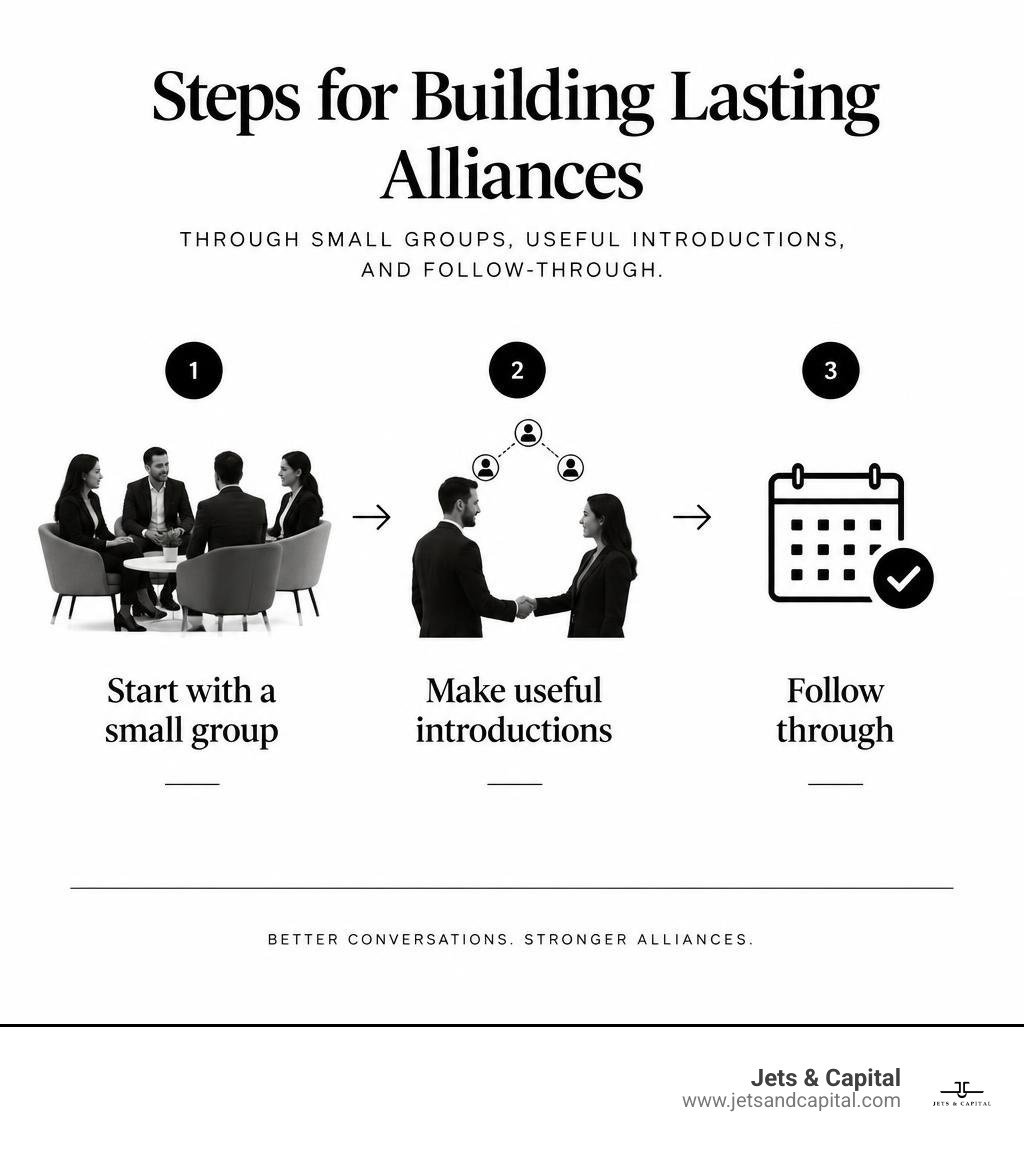
Start with a small group of people whose goals and judgment you respect. Choose settings where you can meet again, ask what they are working toward, and offer useful insight or an introduction before asking for anything. Follow through, and give trust time to grow.
That is the shift from collecting contacts to building allies. A crowded event can help you meet people, but a well-chosen, recurring group gives you more chances to learn how they think and work. Your time and attention are limited; use them on relationships you can sustain.
I'm Jordan Hutchinson, founder of Jets & Capital. My work bringing investors and family offices together at private events has shaped my approach to high level networking: create space for real conversations, then keep showing up.
What Is High-Level Networking and Why Traditional Events Fail
Most professionals have experienced the exhaustion of a generic hotel conference. You spend two hours circulating a ballroom floor with 200 attendees, trading three-minute elevator pitches while glancing at name tags. At the physical limit, you might exchange business cards or LinkedIn QR codes with 35 people.
Six weeks later, how many of those connections remain active? Typically, only one thread survives.
Traditional networking events fail because they suffer from rapid relationship decay. When an encounter is built around hasty self-promotion, the half-life of that contact is measured in days. The exchange is purely transactional. Name badges reduce participants to job titles, triggering immediate sales defense mechanisms rather than opening the door to authentic collaboration.
High-level relationship building operates on the opposite principle: depth over sheer volume. Instead of collecting hundreds of surface-level contacts that fade into digital obscurity, elite operators focus on cultivating a compact circle of trusted allies.
| Metric / Dimension | Traditional Networking Mixers | Curated High-Level Rooms |
|---|---|---|
| Primary Objective | Lead generation, contact volume | Long-term alliance formation, co-investment |
| Room Architecture | Open entry, 150–500+ participants | Strictly capped (typically under 50–100 seats) |
| Vetting Mechanism | Ticket purchase / open registration | Human-reviewed application & member referral |
| Interaction Cadence | Fast-paced, transactional pitches | Unhurried dialogue, dinner tables, private salons |
| Relationship Half-Life | Weeks (steep decay curve) | Years (compounds over recurring touchpoints) |
| Core Dynamic | "What can you do for me right now?" | "How can we create asymmetric value together?" |
The Psychology of Allies Versus Rolodex Building
A classic Rolodex is a list of people you know; an alliance network is a cohort of people who actively champion your success. Moving between these two states requires building trust velocity.
Trust does not develop while shouting over cocktail lounge noise. It grows through mutual vulnerability, shared context, and unhurried dialogue. When senior executives discuss real operational bottlenecks or share unfiltered perspectives on market shifts, defenses drop. Exploring modern leadership relationship strategies reveals that today's top decision-makers actively avoid pitch-heavy mixers in favor of curated executive gathering formats where they can speak as peers without being treated as sales targets.
The Three Core Filters: Curation, Seat Caps, and Repetition
Elite rooms consistently maintain their integrity by relying on three fundamental filters:
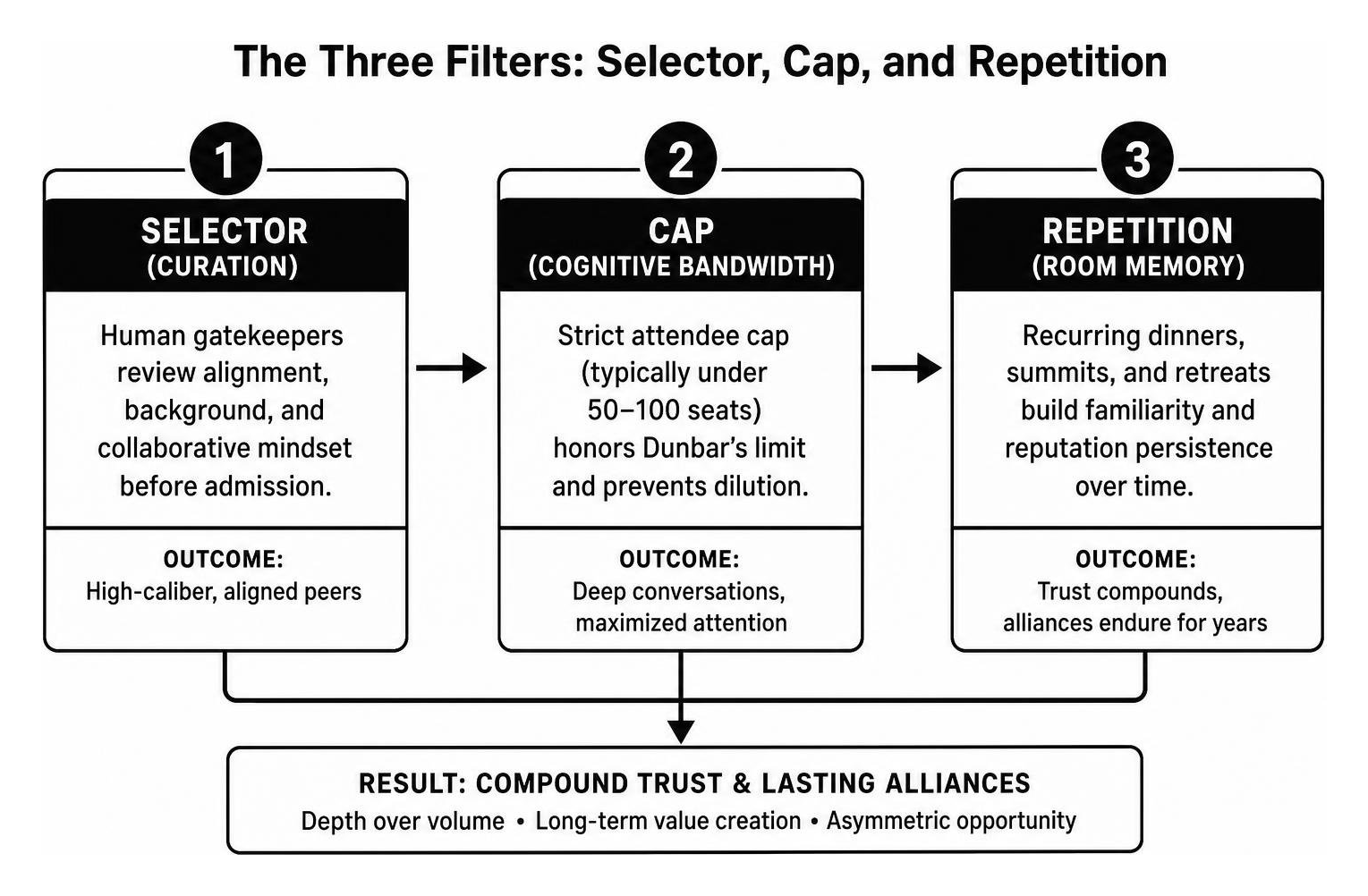
- The Human Gatekeeper (Curation): A purely financial barrier (such as an expensive ticket) does not guarantee quality. A high-level room requires human gatekeepers who evaluate an applicant’s background, alignment, and collaborative mindset before granting admission.
- The Hard Cap (Cognitive Bandwidth): Anthropologist Robin Dunbar established that the human brain can comfortably sustain only about 150 stable social relationships. High-level rooms honor Dunbar’s number by enforcing strict attendee caps, preventing the dilution that ruins large conventions.
- Repetition (Room Memory): True alliances require familiarity. When the same vetted peers meet across recurring dinners, summits, and retreats, reputation persistence takes over. Knowing you will encounter the same individuals next quarter changes behavioral incentives from short-term extraction to long-term value creation, a principle central to navigating high net worth peer groups.
The Three Levels of Professional Connection: Operational, Personal, and Strategic
To build an impactful network, you must understand the three distinct tiers of professional relationships and avoid the common traps associated with each.

- Operational Networking: These connections support your day-to-day responsibilities. They include direct team members, primary vendors, and routine functional counterparts. The risk here is internal myopia—becoming so consumed by immediate operational fires that you fail to see market shifts.
- Personal Networking: These relationships provide social support, camaraderie, and professional grounding outside your direct chain of command. They serve as essential sounding boards for career transitions and personal milestones.
- Strategic Networking: This tier connects you with visionary leaders, capital allocators, and cross-industry pioneers who help identify emerging disruptions, unlock joint-venture possibilities, and secure sovereign deal flow.
Understanding these distinctions helps executives maintain perspective. Leveraging executive network alignment frameworks allows leaders to balance immediate tasks with forward-looking partnerships, a cornerstone of effective senior executive relationship strategies.
Navigating High-Level Networking as an Introvert
You do not need an extroverted, room-working personality to succeed in elite rooms. In fact, many of the most influential allocators and founders are natural introverts.
Introverts often excel at relationship building because their strengths align with high-trust dynamics:
- Active Listening: Elite participants appreciate individuals who ask thoughtful questions and listen without interrupting.
- Asymmetric Preparation: Researching room attendees beforehand allows you to uncover shared interests and tailor discussions without relying on small talk.
- One-on-One Engagement: Deep, focused dialogues at a quiet dinner table forge far stronger bonds than circulating through dozens of casual introductions.
- Consistent Follow-Up: Introverts often excel at structured, written follow-throughs that deliver promised introductions or articles, reinforcing credibility.
The Strategy of Networking Forward
A common mistake is focusing outreach solely on established industry titans. The most effective relationship builders understand the power of "networking forward."
Networking forward means identifying and building ties with high-potential operators, researchers, and founders early in their trajectories. A seed-stage founder operating from a modest office today could manage an enterprise powerhouse five years from now.
By offering unprompted advice, early resources, or strategic introductions before these rising operators reach widespread prominence, you establish foundational goodwill that compounds into lifelong strategic partnerships.
Proven Strategies to Provide Value and Access Elite Circles
Entering sovereign circles requires adopting a value-first posture. Walking into an exclusive environment with an immediate ask is the fastest way to close doors.

To build genuine social capital within elite circles, consider these practical avenues of value delivery:
- Intellectual Capital: Share unique market insights, proprietary industry data, or specialized operational solutions that address challenges faced by other members.
- Bridge-Building Introductions: Connect two aligned peers within your network who have complementary business goals without asking for a finder's fee.
- Strategic Deal Flow: Direct vetted, off-market opportunities to relevant partners, demonstrating your focus on mutual upside. This principle forms the foundation of modern strategic investor networking methods and private wealth and family office relationship building.
How Vetted Communities Screen and Maintain Quality
Invite-only communities maintain high standards by enforcing strict qualification criteria. Unlike open commercial clubs, elite communities use rigorous screening mechanisms:
- Direct Operating Verification: Prospective members provide verifiable evidence of active capital allocation or executive leadership.
- Peer Sponsorship: Many elite groups require recommendations from standing members who vouch for an applicant's character.
- Strict Non-Solicitation Enforcement: High-level rooms maintain strict zero-solicitation rules. Hard pitches, unsolicited decks, and aggressive sales tactics result in immediate removal.
- High Allocator Density: Curating rooms where at least 80% to 85% of participants are active capital allocators ensures discussions remain focused on partnership, mirroring standard ultra-high-net-worth engagement rules.
Balancing Digital Networking Channels with High-Touch In-Person Encounters
Digital communication tools and private messaging groups offer unprecedented scale, but they cannot replace the trust forged through face-to-face interactions.
High-stakes capital commitments and significant joint ventures rarely close over direct messages alone. Body language nuance, direct eye contact, and shared physical environments build trust at a depth digital channels cannot replicate.
Use digital channels for preliminary communication and ongoing logistical updates, but reserve high-stakes deal architecture for in-person business deal environments.
Selecting Environments That Drive Sovereign Deal-Making and Capital Flow
The physical environment directly shapes the tone and depth of professional conversations. Traditional convention halls and crowded hotel lobbies create friction, background noise, and constant distraction. In contrast, distinctive private venues foster focus, comfort, and elevated engagement.
Organizing gatherings in locations like private aviation hangars, discrete executive lounges, or private dining rooms creates an open, relaxed environment. Applying private aviation networking strategies during high-profile gatherings—such as major regional deal-making summits—removes everyday distractions, allowing family offices and principals to explore meaningful co-investment opportunities.
Mastering High-Level Networking in Exclusive Venues
When attending or hosting an exclusive gathering, structuring the experience carefully maximizes relationship-building opportunities:
- Curate for Co-Investment Alignment: Ensure attendees share complementary mandates, whether in venture capital, private equity, or real assets.
- Prioritize Relaxed Luxury Over Formality: Rigid presentations often stifle dialogue. Open floor plans framed by exceptional architectural backdrops encourage fluid, natural discussions.
- Facilitate Frictionless Introductions: Event hosts should actively connect guests with complementary goals, eliminating awkward cold approaches.
This intentional approach underpins premier elite investor networking summits and opens viable venture capital access points for founders and allocators alike across key economic hubs like New York, San Francisco, Dallas, Las Vegas, Salt Lake City, Palm Beach, and Miami.
Frequently Asked Questions About High-Level Networking
How do you transition a transactional contact into a long-term ally?
To turn a casual contact into an ally, offer meaningful value without asking for anything in return. Send an insightful industry report relevant to their portfolio, suggest a strategic introduction, or acknowledge an important personal or company milestone. Maintain this thoughtful communication quarterly to establish trust before ever discussing business proposals.
What is the primary difference between operational and strategic networking?
Operational networking focuses on executing immediate tasks with vendors, direct teammates, and local functional peers. Strategic networking centers on visionary, future-focused connections with investors, cross-industry leaders, and innovators who offer broad market foresight, open doors to capital, and help navigate structural industry changes.
How do invite-only business circles vet applicants?
Invite-only networks use human-led application reviews, verifiable operational benchmarks, and peer recommendations. Gatekeepers look for authentic leadership records, unique industry value, and strong business ethics, while weeding out transactional sellers to protect the room's culture.
Conclusion
Building long-term wealth, access, and professional influence does not come from accumulating thousands of casual social media followers or handing out stacks of business cards at noisy conferences. It comes from curating high-trust relationships within carefully vetted, recurring environments.
At Jets & Capital, we host private hangar networking events across premier hubs—including San Francisco, California, New York, Palm Beach, Miami, Dallas, Las Vegas, and Salt Lake City. By maintaining an 85% allocator concentration through a strict vetting process, we ensure private investors, family offices, and business leaders can connect authentically and build lasting value.
If you are ready to move past transactional mixers and join high-trust investor circles, explore how to join an exclusive allocator network with Jets & Capital.
