
Why Family Office Capital Raising Requires a Different Playbook

Family office capital raising works best when it is treated as a long-term trust-building process, not a high-volume sales campaign. The quickest path is to target families with a real fit for your strategy, earn a credible introduction, show clear downside protection and alignment, and stay useful long before asking for a commitment.
Family offices are a major force in private markets. They managed a combined $3.1 trillion in 2024, and global family office capital is projected to grow from roughly $5.5 trillion today to $9.5 trillion by 2030. Many place a large share of their portfolios in alternatives, including private equity, venture, real estate, private credit, and real assets.
But this capital is private for a reason. A family office may have permanent capital and fewer committee layers than an institution, yet it still protects the family's reputation, legacy, and liquidity. The strongest opportunities often come through trusted people, clear governance, and co-investment structures that let the family evaluate both the deal and the manager.
I am Jordan Hutchinson, an entrepreneur and investor with experience in a family office connected to the founding of Bridge Investment Group, as well as advising capital raises for funds and other initiatives. Through Jets & Capital events and investor relationships, I have seen that successful family office capital raising starts with genuine access, thoughtful fit, and patience.
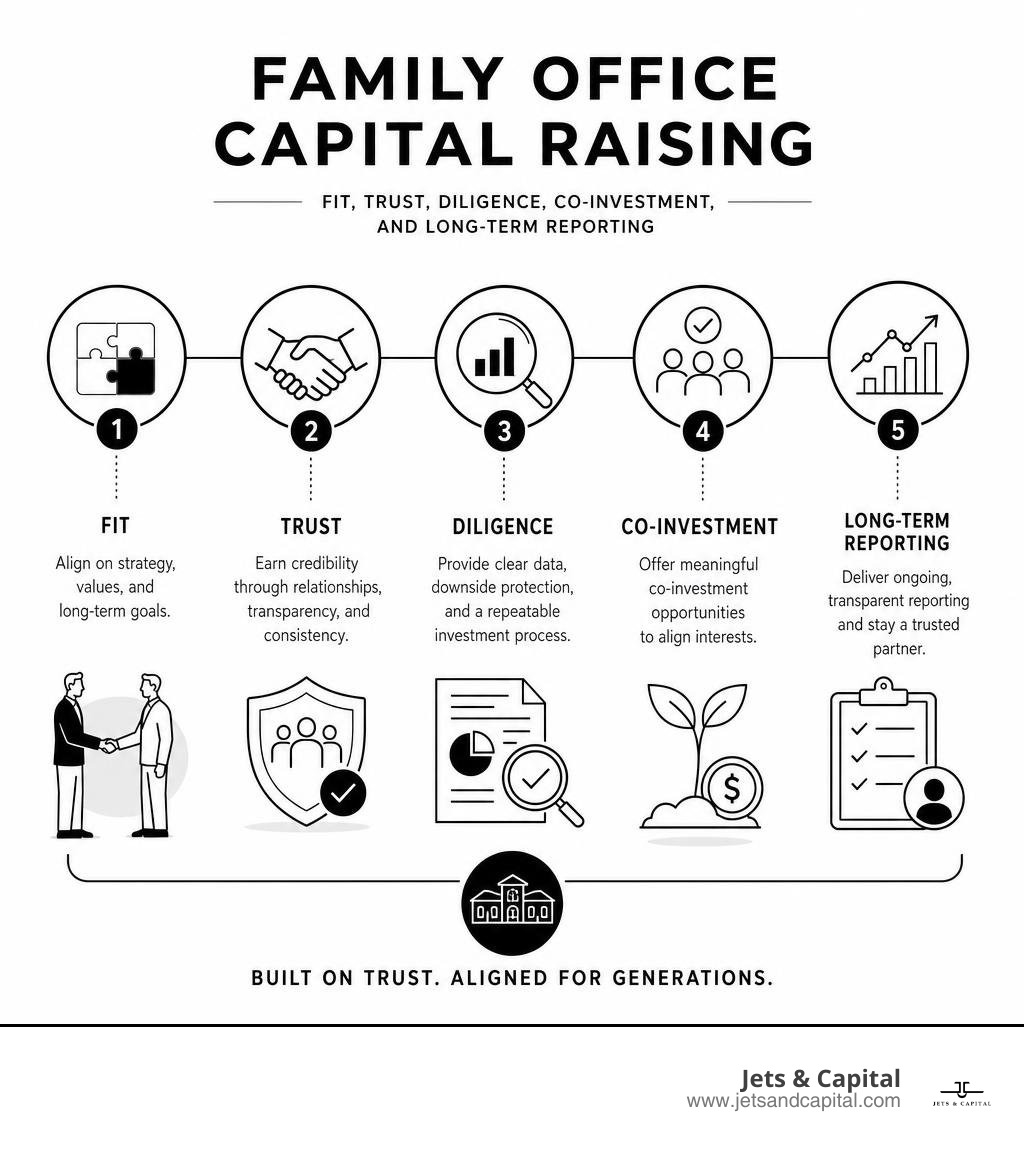
The Core Mechanics of Family Office Capital Raising
To master family office capital raising, fund managers and entrepreneurs must first understand that family wealth operates under distinct rules compared to pension funds, endowments, or traditional institutional LPs. Institutional LPs are governed by rigid 10-year fund lifecycles, benchmark tracking, and multi-tier investment committees. In contrast, family offices deploy balance-sheet capital anchored in multi-generational wealth preservation, legacy alignment, and permanent capital strategies.
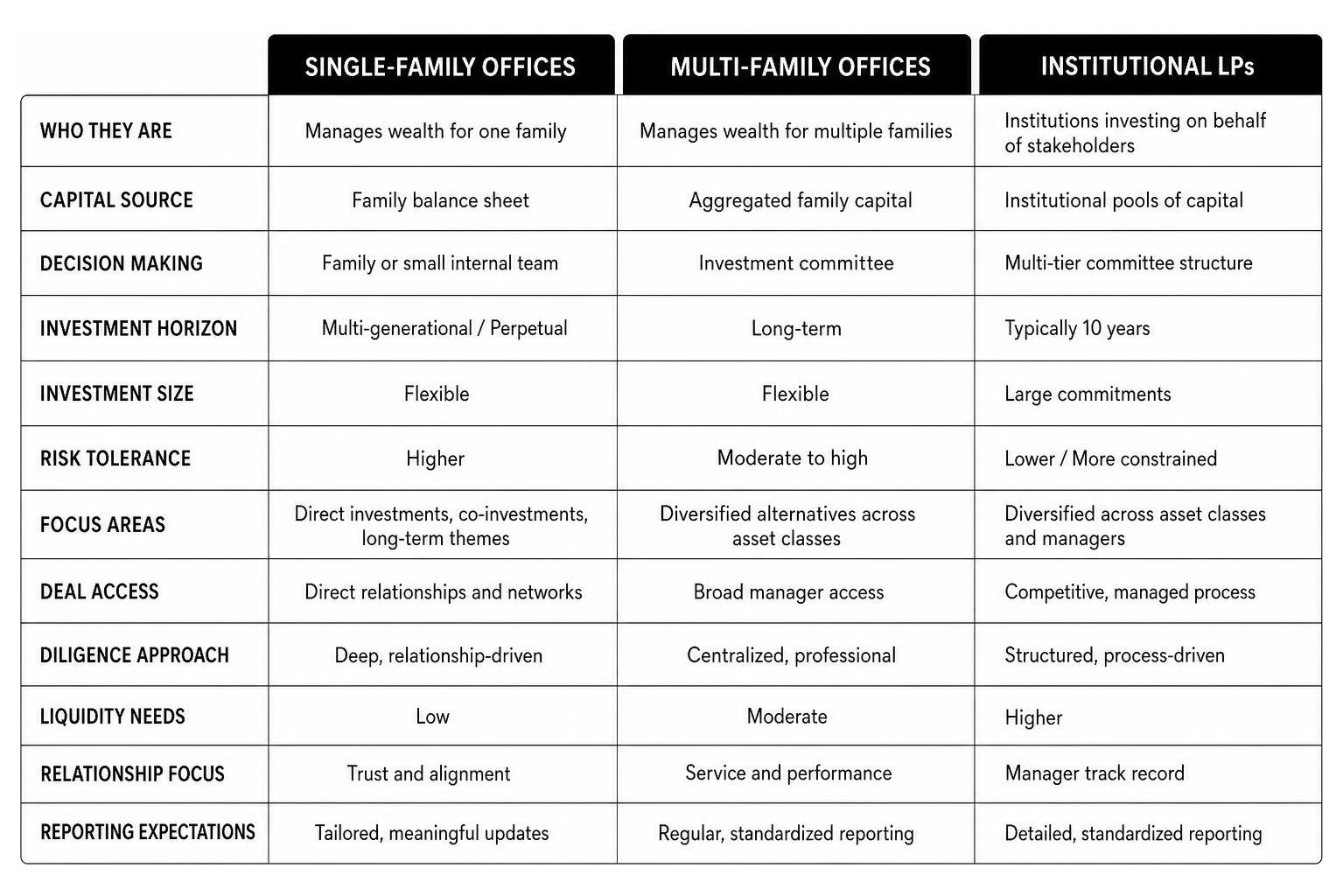
When we examine where family wealth flows, statistics paint a striking picture. Globally, 40% to 50% of family office assets sit in alternative investments. In fact, a significant block of family offices allocate more than 40% of their total portfolios directly to private assets. These allocations span direct private equity, real estate projects across major hubs like Miami, Palm Beach, Dallas, and San Francisco, as well as private credit and venture funds.
Understanding these capital flows requires analyzing how family offices organize their balance sheets across primary allocation buckets:
- Capital Preservation & Liquidity: Cash, high-grade short-duration debt, and defensive liquid strategies designed to protect core family wealth.
- Core Growth Funds: Allocations committed to external fund managers in private equity, real estate, or venture capital to generate compounding compound returns over long cycles.
- Direct Real Estate & Infrastructure: Income-generating real assets providing steady yield and tax advantages. For example, institutional wealth hubs in locations like Palm Beach and San Francisco frequently anchor capital in cash-flowing real estate assets.
- Direct Investments & Co-Investments: High-conviction direct equity or credit positions where the family brings sector operational expertise alongside capital.
Developing sophisticated Capital Allocation Strategies allows managers to position their offering within the exact allocation bucket a family office is seeking to fill.
| Feature / Metric | Single-Family Office (SFO) | Multi-Family Office (MFO) | Institutional LP (Pension/Endowment) |
|---|---|---|---|
| Primary Goal | Multi-generational wealth preservation & legacy | Wealth growth & operational service across multiple families | Pension obligations & strict index benchmarking |
| Decision Structure | Principal or lean investment team (1–3 decision-makers) | Formal investment committee / RIA structure | Multi-layered investment committees & consultants |
| Typical Decision Speed | 2 to 12 weeks | 1 to 3 months | 6 to 12+ months |
| Capital Source | Single family balance sheet / permanent capital | Pooled family capital | Third-party institutional capital |
| Co-Investment Preference | Extremely High (80%+ favor direct deals) | Moderate to High | Low to Moderate |
| Primary Risk Focus | Capital loss, reputational risk, & liquidity management | Fee transparency & fiduciary alignment | Underperforming peer benchmarks |
Single-Family Offices vs Multi-Family Offices
Understanding structural differences across family office types is vital when shaping your capital raising approach:
- Single-Family Offices (SFOs): Created to manage the financial, legal, tax, and lifestyle affairs of a single ultra-high-net-worth family (typically requiring $30M–$100M+ in investable assets). SFOs operate with direct principal involvement. Decision rights often rest with the founding principal or a trusted Chief Investment Officer (CIO). SFOs can move remarkably fast, making commitments in weeks when a deal aligns with their roots.
- Multi-Family Offices (MFOs): Structures that manage wealth for multiple families, often operating as specialized Registered Investment Advisors (RIAs). MFOs utilize formal investment committees, structured due diligence processes, and standardized reporting. While slightly slower than SFOs, MFOs control substantial aggregated capital.
- Virtual Family Offices (VFOs): Lean family structures that outsource investment management, legal, and tax services to a network of third-party advisors.
When engaging these groups at events like our Single Family Office Summit, managers should remember that SFOs value personal relationships and direct strategic fit, while MFOs focus on institutional governance and fee structures.
Decision-Making Speed and Downside Protection
A widespread myth among first-time fund managers is that family offices are aggressive risk-takers searching for unproven moonshots. The reality is quite the opposite. Most families generated their primary fortune through a concentrated business bet in a specific industry. Once created, their central directive becomes capital preservation across generations.
In fact, roughly 65% of family offices plan to maintain the exact same level of portfolio risk in 2025 as they did in 2024. Downside protection is their fundamental priority. During due diligence, family office principals scrutinize margin safety, capital protection mechanics, asset backing, and cash flow stability before evaluating upside projections.
Furthermore, distributions to paid-in capital (DPI) are paramount. With broader market exit windows fluctuating, family allocators favor funds and direct deals that offer tangible yield and realistic liquidity timelines. When downside risks are quantified and mitigated, decision timelines accelerate. A single-family office can evaluate a deal, conduct thorough due diligence, and issue capital in 2 to 12 weeks—far outpacing institutional LPs.
Sourcing and Qualifying Family Office Allocators

One of the largest hurdles in family office capital raising is identifying who is actively allocating and qualifying whether your strategy matches their current mandate. Unlike public funds or traditional VCs, family offices do not advertise their thesis or display public application forms.
Target qualification requires systematic research across four primary criteria:
- Wealth Origin: Did the family make their fortune in real estate, industrial manufacturing, technology, healthcare, or retail? A family whose wealth originated in retail logistics will have an intuitive appetite for supply chain software or industrial distribution real estate.
- Current Portfolio Gaps: What thematic exposures or yield profiles are currently missing from their overall asset allocation?
- Mandate Fit and Deal Sizing: Does your required cheque size match their typical deployment? Pitching a $100,000 allocation to an SFO whose minimum commitment is $5 million wastes time for both parties.
- Geography & Operational Overlap: Many families prefer investing in regions where they maintain operational roots, such as active M&A markets in Dallas, Miami, San Francisco, New York, or Salt Lake City.
Connecting with verified Allocators allows fund managers to focus their energy strictly on active, decision-making wealth owners.
Utilizing Intelligence Platforms and Databases
To build a high-probability target list, elite fund managers leverage specialized software and institutional wealth databases rather than relying on generic internet searches.
Prominent market tools include:
- FINTRX: A leading intelligence platform providing deep profiles on over 4,500 family offices, tracking key decision-makers, past portfolio holdings, regulatory ADV filings, and direct asset allocations.
- AdvizorPro: Excellent for mapping multi-family offices, RIAs, and key executive contacts with updated contact details.
- Axial: Highly useful for identifying family offices actively looking for direct private equity investments and private M&A transactions, especially in mid-market regions like Miami private M&A markets.
- Specialized Debt & Credit Databases: Identifying family offices with dedicated mandates for income-producing assets, as highlighted in profiles of family offices investing in debt.
While these tools provide an excellent foundation, data must be cross-referenced against public regulatory filings (SEC disclosures, Form ADV) and network insights to ensure contact accuracy and active investment appetite.
The Power of Warm Introductions and Network Mapping
Cold emails to single-family offices have an extremely low success rate. Family office inboxes are constantly bombarded with unsolicited pitches, leading principals and gatekeepers to ignore cold outreach. Warm introductions are essential.
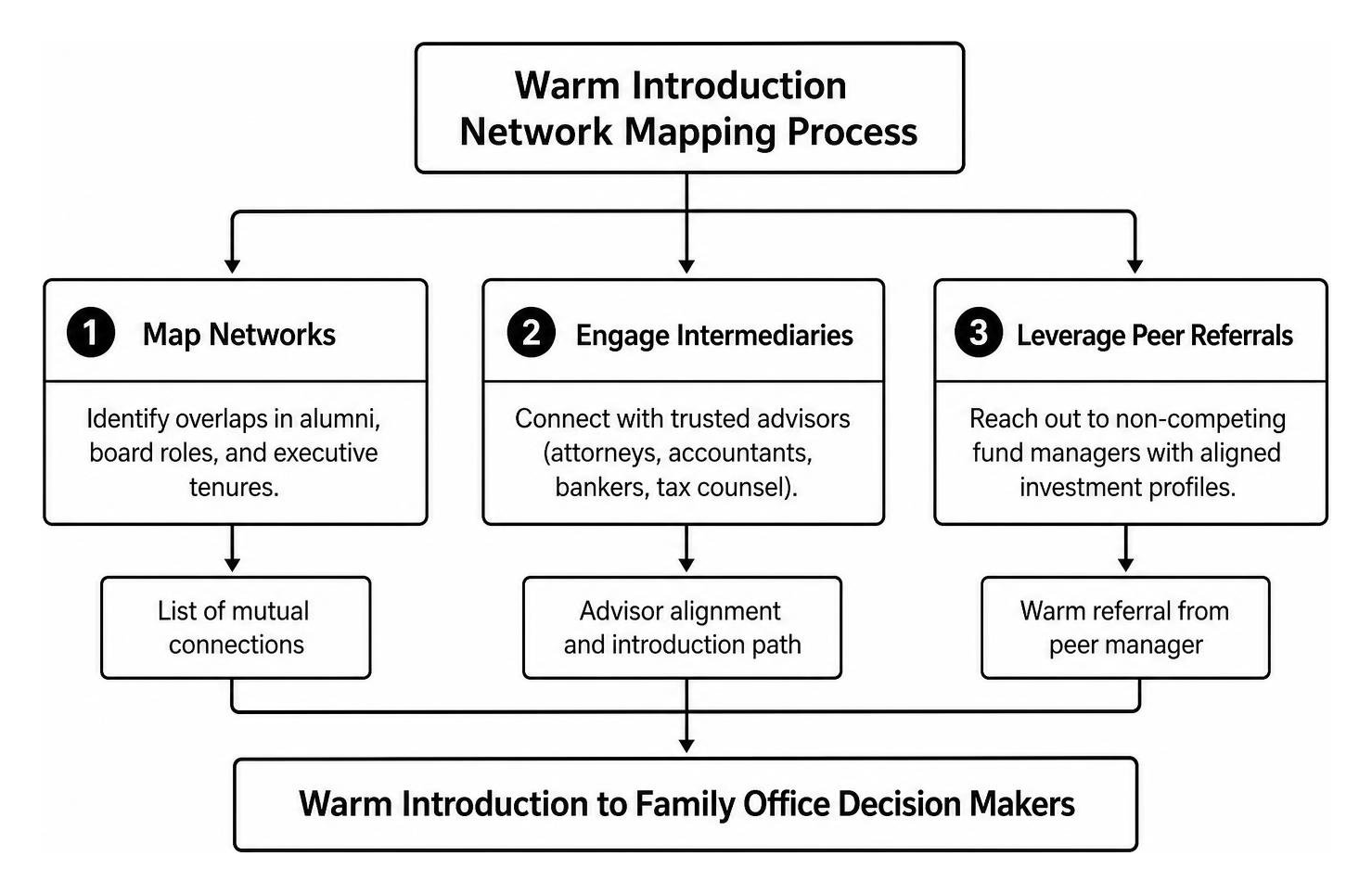
To build warm introduction pathways, managers should deploy relationship back-chaining:
- Map Mutual Alumni & Professional Networks: Use relationship mapping tools to uncover shared board positions, educational backgrounds, or executive tenures.
- Engage Trusted Intermediaries: Estate planning attorneys, specialized accountants, private bankers, and tax counsel are trusted gatekeepers for UHNW families. An introduction from a family's primary legal advisor carries instant credibility.
- Peer-to-Peer Fund Manager Referrals: Non-competing fund managers who share target investment profiles are outstanding sources of warm introductions.
As detailed in industry analyses on how to raise from family offices in 2026, spending time mapping connections prior to making contact yields vastly superior conversion rates.
At Jets & Capital, we facilitate these connections by hosting invite-only networking events in private jet hangars across key hubs like Las Vegas, Dallas, Palm Beach, Miami, New York, and San Francisco. By maintaining an 85% allocator ratio through strict vetting, fund managers engage directly with active principals in a comfortable, non-transactional environment.
Structuring Pitch Materials, Data Rooms, and Co-Investments

When pitching family offices, standard corporate pitch decks often fall flat. Family office principals quickly see through generic multi-billion-dollar market size projections and vague hockey-stick growth charts. Attracting family office capital requires institutional underwriting rigor paired with personal clarity.
To structure pitch presentations effectively, review technical guidance on attracting family office capital. Pitch decks must lead with clear underwriting mechanics, downside protection frameworks, net IRR sensitivity models, and transparent fee disclosures.
Your institutional data room should be prepared before initiating initial calls, containing:
- Comprehensive Private Placement Memorandum (PPM) and Limited Partnership Agreement (LPA).
- Multi-variable stress test scenarios illustrating portfolio performance under adverse economic conditions.
- Complete track record breakdowns highlighting historical DPI, TVPI, and realized cash distributions.
- Transparent fee architecture showing full alignment, including General Partner (GP) personal co-investment commitments.
- Frictionless onboarding compliance frameworks, including pre-vetted KYC/AML procedures and clear Schedule K-1 tax distribution schedules.
Adapting Pitch Decks for Family Office Capital Raising
To capture a family office CIO’s interest in the first 10 minutes, adapt your deck architecture using the BLUF (Bottom Line Up Front) approach:
- The Portfolio Gap & Strategic Fit: Start by addressing the exact macroeconomic challenge or portfolio gap your strategy solves for the family.
- Downside Moderation & Underwriting: Explain how capital is protected before discussing upside potential.
- Cash Flow & Distribution Timelines: Provide explicit timelines on capital call drawdown windows (typically 15-day funding windows) and projected cash-on-cash distribution milestones.
- Governance & Multi-Generational Alignment: Outline governance rights, Advisory Board representation, and reporting transparency.
Leveraging Co-Investments and Club Deals
If there is a single strategy that unlocks family office capital faster than any other, it is offering direct co-investments and club deals. Modern family offices increasingly favor direct deal participation over blind-pool fund commitments.
Data underscores this trend:
- Between 60% and 75% of family office transaction volume consists of club deals or co-investments.
- An astonishing 83% of family office startup and direct growth deals are structured as co-investments.
Why are co-investments so dominant? Co-investments give family offices direct asset control, reduced management fee friction, and the ability to leverage their internal operational expertise. Furthermore, insights on how to raise from family offices at pre-seed and seed emphasize that family offices view co-investments as an opportunity to evaluate a fund manager's deal execution skills firsthand.
Offering zero-fee or reduced-fee co-investment rights on live deals acts as an ideal entry point. Once a family office experiences your execution capabilities and receives prompt cash distributions on a deal-by-deal basis, committing capital to your primary fund becomes a seamless step. For complete structuring guidance, explore our Co-Investment Opportunities Complete Guide.
Operational Execution: Timelines, Cadence, and Avoidable Mistakes
Successfully closing family office LPs requires managing operational velocity and maintaining a consistent relationship cadence over extended timelines.
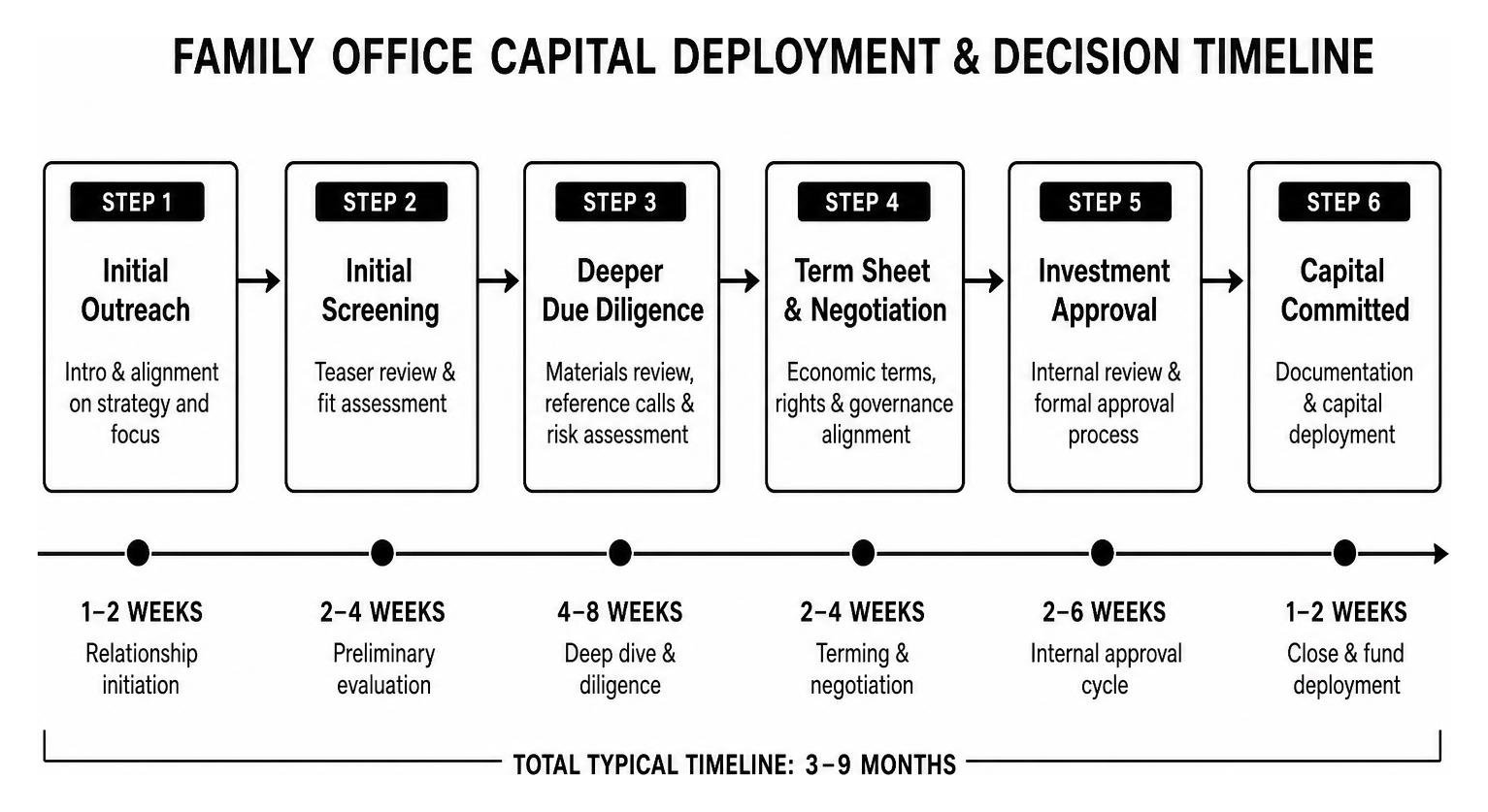
While single-family offices can close straightforward co-investments in 2 to 12 weeks, fund commitments frequently take 3 to 9 months of trust-building. 70% of LPs backing first-time funds are unincorporated individuals and family entities, whereas only 3% of first-time funds successfully raise capital from large institutional LPs. This makes family offices the single most important LP group for emerging fund managers.
Cheque sizes vary depending on office scale:
- Pre-Seed / Seed Direct Cheques: $100,000 to $500,000.
- Mid-Market Growth & Fund Commitments: $1 million to $5 million.
- Large SFO / MFO Direct Co-Investments: $5 million to $20 million+.
Long-Term Nurturing in Family Office Capital Raising
Raising capital from a UHNW Family Office relies on delivering consistent value deposits over time without constantly asking for money. Strategic relationship management involves a structured communication framework:
- Monthly Value Updates: Share brief, insightful updates containing market intelligence, proprietary thesis write-ups, or strategic introductions without asking for capital commitments.
- Quarterly Market Letters: Provide transparent commentary on sector trends, including deal discipline examples—such as highlighting high-profile deals your team deliberately passed on during the quarter due to valuation concerns.
- Annual Budget Season Strategy Calls: Schedule dedicated strategic updates during September and October. This aligns directly with family office annual budget planning when next year's capital deployment decisions are locked in.
As detailed in proven strategies for closing family office LPs, treating fundraising as continuous relationship nurturing converts prospective allocators into long-term partners.
Common Pitfalls That Result in Rejection
Even experienced fund managers make critical mistakes that lead to immediate rejection by family offices.
Avoid these common pitfalls:
- Cold Emailing Generic Pitch Decks: Sending unpersonalized blast emails to generic info@ inboxes destroys credibility instantly.
- Treating the Pitch as Transactional: Approaching family principals with aggressive hard-sell tactics or artificial urgency creates distrust.
- Aggressive or Premature Asset Markups: Over-optimistic portfolio valuation markups raise major red flags during due diligence. Modern LPs value realistic, conservative accounting over paper gains.
- Failing to Understand Governance Structure: Pitching the family principal directly while ignoring their professional CIO or legal counsel creates internal friction.
- Ignoring Downside Risks: Presenting zero risk analysis or failing to detail capital preservation mechanics indicates a lack of maturity.
- Cap Table Friction: Introducing exotic side letters, non-standard liquidation preferences, or complex fee arrangements creates legal barriers.
As explored in articles on the reality of family office fundraising, family offices prefer simplicity, clean term sheets, and operational integrity over complex financial engineering.
Frequently Asked Questions About Family Office Capital
What is the typical cheque size and timeline for family office investments?
Family office cheque sizes generally range from $100,000 to $500,000 for early-stage direct deals, and $1 million to $10 million+ for private equity funds, real estate ventures, or co-investment syndicates. Timelines vary by structure: Single-Family Offices with active principals can make decisions and close in 2 to 12 weeks, whereas Multi-Family Offices with formal investment committees typically require 1 to 3 months.
Why do family offices favor co-investments over fund commitments?
Family offices heavily favor co-investments (accounting for over 80% of direct startup and deal volume) because they offer direct asset visibility, greater strategic control, reduced management fee burdens, and flexible hold periods. Co-investments allow families to leverage their specific operating background while evaluating the deal-sourcing and underwriting capabilities of fund managers prior to making long-term fund commitments.
How do family offices differ from traditional institutional LPs?
Unlike institutional LPs (such as pension funds or university endowments) that operate on rigid 10-year fund lifecycles with multi-layered investment committees, family offices manage private balance-sheet wealth focused on multi-generational preservation. They offer flexible hold periods, patient capital without artificial exit deadlines, faster decision-making structures, and a strong preference for direct relationship alignment over rigid corporate frameworks.
Conclusion
Mastering family office capital raising requires shifting away from high-volume transactional outreach and embracing a disciplined playbook built on fit, downside protection, and long-term trust. By understanding the core mechanics of single and multi-family offices, leveraging intelligence tools for target qualification, securing warm introductions, and offering direct co-investment opportunities, fund managers can build enduring LP partnerships.
At Jets & Capital, we accelerate this relationship building by hosting premier, invite-only events in private jet hangars across top wealth destinations including Las Vegas, Dallas, Salt Lake City, Palm Beach, Miami, New York, and San Francisco. With our strict vetting process ensuring an 85% allocator presence, fund managers gain direct access to active decision-makers in an atmosphere designed for high-value deal-making.
Ready to connect with active family office allocators and transform your fundraising strategy? Explore our upcoming Capital Introduction Events and Deal Sourcing Events, or Explore Upcoming Events on the Calendar to join our exclusive network today.
