
The Art of Connection: How to Host Relationship Building Events

A relationship building event is a structured gathering designed to nurture authentic human connection, mutual respect, and long-term trust among participants. Rather than leaving interactions to chance, these events use intentional design, guided facilitation, and clear group agreements to help attendees skip superficial small talk and enter meaningful dialogue.
At its core, meaningful human connection rests on psychological safety—the shared belief that one can speak openly, share ideas, and take risks without fear of judgment or embarrassment. When organizations host thoughtful relationship building events, they establish a foundation of psychological safety that extends far beyond the venue walls.
Research indicates that employees are around 13% more productive when they are happy, and strong peer dynamics are a primary driver of workplace satisfaction. Furthermore, strategic organizational alignment relies on personal trust. When team members understand each other’s personal strengths, communication styles, and underlying motivations, cross-departmental friction decreases and execution speed accelerates. By discovering new business networking opportunities, leaders turn isolated professionals into cohesive, high-performing networks.
Designing Structured vs. Unstructured Relationship Building Events
The primary difference between a high-impact connection experience and a standard social gathering lies in intentional facilitation. Traditional open social gatherings—such as generic happy hours or unstructured mixers—often trigger performance anxiety. Left without guidance, attendees naturally default to speaking with existing acquaintances or engaging in repetitive, surface-level exchanges about job titles and the weather.
In contrast, structured connection containers, such as relational labs and facilitated mingles, employ proven group mechanics to eliminate awkwardness and lower social barriers.
| Feature | Traditional Unstructured Gatherings | Facilitated Connection Containers |
|---|---|---|
| Social Dynamics | Attendees cluster with familiar peers; high social anxiety for newcomers. | Rotating small groups ensure balanced participation and equal voice. |
| Depth of Dialogue | Default to transactional small talk (job titles, weather, elevator pitches). | Guided prompts encourage active listening and personal sharing. |
| Psychological Safety | Organic and variable; non-inclusive dynamics can easily emerge. | Guarded by clear ground rules, explicit consent, and expert facilitators. |
| Outcome | Shallow cards exchanged; low post-event relationship retention. | Genuine rapport formed; high trust and sustained ongoing contact. |
Core Types of Connection Formats Across Audiences
Connection strategies vary based on the specific group being brought together:
- Workplace Team Workshops: Focused on collaborative problem-solving, role appreciation, and breaking down departmental silos through experiential exercises.
- Student Talking Circles: Designed to cultivate peer empathy, active listening, and social-emotional growth, creating safe environments where students can seek help and take intellectual risks.
- Romantic Couple Connection Games: Structured exercises using conversational jars, shared goal-setting matrices, and gratitude rituals to deepen intimacy and long-term resilience.
- Executive Co-Founder and Investor Speed Matching: Highly targeted formats utilizing rapid candidate pitches, custom skill-matching name tags, and curated discussion tables to build strategic alignment among leaders.
Essential Pillars of Successful Event Design
Hosting an impactful relationship building event requires deliberate execution across four key pillars:

- Clear Shared Intentions: Establish explicit group goals before the gathering begins. Whether the objective is solving an organizational bottleneck or exploring co-investment alignment, setting a collective purpose aligns participant expectations.
- Venue Atmosphere Curation: The physical environment dictates emotional posture. Select unique, inspiring venues—such as private jet hangars, curated art studios, or secluded outdoor retreats—with low ambient noise and comfortable seating arrangements that encourage open dialogue. Accessing exclusive member events offers inspiration for setting high-caliber atmospheres.
- Curated Participant Qualification: True chemistry requires complementary mindsets and mutual alignment. Vetting attendees based on expertise, contribution mindset, and commitment levels ensures a balanced room where every voice adds value.
- Active Listening Models: Embed explicit conversational frameworks, such as structured pause times and direct eye contact exercises, to shift participants from formulating responses to deeply understanding one another.
Fostering Psychological Safety and Inclusivity
Without robust psychological safety, structured connection exercises risk feeling forced or invasive. Event hosts can establish a safe, inclusive environment by applying these proven operational guidelines:
- Explicit Group Agreements: Open every session by setting core boundaries: complete confidentiality, non-judgmental presence, and strict prohibition of direct sales pitches or aggressive networking behaviors.
- Optional Participation Models ("Challenge by Choice"): Always grant participants full agency to pass on any prompt or activity. Knowing they retain complete control over their level of disclosure lowers fight-or-flight nervous system responses.
- Inclusive Prompt Design: Craft conversational prompts that respect diverse cultural, economic, and personal backgrounds. Avoid assumption-heavy questions regarding family origins or financial status.
- Trauma-Informed Facilitation & Emotional De-Escalation: Facilitators must monitor room energy continuously. If a prompt triggers distress, de-escalate gently by offering immediate short breaks, shifting to lighter collaborative topics, and modeling grounded, calm emotional regulation.
The Role of Icebreakers and Guided Conversation Prompts
Icebreakers often get a bad reputation when they feel silly or disconnected from purpose. However, when designed intentionally, guided prompts break transactional habits and build immediate bridges.
For example, using curated questions inspired by the famous "36 Questions That Lead to Love" framework helps attendees transition rapidly from operational roles to shared personal values. Similarly, implementing "Social Shuffle" mechanics—where participants rotate through small groups of three for 15-minute guided rounds—ensures that no single individual dominates the conversation.
Physical prompt menus placed directly on seating tables give participants permission to bypass small talk and explore meaningful themes like personal inspirations, overcome challenges, and long-term visions.
Practical Frameworks and Activities for Team and Executive Bonding
To make relationship building memorable, integrate experiential activities that balance playful engagement with structured debriefing.
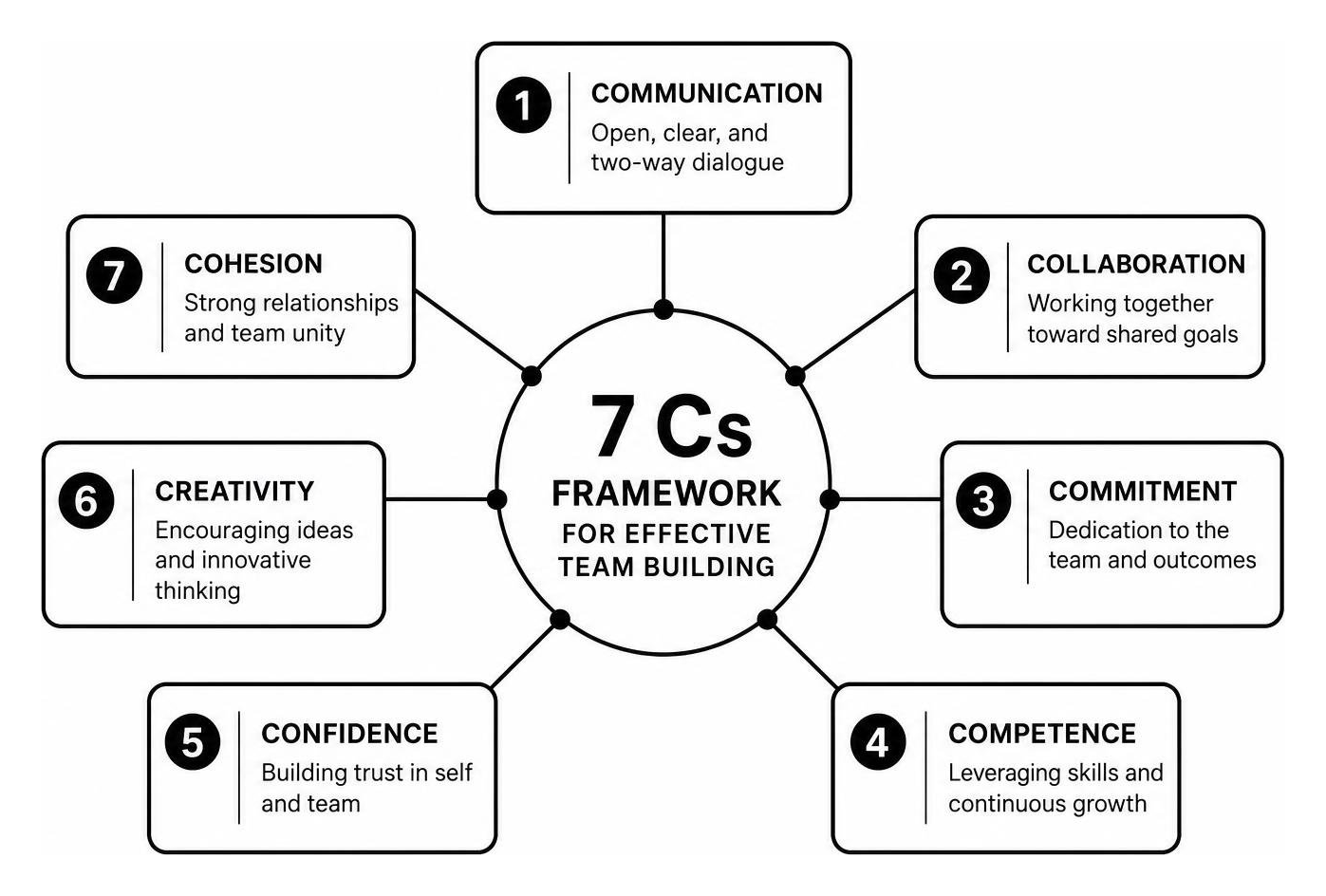
A successful corporate activity strategy relies on the 7 Cs Framework: Communication, Collaboration, Commitment, Competence, Confidence, Creativity, and Cohesion. Implementing this framework through experiential challenges allows leaders to observe organic team dynamics, problem-solving habits, and leadership potential in real time.
High-Impact Facilitated Activities for Corporate Teams
When planning team-building sessions, combine various activity types to target different collaborative skills:
- The Marshmallow Challenge: Small teams construct the tallest freestanding structure using spaghetti, tape, string, and a marshmallow within 18 minutes. This rapid exercise highlights iterative design, rapid prototyping, and non-hierarchical collaboration.
- Problem-Solving Escape Games: Teams work under strict time bounds to decrypt complex puzzles, directly fostering strategic communication and peer trust under pressure.
- Talking Circles & Restorative Repair Circles: Participants pass a physical talking piece around a circle to share unedited perspectives on organizational milestones or work challenges without interruption, building empathy and impulse control.
- Micro-Appreciation Circles: Teammates offer direct, process-focused praise to peers (e.g., "I value how you stayed calm and found a solution during last week's deadline"), creating a strong culture of peer recognition.
- Non-Verbal Coordination Games: Exercises like the Silent Birthday Lineup require participants to arrange themselves chronologically without speaking, sharpening non-verbal awareness and team intuition.
Adapting Relationship Building Events for High-Stakes Professional Audiences
High-net-worth investors, family office allocators, and C-suite executives require a tailored approach to relationship building. Sophisticated professionals are often weary of traditional networking formats and demand understated, high-value experiences.
When hosting executive audiences, replace standard games with bespoke experiential formats. Executive intimacy labs, hosted in exclusive private venues, utilize curated peer-to-peer alignment discussions around capital allocation strategies, legacy building, and macroeconomic trends.
Applying smart seating algorithms—where attendees are seated next to complementary decision-makers based on pre-event survey data—ensures every interaction yields immediate strategic relevance. Reviewing tailored C-suite networking tips for 2026 offers further strategies for optimizing executive-level gatherings.

Overcoming Common Challenges in Event Organization
Even well-conceived events encounter operational hurdles. Here is how top event organizers address common friction points:
- Mitigating Social Awkwardness: Eliminate initial entry anxiety by providing gamified arrival missions or assigning designated hosts to welcome arriving guests and connect them immediately with small, welcoming clusters.
- Managing Pushback Against Forced Participation: Frame every exercise through a clear "why." When attendees understand how a relational lab directly improves communication efficiency and deal quality, resistance turns into active engagement.
- Optimizing Venue Acoustics & Space Layout: Heavy background music, echo-prone concrete spaces, and cramped seating ruin conversation flow. Select acoustically padded environments, utilize soft ambient lighting, and arrange seating in flexible clusters rather than rigid classroom rows.
- Preventing Post-Event Connection Drop-off: The real value of an event takes root in the weeks following it. Implement post-event double opt-in matchmaking systems, where organizers connect participants only when both parties express mutual interest in continuing the conversation. Maintaining post-event digital communication groups (such as private messaging channels) helps sustain relational momentum long after the event wraps up.
Frequently Asked Questions About Relationship Building Events
How do structured connection labs differ from standard social happy hours?
Structured connection labs are facilitated environments guided by clear ground rules, trained moderators, and purposeful conversation frameworks. Unlike standard happy hours, where guests drift aimlessly and default to superficial elevator pitches, connection labs eliminate sales pressure and prioritize vulnerability, active listening, and genuine human alignment.
What is the ideal frequency for holding workplace relationship building events?
Optimal relational health requires a continuous rhythm rather than one-off annual events. We recommend integrating daily micro-habits (such as 2-minute morning gratitude check-ins), monthly facilitated peer circles, and quarterly off-site experiential retreats. Steady consistency builds sustained psychological safety far better than rare, grand gestures.
How can event organizers measure the return on investment of connection events?
Event ROI can be evaluated through both qualitative and quantitative metrics:
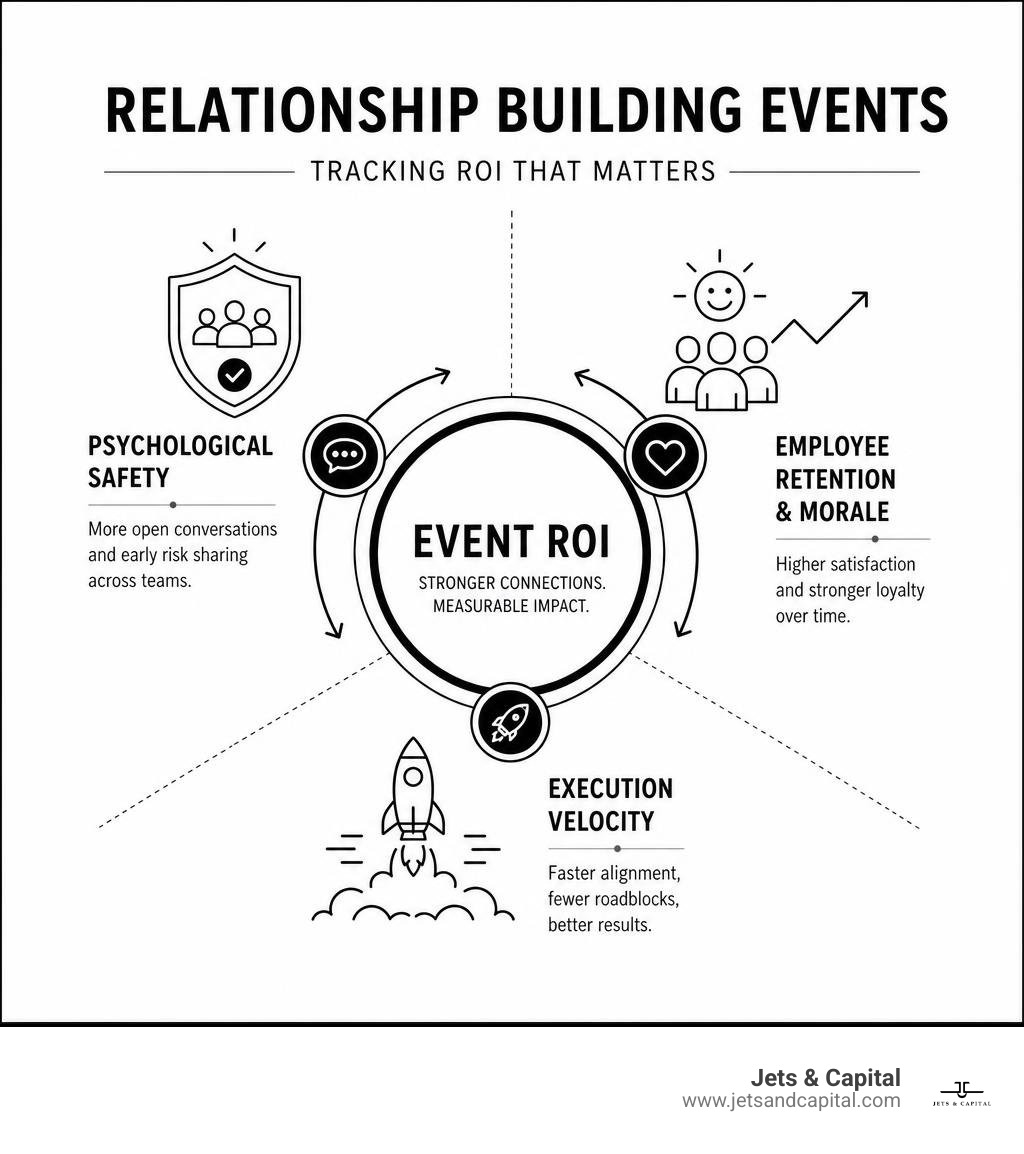
- Psychological Safety Indicators: Measuring increases in voluntary cross-departmental communication and willingness to report operational risks early.
- Employee Retention & Morale: Tracking reduction in staff turnover and increases in employee satisfaction scores following structured connection programs.
- Execution Velocity: Observing how quickly teams resolve internal conflicts and execute joint projects after participating in trust-building retreats.
Conclusion

Building strong professional connections is an art rooted in intentional gathering design, psychological safety, and curated facilitation. By moving past surface-level small talk and hosting structured relationship building events, organizations and executive networks unlock unprecedented levels of trust, collaboration, and long-term resilience.
At Jets & Capital, we apply these precise principles to host exclusive, invite-only gatherings for family offices, institutional investors, and UHNWIs in private jet hangars across key hubs like San Francisco, Miami, Dallas, New York, Las Vegas, Salt Lake City, and Palm Beach. Through a rigorous vetting process that ensures an 85% allocator presence, we eliminate transactional noise and cultivate an environment built for high-level deal flow and lasting partnerships.
Ready to experience a modern benchmark for executive relationship building? Attend our premier relationship building events and connect with an elite peer network designed for long-term growth.
