
Ultimate Checklist for Event Sponsorship Opportunities
Why Event Sponsorship Is One of the Most Powerful Tools in a Smart Marketing Strategy

Event sponsorship is a business arrangement where a company provides financial or in-kind support to an event in exchange for promotional benefits — think brand visibility, audience access, and lead generation.
Here's a quick breakdown of what it involves:
| Element | What It Means |
|---|---|
| What it is | A company funds or supports an event in exchange for exposure and access |
| Who uses it | Corporations, family offices, financial firms, consumer brands |
| Key benefits | Brand visibility, lead generation, thought leadership, audience alignment |
| Common formats | Tiered packages (Title, Premier, Select), custom activations, in-kind support |
| How it differs from charity | Sponsorship expects a business return; philanthropy does not |
| Tax treatment | Often deductible when there is a clear promotional intent and business nexus |
It's not just about slapping a logo on a banner. Done well, event sponsorship connects your brand with exactly the right people at exactly the right moment — whether that's 6,500 global changemakers at an international conference or 1,000 senior sales executives at a private corporate retreat.
And the numbers back this up. In some of the world's largest flagship events, 90% of attendees found sponsor sessions valuable — a signal that sponsorship, when executed strategically, delivers real impact for both sides.
But most guides treat sponsorship as a generic marketing tactic. For high-net-worth investors and family offices, the stakes — and the standards — are much higher.
I'm Jordan Hutchinson, founder of Jets & Capital, where I design exclusive event sponsorship experiences for family offices and high-net-worth investors at venues like private jet hangars, Formula 1 races, and Mar-a-Lago. With a background spanning private equity, capital raising, and elite event production, I've seen what separates a forgettable sponsorship from one that generates real deal flow.
What is Event Sponsorship and Why Does It Matter?
At its core, event sponsorship is a highly strategic marketing partnership. It is a mutually beneficial agreement where a sponsor provides funding, products, or services to an event organizer, and in return, receives tangible business assets. These assets typically include direct access to a highly targeted audience, brand visibility, and direct lead generation opportunities.
Unlike transactional advertising, event sponsorship allows brands to integrate themselves directly into the attendee experience. When a company sponsors a major industry gathering, they aren't just buying ad space; they are buying association, trust, and community goodwill.

For instance, major technology brands rely heavily on live environments to demonstrate complex products. You can Learn more about Microsoft Event Sponsorships to see how global brands leverage massive physical and digital footprints to drive business impact, proving that live engagement remains a cornerstone of enterprise growth.
Key Benefits for Corporate Sponsors
For corporate sponsors, the motivations to invest in an event go far beyond simple logo placement. The primary drivers include:
- Thought Leadership: Presenting on main stages, hosting panel discussions, or leading specialized workshops positions your executives as industry authorities.
- Targeted Audience Access: Sponsors can bypass traditional digital noise and speak directly to decision-makers, whether they are enterprise software buyers, developers, or high-net-worth allocators.
- Quantifiable Marketing ROI: Modern events offer sophisticated tracking, from lead scanners to digital session registrations, giving sponsors a clear view of their pipeline impact.
- Deep Brand Integration: Rather than static signs, sponsors can host interactive lounges, charge stations, or VIP receptions that build memorable brand associations.
To see how premium enterprise events structure these high-impact integrations, you can Read about Atlassian Team '26 Sponsorship opportunities, which show how brands utilize custom-tiered packages to capture maximum mindshare.
Aligning Brand Values with Event Demographics
The secret to a successful sponsorship lies in demographic matching. A sponsor’s target customer profile must align almost perfectly with the event's attendee base. If a financial firm specializing in estate planning sponsors a college hackathon, the demographic mismatch will likely result in zero ROI.
Furthermore, corporate social responsibility (CSR) plays a massive role in modern brand alignment. Today’s businesses prefer to sponsor events that reflect their cultural and ethical values. Niche marketing through highly curated events allows brands to foster deep, authentic audience engagement that broad-market advertising simply cannot replicate.
Eligible vs. Ineligible Events for Corporate Support
Not every event is a prime candidate for corporate sponsorship. While local community groups and global enterprises both seek funding, corporate sponsors and foundations have strict criteria regarding what they will and will not support.
Generally, eligible events must offer clear, measurable promotional benefits or align directly with a company's community development mandates. Ineligible events are typically those that lack a broad promotional platform, carry high reputational risk, or are highly exclusionary.
| Eligible Event Types | Ineligible Event Types |
|---|---|
| One-day fundraising galas for registered charities | Multi-day internal corporate training workshops |
| Industry-specific conferences and tradeshows | Private family reunions or personal milestones |
| Community engagement festivals and cultural initiatives | Events with political or highly partisan agendas |
| Large-scale athletic races and golf tournaments | Low-visibility, closed-door local club meetings |
| Professional development seminars and summits | Events that discriminate based on protected classes |
High-Net-Worth and Investor Gatherings
For businesses targeting ultra-high-net-worth individuals (UHNWIs) and single-family offices, standard conferences simply do not work. These elite allocators avoid crowded convention centers. Instead, they gather at highly private, invite-only environments designed for deal sourcing, capital preservation, and relationship building.
At Jets & Capital, we specialize in exactly these environments. We curate exclusive Family Office Events and Investor Networking Events where the room is strictly vetted to ensure an 85% allocator ratio.
For sponsors looking to showcase investment opportunities, participating in targeted Capital Introduction Events or Alternative Investment Events is the gold standard. These gatherings often take place alongside Private Aviation Events and Luxury Lifestyle Events in major hubs like Miami, Palm Beach, San Francisco, and New York, offering a seamless blend of high-end hospitality and serious business.
Sponsoring these high-caliber Deal Sourcing Events or Capital Markets Events gives sponsors direct, unhurried access to the world’s most private capital.
Community and Local Impact Events
On the other end of the spectrum are community and local impact events. These are organized by neighborhood groups, local non-profits, or municipal entities to drive regional outreach and community development.
These events are highly attractive to regional banks, local retail chains, and service providers looking to build local goodwill. For example, a local bank sponsoring a community park cleanup or a neighborhood cultural festival in Dallas, Las Vegas, or Salt Lake City is looking to build brand trust within their immediate geographic footprint.
Step-by-Step Guide to Securing and Pricing Sponsorship Packages
Securing corporate sponsors requires a structured, professional approach. You cannot simply build a generic PDF deck, blast it to hundreds of info@ corporate email addresses, and hope for the best.
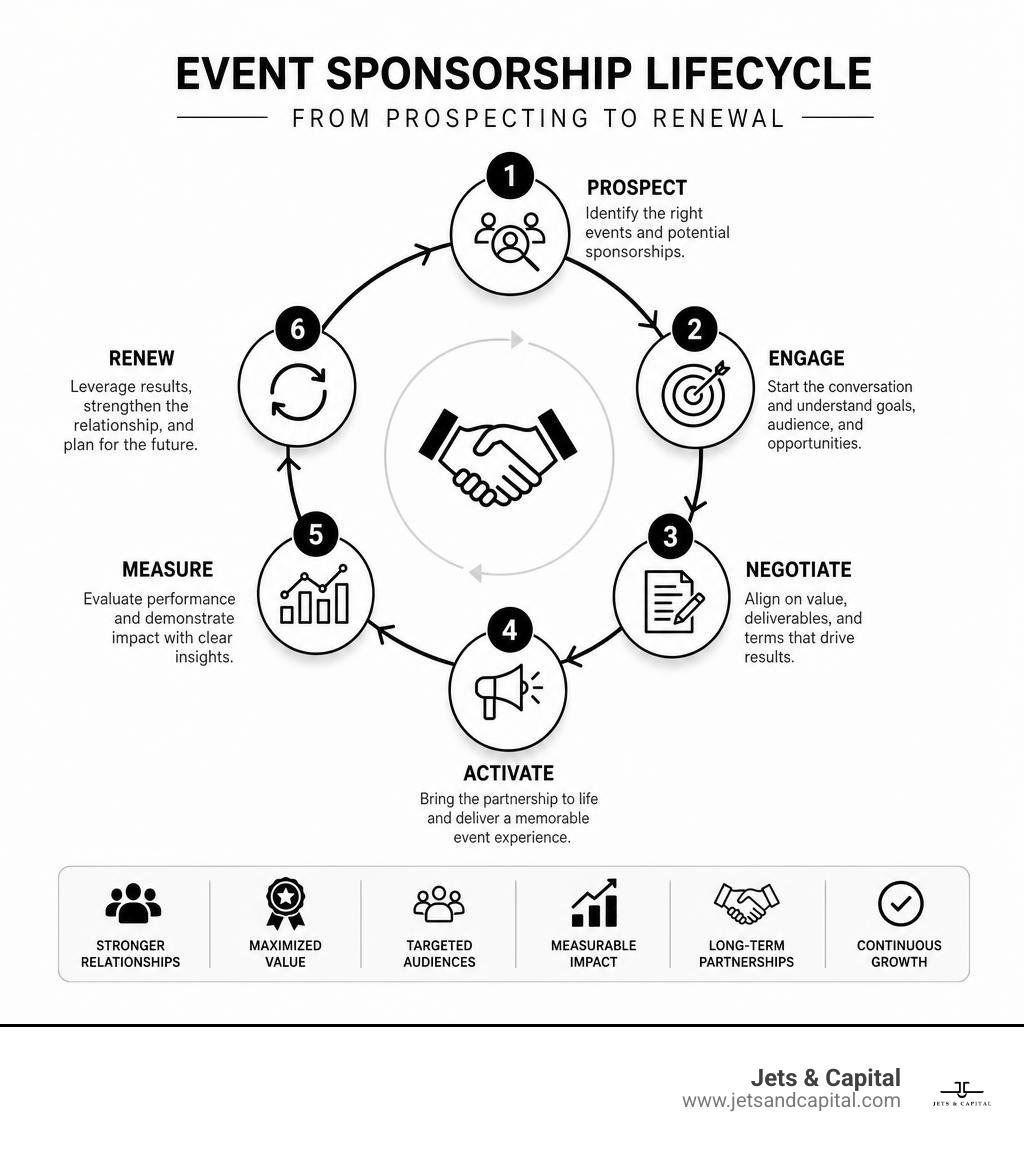
The sponsorship sales process is a relationship-driven cycle that spans eight distinct stages:

- Inventory Building: Document every single asset your event has to offer (e.g., physical signage, digital logo placement, speaking slots, email newsletter features, VIP passes).
- Valuation: Assign a fair market value to each asset based on your audience size, demographic quality, and the cost to deliver the benefit.
- Prospecting: Research and build a highly targeted list of potential sponsors whose target audiences align with your attendees.
- Initial Meeting: Meet with the prospect without presenting a proposal. Use this time exclusively to ask discovery questions and understand their marketing and business goals.
- The Proposal: Create a customized, highly tailored proposal that directly addresses the specific goals the prospect shared during your initial meeting.
- Activation: Work closely with the sponsor to deliver every promised asset leading up to and during the event.
- Fulfillment: Document the delivery of every asset in real-time (take photos, gather screenshots, track click-through rates).
- Renewal: Present a comprehensive post-event report and discuss extending the partnership for the following year while the excitement of the event is still fresh.
Designing High-Value Event Sponsorship Packages
The traditional "Gold, Silver, Bronze" tiered packages are largely outdated. Modern sponsors expect flexibility and custom activations that align with their unique brand objectives.
When structuring your packages, focus on high-impact physical and digital integrations. To see an incredibly elegant example of a flexible, asset-light structure, you can Explore GitHub Sponsorship opportunities designed for their sales kickoffs, which rely on a core package paired with high-value, customizable add-ons like branded meeting pods, digital display towers, and interactive lounges.
Approaching Potential Corporate Sponsors
When approaching corporate sponsors, leverage multiple channels for outreach. Many large enterprises require all applications to go through their formal corporate social responsibility (CSR) portals. However, for mid-sized businesses and local firms, utilizing board connections and personal introductions is far more effective.
Before reaching out, conduct thorough prospect research to understand the company's current giving priorities, target markets, and past sponsorship history. Your personalized pitch should focus entirely on their goals, not your funding needs.
For a masterful example of how to present complex, high-value sponsorship opportunities to global brands, you can Review the Women Deliver WD2026 Sponsorship Brief, which beautifully illustrates how to align corporate goals with global advocacy and impact.
Measuring ROI and Navigating Tax Implications
In modern event management, the work is not finished when the last attendee leaves the venue. Sponsors demand rigorous post-event reporting that proves their marketing ROI.
To build a flawless fulfillment report, you must track and measure key performance indicators (KPIs) throughout the event lifecycle:
- Lead Collection: Total number of qualified leads captured via digital scanners or physical activations.
- Brand Exposure: Total impressions across physical signage, mobile apps, and digital screens.
- Social Media Metrics: Hashtag reach, mentions, impressions, and engagement rates across platforms.
- Session Attendance: The total number of attendees who participated in the sponsor’s speaking sessions or workshops.
Tax Deductibility Rules for Event Sponsorship
For corporate sponsors, the tax treatment of their sponsorship expenditure is a critical financial consideration. Generally, for a sponsorship payment to be tax-deductible, there must be a clear promotional intent and a direct nexus to income-earning activities.
If a business sponsors an event to advertise its products and generate sales, the IRS and other major tax authorities typically allow the expenditure to be fully deducted as an ordinary and necessary business expense. However, there are strict limitations to keep in mind:
- The Private Limitation: If the sponsorship provides a direct, non-business personal benefit to the business owners or their families, that portion of the expense is non-deductible.
- The Capital Limitation: If the sponsorship is used to acquire a long-term capital asset, it must be depreciated over time rather than deducted immediately.
- Entertainment Expenditure Rules: If your sponsorship package includes corporate hospitality boxes, high-end dinners, or tickets to sporting events, tax laws may limit the deductibility of those specific entertainment expenses to 50%.
To dive deeper into how tax authorities analyze these arrangements, you can Read the IS 26/10 Income Tax Guidelines, which offer a comprehensive look at the legal boundaries between tax-deductible promotional expenses and non-deductible philanthropic giving.
Post-Event Reporting and Retention
The key to long-term sponsor retention is speed and transparency. You should deliver your comprehensive fulfillment report within 14 days of the event ending.
Use this report as the foundation for your renewal conversations. Schedule a debrief meeting to gather direct sponsor feedback, review the impact metrics, and pitch a multi-year partnership while the positive momentum of the event is still fresh in their minds.
Common Pitfalls and Resources for Organizers
Securing and managing sponsorships is a complex process, and organizers frequently fall into easily avoidable traps. The most common pitfalls include sending generic, un-customized proposals, failing to communicate regularly with sponsors leading up to the event, and failing to deliver on promised assets.
To protect both your organization and your sponsors, you must establish clear legal protections. Never rely on verbal agreements. Always utilize a formal, written contract that clearly outlines the grant of rights, payment schedules, intellectual property usage, exclusivity clauses, and force majeure terms.
You can Review the SPECIFIC EVENT SPONSORSHIP AGREEMENT template to understand how to legally structure these protections to safeguard your event.
Essential Tools and Platforms
To manage sponsorships efficiently at scale, leverage modern event technology. Utilizing professional grants management and CRM platforms allows you to track pipeline progress, manage deliverables, and streamline communication.
For instance, many large corporate foundations and sponsors have transitioned their application processes to centralized platforms like Blackbaud GrantsConnect to manage their giving pipelines.
Additionally, if your organization is a grassroots group or lacks registered non-profit status, you can utilize Fiscal Sponsorship resources to legally partner with established non-profits, allowing you to accept tax-deductible corporate sponsorships and grants seamlessly.
Frequently Asked Questions about Event Sponsorships
What is the difference between event sponsorship and corporate philanthropy?
The primary difference lies in promotional intent. Corporate philanthropy consists of charitable donations given to a cause with no expectation of commercial return or business benefit. These are typically processed as tax-deductible charitable donations.
In contrast, event sponsorship is a commercial marketing expense. The sponsor provides funding in exchange for specific promotional assets, brand visibility, and audience access, expecting a measurable business return on their investment.
How should event organizers price their sponsorship tiers?
Sponsorship pricing should be based on asset valuation and market demand, not your event's budget deficit. Calculate the fair market value of each individual asset (e.g., the value of an email blast to 10,000 subscribers, physical signage in a high-traffic area, or VIP tickets).
Factor in the direct delivery costs of those assets, the quality and exclusivity of your audience, and what comparable events in your market charge for similar exposure.
When is the best time to ask for a sponsorship renewal?
The absolute best time to ask for a renewal is during your post-event debrief meeting, typically 10 to 14 days after the event.
Present your highly detailed fulfillment report proving that you delivered on every promise. While the sponsor is celebrating the success of the event and seeing the visual proof of their brand integration, ask to lock in their spot for next year before their annual corporate budgeting cycle closes.
Conclusion
Securing high-impact event sponsorship is about building deep, mutually beneficial partnerships. Whether you are organizing a massive corporate conference or hosting exclusive, ultra-private investment summits, the principles remain the same: understand your sponsor's goals, deliver exceptional value, and protect the relationship with rigorous execution and legal clarity.
At Jets & Capital, we pride ourselves on creating these high-quality deal-making environments. We curate private, invite-only gatherings designed specifically for family offices, institutional allocators, and luxury brands to connect and build lasting relationships.
If you are looking to elevate your brand presence among the world's most elite private investors, we invite you to partner with us. You can apply to Sponsor our upcoming high-net-worth gatherings, secure your Tickets for our next exclusive experience, or explore our Blog for more expert insights on high-end capital raising and elite event production.
Whether you join us in New York, Miami, or San Francisco, we look forward to helping you build relationships that drive real, lasting value.
