
Why Private Bedrooms Are Becoming Essential for Modern Corporate Travel
Why Corporate Jet Bedrooms Are Essential for Long-Haul Travel
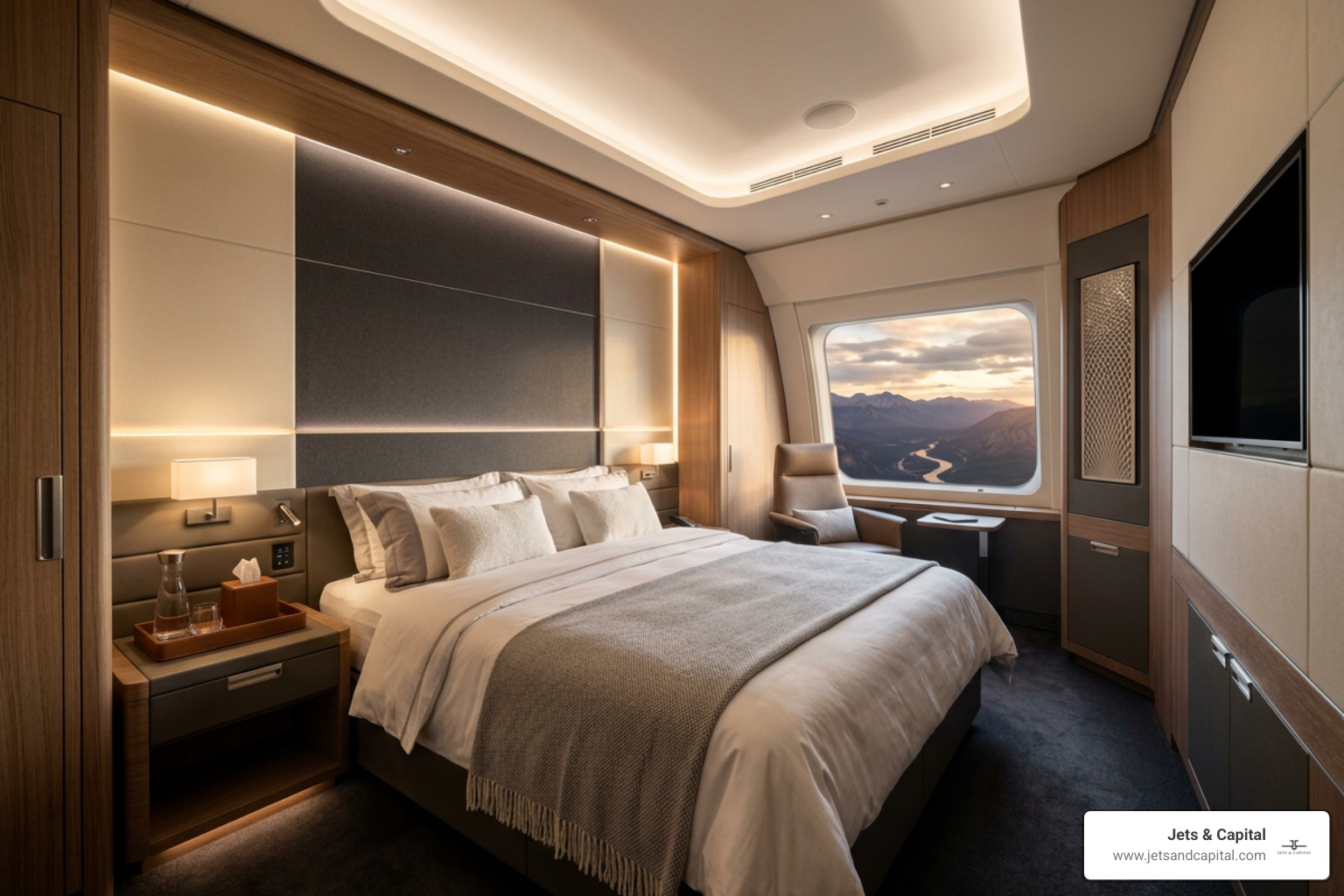
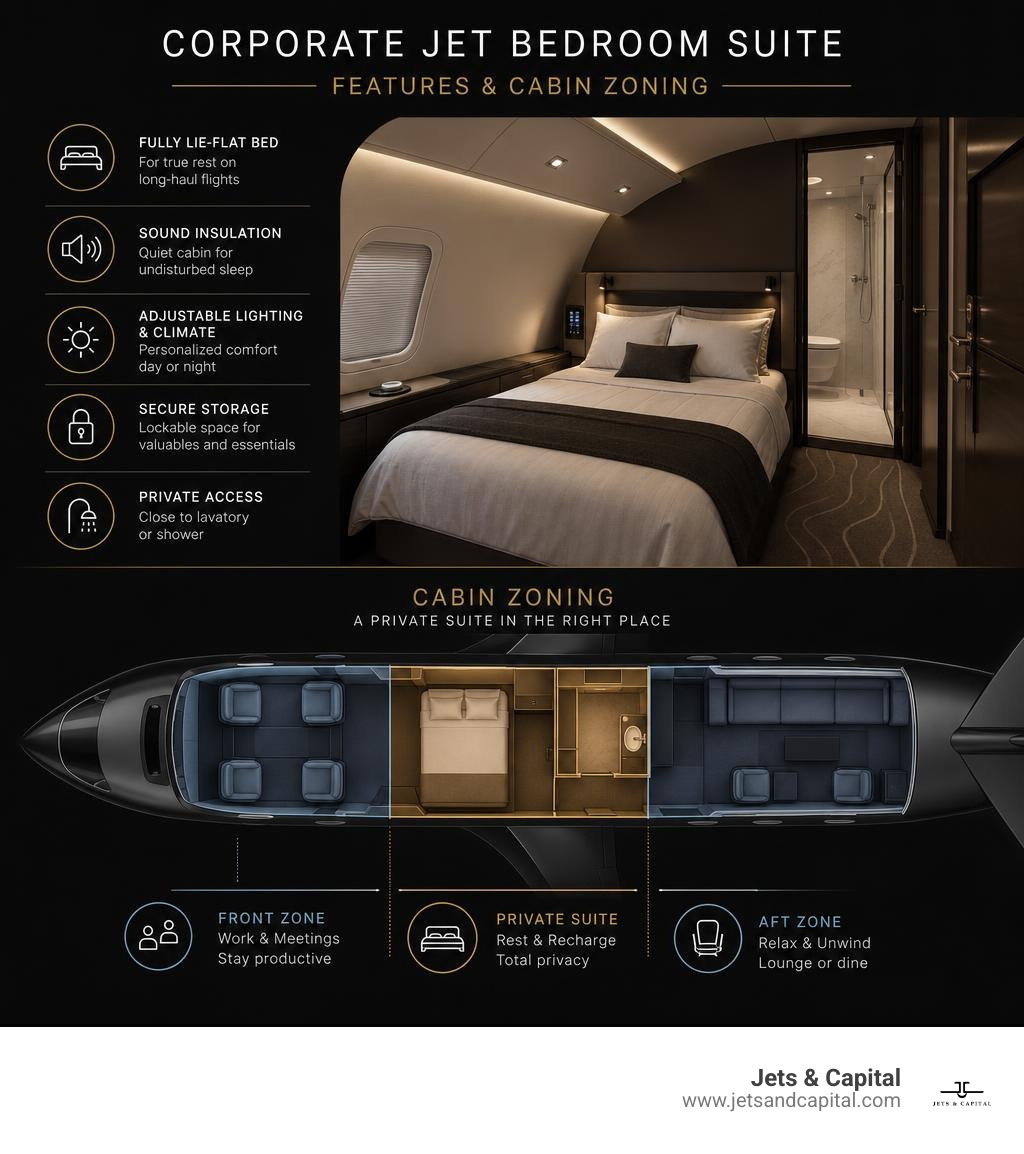
Corporate jet bedrooms turn long flights into usable recovery time. The best layouts combine a real bed, strong sound insulation, adjustable lighting and climate controls, secure storage, and access to a nearby lavatory or shower. For overnight and ultra-long-range trips, a dedicated suite can help executives arrive rested, private, and ready for the next meeting.
A sleeping suite is not simply a luxury upgrade. It is a cabin-planning choice: space given to a permanent bedroom cannot also serve as a conference room or lounge. The aircraft in this roundup show where that trade-off makes sense, from purpose-built staterooms in ultra-long-range business jets to larger VIP airliners designed more like mobile residences.
I am Jordan Hutchinson, founder of Jets & Capital, where I bring together family offices and high-net-worth leaders in curated aviation and investment settings. My work around private aviation and executive travel informs this look at how corporate jet bedrooms can support privacy, performance, and better use of time in the air.
The Evolution of Rest at 40,000 Feet: Why Private Suites Matter
Business aviation has moved far beyond club seating and fold-flat divans. When crossing twelve time zones on nonstop itineraries between financial hubs like New York, San Francisco, London, and Tokyo, sleep quality directly impacts executive cognitive performance. Prolonged exposure to dry cabin air, persistent low-frequency engine vibration, and fluctuating acoustic spikes elevates cortisol levels, disrupts deep REM sleep cycles, and accelerates physical exhaustion.
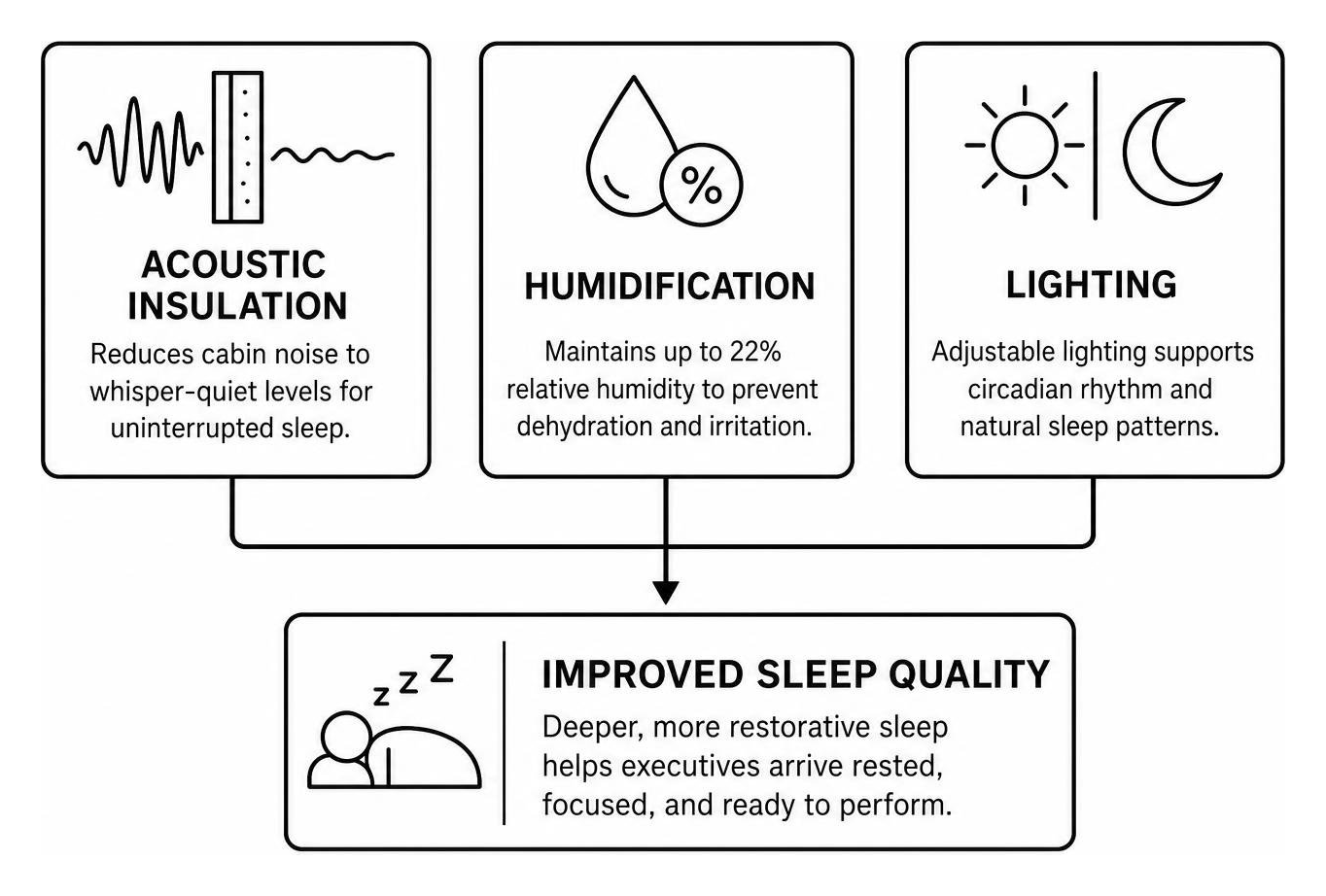
To counteract these physiological stresses, the modern inside private jet bedroom is engineered from the structural frame inward to deliver hospital-grade rest environments. Advanced acoustic dampening techniques bring ambient noise down to between 48 and 54 dB—whisper-quiet levels that mirror a peaceful suburban residence at night. When combined with active cabin humidification systems that maintain up to 22% relative humidity and lower cabin pressure altitudes (often regulated between 2,900 and 4,800 feet), passengers avoid the typical dehydration, headaches, and respiratory strain associated with extended flight times.
Complete executive privacy is anchored by dedicated en-suite washrooms, full-height privacy partitions, and closing architectural doors. Rather than stepping into a shared aisle to prepare for an early-morning arrival, leaders can transition seamlessly from deep rest to board-ready attire within their own private sanctuary, complete with lighted vanities, garment wardrobes, and optional stand-up showers.
The Productivity ROI for Global Leadership Teams
For senior executive teams, private equity partners, and family office principals, private sleeping staterooms are high-return operational assets rather than mere indulgences. Restorative sleep preserves circadian rhythm stability during high-stakes transpacific or transatlantic journeys. Arriving fully refreshed eliminates the standard 24-hour recovery buffer previously required before critical negotiations, directly condensing multi-city tour schedules and maximizing time efficiency.
Furthermore, private suites function as isolated tactical offices at altitude. Executive leadership can conduct sensitive, market-moving negotiations, review confidential acquisition documents, or engage in encrypted satellite communications entirely shielded from support staff, guest travelers, and flight crews.
Top Aircraft Models Redefining In-Flight Suites
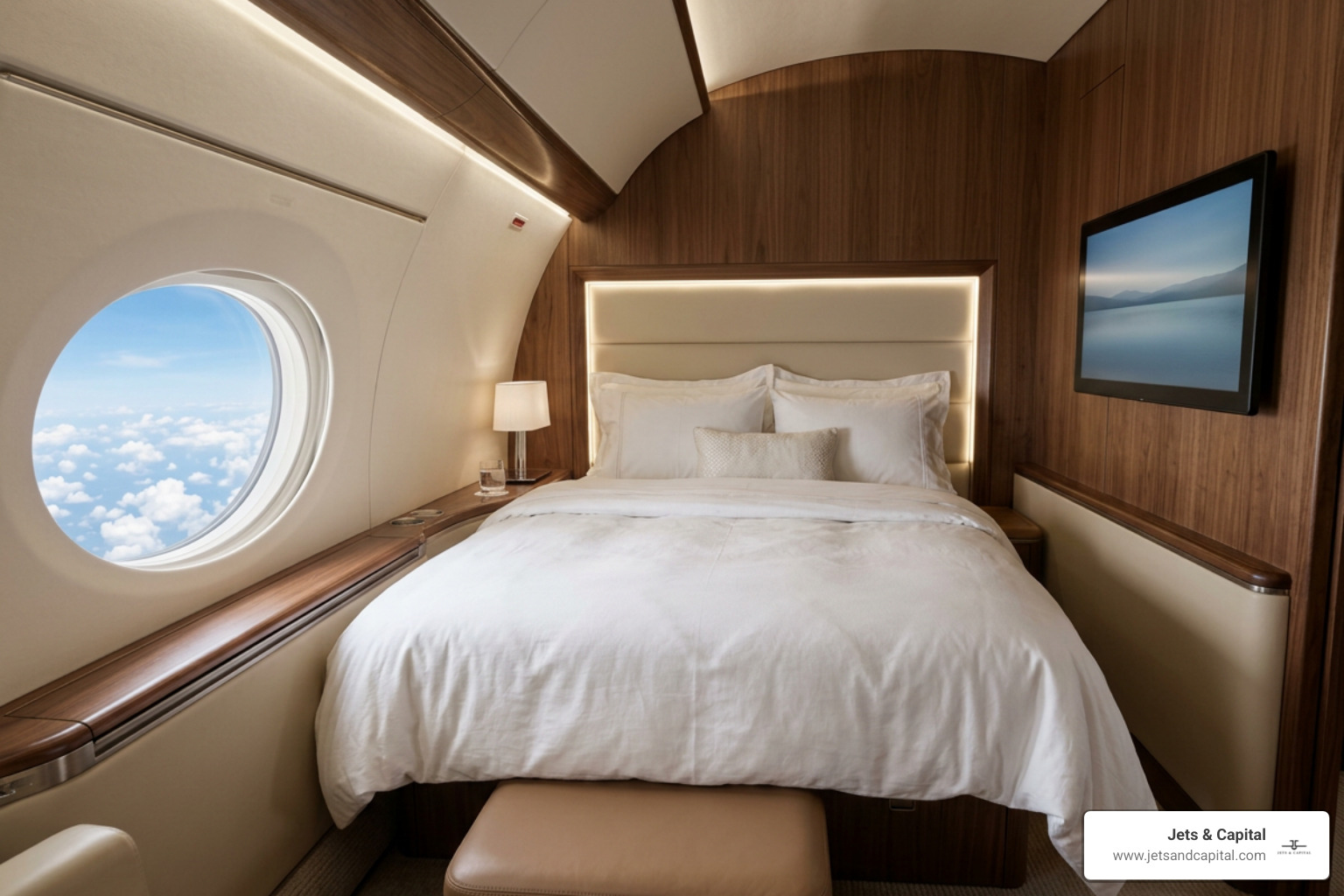
Dedicated sleeping staterooms require thoughtful spatial compromises. Cabin designers must carefully allocate fuselage volume between communal conference spaces, dining zones, galleys, and rest sanctuaries. The leading options span purpose-built ultra-long-range jets and expansive VIP airliners engineered for world-spanning range.
| Aircraft Model | Interior Floor Area | Standard Bed Configuration | Maximum Range | Distinct Bedroom Feature |
|---|---|---|---|---|
| Bombardier Global 7500 | ~337 sq ft (31.3 m²) | Dedicated Full/Queen Stateroom | 7,700 nm | True 4-zone layout with dedicated master suite |
| Airbus ACJ TwoTwenty | 786 sq ft (73 m²) | US King-size Bed | 5,650 nm | 55-inch 4K cinema display and en-suite walk-in shower |
| Airbus ACJ350 | Up to 3,315 sq ft (308 m²) | Full Master Suite / Modular Beds | 11,100 nm | Active humidification with ultra-quiet composite hull |
| Boeing 747-8i BBJ | 4,520 sq ft (420 m²) | Forward Presidential Master Bedroom | ~8,875 nm | Nose placement under cockpit for unmatched quietness |
Through state-of-the-art Airbus corporate jet engineering, modern manufacturers build flexible living zones that rival high-end penthouses in comfort, finish quality, and spatial volume, allowing long-distance travelers to maintain their normal sleep architecture at cruising altitudes.
Ultra-Long-Range Jet Suites: The Standard for Corporate Jet Bedrooms
The Bombardier Global 7500 exemplifies the peak of traditional business aircraft engineering. By dividing the cabin into four distinct architectural zones, it provides a dedicated aft stateroom with a permanent full-size bed, customizable vanity, ambient touch controls, and an en-suite lavatory. Operating at ranges up to 7,700 nautical miles, it links nonstop city pairs such as Miami to London or San Francisco to Tokyo while allowing leadership to sleep uninterrupted through turbulence, cabin service, and altitude transitions. Similarly, competitors in the ultra-long-range tier incorporate flexible aft staterooms that isolate resting executives from forward work lounges.
VIP Airliners and Flying Residences
When enterprise requirements demand larger delegations or extended living accommodations, converted commercial airframes provide unmatched square footage. The Airbus ACJ TwoTwenty reimagines business aviation by offering 786 square feet of floor area, featuring a master bedroom with a full US king-size bed and integrated 55-inch 4K entertainment, along with a full private bathroom and standalone shower.
On an even larger scale, widebody conversions like the Boeing 747-8i Sky Mansion architectural profile place the master suite in the extreme forward fuselage directly beneath the flight deck. Positioning the bedroom at the nose keeps sound levels exceptionally low, isolating sleeping executives from engine bypass roar, galley activities, and aerodynamic wing turbulence.
Designing Modern Corporate Jet Bedrooms: Architecture, Acoustics, and Amenities
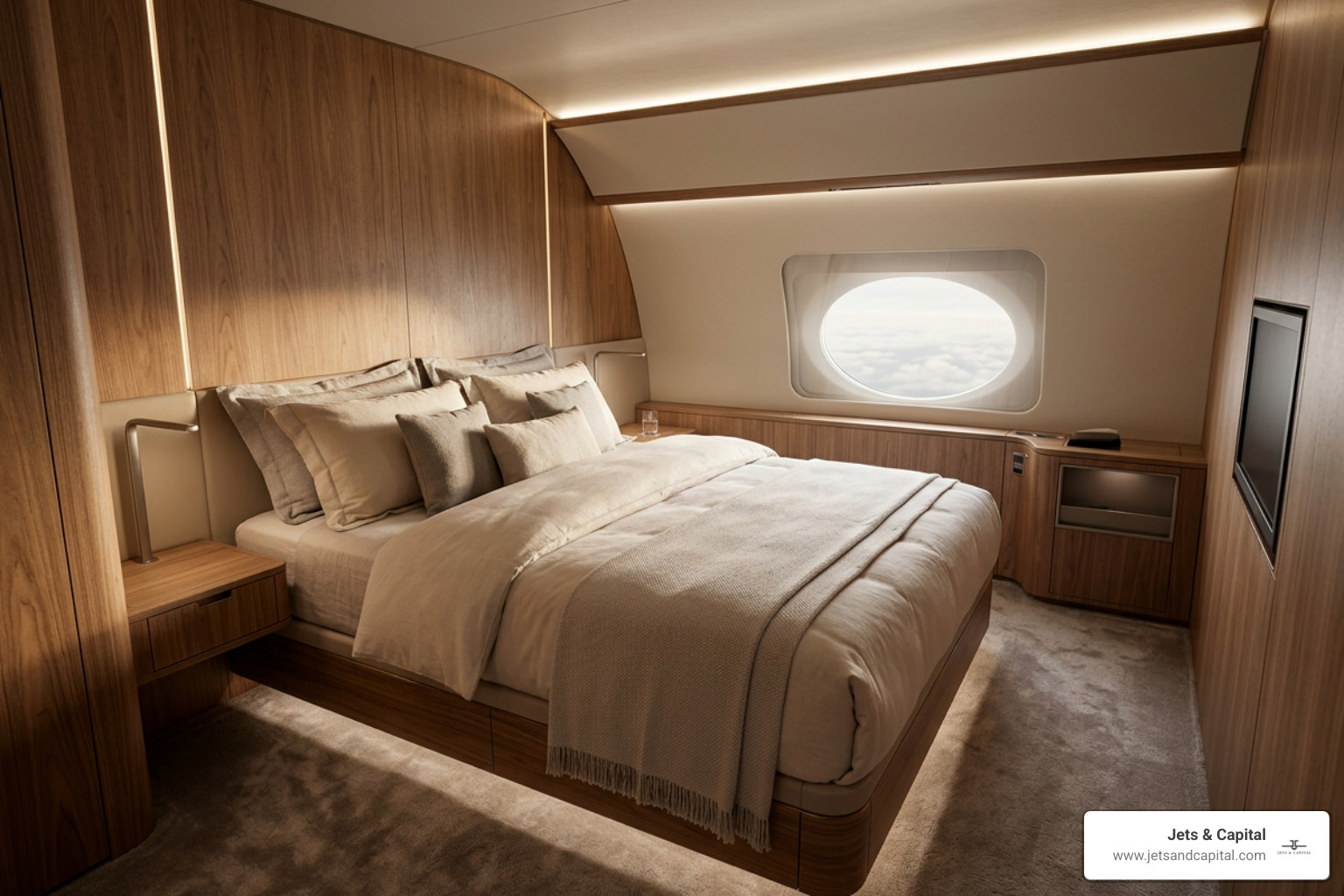
Outfitting an airborne sleeping suite requires balancing residential interior design with uncompromising aerospace safety regulations:
- Aerospace Material Compliance: Every bespoke material—from hand-stitched leather wall panels and open-pore wood veneers to silk-wool carpets—must pass stringent vertical burn, smoke density, and toxicity tests (FAR 25.853 compliance) without adding unnecessary weight.
- Acoustic & Vibration Isolation: Floating floor tracks, acoustic dampening blankets, and elastomeric vibration isolators decouple interior bedroom shells from mechanical airframe resonance and air-conditioning duct turbulence.
- Circadian Lighting Architecture: Full-spectrum dynamic LED lighting transitions systematically from warm sunset tones to gradual sunrise hues, regulating melatonin production and gently acclimating travelers across multiple time zones.
- Custom Climate Optimization: Independent environmental control units let passengers set distinct bedroom temperatures and micro-airflow rates separate from the main conference lounge and flight deck.
How Shared Ownership Models Manage Corporate Jet Bedrooms
Managing dedicated bedroom suites across fractional ownership programs and corporate flight departments introduces distinct operational and maintenance requirements. Cabin turnaround protocols require standardized, aerospace-certified bedding kits and hypoallergenic mattress systems that flight crews can strip, sanitize, and redress rapidly during short turnarounds.
Fleet operators maintain pristine stateroom presentation by employing modular mattress toppers, customizable bed frames, and configurable partition bulkheads. This structural flexibility ensures sleeping suites seamlessly adapt between principal family retreats, VIP guest charters, and high-density corporate roadshows without compromising structural integrity or interior aesthetics.
Frequently Asked Questions About Corporate Jet Sleeping Suites
Which private jets offer a dedicated, permanent bedroom?
Dedicated, permanent bedrooms are standard or available options on ultra-long-range business aircraft like the Bombardier Global 7500 and Dassault Falcon 10X, as well as VIP airliners such as the Airbus ACJ family (ACJ TwoTwenty, ACJ319neo, ACJ350) and Boeing Business Jets (BBJ 737, 787, 747-8i). While large-cabin business jets offer divans that convert into double beds, VIP airliners and purpose-built stateroom jets provide fixed, uncompromised beds that remain made throughout the journey.
How quiet are corporate jet bedrooms during long-haul flight?
Modern corporate jet bedrooms register ambient interior sound levels between 48 and 54 dB, compared to 75 to 85 dB in standard commercial cabins. This quiet environment is achieved through forward or isolated aft cabin placement, multi-layer acoustic composite insulation, triple-sealed door partitions, and vibration-dampening interior bulkheads.
Are onboard private showers standard with in-flight bedrooms?
Private walk-in showers are optional on select ultra-long-range business jets and standard or popular custom configurations on larger VIP airliners like the ACJ and BBJ series. Incorporating a shower requires dedicated freshwater storage tanks (often 100 to 400 liters), high-capacity water-heating units, and specialized vacuum drainage systems to manage weight and balance across long-range flight profiles.
Can passengers sleep in the bed during takeoff and landing?
Under FAA and EASA regulations, passengers must occupy seats certified for taxi, takeoff, and landing (TT&L) equipped with approved seatbelts and shoulder harnesses. While certain custom aircraft feature TT&L-certified divans and berthable berths, most dedicated fixed master beds are certified strictly for in-flight cruise rest, requiring passengers to use certified seating during takeoff and approach.
Conclusion
As international commerce accelerates, the corporate aircraft functions as both an indispensable boardroom and an essential restorative residence. Dedicated in-flight bedrooms allow senior leadership and asset allocators to eliminate travel downtime, safeguarding well-being and operational clarity wherever business demands their presence.
At Jets & Capital, we operate at the intersection of private aviation and premier deal flow. Through our exclusive, invite-only networking events held in private hangars across premier markets—including Las Vegas, Dallas, Salt Lake City, Palm Beach, Miami, New York, and San Francisco—we bring together family offices, institutional allocators, and enterprise leaders. Explore our insights on luxury jets with bedrooms and connect with our vetted network of global decision-makers.
