
A Curated Guide to the World's Most Exclusive Private Jet Events
The Anatomy of Exclusive Jet Gatherings: Vetting, Privacy, and Prestige

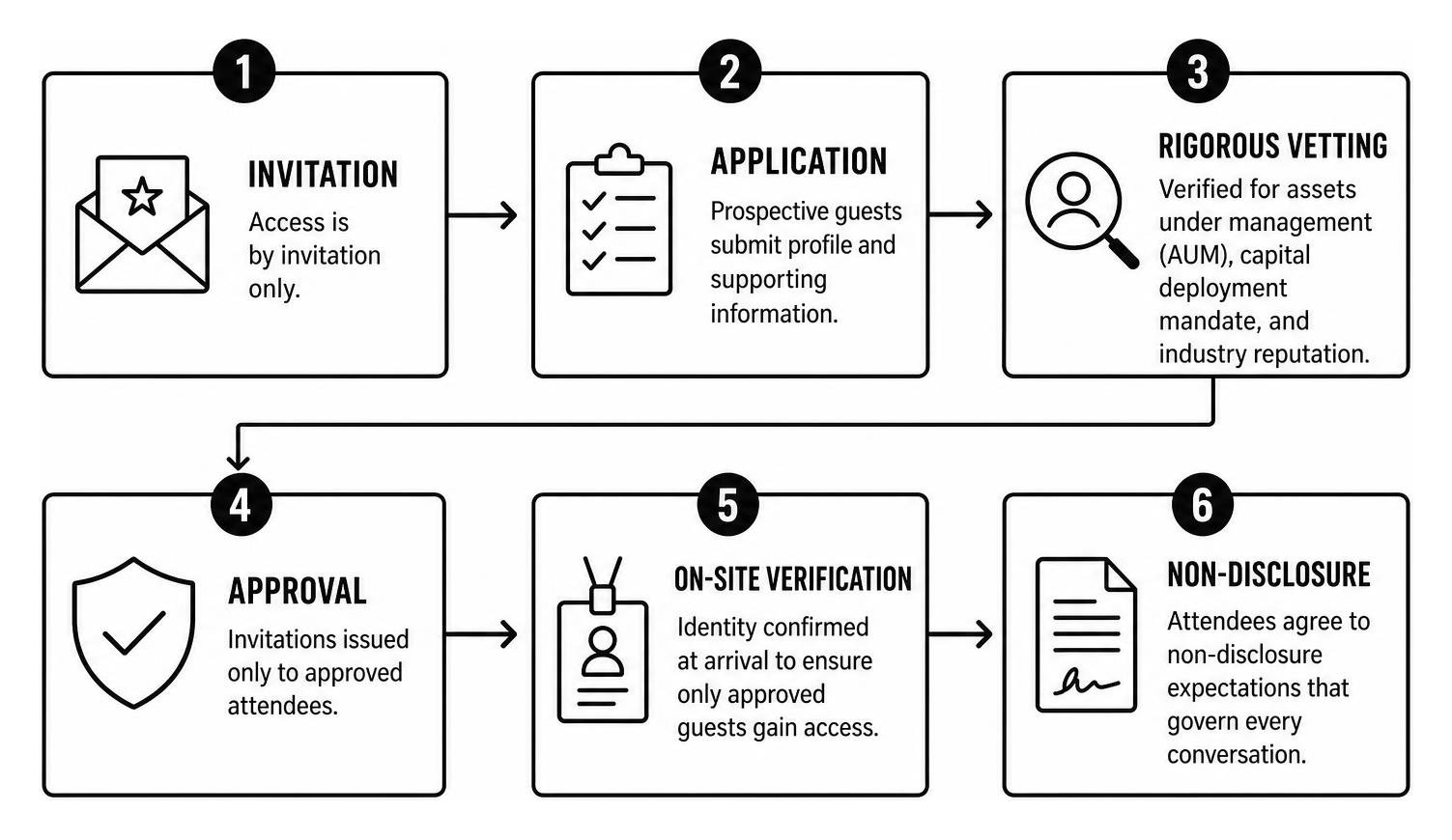
When evaluating private aviation summits, true exclusivity is never defined by ticket pricing alone. Instead, it is determined by who is barred from entry. High-profile principals, family offices, and institutional allocators do not attend public conventions; they seek uncompromised privacy and high-trust peer groups. Organizers protect these spaces by establishing strict invitation protocols, rigorous identity verification, and explicit non-disclosure expectations that govern every conversation on the tarmac.
Curating these rooms requires an extensive screening process. Prospective guests are evaluated not merely by stated wealth, but by verified assets under management (AUM), direct capital deployment mandates, and industry reputation. This level of curation ensures that our exclusive UHNW investor parties remain sanctuary environments where principals can discuss direct venture co-investments, media consolidations, or real estate syndications without being swarmed by commercial vendors.
Why Allocator Ratios Matter in Exclusive Jet Gatherings
The single greatest frustration among ultra-high-net-worth individuals (UHNWIs) and family offices attending conventional conferences is "pitch fatigue." When traditional industry events sell tickets indiscriminately, the room inevitably fills with fundraisers competing for the attention of a handful of overwhelmed investors.
To solve this imbalance, we established a strict benchmark: ensuring at least 85% of attendees are verified capital deployers (allocators), while capping capital raisers at roughly 15%. Verifying liquidity and investment authority in advance transforms the room into an aligned, peer-to-peer forum. Guests engage in genuine relationship-building rather than dodging unsolicited sales presentations. Our curated investor networking events prioritize this high ratio across all major host hubs, including Miami, Palm Beach, Dallas, and San Francisco.
Hangar Logistics and Luxury Lifestyle Integration
Hosting high-stakes gatherings inside private aviation facilities requires a seamless fusion of operational rigor and bespoke luxury. Transforming a private Fixed-Base Operator (FBO) or active aircraft hangar into an executive networking salon demands meticulous ramp management, strict perimeter security, and acoustic tuning.
These summits frequently integrate complementary luxury mobility sectors. For example, some private runway events feature exotic vehicle displays, such as runway hypercar exhibitions where rare Bugattis or historic V12s are parked directly alongside long-range private jets. By combining pristine aircraft displays with fine art, curated culinary experiences, and philanthropic foundations, private jet hangar events create an immersive environment that stimulates both creative thinking and strategic capital deployment.
The Role of Sovereign Wealth and Institutional Mandates
Beyond family offices and private principals, a growing segment of attendees at exclusive jet gatherings represents sovereign wealth funds, pension allocators, and endowment investment committees. These institutions bring multi-billion-dollar mandates and long-duration capital horizons that are rarely accessible through conventional conference circuits. Their presence elevates the quality of dialogue, allowing private investors to explore co-investment structures, infrastructure partnerships, and cross-border private credit opportunities in a discreet setting.
For institutional allocators, the appeal of a private hangar environment lies in its efficiency. Instead of navigating crowded exhibition halls or managing public relations obligations, they can conduct a full day of curated meetings with pre-vetted counterparties. The result is a materially higher conversion rate from introductory conversation to signed term sheet, a metric that matters deeply to both allocators and the principals who seek their capital.
Security, Discretion, and the Non-Disclosure Culture
Exclusive jet gatherings operate under a distinct set of behavioral norms. Attendees understand that conversations held on the ramp or inside an FBO lounge are not for public consumption. Many events adopt Chatham House Rule or complete non-attribution protocols, ensuring that sensitive discussions about acquisition targets, fund performance, or family governance remain confidential.
This culture of discretion extends to physical security. Private aviation facilities already maintain controlled access points, but event organizers layer additional credentialing, guest-list management, and perimeter monitoring to prevent unauthorized entry. For UHNWIs who value privacy as much as deal flow, this combination of operational security and social trust is the defining feature that separates a genuine private summit from a commercial trade show.
Landmark Global Summits and Runway Exhibitions

Private aviation events serve different niches across the globe, ranging from media-executive summits nestled in mountain valleys to high-performance aerodrome seminars. Each format attracts a distinct audience, yet all share a common thread: the use of private aircraft as both a logistical tool and a symbol of the trust required for high-stakes relationship building.
The Sun Valley Phenomenon: Bilateral Deal-Making and Infrastructure
The annual Allen & Company gathering in Sun Valley, Idaho, remains a prime case study in aviation logistics and off-the-record executive culture. Each summer, top media executives, venture capitalists, and tech leaders fly in on private aircraft. The sudden influx places unprecedented demand on regional infrastructure:
- Flight Volume: Between 300 and 350 aircraft—more than four times the standard volume—arrive and depart daily through Friedman Memorial Airport during peak days.
- Ramp Constraints: Because the airport apron accommodates only 100 to 125 parked business jets before hitting maximum capacity, operators must coordinate "drop-and-go" repositioning flights to regional airports like Salt Lake City.
- Deal Velocity: Away from press scrums, attendees conduct informal walks that have historically seeded massive corporate acquisitions, such as major network mergers and landmark tech consolidations.
The operational complexity of such fly-in events underscores why private aviation infrastructure matters. FBOs must coordinate slot reservations, fuel deliveries, and ground handling with military precision. For event organizers, understanding these constraints is essential to delivering a seamless experience for guests who expect efficiency at every touchpoint.
Specialized Aerodrome Gatherings and Owner Showcases
Beyond executive deal forums, specialized gatherings cater directly to aircraft owners and aviation enthusiasts who demand deep technical insights alongside executive hospitality. These owner summits focus on operational safety, next-generation avionics, and aircraft value preservation strategies.
Gatherings hosted at private aerodromes allow owners to assess operational frameworks while enjoying cultural programming, such as live classical performances staged directly on the ramp under the wings of parked aircraft. Engaging with peers through private aviation networking helps owners optimize their operational structures while forming valuable personal and business connections.
Regional Hubs and the Geography of Private Aviation Networking
The geography of exclusive jet gatherings is not random. Certain cities have emerged as natural hubs for private aviation networking due to their concentration of wealth, favorable regulatory environments, and world-class FBO infrastructure. Miami and Palm Beach serve as winter anchors for Latin American and East Coast capital, while Las Vegas and Dallas attract energy, entertainment, and real estate investors. San Francisco and New York remain critical nodes for technology and institutional finance.
For family offices and UHNWIs, proximity to these hubs reduces travel friction and increases the frequency of meaningful interactions. A principal based in California can attend a private hangar event in San Francisco without disrupting their operational schedule, while a New York-based allocator can reach Palm Beach in under three hours by private jet. This geographic accessibility is a core reason why invite-only aviation summits have become a preferred format for modern capital deployment.
High-Value Networking Dynamics: Formats and Macro Trends

Understanding the distinction between different aviation summits helps principals identify which room best serves their immediate capital or operational objectives.
| Gathering Type | Primary Audience | Key Characteristics | Typical Outcome |
|---|---|---|---|
| Allocator Jet Summits (e.g., Jets & Capital) | Family offices, UHNWIs, institutional deployers | 85%+ verified allocators, FBO hangars, invite-only vetting | Direct co-investments, syndicates, private credit deployment |
| Executive Summer Retreats | Fortune 500 CEOs, media moguls, tech founders | Highly confidential, off-the-record, resort-based | Megamergers, cross-industry alliances, strategic acquisitions |
| Runway & Supercar Exhibitions | Exotic car collectors, aviation lifestyle members | Hypercar displays, active runways, brand showcases | Luxury asset acquisitions, cross-industry brand partnerships |
| Turbine Owner Conferences | Aircraft owner-pilots, FBO operators, flight departments | Technical seminars, asset preservation, private aerodromes | Aircraft transactions, fleet upgrades, avionics investments |
How Exclusive Jet Gatherings Differ from Davos and Traditional Summits
While global policy conferences like the World Economic Forum in Davos bring together thousands of diplomats, corporate sponsors, and media crews, private jet summits prioritize discretion over publicity:
- Zero Media Presence: Unlike large summits where speeches are live-streamed, private hangar gatherings operate under strict Chatham House or complete non-attribution rules.
- Direct Capital Focus: Rather than broad geopolitical panels, conversations center on immediate, actionable deal flow, private equity syndication, and private asset protection.
- Frictionless Logistics: High-net-worth guests arrive directly via private charter or corporate aircraft, walking from cabin door to event venue within minutes, fully bypassing public commercial terminals.
The contrast is not merely aesthetic. At a traditional summit, a family office principal might spend hours navigating crowded corridors, attending panels of marginal relevance, and fending off unsolicited pitches. At a private jet gathering, that same principal can complete a full day of curated, high-value meetings in the time it would take to attend two or three sessions at a conventional conference. This efficiency is a primary driver behind the growing preference for aviation-based networking among serious allocators.
Emerging Trends: AI Infrastructure and Cross-Industry Capital
In 2026, the agenda across private aviation gatherings has evolved beyond traditional asset classes. Discussions among family office principals are increasingly dominated by investments in artificial intelligence compute infrastructure, energy grid transitions, and next-generation private aviation technologies, such as hybrid-electric aircraft and sustainable aviation fuels.
Furthermore, media convergence and entertainment investments remain major drivers of capital deployment. Hosting these discussions within private jet facilities allows investors to evaluate complex joint ventures in a setting that matches the scale of their ambitions.
The Rise of Fractional Aviation Access and Its Impact on Networking
A notable trend shaping the private aviation event landscape is the expansion of fractional ownership and jet card programs. These models have lowered the barrier to entry for private flight, enabling a broader cohort of successful entrepreneurs and mid-sized family offices to participate in aviation-based networking. While fractional access does not confer the same level of operational control as whole aircraft ownership, it does provide the mobility required to attend multiple exclusive gatherings across different regions each year.
For event organizers, this trend has expanded the addressable audience without diluting quality. The vetting process remains the critical filter, ensuring that fractional users who attend private summits meet the same allocator thresholds as full aircraft owners. The result is a more diverse, yet still rigorously curated, room of capital deployers.
Frequently Asked Questions About Private Jet Events
What distinguishes an invite-only jet summit from standard aviation expos?
Standard aviation expos are open to the general public, exhibitors, and commercial sales teams focused on broad product promotion. In contrast, invite-only jet summits utilize strict vetting to verify net worth, allocator status, and investment mandates. They limit attendance to preserve an uncrowded, pitch-free networking environment for genuine decision-makers.
How do host airports handle parking capacity during major billionaire fly-ins?
When regional airports experience massive flight surges, FBOs enforce slot reservations and implement "drop-and-go" protocols. Aircraft drop off their passengers, refuel, and immediately reposition to nearby partner airfields with larger apron space before returning for departure pickup.
What percentage of attendees are typically capital deployers versus fundraisers?
At premier investor-focused jet events, organizers enforce an 85:15 allocator-to-fundraiser ratio. This standard ensures that the overwhelming majority of participants have direct capital deployment authority, preventing the oversaturation commonly experienced at commercial finance conferences.
Are private jet events suitable for first-time attendees who are not yet established allocators?
Most invite-only summits maintain strict qualification criteria, but some organizers offer limited observer or guest slots for emerging family office professionals and principals who are actively building their investment mandates. These attendees are typically sponsored by an existing verified allocator and are subject to the same confidentiality expectations as full participants. The goal is to preserve the integrity of the room while allowing the next generation of capital deployers to integrate into high-trust networks.
What types of investment discussions typically occur at private jet gatherings?
Conversations at exclusive jet gatherings span a wide range of asset classes and structures. Common topics include direct venture co-investments, private credit syndication, real estate joint ventures, media and entertainment consolidation, and emerging opportunities in artificial intelligence infrastructure. The common denominator is that discussions are actionable, confidential, and conducted among peers with verified capital deployment authority.
Conclusion
Private aviation gatherings have redefined executive relationship-building. By combining private hangar venues, rigorous attendee vetting, and verified allocator ratios, these summits provide a safe, productive space for modern wealth holders and business leaders.
Whether your focus is expanding your family office co-investment network in New York or attending our upcoming private events across Las Vegas, Miami, and San Francisco, choosing the right room makes all the difference. Discover how private aviation environments can transform your strategic partnerships and long-term capital deployment.
Explore our upcoming private events and learn how to qualify for our next invite-only gathering by visiting Jets & Capital.
